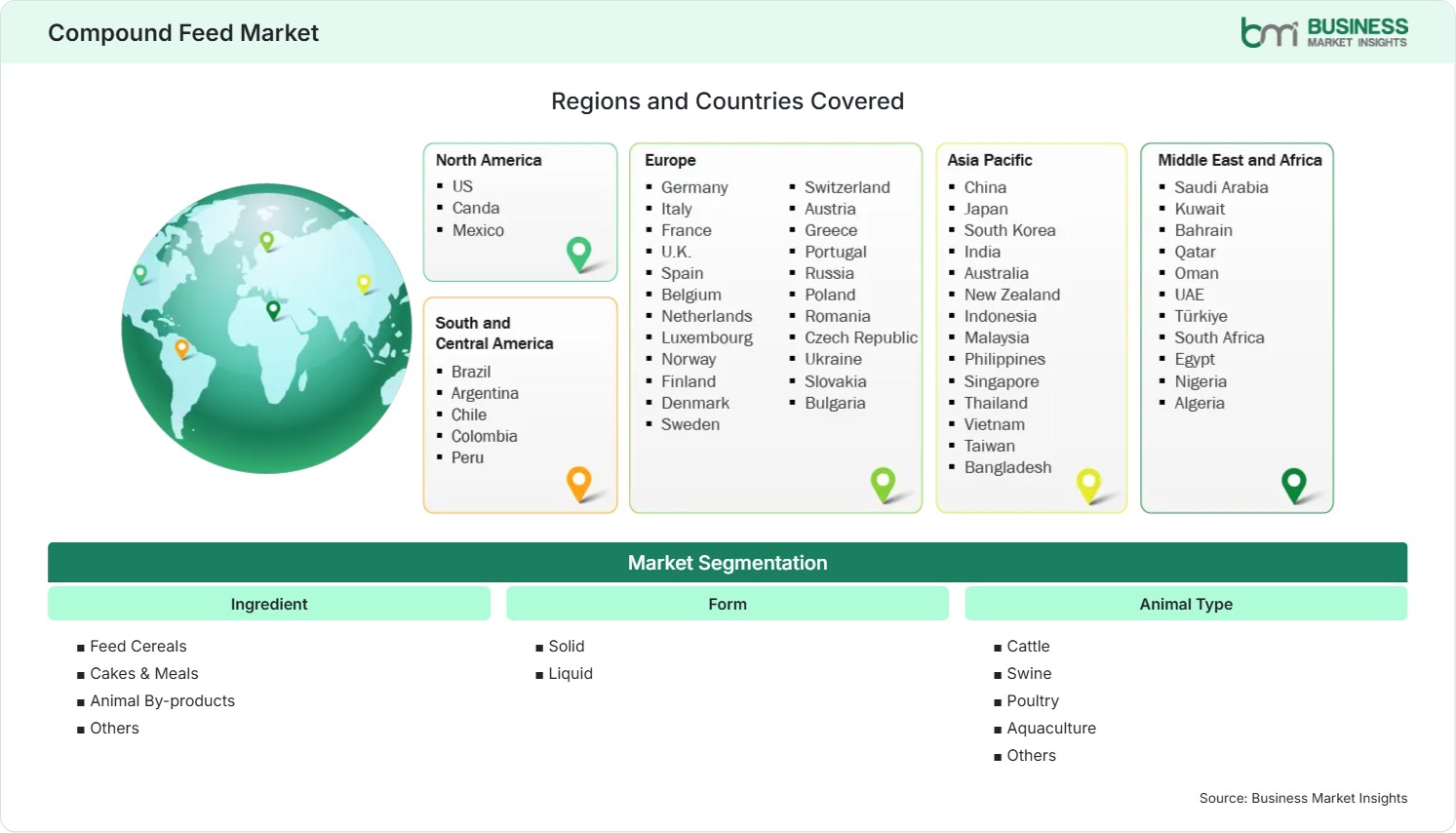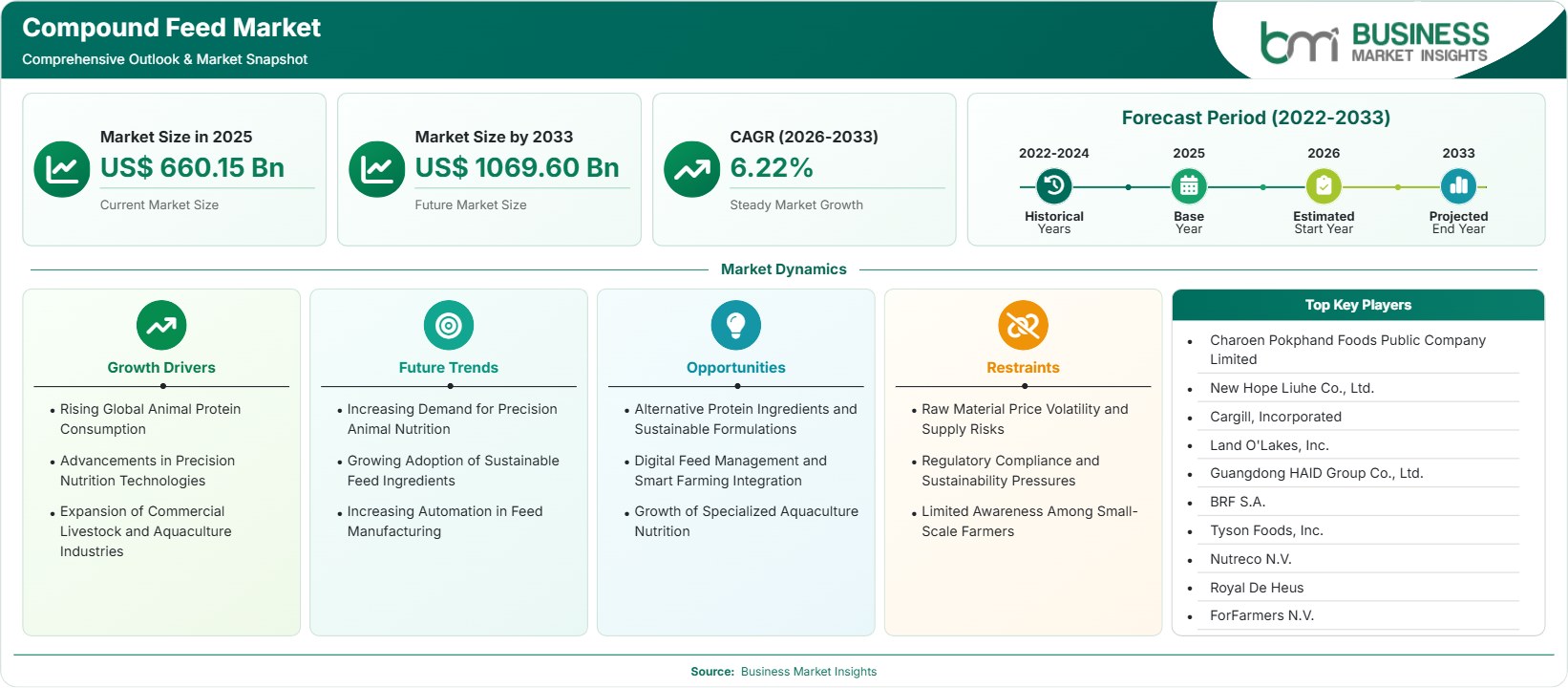
Compound Feed Market Regional Highlights
North America Compound Feed Market
North America accounted for approximately 24%–27% of global demand in 2025 and is expected to expand at a 5.4%–5.8% CAGR through 2033. Large-scale livestock production, advanced feed manufacturing infrastructure, and widespread adoption of nutritional technologies support regional leadership. Commercial poultry and cattle operations continue investing in productivity-enhancing feed formulations. The region benefits from strong grain availability, integrated supply chains, and increasing interest in sustainable ingredients that improve feed efficiency while supporting environmental objectives across livestock production systems. The Compound Feed Market share remains significant due to technological maturity.
- Precision livestock farming technologies are improving feed utilization rates, reducing wastage, and enabling data-driven nutritional strategies across large poultry, cattle, and swine operations throughout the region.
- Sustainability initiatives are encouraging adoption of alternative proteins, feed enzymes, and low-emission nutritional programs that align with evolving environmental and regulatory expectations.
- Strong grain production supports raw material availability, helping manufacturers maintain supply stability despite periodic commodity price fluctuations affecting global agricultural markets.
- Commercial dairy and beef sectors increasingly utilize specialized nutritional programs designed to enhance productivity, animal health outcomes, and operational profitability.
- Investment in automated feed mills continues to strengthen manufacturing efficiency and product consistency while supporting growing demand from industrial livestock enterprises.
US Compound Feed Market
The United States represents approximately 72%–76% of North American demand and is forecast to grow at a 5.5%–5.9% CAGR during 2026–2033. Extensive poultry, beef, dairy, and swine industries create sustained feed requirements. Feed manufacturers continue investing in automation, nutritional science, and ingredient optimization. Demand is supported by export-oriented livestock production and increasing emphasis on productivity improvements in Compound Feed Market.
- Poultry remains the largest feed-consuming livestock category, benefiting from strong domestic consumption and export demand for chicken products.
- Feed efficiency programs incorporating enzymes, amino acids, and specialty additives are gaining adoption among commercial livestock producers seeking productivity improvements.
- Digital monitoring technologies support precision feeding practices, improving operational performance and reducing input costs across intensive farming systems.
- Growing focus on sustainable livestock production encourages investment in alternative ingredients and traceable sourcing programs throughout the value chain.
Europe Compound Feed Market
Europe holds approximately 20%–23% share in 2025 and is projected to register a 5.2%–5.6% CAGR through 2033. Strict feed safety regulations, advanced animal welfare standards, and established livestock industries support market development. Poultry, dairy, and swine sectors remain major demand centers. The region is actively exploring alternative proteins and sustainable feed ingredients to reduce dependency on imported soy products. Germany and Spain remain leading markets, while Eastern European countries exhibit stronger expansion potential through modernization initiatives.
- Regulatory emphasis on feed traceability and sustainability continues driving innovation in ingredient sourcing and manufacturing processes.
- Spain remains among the largest feed-producing countries, supported by significant poultry and swine production activities.
- Alternative protein development, including insect-derived and fermentation-based ingredients, is attracting commercial interest across feed manufacturers.
- Eastern Europe demonstrates above-average expansion potential due to livestock sector modernization and increasing investment in feed production facilities.
- Sustainability targets encourage adoption of nutrient-efficient formulations that reduce environmental impacts while maintaining animal performance.
Asia Pacific Compound Feed Market
Asia Pacific commands the largest regional position with 38%–42% share in 2025 and is anticipated to achieve a 7.0%–7.5% CAGR through 2033. China, India, Vietnam, and Indonesia remain key contributors due to expanding livestock production and increasing protein consumption. Commercialization of farming systems and investments in feed manufacturing capacity continue supporting regional expansion. The region also leads global aquaculture feed demand, creating substantial opportunities for specialized nutrition providers. The Compound Feed Market growth outlook remains strongest in this geography.
- China remains the world's largest feed-producing country, supported by industrial livestock production and ongoing modernization initiatives.
- India demonstrates strong expansion potential through rising poultry consumption, dairy sector development, and increasing commercial farming adoption.
- Aquaculture feed demand continues rising across Southeast Asia, driven by seafood exports and intensification of fish farming operations.
- Governments are promoting feed efficiency and food security initiatives that encourage investment in advanced nutritional technologies.
- Rapid urbanization and income growth continue increasing consumption of animal-derived protein products across major regional economies.
Rest of World Compound Feed Market
Rest of World accounts for approximately 13%–16% of global demand in 2025 and is expected to grow at a 6.0%–6.5% CAGR through 2033. South and Central America benefit from strong livestock export industries, particularly in Brazil and neighboring markets. Meanwhile, Middle East and Africa countries are investing in food security initiatives and modern livestock production systems in Compound Feed Market.
Growing commercial farming activity, improving feed manufacturing infrastructure, and increasing protein consumption continue creating opportunities across emerging economies. Brazil remains the leading market, while Saudi Arabia and South Africa demonstrate notable growth potential.
- Brazil's position as a major poultry and beef exporter supports significant feed production requirements and ongoing investment in manufacturing capacity.
- Livestock modernization programs across the Middle East are increasing demand for nutritionally balanced commercial feed products.
- African poultry production expansion is creating opportunities for local feed manufacturers and international nutrition providers.
- Export-oriented livestock industries in Latin America continue investing in feed efficiency and productivity-enhancing nutritional solutions.
- Food security initiatives encourage adoption of advanced feed technologies that improve livestock performance and reduce production risks.