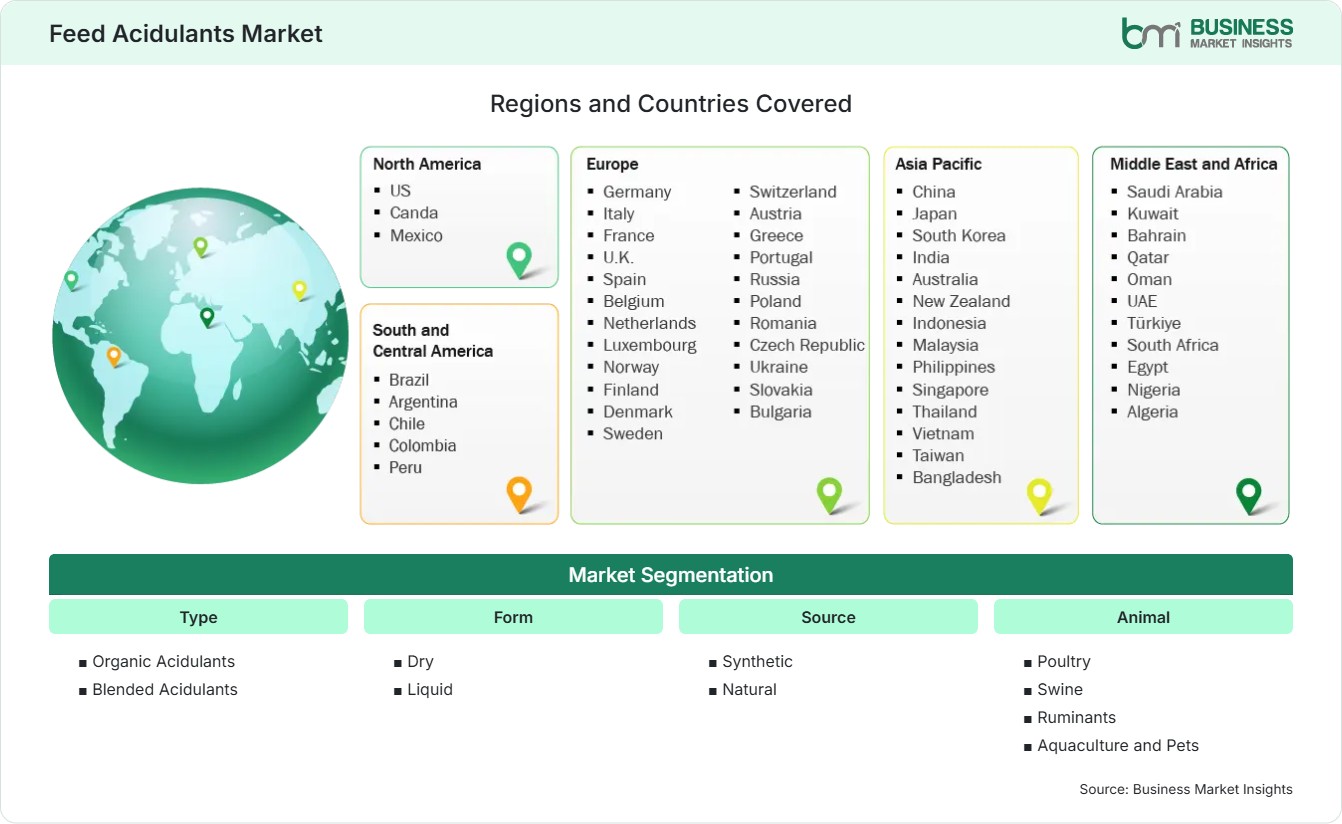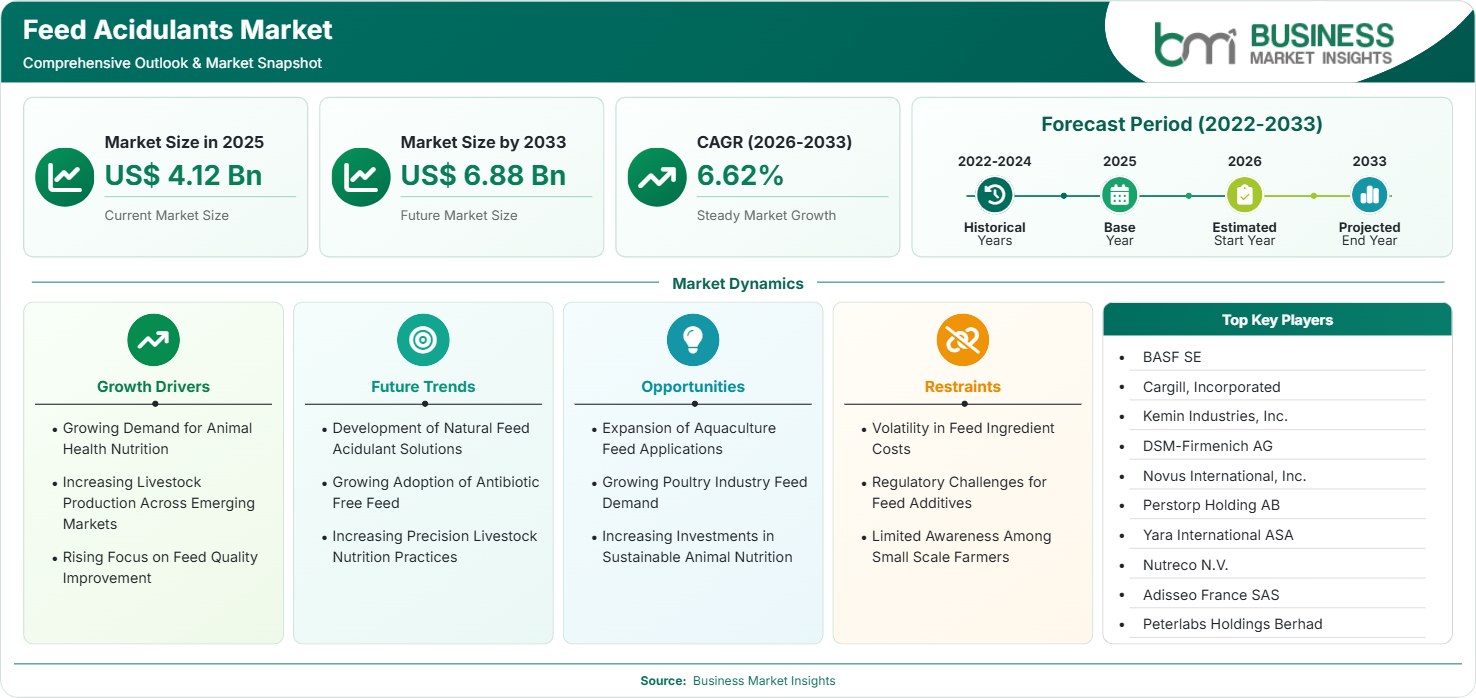
Feed Acidulants Market Regional Highlights
North America Feed Acidulants Market
North America represents 28%–32% share in 2025 and is projected to expand at a CAGR of 5.80%–6.50% during 2026–2033. The region benefits from mature livestock industries, advanced feed manufacturing capabilities, and strict animal health standards. The Feed Acidulants Market share remains supported by poultry and swine producers adopting functional additives. The Feed Acidulants Market growth is strengthened by antibiotic reduction programs and precision nutrition practices across the United States and Canada.
- Commercial poultry producers are adopting acid-based solutions to improve intestinal health, feed preservation, and production efficiency while meeting evolving consumer expectations for responsible animal farming practices.
- The United States remains the dominant regional contributor due to large-scale poultry and swine production, advanced feed technology adoption, and investments in livestock productivity enhancement programs.
- Canada is expanding usage through sustainable agriculture initiatives, increasing demand for specialty feed additives, and modernization of livestock production systems focused on efficiency and animal welfare.
- Feed manufacturers are developing customized acid blends to support different livestock categories, enabling improved performance outcomes and stronger integration of nutritional technologies across commercial farming operations.
US Feed Acidulants Market
The United States holds 22%–26% share of the global market in 2025 and is estimated to register a CAGR of 5.90%–6.40% through 2026–2033. Strong poultry production, established feed industries, and increasing demand for antibiotic alternatives support market expansion. The Feed Acidulants Market share in the US is influenced by advanced nutrition programs, while adoption continues across commercial farms seeking improved feed efficiency and animal performance.
- Large poultry and livestock producers are increasing acidulant usage to support gut health management, reduce contamination risks, and enhance productivity under intensive farming conditions.
- Domestic feed companies are investing in formulation capabilities to provide customized solutions targeting specific animal species, production stages, and nutritional requirements.
- Regulatory attention toward responsible antibiotic usage is encouraging producers to adopt feed acidifiers as preventive health management tools within livestock operations.
Europe Feed Acidulants Market
Europe accounts for 24%–28% share in 2025 and is projected to grow at a CAGR of 5.60%–6.30% between 2026 and 2033. The region benefits from stringent feed safety regulations, advanced livestock practices, and strong demand for sustainable production methods. Germany, France, and the Netherlands remain key contributors, while Eastern European countries show increasing adoption. The Feed Acidulants Market share is supported by regulatory emphasis on animal welfare and antibiotic reduction.
- Germany demonstrates strong adoption due to advanced feed manufacturing infrastructure, research capabilities, and demand for scientifically validated animal nutrition solutions.
- France continues expanding acidulant applications through large poultry and livestock industries focused on productivity improvement and sustainable farming practices.
- The Netherlands supports innovation through intensive livestock production systems, advanced agricultural technology integration, and export-oriented animal farming operations.
- European producers are increasingly selecting natural and blended acid formulations aligned with sustainability objectives and stricter feed ingredient requirements.
Asia Pacific Feed Acidulants Market
Asia Pacific represents 32%–36% share in 2025 and is expected to expand at a CAGR of 7.00%–7.80% during 2026–2033, making it the fastest-growing regional market. China, India, Japan, and Southeast Asian countries are driving demand through livestock expansion, rising protein consumption, and modernization of feed production. The Feed Acidulants Market share in this region is supported by increasing commercial farming adoption and investments in animal nutrition technologies.
- China leads regional consumption due to its large-scale swine and poultry industries, growing feed manufacturing capacity, and increasing focus on improving production efficiency through advanced additives.
- India is witnessing rising adoption as commercial poultry farming expands, organized livestock operations increase, and producers seek solutions for better feed utilization and animal health management.
- Southeast Asian countries are creating opportunities through aquaculture expansion, increasing seafood demand, and investments in modern feed processing infrastructure for intensive farming systems.
- Japan and South Korea continue adopting premium feed additives because of advanced livestock management practices, food safety requirements, and demand for high-quality animal products.
- Regional manufacturers are developing localized formulations to address diverse climatic conditions, production systems, and species-specific nutritional requirements across emerging agricultural markets.
Rest of World Feed Acidulants Market
Rest of World contributes 8%–12% share in 2025 and is forecast to grow at a CAGR of 6.20%–7.00% from 2026–2033. South America benefits from extensive livestock production, particularly Brazil and Argentina, while Middle East and Africa markets are supported by food security initiatives and agricultural development programs. Growing investment in commercial farming infrastructure is strengthening adoption across developing regions.
- Brazil remains a major opportunity center due to its global poultry and beef production position, increasing feed innovation adoption, and export-focused livestock industries.
- Argentina is expanding usage through modern livestock management practices, growing meat production capabilities, and increasing awareness of functional feed ingredients.
- Gulf countries are investing in advanced animal nutrition solutions to improve domestic food production and reduce dependence on imported animal products.
- African markets are gradually adopting acidulants as commercial poultry and aquaculture operations expand through private investments and agricultural development programs.