
Utility Terrain Vehicle Market Outlook: Size, Share, Trends, Growth Analysis, Competitive Landscape & Forecast, 2026-2033

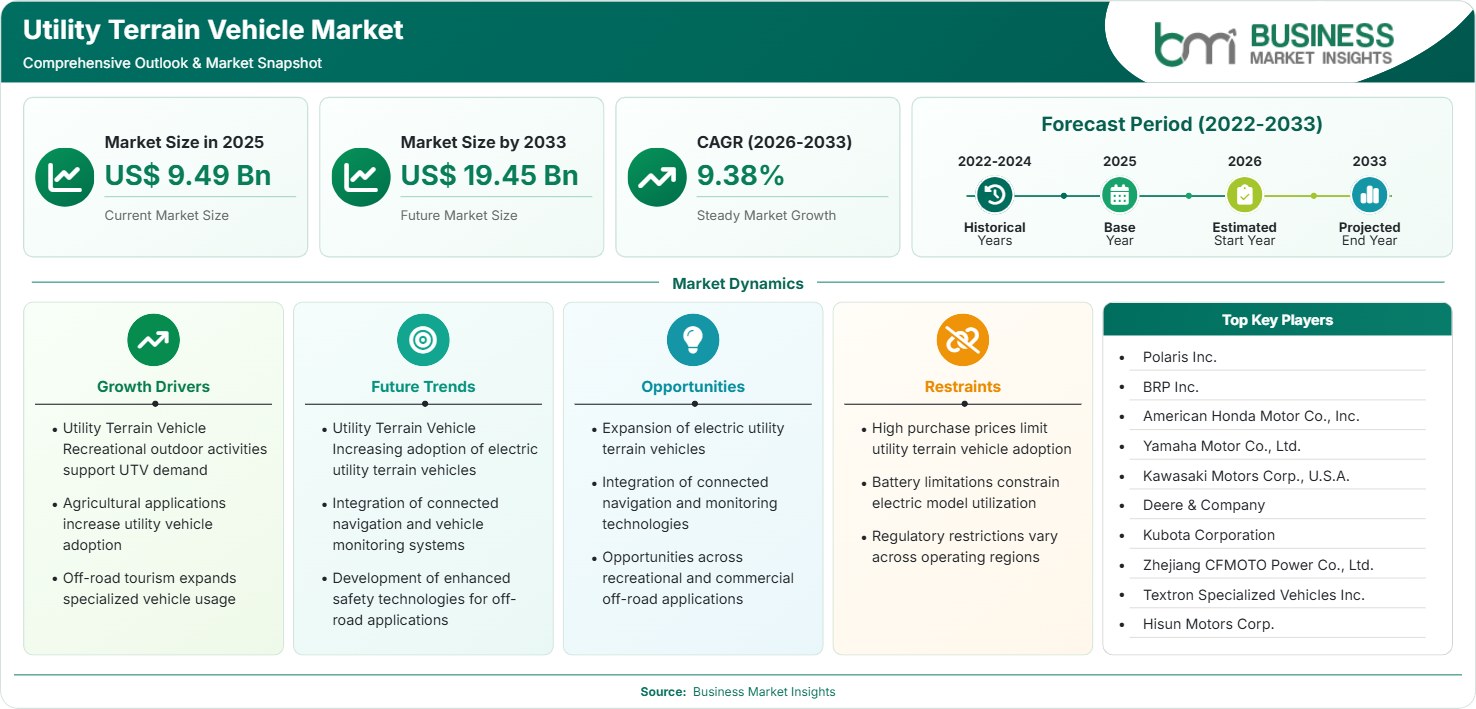
The Utility Terrain Vehicle Market size was valued at US$ 9.49 Billion in 2025 and is projected to reach US$ 19.45 Billion by 2033, growing at a CAGR of 9.38% during 2026–2033, driven by agricultural mechanization, commercial fleet adoption, electrification, construction productivity, and demand for versatile off-road mobility.

Report Coverage
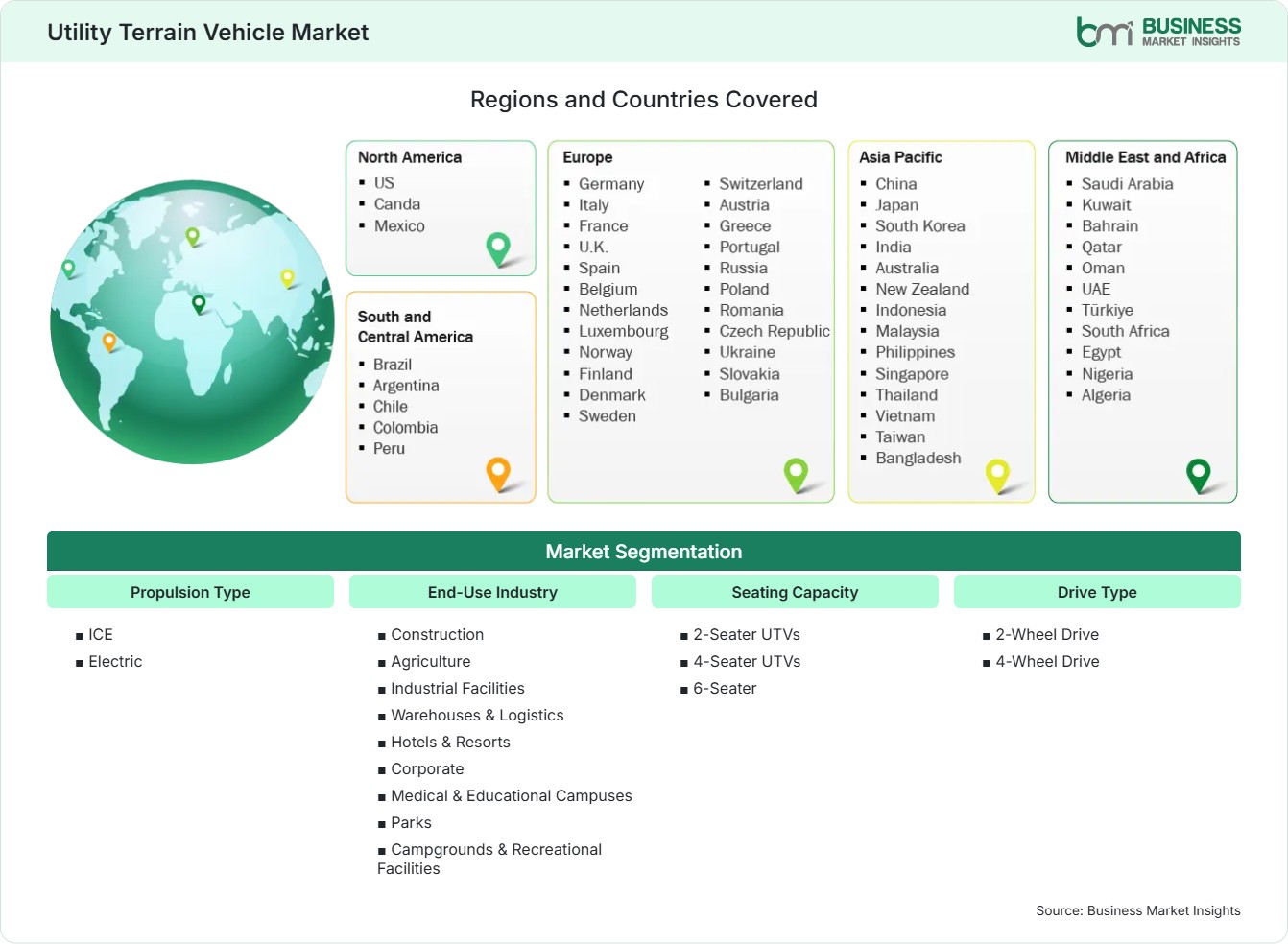
  • Propulsion Type: ICE, Electric
  • End-Use Industry: Construction, Agriculture, Industrial Facilities, Warehouses & Logistics, Hotels & Resorts, Corporate, Medical & Educational Campuses, Parks, Campgrounds & Recreational Facilities
  • Seating Capacity: 2-Seater UTVs, 4-Seater UTVs, 6-Seater
  • Drive Type: 2-Wheel Drive, 4-Wheel Drive
US$ 9.49 Bn Market size in 2025
US$ 19.45 Bn Market Size by 2033
9.38% CAGR, 2026 - 2033
2026-2033 Forecast Period

AI Overview

Utility Terrain Vehicle Market Summary

  • North America Region: North America holds Utility Terrain Vehicle Market market share of 45%–48% in 2025, growing at a CAGR of 8.8%–9.3% during 2026–2033, supported by mature dealer networks, agricultural mechanization, construction demand, recreational ownership, replacement cycles, accessory ecosystems, and institutional fleet procurement. The US market is supported by established powersports distribution, agricultural usage, fleet replacement, and commercial applications, producing a CAGR of 8.6%–9.1% through 2033.
  • Fastest Growing Region: Asia Pacific holds a 17%–20% share in 2025, growing at a CAGR of 10.8%–11.5% during 2026–2033, supported by agricultural mechanization, plantation operations, infrastructure construction, industrial expansion, tourism development, localized manufacturing, rising purchasing power, and broader acceptance of compact utility vehicles.
  • Leading Segment: ICE UTVs in the 400–800 CC category hold a 35%–39% share in 2025, expanding at a CAGR of 8.8%–9.3% through 2033, supported by balanced power, towing capability, serviceability, affordability, fuel availability, and broad applicability across agriculture, construction, recreation, campuses, and commercial properties.
  • High Growth Segment: Electric UTVs above 50 kW hold a 4%–7% share in 2025, expanding at a CAGR of 17.0%–20.0% through 2033, supported by zero tailpipe emissions, quiet operation, lower maintenance, instant torque, battery improvements, regenerative braking, connected diagnostics, and institutional sustainability requirements.
  • Key Market Opportunity: Electrification offers the strongest opportunity through lower operating costs, quiet mobility, indoor suitability, connected fleet management, modular batteries, application-specific configurations, and charging solutions for campuses, resorts, warehouses, industrial facilities, and commercial properties.
  • Major Market Players: Polaris Inc.; BRP Inc.; American Honda Motor Co., Inc.; Yamaha Motor Co., Ltd.; Kawasaki Motors Corp., U.S.A.; Deere & Company; Kubota Corporation; Zhejiang CFMOTO Power Co., Ltd.; Textron Specialized Vehicles Inc.; and Hisun Motors Corp.
Strategic Insights

Utility Terrain Vehicle Market: Strategic Insights

Utility Terrain Vehicle Market Strategic Framework
FREE PDF
Request your free sample
Request free sample
Stakeholder View

Key Takeaways

  • Competitive positioning increasingly depends on integrated powertrains, batteries, accessories, financing, dealer service, replacement parts, software, and fleet support rather than vehicle hardware alone.
  • Mid-capacity utility platforms and high-output electric vehicles provide strong upside because they combine commercial functionality with manageable dimensions and improved operating economics.
  • Product development is moving toward connected diagnostics, electronic driveline controls, application-specific software, improved suspension, quieter cabins, digital displays, and modular accessory systems.
  • Asia Pacific provides an attractive expansion case because agricultural estates, infrastructure projects, plantations, tourism facilities, and industrial parks require compact off-road mobility.
  • Manufacturers are increasingly concentrating capital on scalable platforms, utility products, premium recreational vehicles, electrification, and higher-margin accessories and services.
  • Dealer coverage, financing, parts availability, operator training, and service response increasingly influence commercial fleet decisions because downtime directly affects productivity.
Geographic Outlook

Utility Terrain Vehicle Market Regional Highlights

North America Utility Terrain Vehicle Market

North America represented a 45%–48% Utility Terrain Vehicle Market share in 2025 and is projected to expand at an 8.8%–9.3% CAGR during 2026–2033. Established demand comes from agriculture, construction, recreation, property management, municipalities, and hospitality. Replacement cycles and extensive dealer networks support recurring purchases. Commercial customers increasingly prioritize payload, towing, ground clearance, comfort, accessories, and service availability. Electric platforms are gaining traction in controlled applications where quiet operation, low maintenance, and emissions performance provide measurable operational benefits.

  • Agriculture remains a core application as farms and ranches use compact vehicles for livestock management, crop inspection, fencing, equipment movement, and maintenance activities.
  • Construction operators favor UTVs for transporting personnel, tools, materials, and inspection equipment across restricted or unfinished worksites.
  • Recreational demand remains resilient across trail systems, hunting properties, private land, outdoor tourism, and seasonal leisure activities.
  • Commercial electrification is gaining momentum across campuses, resorts, municipalities, and industrial facilities where charging can be centrally managed.

US Utility Terrain Vehicle Market

The US Utility Terrain Vehicle Market represented 78%–82% of North American demand in 2025, with an 8.6%–9.1% CAGR projected through 2033. Demand combines recreational ownership with professional use across agriculture, construction, hospitality, campuses, property management, and municipal operations. Established manufacturers benefit from broad dealer coverage and extensive aftermarket ecosystems. Product development increasingly targets value-oriented utility buyers alongside premium customers, expanding addressable demand. Fleet operators are also placing greater emphasis on lifecycle cost, service response, accessory availability, towing capability, and operational uptime.

  • Agricultural users increasingly require towing, cargo flexibility, ground clearance, and attachment compatibility for repeated farm and ranch activities.
  • Institutional customers use compact vehicles for landscaping, maintenance, security, groundskeeping, waste handling, and internal transportation.
  • Value-oriented products can expand adoption by lowering acquisition barriers while retaining essential utility, cargo, towing, and drivetrain capabilities.

Europe Utility Terrain Vehicle Market

Europe Utility Terrain Vehicle Market accounted for a 20%–23% share in 2025, advancing at a 9.0%–9.6% CAGR through 2033. Germany and France represent important established markets, while the United Kingdom, Italy, Spain, Poland, and Nordic economies provide application-specific opportunities. Agriculture, tourism, municipal services, industrial estates, and institutional properties support demand. Electrification is particularly relevant where environmental requirements, noise sensitivity, and controlled routes favor battery-powered vehicles. Product requirements increasingly include all-weather capability, operator protection, reliability, and efficient service support.

  • Germany and France provide strong agricultural and industrial applications where durability, reliability, service availability, and productivity influence procurement.
  • The United Kingdom benefits from agricultural estates, landscaping, utilities, tourism, and institutional properties requiring compact off-road mobility.
  • Spain and Italy offer opportunities in vineyards, resorts, tourism, agriculture, and infrastructure maintenance, supporting specialized configurations.
  • Nordic markets favor low-emission and all-weather solutions, creating opportunities for electric drivetrains, enclosed cabins, thermal management, and connected monitoring.

Asia Pacific Utility Terrain Vehicle Market

Asia Pacific Utility Terrain Vehicle Market represented a 17%–20% share in 2025 and is projected to achieve a 10.8%–11.5% CAGR through 2033, making it the fastest-growing region. China, Japan, Australia, and India provide significant demand pools, while Southeast Asia offers additional growth through plantations, tourism, forestry, construction, and industrial projects. Localized production can improve affordability and service responsiveness. Demand is increasingly shaped by agricultural mechanization, infrastructure investment, recreational participation, and expanding applications in industrial and hospitality properties.

  • China provides manufacturing depth, component localization, domestic demand, and export opportunities for competitive utility and electric platforms.
  • Australia offers strong potential across agriculture, ranching, mining support, recreation, and remote operations requiring durability and four-wheel drive capability.
  • India presents opportunities across agriculture, infrastructure, plantations, resorts, campuses, and industrial facilities as mechanized mobility expands.
  • Southeast Asian markets offer potential across plantations, tourism, forestry, construction, and resort operations where terrain restricts conventional vehicles.

Rest of World Utility Terrain Vehicle Market

South and Central America Utility Terrain Vehicle Market represents a 7%–9% share in 2025, with Brazil, Argentina, Chile, Colombia, and Mexico providing important agricultural, mining, tourism, and construction opportunities. Large estates and remote worksites favor compact utility vehicles. Electric adoption remains selective because charging access and acquisition costs influence fleet decisions.

Middle East and Africa account for approximately 5%–7% of demand in 2025, growing at an 8.1%–8.7% CAGR through 2033. Gulf countries and South Africa provide opportunities in tourism, mining, agriculture, security, facilities management, and large developments. Durability, thermal performance, dust protection, and serviceability remain critical.

  • Brazil and Argentina provide agricultural opportunities across livestock operations, crop monitoring, fencing, estates, and dispersed work areas.
  • Chile and Colombia offer applications in mining support, agriculture, forestry, tourism, and infrastructure where four-wheel drive improves access.
  • South Africa combines agricultural, mining, conservation, hospitality, and recreational demand, supporting versatile utility configurations.
  • Gulf markets favor premium utility and recreational platforms for resorts, security, desert tourism, private developments, and infrastructure projects.
Global Market Geography
FREE PDF
Request your free sample
Request free sample
Segment Analysis

Utility Terrain Vehicle Market Segmentation

Propulsion Type

ICE platforms represented an 88%–92% share in 2025, while electric platforms accounted for 8%–12%. Utility Terrain Vehicle Market scope is expanding as customers balance established fueling infrastructure with electric operating advantages. ICE remains dominant in remote and high-utilization environments, while electric adoption is accelerating in controlled commercial applications where emissions, noise, maintenance, and energy costs influence purchasing decisions.

  • ICE: Proven engines provide range, rapid refueling, established service infrastructure, and dependable performance for agriculture, construction, recreation, and remote operations.
  • Below 400 CC: Compact engines support light-duty transport, landscaping, property maintenance, hospitality, and recreational use where affordability and maneuverability are priorities.
  • 400–800 CC: Mid-capacity engines balance power, towing, payload, efficiency, and cost, supporting broad agricultural, construction, campus, and recreational applications.
  • Above 800 CC: High-capacity engines support demanding towing, hauling, steep terrain, heavy-duty work, and performance-oriented recreational applications.
  • Electric: Electric drivetrains provide quiet operation, instant torque, reduced maintenance, and zero tailpipe emissions for commercial and institutional fleets.
  • Up to 50 kW: Lower-output electric vehicles suit predictable short-distance routes across campuses, warehouses, resorts, landscaping, and light-duty commercial operations.
  • Above 50 kW: Higher-output electric platforms address heavier workloads, towing, stronger acceleration, larger payloads, and applications requiring performance comparable to larger ICE vehicles.

End-Use Industry

Construction, agriculture, industrial facilities, and recreational properties remain core demand centers, while hospitality and institutional applications broaden the customer base. Utility Terrain Vehicle Market trends favor multifunctional platforms supporting attachments, cargo modules, passenger configurations, and connected fleet systems. Commercial buyers increasingly assess uptime, maneuverability, operator comfort, maintenance requirements, and lifecycle economics when selecting vehicles.

  • Construction: Vehicles move personnel, tools, materials, and inspection equipment across restricted worksites where conventional trucks lack maneuverability.
  • Agriculture: Farms use UTVs for crop inspection, livestock management, fencing, spraying support, equipment transport, and movement across dispersed properties.
  • Industrial Facilities: Industrial operators deploy utility vehicles for maintenance, security, inspection, internal transport, emergency support, and property management.
  • Warehouses & Logistics: Compact electric platforms support yard inspection, material movement, maintenance, and indoor logistics where emissions and noise are constraints.
  • Hotels & Resorts: Resorts use UTVs for housekeeping logistics, landscaping, security, maintenance, guest support, and transportation across large properties.
  • Corporate: Corporate campuses use compact vehicles for security, grounds management, maintenance, events, landscaping, and internal transportation.
  • Medical & Educational Campuses: Hospitals and universities use quiet utility vehicles for maintenance, landscaping, security, waste handling, and rapid service access.
  • Parks, Campgrounds & Recreational Facilities: Outdoor facilities use UTVs for trail maintenance, visitor support, landscaping, waste collection, emergency response, and equipment movement.

Seating Capacity

Two-seater vehicles remain important for work applications because they maximize cargo access and maneuverability. Four- and six-seat configurations broaden passenger transportation applications. Seating configuration increasingly influences fleet economics because operators can transport multiple workers without adding separate vehicles. Demand therefore varies according to property size, workforce requirements, cargo needs, and operating terrain.

  • 2-Seater UTVs: Two-seat configurations prioritize cargo capacity, maneuverability, and individual operator productivity across farms, construction, maintenance, security, and recreation.
  • 4-Seater UTVs: Four-seat platforms combine workforce transportation and utility functionality for construction, resorts, campuses, agriculture, and recreational users.
  • 6-Seater: Six-seat platforms maximize personnel transportation across resorts, campuses, farms, conservation areas, industrial properties, and large managed facilities.

Drive Type

The four-wheel drive system remains strategically valuable because trucks often travel over terrain that is muddy, inclined, slippery, or uneven. The two-wheel-drive system is still valuable for predictable terrain and cost-effective operation. More electronic traction control systems are becoming valuable in improving drivability through automatic torque distribution.

  • 2-Wheel Drive (2WD): Two-wheel-drive systems provide lower complexity and efficient operation for flat properties, landscaping, light transport, and predictable surfaces.
  • 4-Wheel Drive (4WD/AWD): Four-wheel and all-wheel drive provide stronger traction, hill capability, mud performance, towing, and load movement across demanding applications.
Market Forces

Utility Terrain Vehicle Market Dynamics

Key Market Drivers

Expansion of Multi-Application Utility Fleets

UTV procurement is moving beyond recreational ownership toward multi-application fleet utilization. Agriculture, construction, hospitality, campuses, and industrial facilities increasingly require platforms capable of towing, transporting equipment, carrying personnel, and supporting attachments. Utility Terrain Vehicle Market growth therefore increasingly reflects productivity economics. Manufacturers with broad portfolios can serve different applications through shared platforms, components, and accessory architectures. Mid-capacity vehicles remain attractive because they balance operating capability and acquisition cost. Fleet buyers also value service availability because downtime directly affects productivity. This combination of multifunctionality, platform commonality, dealer support, and accessory integration is strengthening commercial demand across mature and developing markets.

Powertrain Technology and Vehicle Productivity

Development of the powertrain is enhancing vehicle capabilities through torque transfer, improved transmission tuning, electronically controlled drive systems, thermal management, and electric powertrains. The Utility Terrain Vehicle Market trends include the growing importance of dependable performance under load rather than peak performance alone. Advantages of electric drive vehicles include torque on demand, silent running, and reduced maintenance, whereas Internal Combustion Engine (ICE) platforms provide benefits in areas with limited charging infrastructure. Digital gauges, remote diagnostics, electronic power steering, improved suspension, and variable drive modes enhance the operator's performance.

Growth of Mechanized Agriculture and Remote-Site Operations

The growth of agricultural mechanization and infrastructure is raising the need for small utility mobility options. There is a need for frequent movement on land, which would be difficult with normal modes of transport. UTVs help provide quick access to inspection sites, livestock, irrigation resources, fences, equipment, and workers. Cargo racks, sprayers, winches, tool boxes, and enclosed cabs enhance the vehicle's usefulness. The need is greatest in situations where a small vehicle can save time over short distances compared to manual transport or truck transport. The resulting labor and operating efficiencies strengthen the business case for higher-specification vehicles.

Key Market Opportunities

Commercial Electrification and Fleet-as-a-Service Models

There is potential in commercial electrification, as controlled settings allow fleet operators to manage charging, track usage, and record power consumption. Resorts, warehouses, hospitals, educational institutions, corporate parks, and industrial parks can take advantage of the silent nature of electric vehicles and the absence of tailpipe emissions. Utility Terrain Vehicle Market Forecasts could account for recurring revenues generated through charging, software, maintenance, batteries, financing, and fleet analysis. The fleet-as-a-service approach can help minimize institutional customers' upfront capital investments. Companies and dealers that offer electric vehicles bundled with charging, telematics, maintenance, warranty, and financing will be able to simplify the purchasing process and establish ongoing customer relationships.

Application-Specific Platforms and Modular Accessories

Application-specific designs present an appealing option as professional buyers become increasingly interested in equipment that meets their needs. For construction clients, tool carriage and tow capability would be important, while the agricultural sector might demand sprayer capability, cargo space, and all-weather capability. Recreational clients and institutions could be interested in passenger seating, electric drive, and security gear. Application-oriented accessory platforms allow companies to use common platforms while increasing sales revenue through enclosures, lighting, winches, storage, cargo capacity, and networking capabilities. The applications may also help enhance client relations in the aftermarket, as customers will have the opportunity to switch vehicles based on the operation's needs. Manufacturers that can integrate application-specific equipment without compromising safety, warranties, or service may be able to distinguish their products from similar offerings.

Asia Pacific Localization and Dealer Expansion

Asia Pacific is an attractive investment destination due to cost-reduction opportunities through production localization and improved product delivery response. There is demand for the product in countries such as India, China, Australia, Japan, and Southeast Asia, across various sectors including agriculture, plantation, mining, tourism, construction, and recreation. The manufacturer may be able to localize the product assembly to enable local sourcing of components, engineering, training, and exporting. The manufacturers will be able to modify aspects of the product, such as suspension, cooling, battery, seats, cargo, and drivetrain, according to local needs. The strongest strategies are likely to combine globally standardized platforms with regional customization, allowing manufacturers to capture scale benefits while addressing differences in climate, terrain, regulations, and customer preferences.

Market Restraints and Challenges

High Acquisition Cost and Financing Sensitivity

Factor: The use of specialized drivetrain configurations, suspensions, electronic systems, safety gear, and add-on equipment in the construction of the UTV results in a higher acquisition cost than standard utility models. Impact: Price-conscious consumers are likely to delay purchasing new vehicles or opt for lower-end models if agricultural earnings or construction activity decline. There might be additional cost considerations related to batteries and charging equipment for electric vehicles. The availability of financing thus becomes an issue for small farmers, contractors, recreational users, and consumers in developing countries.

Charging Infrastructure and Harsh-Environment Reliability

Factor: The use of electric UTVs depends on access to charging infrastructure, battery longevity, thermal management, ease of maintenance, and consistent range across varying loads and terrains. Impact: Farmers, miners, loggers, and construction companies operating in remote locations are likely to continue to opt for ICE vehicles as long as refueling takes less time and proper infrastructure is available. The battery will show varying levels of performance under different conditions, such as varying temperatures, load, terrain, and the power use of accessories, making fleet management difficult. The manufacturers will have to produce rugged batteries and thermal management systems, diagnostic systems, and rapid chargers.

Company Analysis

Competitive Landscape

Utility Terrain Vehicle Market analysis indicates a moderately concentrated competitive environment where product breadth, dealer reach, reliability, powertrain capability, accessories, financing, and aftermarket support shape purchasing decisions. Polaris and BRP maintain broad utility and recreational portfolios, while Honda, Yamaha, Kawasaki, Deere, and Kubota compete through established brands and application expertise. CFMOTO and Hisun provide value-oriented alternatives with expanding international reach. Competitive differentiation increasingly centers on specialized configurations, electric powertrains, connected functions, operator comfort, cargo flexibility, and lifecycle support.

Company Name

Overview

Products and Services relevant to this market

Polaris Inc.

Major powersports manufacturer with broad side-by-side coverage and extensive distribution across professional and recreational markets.

RANGER utility vehicles, RZR sport platforms, GENERAL crossover vehicles, XPEDITION platforms, accessories, financing, and service.

BRP Inc.

Global powersports manufacturer competing through differentiated Can-Am utility, crossover, and performance side-by-side platforms.

Can-Am Defender and Maverick vehicles, accessories, parts, financing, dealer support, and connected technologies.

American Honda Motor Co., Inc.

Established manufacturer recognized for durable utility vehicles and extensive dealer support.

Pioneer side-by-side vehicles, accessories, parts, service, utility configurations, and multiple seating options.

Yamaha Motor Co., Ltd.

Global powersports manufacturer with established recreational and utility vehicle expertise.

Wolverine and Viking platforms, accessories, replacement parts, dealer services, and utility configurations.

Kawasaki Motors Corp., U.S.A.

Established powersports supplier with extensive utility and recreational side-by-side experience.

MULE utility vehicles, Teryx platforms, Ridge models, accessories, parts, and dealer service.

Deere & Company

Agricultural equipment leader serving professional customers through integrated farm equipment distribution.

Gator utility vehicles, cargo solutions, accessories, connectivity, dealer service, and agricultural configurations.

Kubota Corporation

Agricultural and compact-equipment specialist serving professional utility and landscaping customers.

RTV utility vehicles, cargo systems, attachments, accessories, dealer support, and agricultural applications.

Zhejiang CFMOTO Power Co., Ltd.

Chinese powersports manufacturer expanding internationally with competitively positioned utility and recreational vehicles.

UFORCE utility vehicles, ZFORCE platforms, accessories, digital features, and international dealer support.

Textron Specialized Vehicles Inc.

Specialized vehicle business associated with established off-road product portfolios.

Arctic Cat-related off-road vehicles, parts, service, recreational products, and utility applications.

Hisun Motors Corp.

Powersports manufacturer serving value-oriented recreational and professional customers.

Sector and HS: utility vehicles, accessories, parts, dealer support, and commercial configurations.

Trust & Transparency

Research Methodology

The market analysis combines proprietary research with secondary data from government agencies, company disclosures, regulatory filings, industry databases and expert interviews. Market estimates are validated through data triangulation, cross-market benchmarking and analyst review.

View Full Research Methodology

Questions Answered

Frequently Asked Questions

What differentiates premium utility vehicles?

As per the Utility Terrain Vehicle Market report, Premium platforms increasingly differentiate through advanced suspension, enclosed cabins, electronic driveline controls, connectivity, digital displays, specialized cargo systems, higher towing capacity, improved ergonomics, and integrated accessories.

How can manufacturers increase recurring revenue?

Manufacturers can develop recurring revenue through maintenance contracts, financing, leasing, connected diagnostics, software, battery services, accessories, replacement parts, extended warranties, and fleet monitoring.

Which attributes influence fleet purchasing?

Payload, towing capacity, ground clearance, drivetrain, seating, service availability, accessory compatibility, reliability, range, operator comfort, and lifecycle cost are key commercial purchasing considerations.

Why are electric UTVs gaining attention?

Electric platforms offer quiet operation, zero tailpipe emissions, instant torque, and reduced routine maintenance, making them particularly suitable for campuses, resorts, warehouses, industrial facilities, and controlled commercial properties.

What is driving commercial UTV adoption?

Commercial adoption is being driven by labor productivity, maneuverability, towing capability, compact dimensions, accessory compatibility, and the ability to perform multiple short-distance transport tasks with one vehicle.

Access the Full Utility Terrain Vehicle Market Report

Get segment-level forecasts, regional estimates, competitive benchmarking, company profiles and downloadable Excel datasets.

Access the full Utility Terrain Vehicle Market Report
350 pages PDF & Excel | 2026-09-30
Similar Research

Related Market Reports