
Urban Air Mobility (UAM) Market Outlook: Size, Share, Trends, Growth Analysis, Competitive Landscape & Forecast, 2026-2033

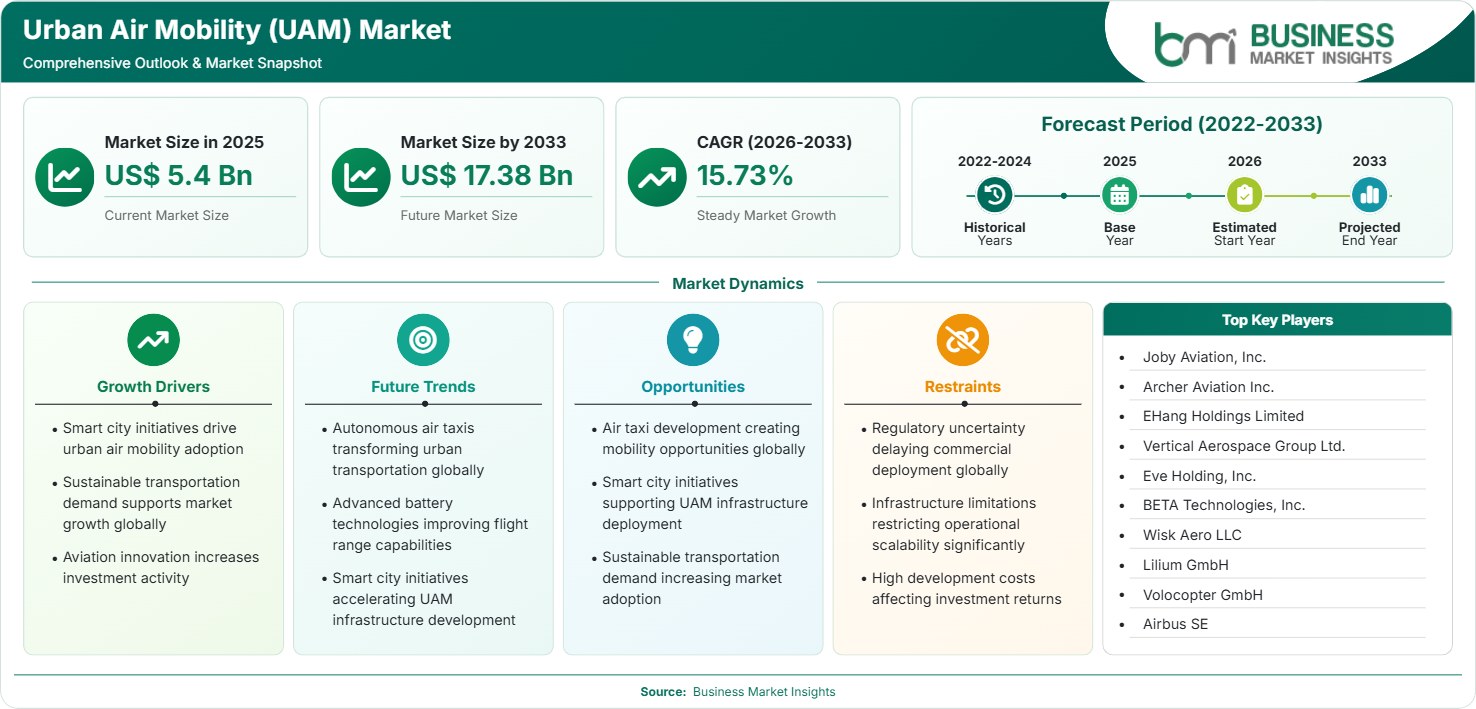
The Urban Air Mobility (UAM) Market size was valued at US$ 5.4 Billion in 2025 and is projected to reach US$ 17.38 Billion by 2033, growing at a CAGR of 15.73% during 2026–2033, driven by innovations in electric aircraft, urban congestion, airport connectivity, and demand for faster passenger and medical transport.

Report Coverage
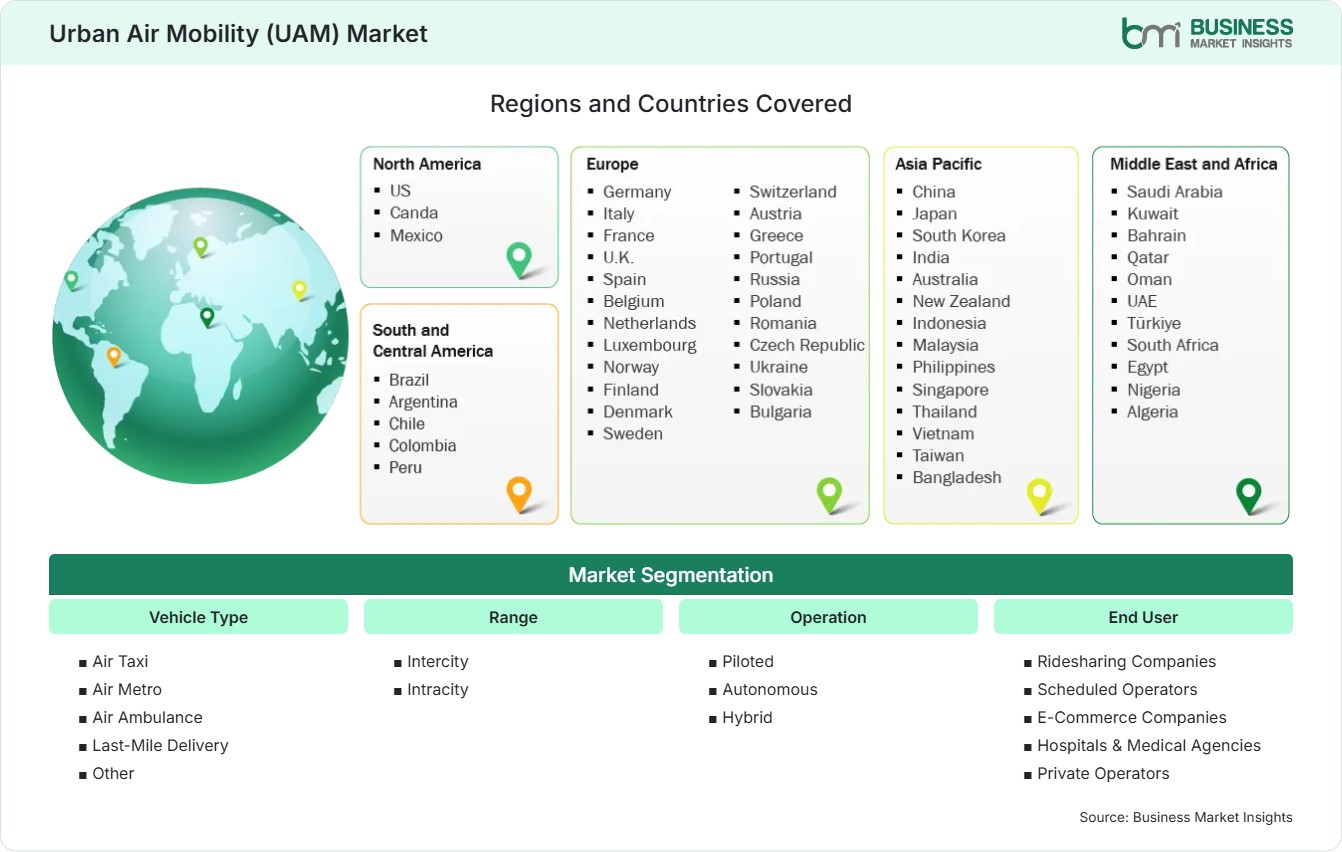
  • Vehicle Type: Air Taxi, Air Metro, Air Ambulance, Last-Mile Delivery, Other
  • Range: Intercity, Intracity
  • Operation: Piloted, Autonomous, Hybrid
  • End User: Ridesharing Companies, Scheduled Operators, E-Commerce Companies, Hospitals & Medical Agencies, Private Operators
US$ 5.4 Bn Market size in 2025
US$ 17.38 Bn Market Size by 2033
15.73% CAGR, 2026 - 2033
2026-2033 Forecast Period

AI Overview

Urban Air Mobility (UAM) Market Summary

  • North America Region: North America holds a modelled 38%–42% Urban Air Mobility Market share in 2025, growing at a CAGR of 15%–17%, supported by aerospace investment, advanced aviation infrastructure, certification progress, and airport transfer opportunities. The US benefits from established aerospace suppliers, venture funding, and early air taxi deployment planning, with a modeled CAGR of 15%–17% during 2026–2033.
  • Fastest Growing Region: Asia Pacific accounts for a modelled 22%–26% share in 2025 and is projected to expand at a CAGR of 18%–21%, driven by dense cities, manufacturing capacity, and government-backed advanced air mobility programs.
  • Leading Segment: Air Taxi represents a modelled 38%–42% share in 2025, with a CAGR of 16%–19%, supported by airport transfers, premium urban journeys, electric vertical take-off aircraft development, and emerging commercial passenger services.
  • High Growth Segment: Autonomous operations account for a modelled 10%–14% Urban Air Mobility Market share in 2025 and may expand at a CAGR of 22%–26%, supported by flight automation, route optimization, remote supervision, and longer-term operating cost reductions.
  • Key Market Opportunity: Vertiport networks, airport connections, fleet software, charging infrastructure, and integrated booking platforms create opportunities for infrastructure investors and technology suppliers beyond aircraft manufacturing.
  • Major Market Players: Joby Aviation, Inc.; Archer Aviation Inc.; EHang Holdings Limited; Vertical Aerospace Group Ltd.; Eve Holding, Inc.; BETA Technologies, Inc.; Wisk Aero LLC; Lilium GmbH; Volocopter GmbH; and Airbus SE.
Strategic Insights

Urban Air Mobility (UAM) Market: Strategic Insights

Urban Air Mobility (UAM) Market Strategic Framework
FREE PDF
Request your free sample
Request free sample
Stakeholder View

Key Takeaways

  • Ecosystem integration determines competitive advantage. Aircraft developers need coordinated relationships with battery suppliers, avionics manufacturers, maintenance providers, insurers, charging-system vendors, and airport operators. Companies capable of integrating these capabilities can reduce deployment friction and establish stronger commercial relationships.
  • Airport transfers offer an early commercial pathway. Premium airport connections provide identifiable routes, measurable time savings, and established passenger demand. Operators can use these services to assess fleet utilization, pricing, turnaround times, and repeat bookings before extending into broader urban networks.
  • Aircraft design is shifting towards operational readiness. Developers are balancing battery energy density, rotor redundancy, cabin capacity, thermal management, and maintainability. The winning configuration will depend on reliable dispatch, certification compliance, and operating cost per passenger rather than flight performance alone.
  • Asia Pacific presents a manufacturing and deployment opportunity. China has advanced pilotless passenger aircraft through regulatory milestones, while Japan, South Korea, Singapore, and India offer different combinations of aerospace capability, dense metropolitan demand, and potential transport partnerships. Investment cases require country-specific regulatory assessment.
  • Capital allocation is moving towards commercial infrastructure. Investors should assess vertiport access, charging availability, fleet financing, and customer acquisition alongside aircraft development. Partnerships with established aviation and mobility businesses can provide distribution, operating expertise, and access to prospective passengers.
  • Certification progress should guide investment decisions. Aircraft programs face different technical, regulatory, and funding risks. Investors should distinguish prototype achievements from type certification, production approval, operator authorization, and actual revenue-generating passenger service.
Geographic Outlook

Urban Air Mobility (UAM) Market Regional Highlights

North America Urban Air Mobility Market

The North American Urban Air Mobility Market is expected to account for 38% - 42% of the worldwide market share in 2025 and is forecast to grow at a CAGR of 15% - 17% through 2033. This market positioning is owing to its experience in aerospace engineering, capital investment, presence of aviation players, and certification programs. The United States is the primary commercial development hub, while Canada is the secondary market owing to its manufacturing capacity and mobility applications.

  • US manufacturers benefit from established aerospace testing and engineering ecosystems. However, certification schedules remain decisive for launch timing, fleet investment, production commitments, and commercial revenue recognition.
  • Major metropolitan airports offer identifiable routes where road congestion supports premium air transfer services. Existing aviation infrastructure can reduce initial construction requirements, although charging, passenger processing, and security arrangements need adaptation.
  • Government programs encourage cooperation among regulators, municipalities, manufacturers, and operators. The commercial value depends on converting demonstration flights into repeatable operations with defined safety, maintenance, and passenger-service procedures.
  • Regional aerospace suppliers can provide propulsion, avionics, materials, and manufacturing expertise. Domestic sourcing may strengthen production resilience, but specialized components and battery systems remain important cost and delivery considerations.

US Urban Air Mobility Market

The US Urban Air Mobility Market is forecast to represent 32%-36% of total revenues by 2025, accounting for a large share of North America, with a CAGR between 15%-17%. This positioning takes into account factors such as aircraft manufacturers, aerospace suppliers, airport systems, and government agencies. The Federal Aviation Administration's planning for advanced air mobility includes considerations such as aircraft certification, pilot training, airspace operations, infrastructure, security, and community relations.

  • Federal initiatives support coordination between manufacturers, aviation authorities, and local governments. Their value lies in creating repeatable operating procedures rather than bypassing safety requirements or guaranteeing immediate commercial certification.
  • Dallas-Fort Worth, Los Angeles, and New York offer different opportunities for airport links and premium passenger services. Route selection must account for airspace restrictions, ground access, noise exposure, and passenger willingness to pay.
  • Aircraft developers are working with established aviation and mobility businesses to connect vehicle development with distribution and infrastructure. These relationships can shorten customer-acquisition cycles but do not eliminate technical or regulatory risk.

Europe Urban Air Mobility Market

The Europe Urban Air Mobility Market is projected to possess a market share of 24%–28% in 2025 and grow at a rate of 14%–17% from 2026 to 2033. Countries like Germany, the UK, France, and Italy add value in aerospace engineering, aviation services, and possible airport transfer needs. Germany is a major player in aircraft development, and the UK has opportunities in urban transport and aviation collaboration.

  • Germany's aerospace engineering and industrial manufacturing support aircraft development, component production, and testing. Commercial prospects depend on certification progress, reliable supplier networks, and suitable routes connecting airports with major business centers.
  • The United Kingdom, London, and other major cities offer premium airport-transfer applications. Partnerships involving aviation operators and transport providers can improve distribution, while local planning and public acceptance will influence vertiport deployment.
  • France and Italy established aviation industries, and major metropolitan centers created opportunities for aircraft programs, tourism services, and airport links. Investment decisions should distinguish infrastructure readiness from the operational approval of individual aircraft.

Asia Pacific Urban Air Mobility Market

The Asia-Pacific Urban Air Mobility market is forecast to account for 22% - 26% of total revenue in 2025 and grow at a CAGR of 18% - 21% through 2033, making it the fastest-growing region in this analysis. China leads in pilotless passenger aircraft due to regulatory approval, whereas Japan, South Korea, Singapore, and India provide separate growth prospects.

  • China regulatory milestones for pilotless passenger aircraft and designated operating locations support early commercial experimentation. Tourism, sightseeing, and controlled passenger routes provide initial applications, although expansion into routine commuting requires broader operating experience.
  • Japan aerospace engineering, advanced manufacturing, and metropolitan transport demand support potential airport transfers and regional mobility. Commercial viability will depend on aircraft approval, operating partnerships, and public confidence in unfamiliar aviation services.
  • South Korea and Singapore, technology-oriented economies and dense urban centers, offer opportunities for controlled flight corridors and airport connectivity. Deployment requires coordination among aviation regulators, municipal authorities, infrastructure developers, and established transport operators.
  • India's congested metropolitan corridors and established aerospace capabilities create potential applications in airport connectivity, emergency medical transport, and premium passenger services. Pricing, infrastructure availability, certification, and operating economics will determine the pace of adoption.

Rest of World Urban Air Mobility Market

South and Central America are modelled to represent a portion of the remaining 6%–16% of global revenue in 2025, with regional development supported by airport connections, tourism, and medical transport. Brazil and Mexico offer potential applications around large cities and regional transport hubs. Urban Air Mobility Market investment depends on purchasing power, aviation regulation, local operating costs, and access to suitable infrastructure. Commercial deployment is likely to favor specific high-value corridors rather than extensive citywide networks during the initial stages.

There is competition in the Middle East and Africa concerning tourism, luxurious transportation, and business connectivity. The UAE has attracted the attention of aircraft manufacturers and other infrastructure partners. Saudi Arabia is currently looking at future modes of transport as part of its urbanization strategy. There is potential in South Africa for special transport and aviation. Growth will be defined by local laws, heat management, financing, and consumer demands.

  • Dubai provides a visible test case for integrating electric aircraft with airport infrastructure and premium transport services. Vertiport completion, operating approvals, and passenger-service readiness remain distinct milestones.
  • New urban developments may create opportunities to incorporate vertiports into transport planning from the outset. Project economics will depend on construction sequencing, expected passenger demand, and long-term operating commitments.
  • Brazil and Mexico's major metropolitan areas offer potential for airport links, medical transport, and selected tourism routes. Operators must assess affordability, airspace conditions, infrastructure costs, and the availability of local maintenance support.
  • South Africa and neighboring markets specialized in passenger and medical applications may offer a more practical starting point than mass urban commuting. Sustainable deployment requires suitable aircraft, trained personnel, regulatory clarity, and dependable maintenance arrangements.
Global Market Geography
FREE PDF
Request your free sample
Request free sample
Segment Analysis

Urban Air Mobility (UAM) Market Segmentation

Vehicle Type

Air Taxis are designed to dominate this class of aircraft by obtaining 38%-42% share of the Urban Air Mobility Market in 2025 with the highest CAGR of 16%-19% in the period of 2026-2033. The demand will be mostly driven by airport shuttles and high-end trips. Air ambulances, air metros, and last-mile deliveries serve different purposes and have distinct operational needs.

  • Air Taxi: Electric vertical take-off aircraft can connect airports, business districts, and selected metropolitan destinations. Adoption depends on passenger pricing, travel-time savings, aircraft certification, and reliable service frequency.
  • Air Metro: Higher-capacity or network-oriented aerial transport concepts target repeated journeys between designated urban locations. Commercial development requires predictable demand, coordinated terminals, efficient boarding, and suitable traffic-management arrangements.
  • Air Ambulance: Medical transport applications prioritize rapid response, cabin accessibility, clinical equipment integration, and reliable dispatch. Adoption depends on medical operator requirements, aircraft payload, weather limitations, and emergency-service coordination.
  • Last-Mile Delivery: Aerial logistics can support urgent shipments, selected e-commerce deliveries, and access to difficult-to-reach locations. Operators must demonstrate delivery reliability, payload economics, safe routing, and efficient handovers.

Range

Intracity mobility is modelled by accounting for a 58% - 64% Urban Air Mobility Market share in 2025, at a growth rate of 15% - 18% per annum over the period 2026-2033. Shorter distances can help overcome battery limitations and reserve-range constraints while facilitating repeatable daily flights. Intercity mobility refers to longer flights between cities and regional centers.

  • Intercity: Connections between cities can reduce road travel times on selected corridors. Commercial deployment requires sufficient range, operational reserves, suitable landing infrastructure, and passenger demand across both departure and arrival locations.
  • Intracity: Short urban routes can support airport transfers, business travel, and selected premium journeys. Frequent operations depend on dependable turnaround, convenient boarding locations, predictable flight schedules, and manageable noise exposure.

Operation

Piloted aircraft are modelled to retain the largest share of operational revenue in 2025, at 76%–82%, with a CAGR of 14%–17% of the Urban Air Mobility Market. Pilots provide a familiar operating framework while aircraft and service systems mature. Autonomous operations could expand faster as sensing, navigation, flight-control redundancy, and remote oversight improve. Hybrid operating models may combine onboard pilots with increasing automation.

  • Piloted: Onboard pilots support initial passenger services within established aviation procedures. Operators must manage training, crew scheduling, flight duty requirements, and the cost of maintaining qualified personnel.
  • Autonomous: Automated flight systems may reduce selected operational tasks and support more scalable fleet management. Commercial adoption requires validated safety performance, robust communications, cybersecurity, and appropriate regulatory approval.
  • Hybrid: Hybrid operations combine onboard human oversight with advanced automated functions. This approach can support incremental technology deployment while preserving human intervention for abnormal conditions and complex operating environments.

End User

Different purchasers have different requirements regarding network integration and even access to their own aircraft. For hospitals and health organizations, priority factors include emergency response capability, clinical suitability, and dispatch reliability. The other purchaser type includes e-commerce firms whose priorities are payload, delivery time, and route economics.

  • Ridesharing Companies: Mobility platforms can integrate aerial journeys with ground transport bookings, providing passenger acquisition and multimodal trip planning. Adoption depends on competitive fares, dependable schedules, and airport or city access.
  • Scheduled Operators: Aviation businesses can offer repeatable services on defined corridors. Their priorities include aircraft utilization, regulatory compliance, maintenance planning, passenger handling, and reliable connections with existing transport services.
  • E-Commerce Companies: Logistics providers can evaluate aircraft for time-sensitive parcels and specialized delivery routes. Commercial deployment depends on payload capacity, fulfillment integration, operating costs, and the reliability of delivery windows.
  • Hospitals: Healthcare facilities may use aerial transport for urgent medical transfers and selected patient journeys. Adoption requires appropriate clinical equipment, trained personnel, secure handling, and integration with emergency-care protocols.
  • Medical Agencies: Emergency response organizations can assess aircraft for rapid access to selected locations and time-critical transport. Procurement depends on response reliability, dispatch coordination, operating permissions, and lifecycle costs.
  • Private Operators: Corporate and individual operators may use aircraft for premium point-to-point travel. Demand depends on acquisition or charter costs, service availability, aircraft range, safety assurance, and convenient landing access.
Market Forces

Urban Air Mobility (UAM) Market Dynamics

Key Market Drivers

Rising Urban Congestion and Demand for Faster Point-to-Point Travel

Road congestion creates a potential market for aerial journeys where ground travel times are long, and passengers can justify premium fares. Airport transfer services, business center transfer services, and inter-city travel between two urban areas represent concrete use cases. In contrast to the conventional helicopter concept, the electric vertical take-off aircraft is currently designed with distributed electric propulsion systems and an urban operational profile. It is necessary to account for passenger transport to the point of departure, security checks, and boarding processes when assessing time savings. The Urban Air Mobility Market growth will be driven by comprehensive journey performance rather than flight time.

Advances in Electric Propulsion, Batteries, and Flight Controls

With electric propulsion, airplane design engineers can distribute the aircraft's weight across multiple motors and develop designs that enable vertical takeoff from confined spaces. With better batteries and improved thermal and control management systems, it becomes possible to achieve payload and range. Nonetheless, battery energy density, battery degradation, battery recharge time, and reserve capacity still matter. It is vital to test the airplanes under real passenger loads, different weather conditions, and operational cycles. Urban air mobility market trends show a greater emphasis on maintenance and manufacturing quality. When making investment decisions, investors need to consider certification data, flight test maturity, supplier readiness, and operational reliability.

Regulatory Frameworks and Aviation Ecosystem Development

Frameworks for integrating new aircraft types into airspace are being developed by aviation regulatory bodies. Planning by the US Federal Aviation Administration involves certification, pilot training, airspace integration, infrastructure development, security issues, and public consultation. In September 2025, the US Department of Transportation announced an integration pilot program for electric vertical takeoff and landing to facilitate partnerships between the private and public sectors. These frameworks will assist in clarifying the roles of both parties involved; however, they do not automatically mean that the specific aircraft is certified and operational.

Key Market Opportunities

Vertiport Networks and Integrated Ground Transport

Vertiports represent an opportunity for investment from airport operators, developers, infrastructure funds, and mobility providers. Early vertiports may use existing heliports or airport infrastructure until a viable network is created. The optimal site will have passenger traffic and ground access, as well as electricity access and favorable airspace. The infrastructure design needs to consider passenger flow, emergency access, noise control, fire safety, aircraft parking, and electrical requirements. Developers need to have site operators and demonstrate route demand before committing to large infrastructure investments. Networked vertiports across multiple viable locations can provide greater value than isolated vertiport landings, as long as flight schedules and ground access coordination are considered.

Medical Transport and Specialised Logistics Services

Medical transportation presents a distinct commercial opportunity, where rapid availability will enhance logistics in an emergency or enable the timely transport of medical equipment. Hospitals and medical organizations can evaluate their desired transfers, while logistics operators can assess delivery timeliness between distribution centers. The needs of such applications will be completely different in terms of the type of aircraft needed, scheduling, cargo loading, and other considerations. Service developers should define the criteria for use in terms of speed, efficiency, and cost relative to existing solutions. Collaboration with healthcare organizations and logistics companies will facilitate testing and procurement.

Fleet Software, Financing, and Integrated Mobility Platforms

In addition to selling airplanes, digital fleet management, predictive maintenance, reservations, charging optimization, and routing can all offer recurring revenue opportunities for companies. Leasing and specialized financing can help manage the high upfront costs of buying an aircraft. Booking platforms can help integrate aerial transportation with ground transportation. Urban Air Mobility Market Forecasts need to include revenues from infrastructure and digital services, in addition to aircraft deliveries. It is possible to analyze companies that have created interoperable systems across different manufacturers, even though barriers to rapid standardization exist. Commercial success can be achieved when software or financing solves an operational issue and provides recurring revenue not tied to any one aircraft program.

Market Restraints and Challenges

Aircraft Certification and Operational Safety Requirements

Factor: There must be proof of structural strength, power system, control system, software, battery safety, emergency procedures, and the aircraft's airworthiness. The operators must have the necessary approvals, skilled personnel, maintenance processes, and proper operating procedures. Impact: A lengthy validation process could delay the commercial launch, increase financing needs, and increase production order risks. Certification in one region does not automatically mean the aircraft is allowed to operate in other regions, thereby requiring the manufacturer to undertake compliance efforts in international markets. Public perception also relies on the performance record and effective incident response measures.

Infrastructure Costs, Noise, and Uncertain Unit Economics

Factor: For commercial use, there must be a need for appropriate landing areas, electrical infrastructure, charging facilities, maintenance services, passenger access, and coordination with the surrounding airspace. Aircraft noise pollution, visual impact, weather vulnerability, and battery replacement costs are other limitations. Impact: High expenses and low passenger numbers can adversely affect route efficiency, particularly when fares must remain affordable. Vertiports that are not properly situated can negate the benefit of reduced travel time despite fast flights. It is necessary to evaluate local regulations, grid connection options, community considerations, and demand before developing the infrastructure.

Company Analysis

Competitive Landscape

The competitive landscape is shaped by aircraft developers, aerospace manufacturers, and autonomous aviation specialists. Urban Air Mobility Market analysis requires assessing certification progress, production capacity, aircraft configuration, commercial partnerships, and the ability to support passenger operations. The following companies represent active participants in aircraft development or the supporting aviation ecosystem; their commercial maturity and certification status differ.

Company Name

Overview

Products and Services relevant to this market

Joby Aviation, Inc.

US-based developer of electric vertical take-off and landing aircraft focused on commercial passenger transportation and integrated air mobility services.

Electric air taxi development, flight testing, aircraft manufacturing, commercial service planning, and partnerships for landing infrastructure and passenger distribution.

Archer Aviation Inc.

US aircraft developer pursuing electric vertical take-off and landing technology for short-distance passenger transport and selected specialized applications.

Midnight electric aircraft development, flight testing, certification activities, production planning, and partnerships with aviation and mobility operators.

EHang Holdings Limited

Chinese autonomous aerial vehicle technology company developing pilotless aircraft for passenger transportation and other low-altitude applications.

EH216-S autonomous passenger aircraft, aerial mobility systems, flight-control technologies, and services supporting authorized passenger flights and tourism applications.

Vertical Aerospace Group Ltd.

UK-based aerospace company developing electric vertical take-off and landing aircraft for regional and urban passenger transportation.

VX4 aircraft development, flight testing, electric propulsion integration, certification activities, and partnerships for future commercial passenger operations.

Eve Holding, Inc.

Aerospace technology company developing electric vertical take-off and landing aircraft and digital solutions for advanced air mobility.

Electric aircraft development, air traffic management software, service planning, and ecosystem partnerships supporting future urban flight operations.

BETA Technologies, Inc.

US aerospace company developing electric aircraft and charging infrastructure for passenger, cargo, and specialized aviation applications.

ALIA aircraft platforms, electric propulsion systems, charging infrastructure, and support solutions for electric aviation operators.

Wisk Aero LLC

Autonomous aviation developer focused on self-flying electric aircraft and future passenger transportation systems.

Autonomous electric aircraft development, flight-control technologies, safety engineering, and systems intended for future pilotless passenger operations.

Lilium GmbH

German aerospace developer known for its electric jet aircraft concept and focus on regional air mobility.

Electric aircraft development, distributed electric propulsion, flight testing, aircraft systems integration, and regional passenger transport concepts.

Volocopter GmbH

German electric aviation developer specializing in multicopter aircraft and urban passenger transport concepts.

Electric vertical take-off aircraft development, flight testing, aircraft systems, and urban air mobility integration activities.

Airbus SE

Global aerospace manufacturer with expertise in commercial aviation, helicopters, advanced aircraft engineering, and aviation systems.

Aerospace engineering, helicopter operations and technology, aircraft systems, and research supporting future electric and advanced air mobility applications.

Trust & Transparency

Research Methodology

The market analysis combines proprietary research with secondary data from government agencies, company disclosures, regulatory filings, industry databases and expert interviews. Market estimates are validated through data triangulation, cross-market benchmarking and analyst review.

View Full Research Methodology

Questions Answered

Frequently Asked Questions

What should buyers examine in an Urban Air Mobility Market Report?

Buyers should examine the market-sizing methodology, certification status, aircraft production readiness, operating economics, infrastructure assumptions, regional regulatory differences, and evidence supporting passenger demand. They should also distinguish announced projects from completed infrastructure and authorized revenue-generating services.

Why are airport connections a priority for early air mobility services?

Airports concentrate passenger demand and provide established destinations for time-sensitive journeys. Premium travellers may value predictable time savings, while existing aviation facilities can provide a starting point for infrastructure development. Commercial success still depends on fares, access, frequency, and regulatory approval.

Can autonomous aircraft eliminate the need for aviation safety oversight?

No. Autonomous aircraft still require appropriate certification, operational authorization, validated safety systems, cybersecurity safeguards, and procedures for abnormal situations. Remote supervision may change staffing and operating models, but it does not remove the need for accountable operators or regulatory oversight.

How do vertiports differ from conventional heliports?

Vertiports are designed or adapted for vertical take-off and landing aircraft, with infrastructure requirements that may include charging, aircraft parking, passenger handling, and specialized safety provisions. The required facilities depend on aircraft design, operating frequency, local regulations, and the electrical capacity available at the site.

What factors determine whether an electric air taxi route is commercially viable?

Route viability depends on passenger demand, fare affordability, flight frequency, aircraft utilization, landing-site access, charging availability, and the time saved compared with ground transport. Operators must include passenger access and onward connections when evaluating the complete journey.

Access the Full Urban Air Mobility (UAM) Market Report

Get segment-level forecasts, regional estimates, competitive benchmarking, company profiles and downloadable Excel datasets.

Access the full Urban Air Mobility (UAM) Market Report
350 pages PDF & Excel | 2026-10-21
Similar Research

Related Market Reports