
Unit Load Devices Market Outlook: Size, Share, Trends, Growth Analysis, Competitive Landscape & Forecast, 2026-2033

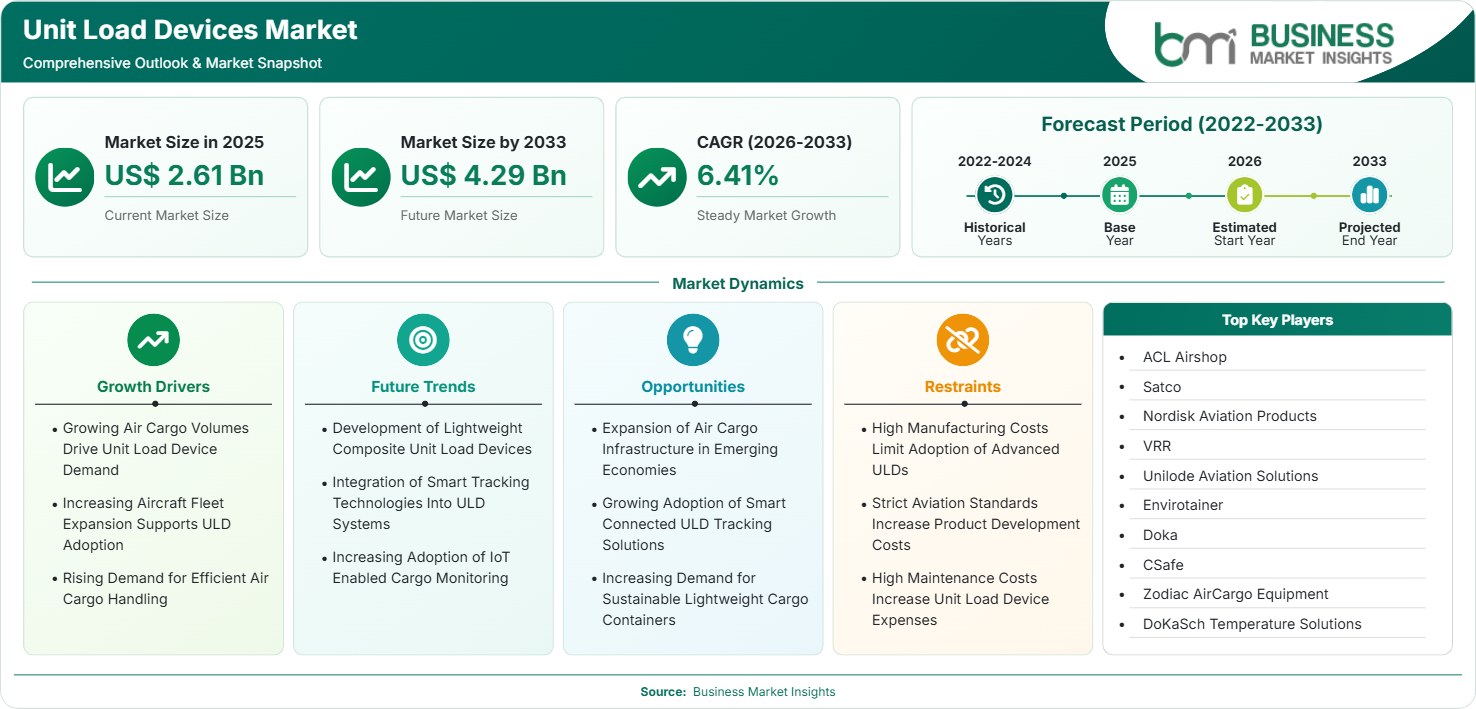
The Unit Load Devices Market size was valued at US$ 2.61 billion in 2025 and is projected to reach US$ 4.29 billion by 2033, growing at a CAGR of 6.41% during 2026–2033, driven by expanding air cargo volumes, fleet growth, efficient cargo handling, digital tracking, lightweight materials, and sustainable aviation logistics.

Report Coverage
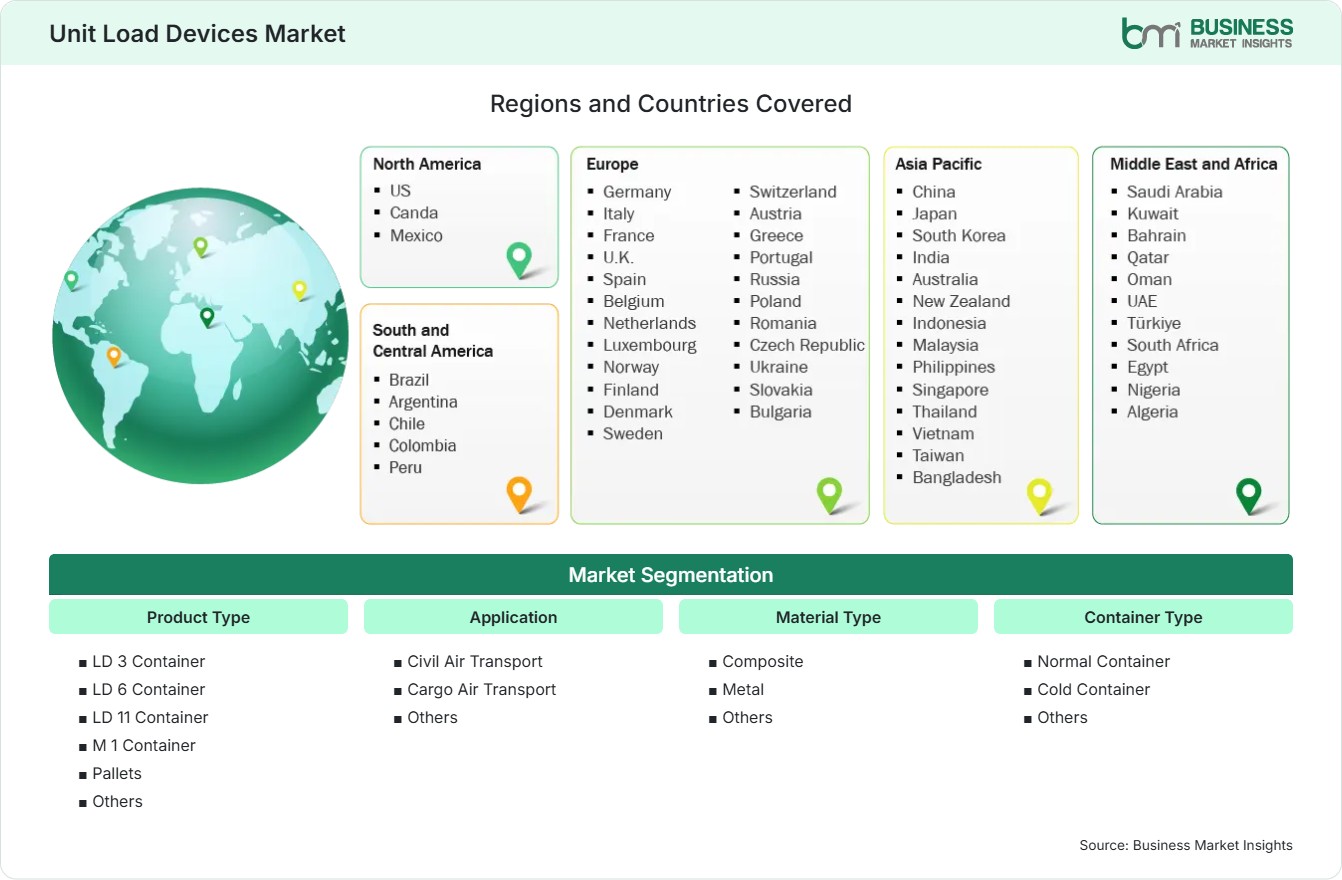
  • Product Type: LD 3 Container, LD 6 Container, LD 11 Container, M 1 Container, Pallets, Others
  • Application: Civil Air Transport, Cargo Air Transport, Others
  • Material Type: Composite, Metal, Others
  • Container Type: Normal Container, Cold Container, Others
US$ 2.61 Bn Market size in 2025
US$ 4.29 Bn Market Size by 2033
6.41% CAGR, 2026 - 2033
2026-2033 Forecast Period

AI Overview

Unit Load Devices Market Summary

  • North America Region: North America held an estimated 35%–39% share in 2025 and is projected to grow at a 6.0%–6.4% CAGR, supported by extensive cargo airline networks, major airports, fleet modernization, established logistics infrastructure, and rising demand for efficient freight handling. The U.S. Unit Load Devices Market is projected to grow at a 6.1%–6.5% CAGR, supported by cargo fleet activity and logistics investment.
  • Fastest Growing Region: Asia Pacific held an estimated 26%–30% share in 2025 and is projected to grow at a 7.4%–7.8% CAGR, driven by expanding e-commerce, rising cross-border trade, airport infrastructure investment, growing cargo fleets, and increasing demand for temperature-controlled pharmaceutical and perishable shipments.
  • Leading Segment: Pallets held an estimated 39%–43% share in 2025 and are projected to grow at a 6.2%–6.6% CAGR, supported by their broad compatibility, high cargo flexibility, efficient handling, and extensive use across international air freight operations.
  • High Growth Segment: Cold Containers held an estimated 12%–16% share in 2025 and are projected to grow at a 8.4%–8.8% CAGR, supported by pharmaceutical logistics, biologics distribution, temperature-sensitive food shipments, and increasing demand for controlled transport conditions.
  • Key Market Opportunity: Digital tracking, lightweight composite construction, and temperature-controlled technologies are creating opportunities for ULD providers to improve cargo visibility, reduce handling losses, and support higher-value air freight.
  • Major Market Players: ACL Airshop, Satco, Nordisk Aviation Products, VRR, Unilode Aviation Solutions, Envirotainer, Doka, CSafe, Zodiac AirCargo Equipment, DoKaSch Temperature Solutions.
Strategic Insights

Unit Load Devices Market: Strategic Insights

Unit Load Devices Market Strategic Framework
FREE PDF
Request your free sample
Request free sample
Stakeholder View

Key Takeaways

  • The ULD ecosystem connects manufacturers, airlines, cargo carriers, leasing providers, ground handlers, airport operators, freight forwarders, and technology companies, creating opportunities for integrated asset management solutions.
  • Temperature-controlled containers offer strong upside as pharmaceutical products, vaccines, biologics, and other high-value healthcare shipments require reliable thermal protection throughout increasingly complex international supply chains.
  • Smart tracking technologies are changing ULD management by enabling operators to monitor location, utilization, condition, and movement, potentially reducing asset losses and improving fleet efficiency.
  • Asia Pacific presents a compelling investment opportunity because expanding e-commerce, manufacturing exports, airport capacity, and pharmaceutical logistics are increasing demand for air cargo infrastructure and specialized ULD equipment.
  • The competitive environment is encouraging partnerships between ULD manufacturers, leasing specialists, airlines, and technology providers, particularly around digital tracking and temperature-controlled logistics.
  • Lightweight composite materials and improved structural designs can help reduce aircraft weight while maintaining cargo protection, creating opportunities for suppliers that combine durability with lifecycle efficiency.
Geographic Outlook

Unit Load Devices Market Regional Highlights

North America Unit Load Devices Market

North America held an estimated 35%–39% share in 2025 and is projected to grow at a 6.0%–6.4% CAGR through 2033. The region benefits from extensive cargo airline operations, large airport networks, mature logistics infrastructure, and significant pharmaceutical distribution activity. The U.S. remains the dominant Unit Load Devices Market, while Canada contributes through international freight operations and growing demand for efficient cargo handling across major aviation hubs.

  • The U.S. benefits from extensive air cargo networks and major logistics hubs, supporting recurring demand for pallets, containers, replacement equipment, and specialized temperature-controlled solutions.
  • Pharmaceutical distribution is creating opportunities for advanced ULDs capable of maintaining controlled conditions, particularly for biologics and other high-value healthcare shipments.
  • Cargo airlines are increasingly focused on asset utilization and operational efficiency, supporting demand for tracking systems that improve ULD visibility and reduce equipment losses.
  • Established airport infrastructure allows airlines and logistics providers to deploy standardized handling systems, supporting continued demand for compatible ULD equipment across major freight routes.

US Unit Load Devices Market

The U.S. represented an estimated 32%–36% share in 2025 and is projected to grow at a 6.1%–6.5% CAGR through 2033. Strong cargo aviation activity, extensive international trade, e-commerce distribution, and pharmaceutical logistics support demand. Major cargo carriers and airports are investing in efficient handling processes, while ULD operators increasingly focus on tracking, repair, maintenance, and asset utilization.

  • Large cargo airline fleets generate recurring demand for ULD procurement, replacement, maintenance, repair, and refurbishment throughout equipment operating lifecycles.
  • E-commerce distribution is supporting air freight activity, increasing the need for standardized cargo equipment capable of supporting high-volume and time-sensitive logistics.
  • Pharmaceutical and healthcare logistics are expanding demand for specialized containers that provide reliable temperature control across domestic and international air transport.
  • Digital asset tracking can help ULD owners monitor utilization, identify misplaced equipment, and improve fleet planning across complex multi-airport operating networks.

Europe Unit Load Devices Market

Europe held an estimated 26%–30% share in 2025 and is projected to grow at a 5.8%–6.2% CAGR through 2033. Germany, the UK, France, and the Netherlands are leading Unit Load Devices Markets supported by major cargo airports and established logistics networks. Germany is projected to grow at a 6.1%–6.5% CAGR, while the Netherlands benefits from its strategic role in European air freight and distribution.

  • Germany benefits from strong manufacturing and pharmaceutical logistics, supporting demand for specialized ULDs serving high-value and temperature-sensitive international shipments.
  • The Netherlands offers strategic advantages through major cargo gateways and logistics infrastructure, supporting efficient ULD circulation across European and global freight networks.
  • The UK provides opportunities through international cargo operations, pharmaceutical distribution, and e-commerce logistics requiring reliable and efficient air freight equipment.
  • European operators are increasingly evaluating lightweight and durable ULD designs that can improve aircraft efficiency while supporting longer service lives and reduced lifecycle impacts.

Asia Pacific Unit Load Devices Market

Asia Pacific represented an estimated 26%–30% unit load devices market share in 2025 and is projected to grow at a 7.4%–7.8% CAGR through 2033. China, Japan, Singapore, South Korea, and India are important markets, with India projected to grow at a 8.2%–8.6% CAGR. E-commerce, manufacturing exports, expanding cargo fleets, airport investment, and pharmaceutical logistics are strengthening regional demand.

  • China offers substantial potential due to its manufacturing base, international trade activity, expanding cargo infrastructure, and growing requirement for standardized freight handling equipment.
  • India is experiencing rising air cargo activity as e-commerce and pharmaceutical exports expand, creating opportunities for ULD suppliers and specialized logistics providers.
  • Singapore serves as a major regional aviation and logistics hub, supporting demand for high-quality ULDs and efficient asset management across international freight routes.
  • Japan and South Korea benefit from advanced logistics infrastructure and high-value exports, supporting demand for reliable containers and specialized temperature-controlled cargo equipment.

Rest of World Unit Load Devices Market

South and Central America accounted for an estimated 6%–8% share in 2025 and are projected to grow at a 6.5%–6.9% CAGR through 2033. Brazil and Mexico lead regional opportunities. The Middle East and Africa represented an estimated 7%–9% share and are projected to grow at a 7.0%–7.4% CAGR, supported by cargo hubs and expanding logistics infrastructure.

  • Brazil offers opportunities through agricultural exports, pharmaceutical distribution, and growing international cargo operations requiring standardized equipment for efficient air freight handling.
  • Mexico benefits from manufacturing trade and proximity to North American markets, supporting demand for ULDs across integrated regional and international supply chains.
  • The UAE is a major air cargo hub where extensive international connectivity and logistics investment support demand for advanced ULD management and specialized cargo containers.
  • Saudi Arabia is developing aviation and logistics infrastructure, creating long-term opportunities for ULD suppliers as cargo capacity and international freight connectivity expand.
Global Market Geography
FREE PDF
Request your free sample
Request free sample
Segment Analysis

Unit Load Devices Market Segmentation

Product Type

Pallets held an estimated 39%–43% share in 2025 and are projected to grow at a 6.2%–6.6% CAGR between 2026–2033. Their broad applicability across cargo categories and compatibility with established loading systems support continued adoption. LD containers provide efficient enclosed cargo handling, while specialized M containers and other formats address aircraft-specific requirements and operational needs.

  • LD 3 Container: LD 3 containers are widely used for lower-deck aircraft cargo operations, supporting standardized loading, efficient space utilization, and broad compatibility across commercial aircraft fleets.
  • LD 6 Container: LD 6 containers provide larger enclosed cargo capacity, supporting airlines transporting consolidated freight while improving loading efficiency and protection during aircraft handling operations.
  • LD 11 Container: LD 11 containers support high-capacity cargo operations, offering efficient enclosed transport for airlines and logistics providers managing larger freight volumes.
  • M 1 Container: M 1 containers serve specialized aircraft cargo requirements, providing standardized handling capabilities and supporting efficient freight movement across compatible aircraft platforms.
  • Pallets: Pallets offer flexibility for different cargo configurations and remain widely used because they support efficient consolidation, securing, handling, and loading across diverse freight operations.

Application

Civil Air Transport held an estimated 48%–52% share in 2025 and is projected to grow at a 6.1%–6.5% CAGR between 2026–2033. Passenger aircraft belly cargo remains important to international freight networks, while dedicated cargo aircraft support high-volume shipments. Increasing e-commerce and pharmaceutical distribution are strengthening requirements for reliable containers, pallets, and specialized temperature-controlled equipment.

  • Civil Air Transport: Belly cargo operations provide important freight capacity, creating demand for standardized ULDs that maximize available aircraft space while supporting efficient passenger aircraft turnaround.
  • Cargo Air Transport: Dedicated cargo aircraft require extensive ULD deployment for high-volume freight, supporting demand for durable containers, pallets, and specialized cargo handling systems.

Material Type

Metal ULDs held an estimated 55%–59% share in 2025 and are projected to grow at a 5.8%–6.2% CAGR between 2026–2033. Their established durability and structural performance support widespread adoption. Composite materials are gaining attention because their lower weight can support aircraft efficiency, while material innovation is improving durability and lifecycle performance.

  • Composite: Composite ULDs provide lightweight construction and corrosion resistance, supporting airline efforts to reduce aircraft weight while maintaining cargo protection and operational durability.
  • Metal: Metal ULDs remain widely adopted because of their established structural strength, durability, repairability, and compatibility with demanding cargo handling environments.

Container Type

Normal Containers held an estimated 72%–76% share in 2025 and are projected to grow at a 5.9%–6.3% CAGR between 2026–2033. They serve broad cargo requirements across international freight networks. Cold containers are gaining faster adoption because pharmaceutical, biologic, food, and other temperature-sensitive shipments require dependable thermal protection.

  • Normal Container: Normal containers support general cargo movement and remain widely used because they offer standardized protection, efficient handling, and broad applicability across freight categories.
  • Cold Container: Cold containers provide controlled thermal environments for pharmaceuticals, biologics, perishables, and other sensitive cargo, supporting reliable transport across temperature-sensitive supply chains.
Market Forces

Unit Load Devices Market Dynamics

Key Market Drivers

Growing Air Cargo Volumes Drive Unit Load Device Demand

Air cargo operations worldwide are contributing to the demand for standardized cargo equipment as carriers transport growing amounts of goods on international air routes. This consistent air freight demand boosts the Unit Load Devices Market growth through higher usage of containers and pallets within cargo aircraft and even passenger aircraft’s belly space. E-commerce shipping, pharmaceutical shipping, and manufacturing logistics with high timeliness requirements all contribute to the demand for such cargo equipment. Providers of ULD with durability, lightweightness, and tracking capability may find opportunities amid rising complexities in air freight.

Increasing Aircraft Fleet Expansion Supports ULD Adoption

An increase in the number of aircraft in the airline’s fleet results in an increase in the number of aircraft that need compatible cargo handling equipment. Growth in the number of passenger aircraft would increase demand for belly cargo ULDs, whereas growth in the number of freighters would increase demand for pallets and containers. Growth in the number of routes and higher utilization rates of the aircraft also require more ULDs and better management of the asset. Replacement demand is another source of income, as ULDs wear out due to frequent loading/unloading, movement, and handling.

Rising Demand for Efficient Air Cargo Handling

The airlines and the freight carriers are working on decreasing the turnaround time, cargo damage, and efficient utilization of aircraft capacity. Standardized Unit Load Devices provide support for this purpose by enabling cargo to be packaged in standardized, easily movable containers. Digitization provides an additional tool for increasing efficiency through the location and management of equipment movement. Light construction reduces the weight of aircraft operations, whereas durability will decrease the frequency of replacing ULDs. Thus, the Unit Load Devices market trend is moving towards the development of tools that provide cargo protection as well as digital information about the cargo.

Key Market Opportunities

Expansion of Air Cargo Infrastructure in Emerging Economies

The emergence of investments in airports, cargo terminals, logistics centers, and cold-chain facilities within emerging economies presents an opportunity for ULD manufacturers. With the rise of international trade and online retail, there will be a need for equipment that will handle increased shipments of cargo. Additionally, the establishment of new cargo gateways may create additional demand for ULD pooling, maintenance, and handling services. Manufacturers who decide to venture into such markets may find it beneficial to partner with airlines, freight forwarders, airport companies, and logistics firms.

Growing Adoption of Smart Connected ULD Tracking Solutions

Digitization offers a significant potential to the Unit Load Devices market since the requirements for precise data on location, usage, condition, and movement of ULDs by airlines and leasing organizations are becoming higher. Digital tools can assist in reducing the number of missing products, improving inventory planning, and detecting bottlenecks. Additionally, sensors can provide information on aspects such as temperature, vibrations, humidity levels, and unauthorized manipulation of specific cargo. Connections with management systems of airlines and logistics operations can improve decision-making for dispersed networks. The Unit Load Devices market forecast favors the suppliers with integrated physical devices and digital offerings.

Increasing Demand for Sustainable Lightweight Cargo Containers

There is a growing trend among airlines to be cost-effective and environmentally-friendly, and there are thus opportunities for designing ULDs that are lightweight. This is because composite materials can be used to reduce weight without sacrificing structural strength, thereby reducing fuel consumption during flights. There is also consideration of factors such as durability, reparability, and recyclability in the production of new products. Sustainable ULDs will, therefore, help to address both cost efficiency and environmental issues. Those suppliers who design lightweight products without compromising cargo safety or lifespan will enjoy a competitive edge.

Market Restraints and Challenges

High Manufacturing Costs Limit Adoption of Advanced ULDs

Factor: Advanced ULDs incorporating composite materials, embedded sensors, thermal management technologies, or specialized structural designs require more expensive materials and manufacturing processes than conventional equipment. Impact: Increased purchase costs could prevent smaller airlines and cargo shippers from adopting these devices. While temperature-controlled containers and connected ULDs could offer many benefits, operators need to weigh these against the costs of purchasing and maintaining the technology. The manufacturers could resolve this problem through modular designs, mass production, extended lifetimes of the systems, and life-cycle pricing models.

Strict Aviation Standards Increase Product Development Costs

Factor: ULDs must satisfy rigorous aviation requirements covering structural integrity, fire resistance, dimensional compatibility, handling safety, and operational reliability. Impact: Compliance testing and certification can be costly and time-consuming, especially when developing novel materials and technologically advanced, digitally linked systems. The manufacturers also have to provide compatibility with the loading systems in the airplane and the airport facilities. All these can pose an entry barrier to new entrants and can result in existing companies having an advantage because of their experience in certification. With continued technological advancements in the development of smart, lightweight ULDs, developers must strike a balance between innovation and certification.

Company Analysis

Competitive Landscape

The competitive environment includes ULD manufacturers, cargo equipment specialists, temperature-controlled logistics providers, leasing companies, and aviation technology firms. The Unit Load Devices Market analysis indicates that competition increasingly centers on product durability, aircraft compatibility, lightweight construction, global service networks, temperature control, digital tracking, and lifecycle management capabilities.

Company Name

Overview

Products and Services relevant to this market

ACL Airshop

ULD specialist providing equipment, leasing, repair, and asset management solutions for air cargo operators.

ULD containers, pallets, leasing, repair services, fleet management, and cargo equipment support.

Satco

Aviation cargo equipment provider focused on ULD manufacturing, maintenance, and specialized solutions.

Aircraft containers, pallets, ULD repair, cargo equipment, and related aviation logistics services.

Nordisk Aviation Products

Major ULD manufacturer serving airlines, cargo operators, and aviation logistics companies globally.

Aircraft pallets, containers, lightweight ULDs, repair services, and cargo handling solutions.

VRR

Aviation equipment company supplying ULDs and cargo handling solutions for global airline operations.

Aircraft containers, pallets, cargo equipment, repair, and customized ULD solutions.

Unilode Aviation Solutions

Aviation asset management specialist providing ULD leasing, digital tracking, and lifecycle services.

ULD leasing, RFID tracking, asset management, repair, maintenance, and digital solutions.

Envirotainer

Temperature-controlled air cargo specialist focused on pharmaceutical and healthcare logistics.

Active temperature-controlled containers, cold-chain solutions, monitoring, and pharmaceutical cargo services.

Doka

Aviation cargo equipment provider offering ULD and specialized air freight handling solutions.

Aircraft containers, pallets, cargo equipment, and customized logistics solutions.

CSafe

Temperature-controlled container provider specializing in pharmaceutical and life sciences logistics.

Active and passive temperature-controlled containers, monitoring, and cold-chain logistics solutions.

Zodiac AirCargo Equipment

Aerospace equipment specialist serving aircraft cargo handling and ULD-related requirements.

Cargo containers, pallets, aircraft cargo equipment, and specialized handling solutions.

DoKaSch Temperature Solutions

Specialist provider of temperature-controlled air freight containers for sensitive cargo.

Opticooler active containers, temperature-controlled solutions, monitoring, and pharmaceutical logistics support.

Trust & Transparency

Research Methodology

The market analysis combines proprietary research with secondary data from government agencies, company disclosures, regulatory filings, industry databases and expert interviews. Market estimates are validated through data triangulation, cross-market benchmarking and analyst review.

View Full Research Methodology

Questions Answered

Frequently Asked Questions

What is the Unit Load Devices Market forecast through 2033?

The market forecast indicates continued expansion as air freight volumes, aircraft fleets, e-commerce, pharmaceutical logistics, digital tracking, and demand for lightweight and temperature-controlled cargo solutions increase.

What materials are increasingly used in lightweight ULD development?

Composite materials are gaining attention because they can reduce weight while maintaining structural performance and corrosion resistance, supporting airline efforts to improve aircraft efficiency and lower lifecycle costs.

How are smart technologies changing ULD management?

Connected tracking systems can provide real-time or near-real-time visibility into ULD location, utilization, and condition, helping operators reduce asset losses, improve fleet planning, and strengthen operational efficiency.

Why are temperature-controlled ULDs gaining importance?

Temperature-controlled ULDs are increasingly important because pharmaceutical products, biologics, vaccines, perishables, and other sensitive shipments require controlled conditions throughout transportation and airport handling processes.

What is driving demand for unit load devices?

The Unit Load Devices Market report identifies rising air cargo volumes, aircraft fleet expansion, e-commerce logistics, pharmaceutical transportation, and increasing demand for efficient cargo handling as key demand drivers.

Access the Full Unit Load Devices Market Report

Get segment-level forecasts, regional estimates, competitive benchmarking, company profiles and downloadable Excel datasets.

Access the full Unit Load Devices Market Report
350 pages PDF & Excel | 2026-08-04