Market Summary
Executive Summary and Global Market Analysis
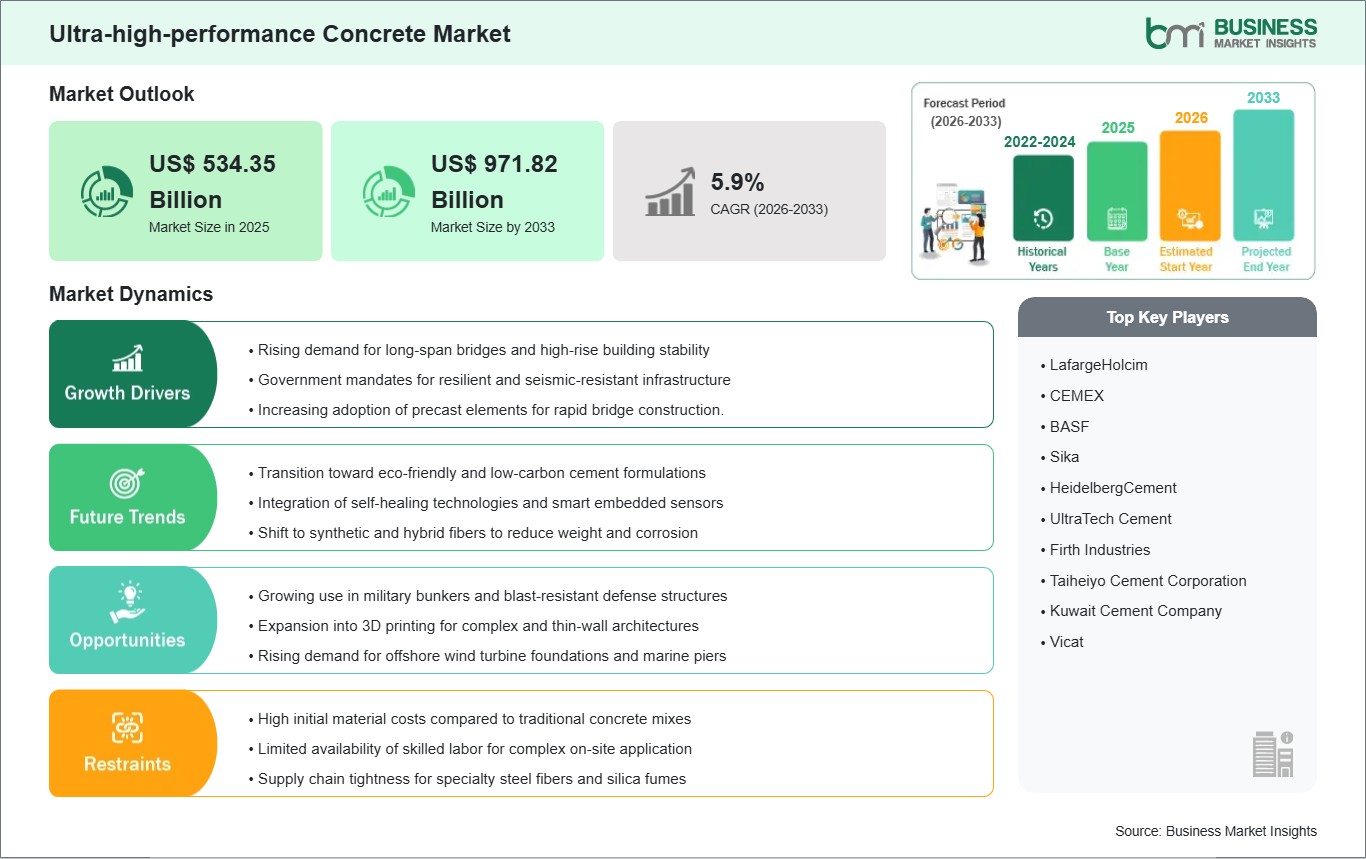
Ultra-high-performance Concrete (UHPC) represents a paradigm shift in cementitious technology, engineered to bridge the gap between traditional masonry and structural steel. Defined by a dense, optimized packing of microscopic particles and high-strength fiber reinforcement, UHPC achieves compressive strengths exceeding 150 MPa and exceptional tensile ductility. Unlike conventional concrete, its nearly impermeable matrix eliminates capillary porosity, providing an impenetrable barrier against chloride ingress, freeze-thaw cycles, and chemical erosion. This makes the material indispensable for critical infrastructure, such as bridge joints, seismic-resistant columns, and blast-proof fortifications, where structural integrity is a non-negotiable requirement.
Despite its superior technical profile, the market must navigate significant structural restraints. The primary hurdle remains the substantial upfront cost, driven by the high concentration of expensive binders and specialized steel fibers, which often necessitates a complex cost-benefit justification for stakeholders. Furthermore, the market is challenged by a lack of universal design standards and the requirement for specialized high-shear mixing equipment, which can limit adoption to high-tier contractors. Supply chain sensitivities regarding high-purity silica fume and quartz also pose risks to consistent global production.
However, these challenges are outweighed by lucrative opportunities emerging from the global shift toward "Sustainable Longevity." As governments transition to life-cycle cost analysis (LCCA) in public procurement, UHPC's ability to extend asset life by decades offers a compelling economic advantage. Significant growth potential exists in the integration of UHPC with 3D concrete printing for bespoke architectural forms and the burgeoning offshore wind energy sector, where ultra-durable grouts are required for subsea foundations. Innovations in carbon-neutral binders and waste-derived fillers further position UHPC as a cornerstone of the future circular construction economy.
Segment Analysis
Ultra-high-performance Concrete Market Segmentation
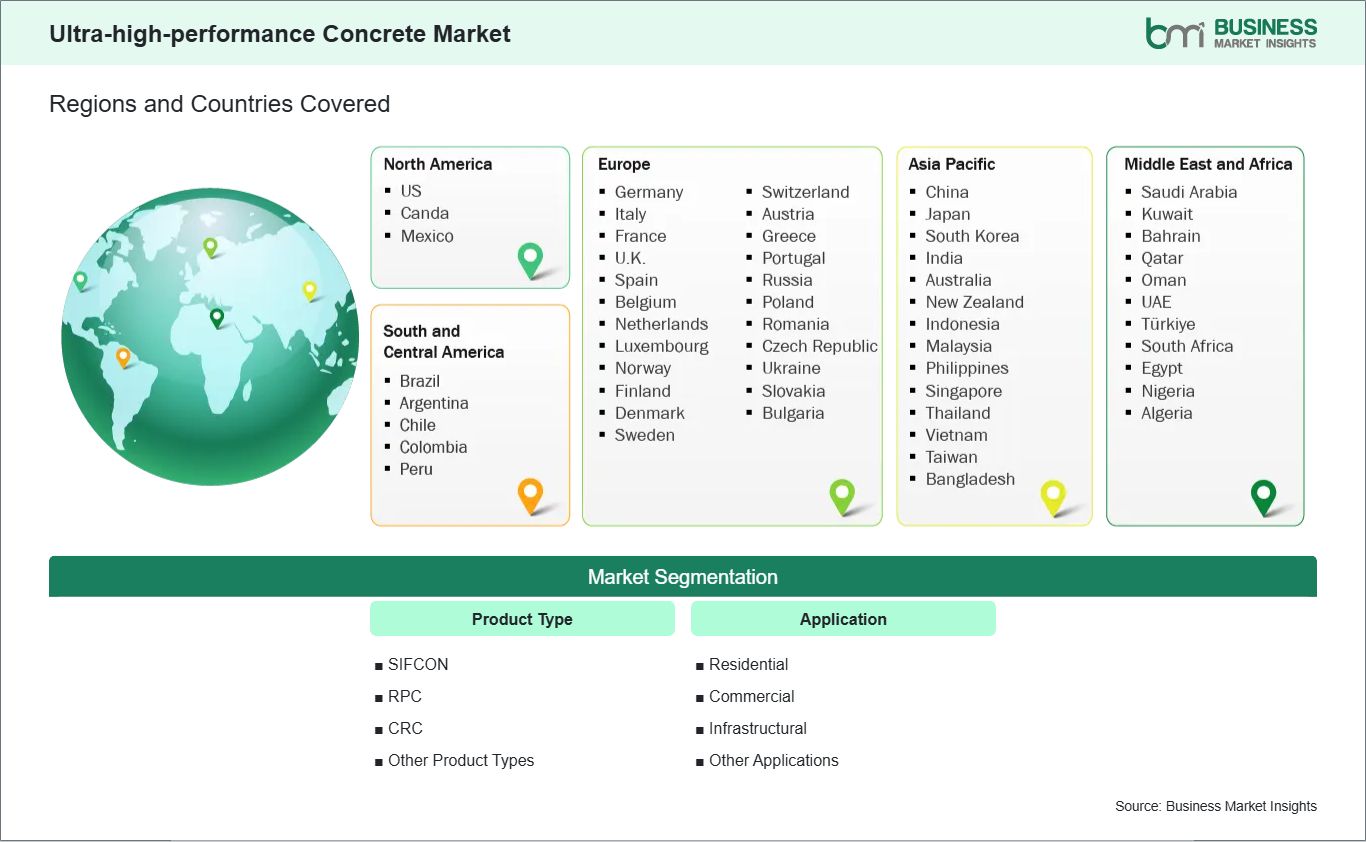
Key segments that contributed to the derivation of the Ultra-high-performance Concrete market analysis are product type and application.
- By Product Type, the market is segmented into SIFCON, RPC, CRC, and Others.
- By Application, the market is divided into Residential, Commercial, Infrastructural, and Others.
Market Forces
Ultra-high-performance Concrete Market Drivers and Opportunities
Urgent Rehabilitation and Modernization of Aging Global Infrastructure
The primary catalyst for the ultra-high-performance concrete market is the critical need to restore and upgrade deteriorating civil infrastructure across the globe. Many industrialized nations are grappling with bridge networks, tunnels, and highway systems that have far exceeded their intended functional lifespan and are now susceptible to structural fatigue and environmental corrosion. Traditional repair methods often provide only temporary solutions, leading to a cycle of frequent maintenance and traffic disruption. In contrast, this advanced cementitious material offers a definitive solution due to its exceptional impermeability and strength. By implementing thin overlays and field-cast connections, engineers can effectively seal structures against the ingress of moisture and de-icing salts, which are the leading causes of rebar oxidation and concrete spalling.
Furthermore, the shift toward performance-based specifications in public procurement is encouraging the adoption of materials that prioritize long-term resilience over the lowest initial bid. Government agencies are increasingly recognizing that while the upfront cost of high-performance mixes is higher, the massive reduction in life-cycle expenses—such as avoided repairs and extended service intervals—creates a superior economic case. This driver is particularly potent in seismic-prone regions and coastal areas, where the material's ability to absorb energy and resist harsh marine environments is unmatched. As international focus intensifies on building more resilient cities, the mandate for durable, high-capacity structural materials is transforming from a niche requirement into a standard engineering practice for all critical public assets.
Synergy with Additive Manufacturing and Digital Construction Workflows
A significant growth opportunity lies in the convergence of ultra-high-performance concrete with large-scale 3D printing and automated digital fabrication. Conventional concrete construction is often limited by the labor-intensive process of building complex wooden or steel formwork, which restricts architectural creativity and generates substantial material waste. This advanced concrete, however, possesses unique rheological properties—such as high flowability combined with rapid setting times—that make it an ideal medium for additive manufacturing. By extruding the material layer-by-layer based on precise digital models, construction firms can produce intricate, topologically optimized structural elements that use the minimum amount of material necessary to support specific loads.
This transition toward "Digital Concrete" enables the creation of slender, organic architectural forms that were previously cost-prohibitive or physically impossible to cast. In the context of the burgeoning smart city movement, this capability allows for the on-site production of modular housing units and complex infrastructure components with extreme precision. Furthermore, the integration of digital tools reduces the reliance on manual labor in hazardous environments and significantly shortens project timelines. As 3D printing technology matures and specialized printers become more accessible, the opportunity to deploy ultra-high-performance concrete for customized, aesthetic, and highly efficient urban structures will expand. This evolution not only addresses the global housing shortage but also aligns with sustainability goals by drastically reducing the carbon footprint associated with construction waste and over-engineering.
Size and Share Analysis
Ultra-high-performance Concrete Market Size and Share Analysis
The Ultra-high-performance Concrete market demonstrates steady growth, with size and share analysis revealing evolving trends and competitive positioning among key players. The report further examines subsegments categorized within product type and application, offering insights into their contribution to overall market performance.
Within the product type segment, Slurry-infiltrated Fibrous Concrete (SIFCON) sub-segment maintains a prominent position due to its extreme energy-absorption capacity and impact resistance, which is highly valued in military and anti-detonating applications.
From an application perspective, the Infrastructural sub-segment accounts for the majority of the market share, fueled by the widespread adoption of Reactive Powder Concrete (RPC) in the construction of long-span bridges and high-speed rail networks where structural longevity is paramount.
Report Coverage
Ultra-high-performance Concrete Market Report Coverage and Deliverables
The "Ultra-high-performance Concrete Market Size and Forecast (2022 - 2033)" report provides a detailed analysis of the market covering below areas:
- Ultra-high-performance Concrete market size and forecast at global, regional, and country levels for all the key market segments covered under the scope
- Ultra-high-performance Concrete market trends, as well as market dynamics such as drivers, restraints, and key opportunities
- Ultra-high-performance Concrete market analysis covering key market trends, global and regional framework, major players, regulations, and recent market developments
- Industry landscape and competition analysis covering market concentration, heat map analysis, prominent players, and recent developments for the Ultra-high-performance Concrete market
- Detailed company profiles, including SWOT analysis
Geographic Insights
Ultra-high-performance Concrete Market Geographic Insights
The geographical scope of the Ultra-high-performance Concrete market report is divided into five regions: North America, Asia Pacific, Europe, Middle East &Africa, and South &Central America.
In North America, the market is primarily characterized by an intense focus on the rehabilitation of aging civil assets, with government initiatives increasingly favoring high-durability materials for bridge deck overlays and seismic retrofitting to ensure long-term structural resilience. Across Europe, the industry is increasingly aligned with rigorous green building certifications and sustainability mandates, where the long service life and low maintenance profile of advanced cementitious mixes serve as a strategic tool for reducing the lifetime carbon footprint of commercial and public structures. The Asia-Pacific region functions as a high-growth epicenter, propelled by aggressive urbanization and the rapid expansion of high-speed transit networks that demand the extreme compressive strength and rapid-setting capabilities inherent in these specialized formulations.
In the Middle East and Africa, market activity is increasingly tied to the development of ambitious "giga-projects" and smart city frameworks that utilize the aesthetic flexibility and extreme environmental resistance of the material to withstand harsh desert and maritime climates. Meanwhile, South and Central America are witnessing a steady integration of high-performance concrete within the industrial sector, particularly for heavy-duty warehouse flooring and specialized port infrastructure that requires superior abrasion resistance and load-bearing capacity. This global distribution ensures a balanced market trajectory as local economies continue to modernize their built environments through the adoption of next-generation construction technologies.
Industry Activity
Recent Developments
The Ultra-high-performance Concrete market is evaluated by gathering qualitative and quantitative data post primary and secondary research, which includes important corporate publications, association data, and databases. A few of the key developments in the Ultra-high-performance Concrete market are:
- In June 2025, Sika AG successfully completed the acquisition of Gulf Additive Factory LLC in the State of Qatar. As a prominent manufacturer of a diverse range of construction chemical products, the company held a robust standing within the rapidly accelerating Qatari construction sector. This strategic acquisition significantly strengthened Sika's operational foothold in the country and established a localized production hub to meet the surging demand for specialized materials, including Ultra-high-performance Concrete admixtures and sustainable facade systems. Furthermore, the integration provided the group with lucrative opportunities for further regional expansion and technical synergy across the Middle East.
- In April 2025, Heidelberg Materials North America announced that it had completed the acquisition of Giant Cement Holding Inc. (GCHI) and its subsidiaries—Giant Cement Company, Dragon Products Company, and Giant Resource Recovery—from the Fortaleza, Uniland, and Trituradora groups. The acquired operations encompassed a cement plant in Harleyville, South Carolina, alongside four associated distribution terminals, and a joint-venture deep-water import terminal in Savannah, Georgia. Additionally, the transaction included cement and slag distribution terminals in Newington, New Hampshire, and Thomaston, Maine, as well as a deep-water import terminal in Boston, Massachusetts. This strategic purchase also integrated Giant Resource Recovery (GRR!), an alternative fuel recycling business in the Eastern U.S., into the company's portfolio. By securing these high-grade cement and slag assets, Heidelberg Materials significantly enhanced its supply chain capability to produce the specialized binders essential for Ultra-high-performance Concrete applications across the Atlantic seaboard.
Trust & Transparency
Research Methodology
The market analysis combines proprietary research with secondary data from government agencies, company disclosures, regulatory filings, industry databases and expert interviews. Market estimates are validated through data triangulation, cross-market benchmarking and analyst
review.
View Full Research Methodology
Key Sources Referred:
World Bank - Global Trade IndicatorsWorld Trade Organization (WTO)International Monetary Fund (IMF)International Trade Administration (ITA)Company websiteCompany annual reportsCompany investor presentations