Market Summary
Executive Summary and Global Market Analysis
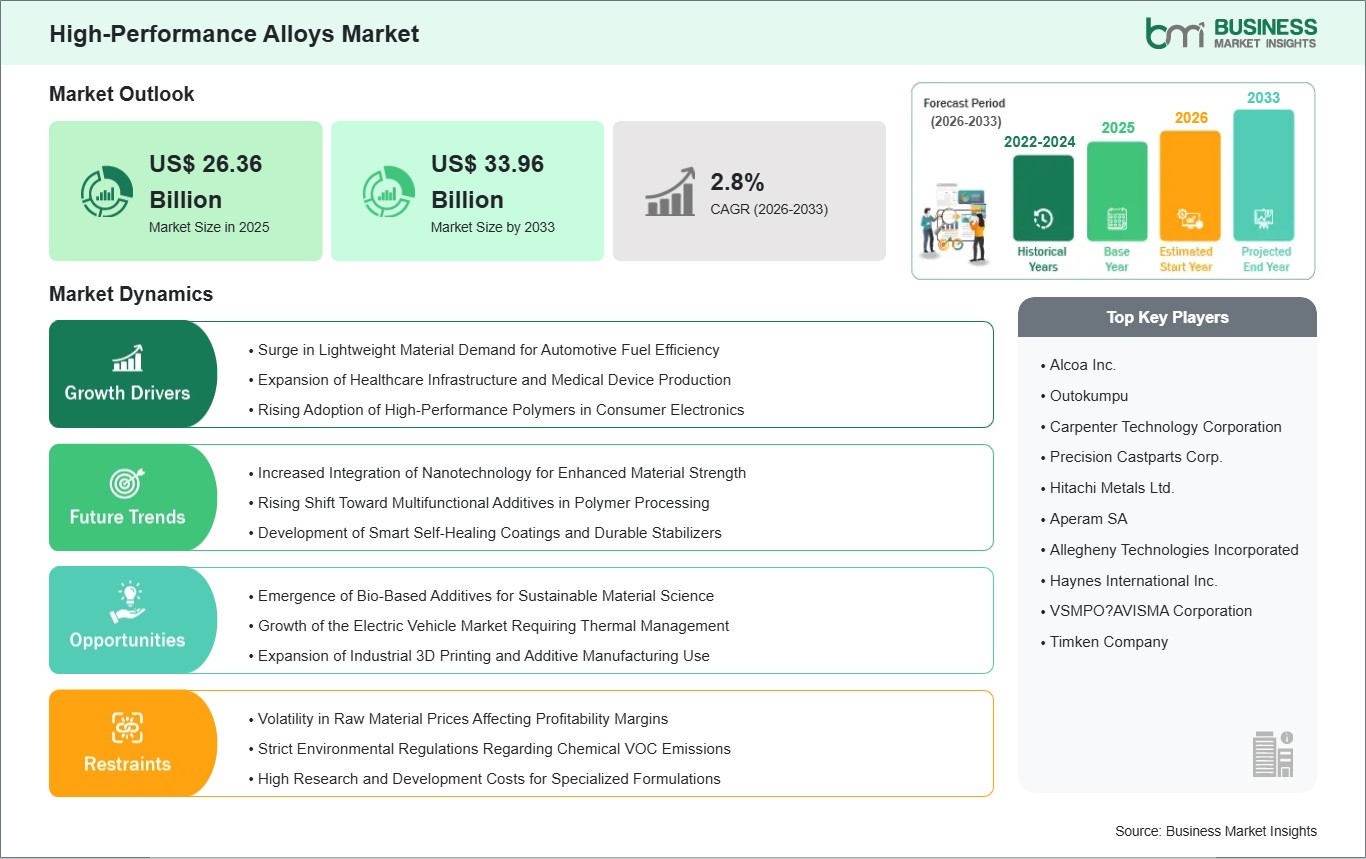
High-performance alloys, widely recognized as superalloys, are premium metallic materials designed to provide exceptional mechanical strength, resistance to thermal creep, and high protection against corrosion or oxidation. These materials are essential for critical applications in the aerospace, automotive, oil and gas, and industrial gas turbine sectors. Composed primarily of nickel, cobalt, or iron, they maintain structural integrity at temperatures that would melt conventional metals. The market is propelled by the global transition toward high-efficiency energy systems and the aerospace industry's demand for lightweight components to reduce fuel consumption.
However, several challenges can restrain market growth, such as the volatile pricing of raw materials (like nickel and chromium), energy-intensive refining processes, and the technical difficulty of machining complex alloy parts. Moreover, geopolitical instability further jeopardizes the stable sourcing of rare alloying elements. Besides these challenges, there are great opportunities within this market due to the rapid adoption of metal additive manufacturing, better known as 3D printing; the development of a new generation of high-entropy alloys, also known as HEAs; and the fast-expanding role of specialty alloys in hydrogen storage and atomic power generation.
Segment Analysis
High-Performance Alloys Market Segmentation
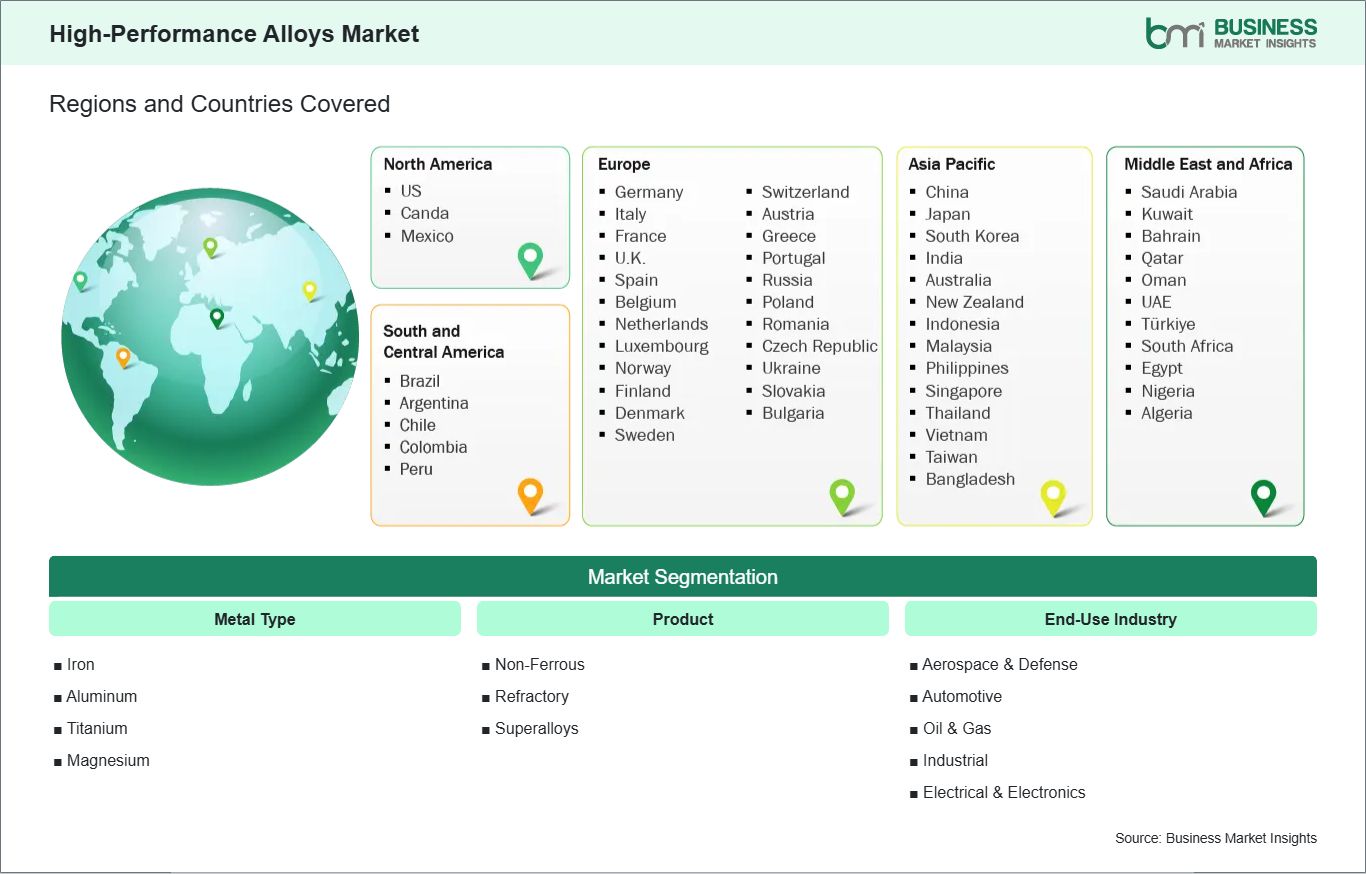
Key segments that contributed to the derivation of the high-performance alloys market analysis are metal type, product, and end-use industry.
- By Metal Type, the market is segmented into Iron, Aluminum, Titanium, and Magnesium.
- By Product, the market is divided into Non-Ferrous, Refractory, and Superalloys.
- By End-Use Industry, the market is categorized into Aerospace &Defense, Automotive, Oil &Gas, Industrial, and Electrical &Electronics.
Market Forces
High-Performance Alloys Market Drivers and Opportunities
Aerospace Expansion and Demand for Advanced Engine Efficiency
The rapid growth of the global aviation sector has emerged as a pivotal factor positively driving the high-performance alloys market. As airlines look to minimize operational costs, there is an increasing demand for next-generation engines that operate at higher temperatures for better fuel combustion. High-performance alloys, particularly nickel and cobalt-based superalloys, are critical for turbine blades, discs, and structural components that endure these extreme environments.
Each aircraft utilizes advanced alloys to achieve higher engine bypass ratios and improved fuel economy, with companies like GE Aviation and Rolls-Royce leveraging these materials to reduce fuel consumption by up to 25%. The surge in defense spending across North America and Europe for advanced fighter jets and missile systems further fuels this demand. This robust aerospace expansion directly supports the market growth, as high-value materials are essential to meet the stringent safety and performance standards of modern aviation while reducing environmental impact through lightweighting.
Innovation in Additive Manufacturing and Sustainable Energy Solutions
Metal additive manufacturing allows for the creation of complex, near-net-shape components that reduce material waste and enable the design of parts previously impossible with traditional casting. This is particularly valuable for producing lightweight aerospace brackets and specialized medical implants, with the global additive manufacturing alloy market projected to grow rapidly as OEMs shift toward rapid customization.
Moreover, the global transition toward renewable energy is creating new applications for these alloys. In the burgeoning hydrogen economy, high-entropy alloys (HEAs) are being used for solid-state hydrogen storage due to their superior resistance to hydrogen embrittlement and high absorption rates. Additionally, the expansion of the nuclear power sector, including Small Modular Reactors (SMRs), relies on high-performance refractory alloys that can withstand intense radiation and high thermal loads. As industries move toward carbon-neutral operations, the demand for alloys that support high-efficiency power generation and clean energy storage is expected to grow steadily, offering manufacturers significant long-term growth prospects.
Size and Share Analysis
High-Performance Alloys Market Size and Share Analysis
The high-performance alloys market demonstrates steady growth, with size and share analysis revealing evolving trends and competitive positioning among key players. The report further examines subsegments categorized within metal type, product, and end-use industry, offering insights into their contribution to overall market performance.
Based on metal type, titanium alloys are highly valued for their high strength-to-weight ratio and are predominantly used in the aerospace and defense sectors for structural airframe components.
In terms of product, superalloys continue to lead the product segment, particularly nickel-based variants, which are vital for the hot section of industrial gas turbines. This segment benefits from the rising global demand for efficient electricity generation and the modernization of power grids.
Report Coverage
High-Performance Alloys Market Report Coverage and Deliverables
The "High-Performance Alloys Market Size and Forecast (2022 - 2033)" report provides a detailed analysis of the market covering below areas:
- High-Performance Alloys market size and forecast at global, regional, and country levels for all the key market segments covered under the scope
- High-Performance Alloys market trends, as well as market dynamics such as drivers, restraints, and key opportunities
- High-Performance Alloys market analysis covering key market trends, global and regional framework, major players, regulations, and recent market developments
- Industry landscape and competition analysis covering market concentration, heat map analysis, prominent players, and recent developments for the High-Performance Alloys market
- Detailed company profiles, including SWOT analysis
Geographic Insights
High-Performance Alloys Market Geographic Insights
The geographical scope of the high-performance alloys market report is divided into five regions: North America, Asia Pacific, Europe, Middle East &Africa, and South &Central America.
The North American market, led by the U.S., remains the largest consumer, driven by a highly established aerospace and defense sector and significant investments in medical device manufacturing. However, the Asia-Pacific region is the fastest-growing market, with China and India leading the way due to rapid industrialization, the expansion of local automotive hubs, and massive infrastructure projects.
The region is witnessing a surge in the adoption of advanced metallurgy techniques to support its growing domestic aircraft programs and renewable energy initiatives. Air cargo capacity expansion for high-value components, combined with the development of strategic free trade zones, is enhancing the regional supply chain. Additionally, the presence of major electronics manufacturing hubs in Taiwan and South Korea further solidifies Asia-Pacific's position as a critical node in the global high-performance alloys ecosystem.
Industry Activity
Recent Developments
The high-performance alloys market is evaluated by gathering qualitative and quantitative data post primary and secondary research, which includes important corporate publications, association data, and databases. A few of the key developments in the high-performance alloys market are:
- In July 2025, ATI Inc. announced the extension and expansion of its long-term titanium products agreement with The Boeing Company, reinforcing ATI's position as a top supplier of high-performance titanium materials for aerospace. Under the terms of the agreement, ATI will supply a comprehensive portfolio of high-performance titanium materials, including long products such as ingots, billets, rectangles, and bars, and flat-rolled products, including plate, sheet, and coil.
- In January 2025, Aperam S.A. (Aperam) announced the successful completion of Aperam's acquisition of Universal Stainless &Alloy Products. The Acquisition of Universal Stainless &Alloy Products has been approved by its Shareholders and has received all necessary approvals from regulatory authorities. This acquisition is an important step in the achievement of the joint vision of innovation, excellence, and sustainable growth of both companies. The Acquisition is also an affirmation of the commitment of the company to its aim of strengthening its position in the aerospace market, as it aims to extend its presence in the production of Alloys &Specialties steel.
Trust & Transparency
Research Methodology
The market analysis combines proprietary research with secondary data from government agencies, company disclosures, regulatory filings, industry databases and expert interviews. Market estimates are validated through data triangulation, cross-market benchmarking and analyst
review.
View Full Research Methodology
Key Sources Referred:
World Bank - Global Trade Indicators World Trade Organization (WTO) International Monetary Fund (IMF) International Trade Administration (ITA) Company website Company annual reports Company investor presentations