Market Summary
Executive Summary and Global Market Analysis
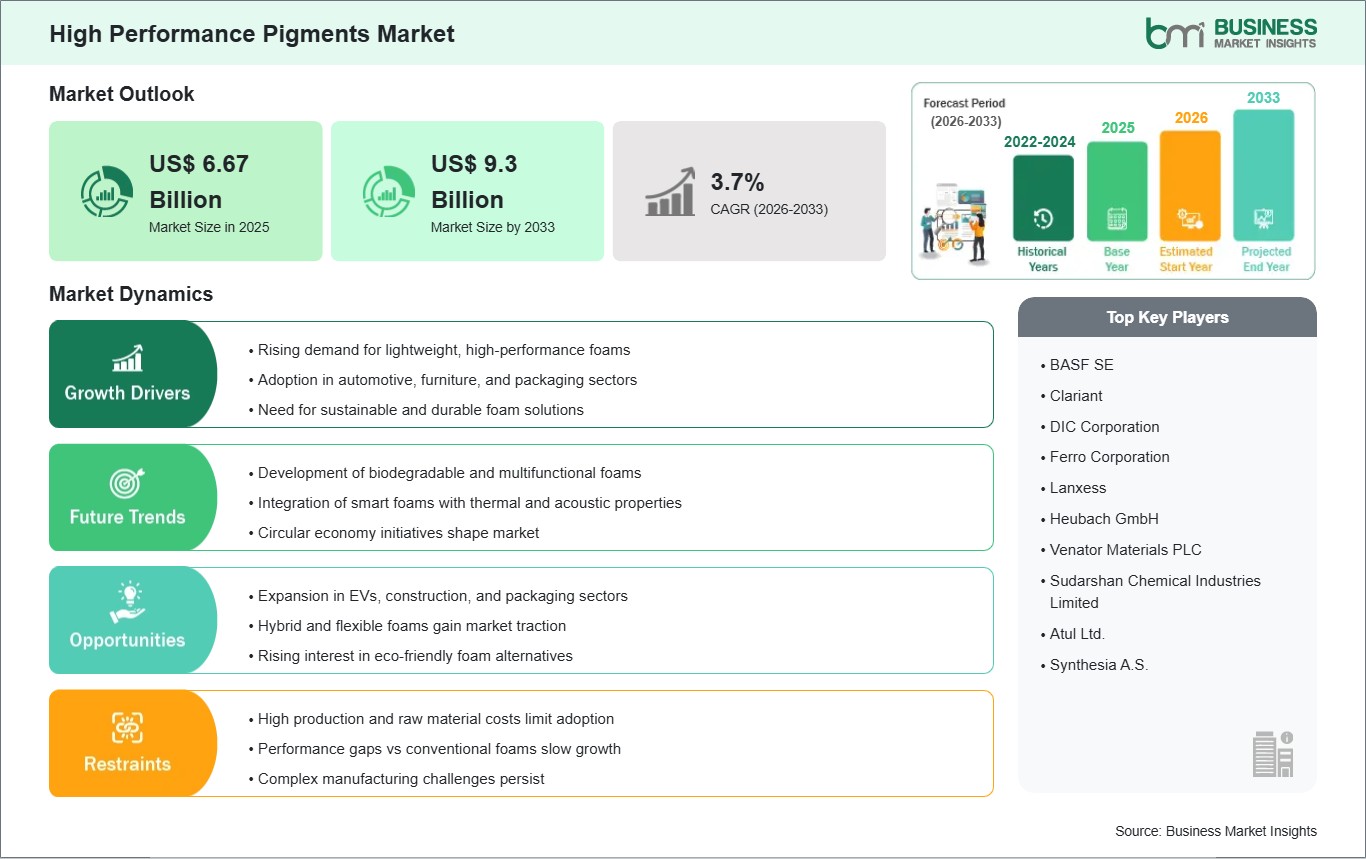
High Performance Pigments (HPPs) represent a specialized class of colorants engineered to provide superior durability, heat stability, and chemical resistance compared to conventional organic and inorganic pigments. These materials are indispensable in environments where extreme lightfastness and weatherability are required, such as in high-end automotive finishes, industrial protective coatings, and outdoor plastics. Unlike standard pigments, HPPs maintain their color integrity and gloss under intense UV exposure and thermal stress, making them the primary choice for mission-critical aesthetic and functional applications. The market is currently driven by the rapid global shift toward high-quality aesthetic finishes in the automotive sector and the rising demand for long-lasting architectural materials in modern urban infrastructure.
However, the market faces significant restraints, primarily stemming from the high manufacturing complexity and the steep cost of specialized raw materials. The synthesis of HPPs often involves multi-step chemical processes that are energy-intensive and require stringent quality control to ensure batch-to-batch consistency. Furthermore, increasing regulatory scrutiny under frameworks like REACH and the EPA regarding the use of heavy metals and hazardous solvents adds a layer of compliance cost and technical difficulty for manufacturers. These economic and regulatory hurdles can limit the adoption of HPPs in price-sensitive segments, where lower-cost alternatives are often prioritized despite their inferior performance profiles.
Despite these challenges, lucrative opportunities remain prevalent, particularly in the development of sustainable and bio-based pigment formulations. As global industries pivot toward a circular economy, there is a surging demand for "green" HPPs that offer a reduced carbon footprint without compromising on performance. Additionally, the integration of HPPs into smart coatings, capable of reflecting near-infrared (NIR) light to manage solar heat or providing antimicrobial properties, opens new growth avenues in the aerospace, construction, and healthcare sectors. The ongoing digitalization of color matching and the expansion of the electric vehicle (EV) market also provide a fertile ground for manufacturers to introduce innovative, application-specific pigment solutions that align with the next generation of high-tech industrial requirements.
Segment Analysis
High Performance Pigments Market Segmentation
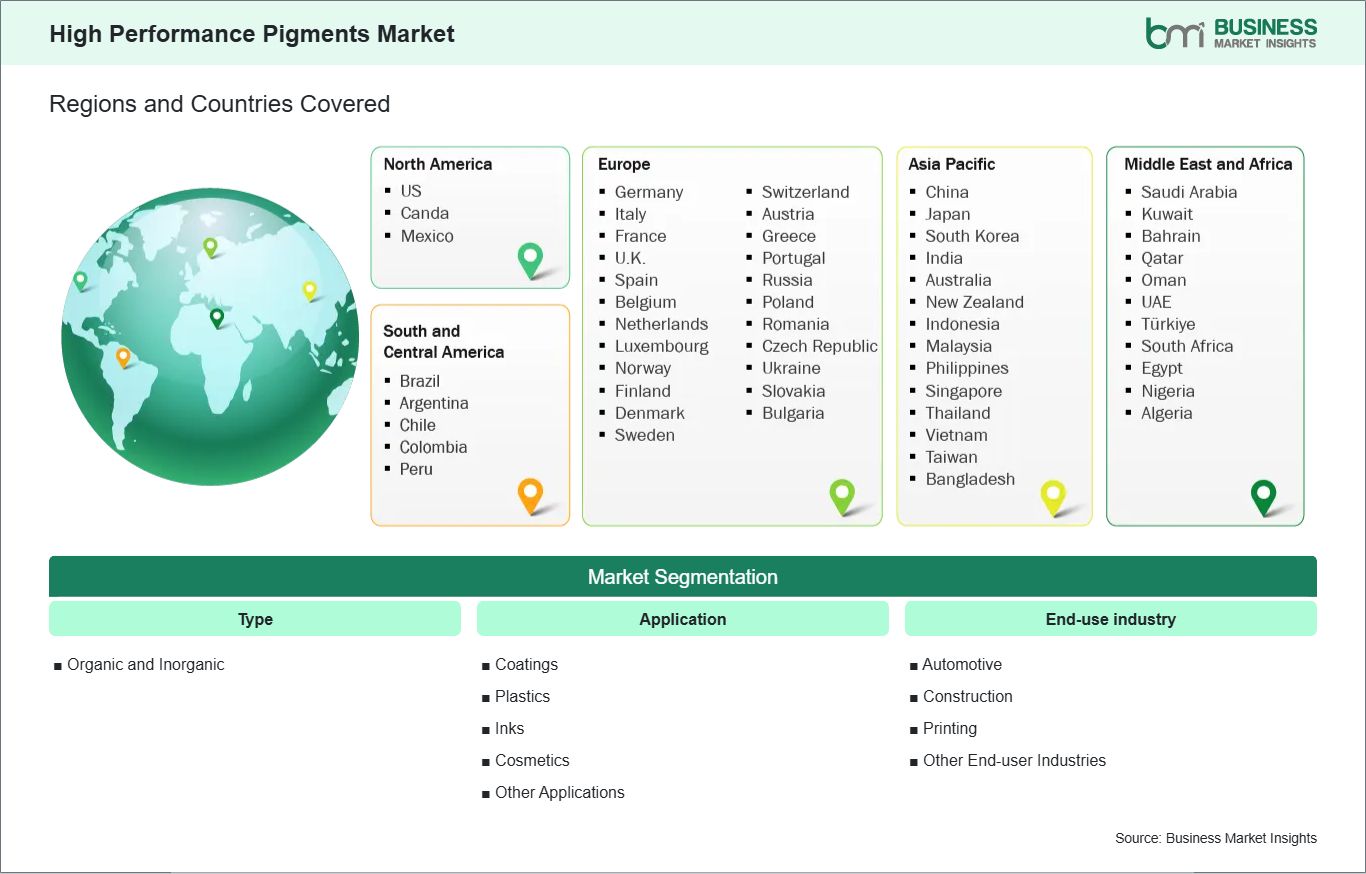
Key segments that contributed to the derivation of the High Performance Pigments market analysis are type, application, and end-use industry.
- By Type, the market is segmented into Organic and Inorganic.
- By Application, the market is divided into Coatings, Plastics, Inks, Cosmetics, and Others.
- By End-use industry, the market is categorized into Automotive, Construction, Printing, and Others.
Market Forces
High Performance Pigments Market Drivers and Opportunities
Surge in Automotive OEM Demand for Advanced Color Aesthetic
The global automotive Original Equipment Manufacturer (OEM) sector serves as a primary driver for the high-performance pigments market, dictated by the increasing consumer appetite for premium finishes and the technical demands of next-generation vehicle architectures. As automotive designs evolve toward electric and autonomous platforms, branding is increasingly tied to "signature" colors, high-chroma reds, deep blues, and sophisticated metallic pearls that require pigments with exceptional tinting strength and saturation. Unlike standard colorants, HPPs such as quinacridones and perylenes provide the necessary chemical resistance to withstand environmental pollutants and the thermal stability required for high-temperature curing processes in modern paint shops.
Furthermore, the rise of Advanced Driver Assistance Systems (ADAS) has transformed exterior coatings from purely aesthetic layers into functional components. New HPP formulations are being engineered to be "radar-transparent" or "LiDAR-reflective," ensuring that the dark or metallic pigments used on a vehicle's body do not interfere with the sensors used for autonomous navigation. This convergence of high-end aesthetics and sensor-compatibility necessitates a shift toward advanced inorganic and organic pigments that maintain color integrity under intense UV exposure without degrading the vehicle's safety hardware. Consequently, OEMs are intensifying their partnerships with pigment manufacturers to develop proprietary, high-performance coating systems that offer both a competitive visual edge and long-term structural durability.
Expansion into Sustainable and Bio-Based Pigment Technologies
The transition toward a circular economy represents the most significant growth opportunity for the high-performance pigments industry, driven by global regulatory shifts and the "green chemistry" movement. Traditional pigment manufacturing often relies on petroleum-based feedstocks and heavy metals like cadmium or lead, which face increasing restrictions under frameworks such as the EU's REACH and the US EPA's TSCA. This has created a lucrative opening for bio-based HPPs derived from renewable biomass, agricultural waste, or microbial fermentation. These sustainable alternatives are designed to offer a "drop-in" replacement for synthetic pigments, matching their performance in terms of lightfastness and heat stability while significantly reducing the overall carbon footprint of the end-product.
Innovation in this space is particularly robust within the packaging and consumer electronics sectors, where brands are eager to market VOC-free and biodegradable products to eco-conscious consumers. For example, recent breakthroughs in "carbon black" alternatives derived from wood waste (bio-char) allow manufacturers to achieve deep, high-performance blacks without the environmental cost of traditional furnace-black production. Additionally, the integration of bio-pigments into waterborne coating systems, which are naturally lower in solvent content, positions HPP manufacturers to lead the industry's shift away from hazardous chemical dependencies. As production scales and the cost-parity with synthetic HPPs improves by 2033, companies that have invested in bio-based IP will be uniquely positioned to capture market share in a regulatory landscape that increasingly penalizes carbon-intensive materials.
Size and Share Analysis
High Performance Pigments Market Size and Share Analysis
The High Performance Pigments market demonstrates steady growth, with size and share analysis revealing evolving trends and competitive positioning among key players. The report further examines subsegments categorized within type, application, and end-use industry, offering insights into their contribution to overall market performance.
Within the type category, the organic sub-segment is gaining substantial traction due to its vibrant hue ranges and superior tinting strength, which are highly valued in the decorative and automotive sectors.
Regarding applications, the coatings sub-segment continues to represent the most significant portion of the market, fueled by the necessity for weather-resistant finishes in high-rise architectural projects.
In terms of end-use industry, the automotive sub-sector remains a dominant force as manufacturers increasingly adopt high-performance effect pigments to enhance vehicle aesthetics and durability, ensuring that the market for specialized colorants remains resilient amid broader industrial shifts toward high-tech and sustainable mobility.
Report Coverage
High Performance Pigments Market Report Coverage and Deliverables
The "High Performance Pigments Market Size and Forecast (2022 - 2033)" report provides a detailed analysis of the market covering below areas:
- High Performance Pigments market size and forecast at global, regional, and country levels for all the key market segments covered under the scope
- High Performance Pigments market trends, as well as market dynamics such as drivers, restraints, and key opportunities
- High Performance Pigments market analysis covering key market trends, global and regional framework, major players, regulations, and recent market developments
- Industry landscape and competition analysis covering market concentration, heat map analysis, prominent players, and recent developments for the High Performance Pigments market
- Detailed company profiles, including SWOT analysis
Geographic Insights
High Performance Pigments Market Geographic Insights
The geographical scope of the High Performance Pigments market report is divided into five regions: North America, Asia Pacific, Europe, the Middle East &Africa, and South &Central America.
In North America, market activity is driven by a sophisticated industrial base where high-speed signal integrity and extreme environmental resilience are paramount for aerospace, defense, and premium automotive sectors. The regional focus remains on the integration of smart pigments that complement advanced sensor technologies and autonomous vehicle hardware. Europe maintains its position as a global leader in regulatory excellence and green chemistry, where stringent environmental mandates and a profound shift toward sustainable, non-toxic pigment formulations for high-end architectural and automotive finishes shape the market. This commitment to eco-friendly innovation aligns with a broad regional preference for high-fidelity, light-stable materials that meet long-term sustainability goals.
The Asia Pacific region serves as a central engine for the market, characterized by rapid urbanization and a robust manufacturing ecosystem that necessitates large-scale consumption of durable colorants across the construction and electronics industries. Regional development is fueled by the expansion of automotive production hubs and an increasing focus on upgrading local manufacturing capabilities to produce higher-value, application-specific pigments. In the Middle East &Africa, the market is expanding through massive infrastructure investments and smart city initiatives that require pigments capable of withstanding intense thermal stress and solar radiation. Meanwhile, South &Central America are witnessing steady progress as regional industrial sectors modernize, driving the adoption of high-performance finishes to enhance the quality and lifespan of domestic consumer goods and industrial equipment. This diversified growth ensures a resilient global market as regions align their digital and industrial frameworks with high-performance standards.
Industry Activity
Recent Developments
The High Performance Pigments market is evaluated by gathering qualitative and quantitative data post primary and secondary research, which includes important corporate publications, association data, and databases. A few of the key developments in the High Performance Pigments market are:
- In November 2025, DIC Corporation and its subsidiary Sun Chemical introduced several world premieres within their High Performance Pigments portfolio at CHINACOAT 2025. Among the highlights, they debuted the Paliocrom Brilliant Ruby L 3558, an intense bluish-red aluminum effect pigment specifically engineered for modern automotive and industrial coatings.
- In November 2025, BASF officially commissioned its new high-performance dispersant production line at the Jiangbei New Material Technology Park in Nanjing, China. This strategic investment enabled the local manufacturing of advanced dispersants utilizing Controlled Free Radical Polymerization (CFRP) technology, which significantly improved the dispersion and stability of High Performance Pigments in industrial and automotive coatings. The resulting increase in global capacity bolstered supply reliability and flexibility, complementing the company's existing operations at its site in Heerenveen, the Netherlands.
Trust & Transparency
Research Methodology
The market analysis combines proprietary research with secondary data from government agencies, company disclosures, regulatory filings, industry databases and expert interviews. Market estimates are validated through data triangulation, cross-market benchmarking and analyst
review.
View Full Research Methodology
Key Sources Referred:
World Bank - Global Trade IndicatorsWorld Trade Organization (WTO)International Monetary Fund (IMF)International Trade Administration (ITA)Company websiteCompany annual reportsCompany investor presentations