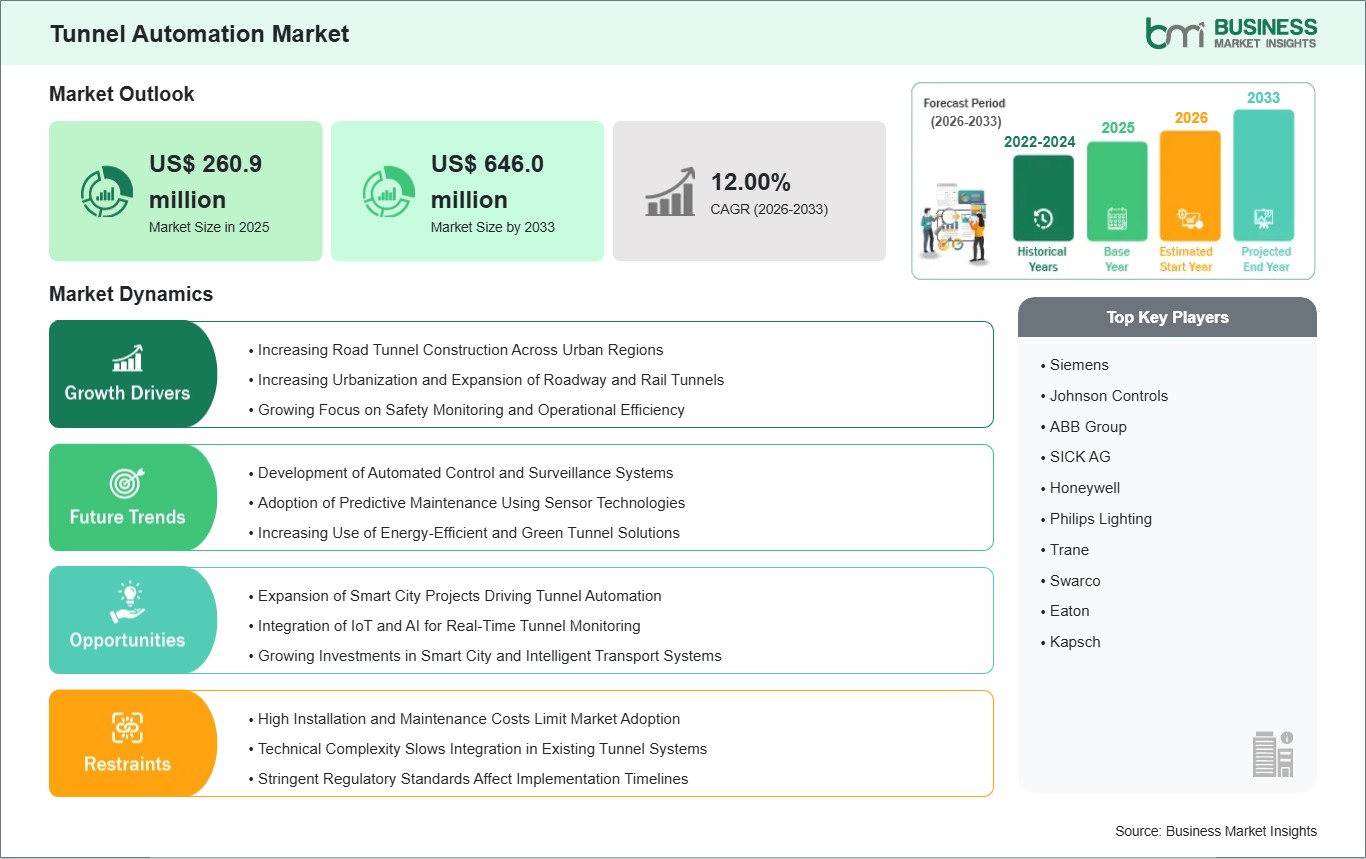
The Tunnel Automation Market size is expected to reach US$ 646. million by 2033 from US$ 260.9 million in 2025. The market is estimated to record a CAGR of 12.00% from 2026 to 2033.
The global tunnel automation market is growing at a rapid rate. Tunnel automation involves the use of ventilation systems, lighting systems, traffic management systems, environmental monitoring systems, and emergency response systems. Tunnel automation systems play a vital role in improving the efficiency of tunnel systems while maintaining their safety. Tunnel systems can benefit from reduced human error, faster response times in case of emergencies, and real-time analytics. Some of the major drivers of the tunnel automation market include the increasing investments made by governments in smart transportation systems and smart urban mobility systems. Another driver of the tunnel automation market includes the increasing focus on smart cities across the globe.
Tunnel automation systems can benefit from the use of IoT technology, artificial intelligence technology, and SCADA technology. Tunnel systems can benefit from the use of integrated tunnel automation systems that can help in improving the efficiency of tunnel systems. Some of the challenges faced by the tunnel automation market include the high cost of tunnel automation systems. Integrating new systems with older tunnels often requires careful planning and specialized skills, which creates additional hurdles. Workforce training and system management also add to operational complexity. Still, the increasing emphasis on infrastructure modernization, technological progress, and better urban mobility keeps the demand for tunnel automation strong. This positions the market for long-term growth and supports safer, more efficient, and more reliable underground transportation worldwide. However, it is important to note that integrating new systems into older tunnels often requires planning and skills, which are additional challenges. Training the workforce and managing systems is another factor that adds to the complexities.
Despite all these, the focus on infrastructure upgrade, technology, and urban mobility is increasing, which keeps the tunnel automation market in high demand for long-term growth.

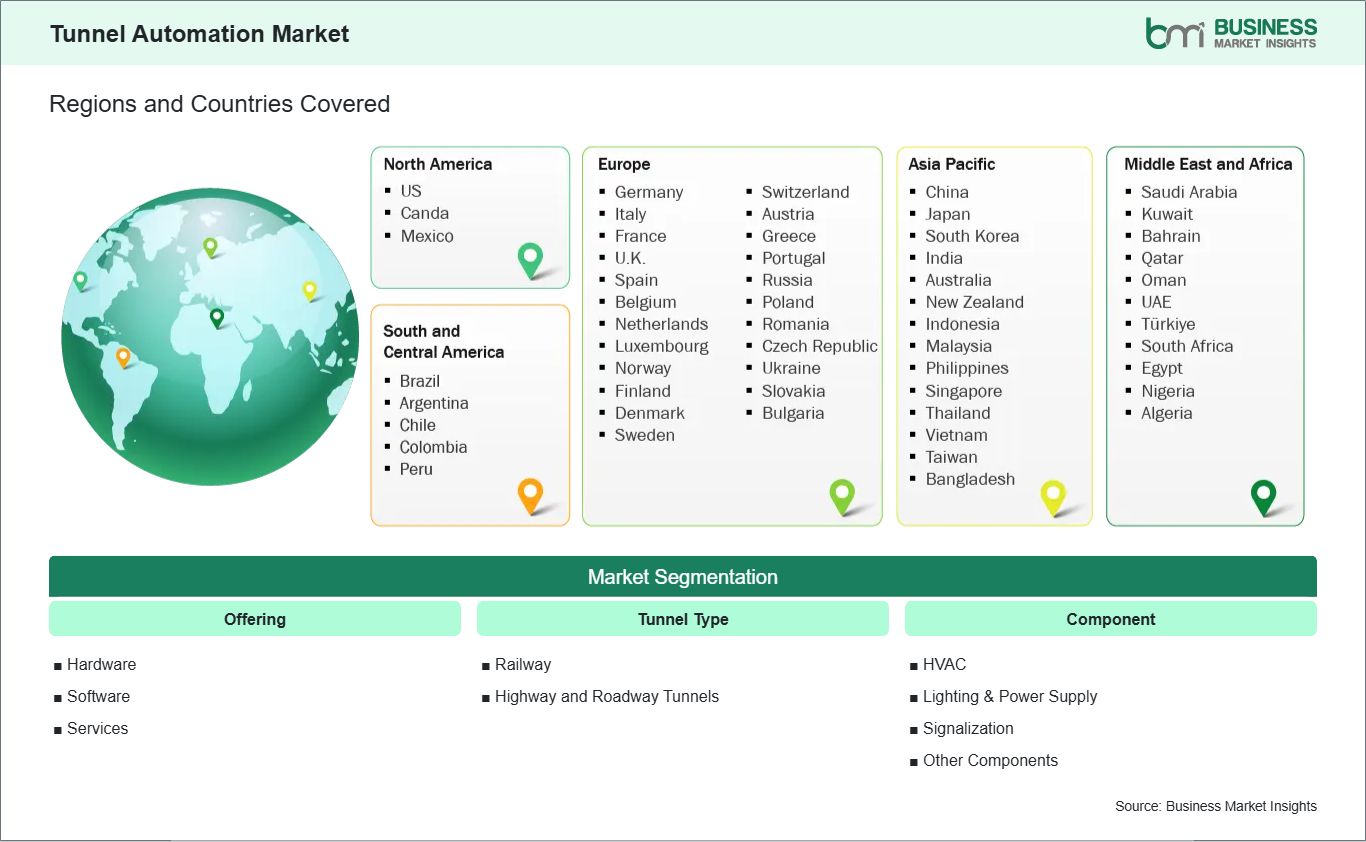
Key segments that contributed to the derivation of the tunnel automation market analysis are offering, tunnel type and component.
The development of road tunnel infrastructure across the globe is emerging as a key driver in the tunnel automation market. It is a general phenomenon that cities across the globe face issues like traffic congestion and increasing population. To mitigate this, cities have to develop underground transport corridors to ensure efficient movement of people. In the present-day world, road tunnel development requires the application of tunnel automation technology.
Tunnel automation technology includes various systems like ventilation, lighting, traffic management, and emergency response systems. These systems play a vital role in maintaining the efficiency of road tunnel systems. By adopting tunnel automation technology, authorities can ensure smooth operation of road tunnel systems, thereby increasing their efficiency and reducing downtime. In countries like China and India, major highway tunnel development projects are underway to ensure efficient connectivity between cities.
In Europe, countries like Switzerland and Norway are expanding their tunnel systems to overcome geographical barriers. These efforts are creating a strong market for integrated tunnel automation solutions that are able to support complex operations and various environmental conditions. In addition to new construction, upgrading existing tunnels is also playing a significant role in driving market growth. Many older tunnels in Europe and North America are being equipped with smart control systems, environmental monitoring systems, and automated safety systems to meet new regulatory requirements. Modern SCADA systems and real-time monitoring systems are helping operators quickly respond to incidents and respond effectively. As global tunnel infrastructure continues to grow, automation technologies are becoming increasingly important for supporting safe, reliable, and efficient urban transportation systems.
Smart city development initiatives in different regions of the world are providing tunnel automation with considerable growth opportunities. This is because cities are increasingly incorporating intelligent transportation systems into their digital landscape, with tunnels being an essential part of this. Tunnel automation enables cities to control tunnel ventilation, lighting, emergency services, and traffic management from a central location. This has helped cities to enhance their efficiency, commuter safety, and reduce congestion.
Cities in regions like Asia Pacific, the Middle East, and Europe are leaders in smart city development. Cities like Singapore, Seoul, and Dubai have implemented intelligent traffic management systems, which include data from intelligent tunnels. This has helped cities to enhance their efficiency, commuter safety, and reduce congestion. This has helped cities to enhance their efficiency, commuter safety, and reduce congestion. By integrating tunnel automation with intelligent transportation systems, cities can enhance commuter safety, efficiency, and reduce congestion.
In addition, smart city development frameworks are encouraging the development of fully integrated control centers that can connect tunnels with highway, bridge, and public transportation systems. These platforms help operators manage traffic flow, identify incidents, and respond to emergencies in a timely manner. Technologies like AI-based predictive maintenance and data analytics are being used to minimize downtime and improve reliability. As more and more cities around the world become smarter, tunnel automation is likely to play a significant role in developing safer, more efficient, and connected transport networks

The tunnel automation market demonstrates steady growth, with size and share analysis highlighting evolving trends and competitive dynamics among key players. The report examines subsegments categorized within offering, tunnel type and component, offering insights into their contribution to overall market performance.
By offering, the hardware subsegment dominated the market in 2025, driven by extensive deployment of physical tunnel automation components such as sensors, ventilation systems, lighting systems, and control equipment required for tunnel safety and operations.
Based on tunnel type, the railway subsegment dominated the market in 2025, driven by growing investments in metro systems, high-speed rail networks, and expanding railway tunnel infrastructure worldwide.
In terms of component, the other components subsegment dominated the market in 2025, driven by the critical role of supporting systems such as fire detection, traffic management, and monitoring systems in ensuring tunnel safety and operational efficiency.
| Report Attribute | Details |
|---|---|
| Market size in 2025 | US$ 260.9 million |
| Market Size by 2033 | US$ 646.0 million |
| Global CAGR (2026 - 2033) | 12.00% |
| Historical Data | 2022-2024 |
| Forecast period | 2026-2033 |
| Segments Covered | By Offering
|
|
Regions and Countries Covered
| |
| North America | US, Canada, Mexico |
| Europe | Belgium, Austria, Finland, Denmark, Greece, Poland, Romania, Russia, Ukraine, Czech Republic, Slovakia, Bulgaria, Italy, Luxembourg, Germany, Switzerland, France, Netherlands, Norway, Portugal, Spain, Sweden, United Kingdom |
| Asia-Pacific | Australia, China, India, Japan, South Korea, Indonesia, Malaysia, Philippines, Singapore, Thailand, Vietnam, Bangladesh, New Zealand, Taiwan |
| South and Central America | Brazil, Argentina, Peru, Chile, Colombia |
| Middle East and Africa | Bahrain, Kuwait, Oman, Qatar, Saudi Arabia, United Arab Emirates, Turkiye, South Africa, Egypt, Algeria, Nigeria |
| Market leaders and key company profiles |
|
The "Tunnel Automation Market Size and Forecast (2022 - 2033)" report provides a detailed analysis of the market covering below areas:
The geographical scope of the Tunnel Automation Market report is divided into North America, Asia Pacific, Europe, Middle East & Africa, and South & Central America. North America held the largest share in 2025.
North America holds the highest market share in the global tunnel automation market. This can be attributed to the high level of development in their transport infrastructure, high levels of investments in intelligent transport systems, and stringent regulations concerning tunnel efficiency and safety. For example, the US and Canada have a high number of tunnel systems. These systems have been at the forefront in adopting high levels of tunnel automation technology. Additionally, the countries have invested heavily in artificial intelligence-based monitoring systems. This makes North America a leading market in tunnel automation.
Europe is also a key market in the tunnel automation industry. This can be attributed to countries such as Germany, Switzerland, and Norway. These countries have high levels of tunnel systems. For example, Germany and Switzerland have high levels of tunnel systems in their cities. Additionally, Norway has high levels of tunnel systems in mountainous regions. In Europe, tunnel automation technology uptake is highly dependent on stringent regulations concerning tunnel efficiency and safety. The need to achieve high operational standards and extend the lifespan of existing tunnel infrastructure continues to drive automation investments in the continent.
Asia Pacific is experiencing rapid growth due to urbanization, increasing metro and highway tunnel projects, and smart city initiatives taken by China, India, Japan, and South Korea. There is increased adoption of integrated automation systems to manage traffic flow, monitor air quality, and achieve predictive maintenance. This is because the region is focusing on developing intelligent, safe, and sustainable transport infrastructure.
The Middle East and Africa regions are gradually adopting tunnel automation technology, particularly in the UAE, Saudi Arabia, and South Africa. Urbanization and modernization of infrastructure require efficiency and safety in these regions. South and Central America is another developing market. Countries such as Brazil, Chile, and Colombia are incorporating automation in highway tunnels as well as metro systems to improve safety, minimize congestion, and improve maintenance in difficult terrains.
Overall, while North America retains its position as market leader due to technology and infrastructure development, other regions are making progress as tunnel development increases globally.

The Tunnel Automation Market is evaluated by gathering qualitative and quantitative data post primary and secondary research, which includes important corporate publications, association data, and databases. A few of the key developments in the tunnel automation market are:
The Tunnel Automation Market is valued at US$ 260.9 million in 2025, it is projected to reach US$ 646.0 million by 2033.
As per our report Tunnel Automation Market, the market size is valued at US$ 260.9 million in 2025, projecting it to reach US$ 646.0 million by 2033. This translates to a CAGR of approximately 12.00% during the forecast period.
The Tunnel Automation Market report typically cover these key segments-
The historic period, base year, and forecast period can vary slightly depending on the specific market research report. However, for the Tunnel Automation Market report:
The Tunnel Automation Market is populated by several key players, each contributing to its growth and innovation. Some of the major players include:
The Tunnel Automation Market report is valuable for diverse stakeholders, including:
Essentially, anyone involved in or considering involvement in the Tunnel Automation Market value chain can benefit from the information contained in a comprehensive market report.
Please tell us your area of interest
(Market Segments/ Regions and Countries/ Companies)