Market Summary
Executive Summary and Global Market Analysis
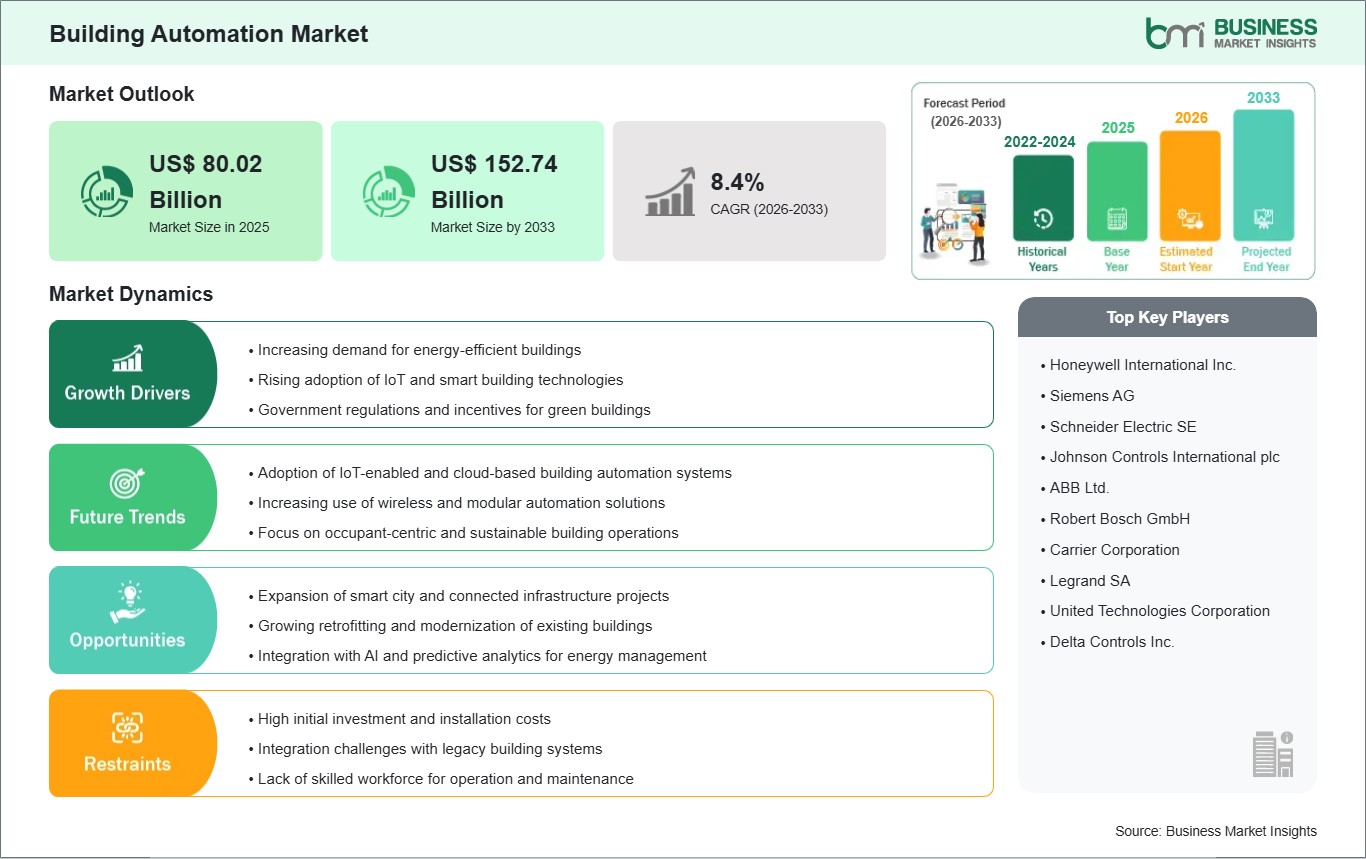
The Building Automation Market is essentially the worldwide industry that revolves around the creation, the development, and the application of the systems that handle and oversee in an automatic way the units of a building such as heating, ventilation, air conditioning (HVAC), lighting, security, and energy management without human interventions. These services endeavor to utilize the building at its best, to lower the energy consumption, to raise the comfort of the users, and to facilitate the deployment of eco, friendly and intelligent buildings. The increasing demand for energy-efficient, sustainable, and intelligent architecture combined with government regulations favoring automation, as well as the increasing implementation of the Internet of Things (IoT) in building automation systems, and the growing adoption of advanced analytics and artificial intelligence (AI) to optimize heating, ventilation, and air conditioning (HVAC), lighting systems, security and energy efficiency provide an expansive opportunity within the global building automation marketplace. The present market trends are focused on development of intelligent, interconnected buildings, predictive maintenance and automated energy management systems, which all offer greater operational efficiency, improved user experience, as well as a lower carbon footprint.
Segment Analysis
Building Automation Market Segmentation
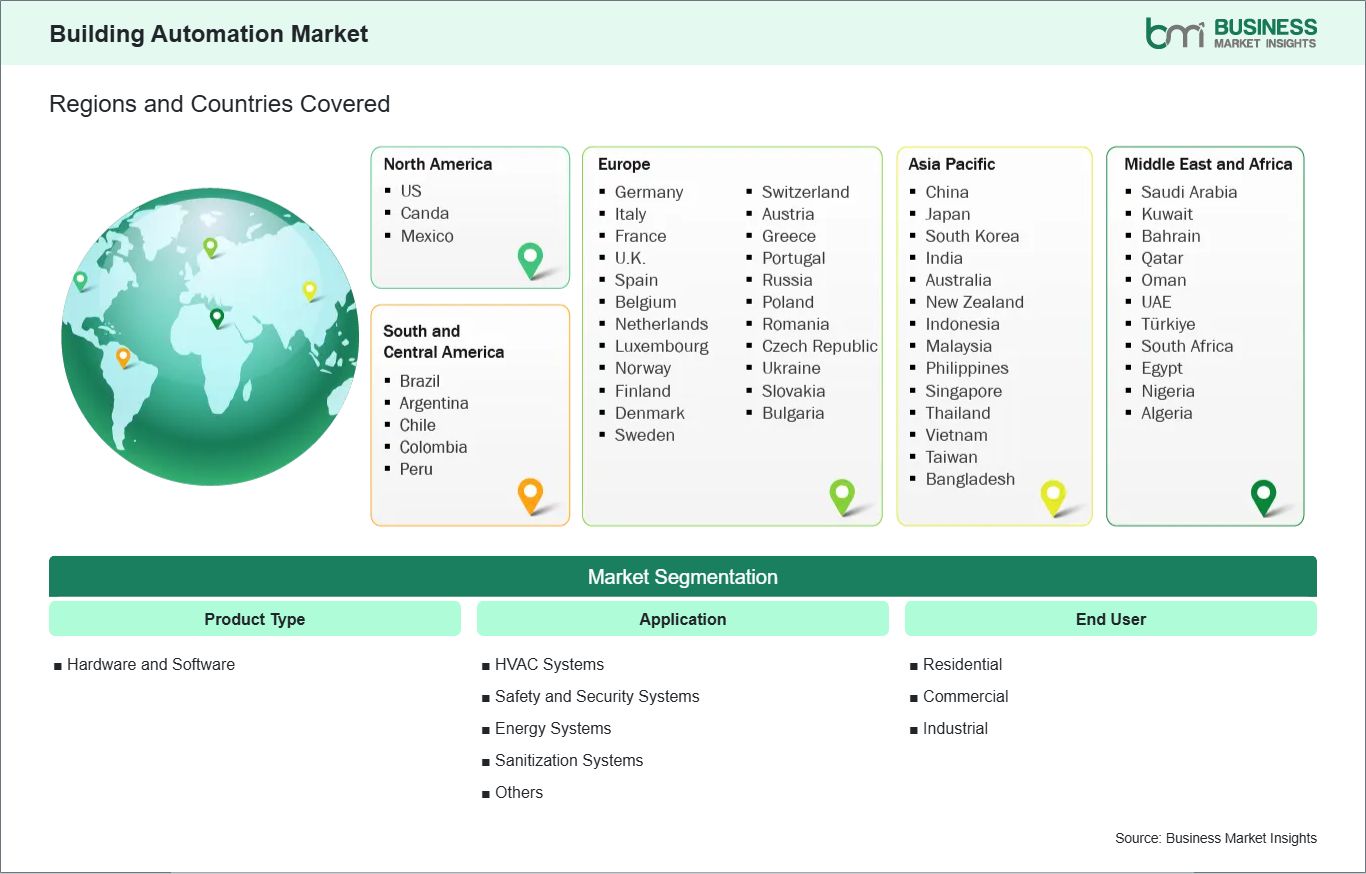
Key segments that contributed to the derivation of the Building Automation market analysis are product type , application, and end user.
- By product type, the Building Automation market is bifurcated into Hardware and Software. The hardware segment dominated the market in 2024.
- By application, the market is categorized into HVAC Systems, Safety and Security Systems, Energy Systems, Sanitization Systems, and Others. HVAC Systems held the largest share in 2024.
- By end user, the market is segmented into Residential, Commercial, and Industrial. The Residential accounted for the largest market share in 2024.
Market Forces
Building Automation Market Drivers and Opportunities
Increasing demand for energy-efficient buildings
The global building automation market has undergone a transformational transition characterized by major changes brought about by the emergence of smart building technologies as it embraces the integration of the Internet of Things (IoT), artificial intelligence (AI), big data analytics, cloud computing, and other innovative technologies to facilitate the automation, interconnectivity, and intelligent decision-making based on real-time data. The implementation of advanced building management systems provides operators with the ability to monitor and control their building environments in real-time through the deployment of intelligent sensors and controllers, capable of receiving instantaneous input from these devices regarding occupancy, energy usage, and environmental conditions throughout the facility.
Through collecting accurate operational data throughout the building lifecycle, facility managers can obtain real-time information regarding their systems performance, enabling them to effectively manage their assets (HVAC, lighting, and security) as well as enabling them to perform predictive maintenance which will help prevent system failure and minimize both the amount of downtime and associated costs incurred by maintaining the equipment.
Expansion of smart city and connected infrastructure projects
With the rising complexity of modern building operations, unscheduled equipment downtime has become a key business risk, affecting occupant comfort, operational efficiency, and energy costs. When combined with predictive maintenance technologies, Building Automation enables businesses to monitor equipment health in real time and discover early warning signals of probable breakdowns before they cause costly disruptions. Advances in AI-driven analytics, machine learning, and cloud computing allow predictive maintenance systems to evaluate massive volumes of operational data—from sensors, controllers, and building systems—and discover patterns, anomalies, and performance trends. This enables operators to schedule maintenance in advance rather than reactively, avoiding unexpected downtime, optimizing energy usage, and prolonging the lives of important assets.
Size and Share Analysis
Building Automation Market Size and Share Analysis
By product type, the Building Automation market is bifurcated into Hardware and Software. The hardware segment dominated in 2024, driven by widespread deployment of sensors, actuators, controllers, and gateways essential for real-time data capture and physical system integration across smart buildings. Software solutions, including building management platforms and analytics tools, complement hardware by enabling centralized control, visualization dashboards, and AI-driven optimization for energy management and occupant comfort.
By application, the market is categorized into HVAC Systems, Safety and Security Systems, Energy Systems, Sanitization Systems, and Others. HVAC Systems held the largest share in 2024, powering climate control, ventilation, and thermal regulation in commercial and residential spaces to achieve energy savings and indoor air quality standards. Safety and Security Systems integrate access control, surveillance, and fire detection; Energy Systems focus on metering and demand response; Sanitization Systems support air purification.
By end user, the market is segmented into Residential, Commercial, and Industrial. Residential accounted for the largest market share in 2024, fueled by smart home adoption through connected thermostats, lighting, and security devices that enhance convenience, security, and utility bill reductions. Commercial buildings leverage integrated platforms for multi-tenant management and sustainability compliance; Industrial facilities deploy ruggedized systems for process automation, facility monitoring, and compliance with operational safety standards.
Report Coverage
Building Automation Market Report Coverage and Deliverables
The Building Automation Market Size and Forecast (2022–2033) report provides a detailed analysis of the market covering below areas:
- Building Automation market size and forecast at global, regional, and country levels for all the key market segments covered under the scope
- Building Automation market trends, as well as market dynamics such as drivers, restraints, and key opportunities
- Building Automation market analysis covering key market trends, global and regional framework, major players, regulations, and recent market developments
- Industry landscape and competition analysis covering market concentration, heat map analysis, prominent players, and recent developments for the Building Automation market
- Detailed company profiles, including SWOT analysis
Geographic Insights
Building Automation Market Geographic Insights
The geographical scope of the Building Automation market report is divided into five regions: North America, Asia Pacific, Europe, Middle East & Africa, and South & Central America. The Building Automation market in Asia Pacific is expected to grow significantly during the forecast period.
The Asia Pacific Building Automation market includes key countries such as China, Japan, South Korea, India, Australia, New Zealand, Indonesia, Malaysia, the Philippines, Singapore, Thailand, Vietnam, Taiwan, Bangladesh, and the Rest of Asia. Growth in this region is supported by strong demand from commercial real estate, smart cities, residential developments, and infrastructure projects. Governments and enterprises across Asia Pacific are investing heavily in energy-efficient buildings, green construction standards, and integrated building management systems, all of which are driving Building Automation adoption.
China continues to dominate the regional Building Automation market due to its massive urbanization drive, large-scale commercial and residential construction, and strong government focus on carbon neutrality and smart infrastructure development. Japan and South Korea are leading adopters of advanced Building Automation solutions, leveraging their strong technological capabilities in IoT sensors, energy management, and AI optimization to improve building efficiency and occupant experience. Meanwhile, India is emerging as a high-growth market, supported by rapid urban expansion, green building certifications, and increasing adoption of smart systems across office complexes, hospitals, and high-rise residential towers.
Industry Activity
Recent Developments
The Building Automation market is evaluated by gathering qualitative and quantitative data post primary and secondary research, which includes important corporate publications, association data, and databases. A few of the key developments in the Building Automation market are:
- In June 2025, Honeywell announced the launch of Honeywell Connected Solutions, an AI-powered platform that integrates critical building software and technologies into a single interface to help enable more efficient operations.
- In August 2024, Accuenergy Inc. released the first models in its BAS instrument line, including pressure, relative humidity, and temperature sensors. The launch expands the company’s sensor portfolio for building automation and control.
Trust & Transparency
Research Methodology
The market analysis combines proprietary research with secondary data from government agencies, company disclosures, regulatory filings, industry databases and expert interviews. Market estimates are validated through data triangulation, cross-market benchmarking and analyst
review.
View Full Research Methodology
Key Sources Referred:
World Green Building Council (WorldGBC) – Smart Building Reports
International Energy Agency (IEA)
Company website
Company annual reports
Company investor presentations