Market Summary
Executive Summary and Global Market Analysis
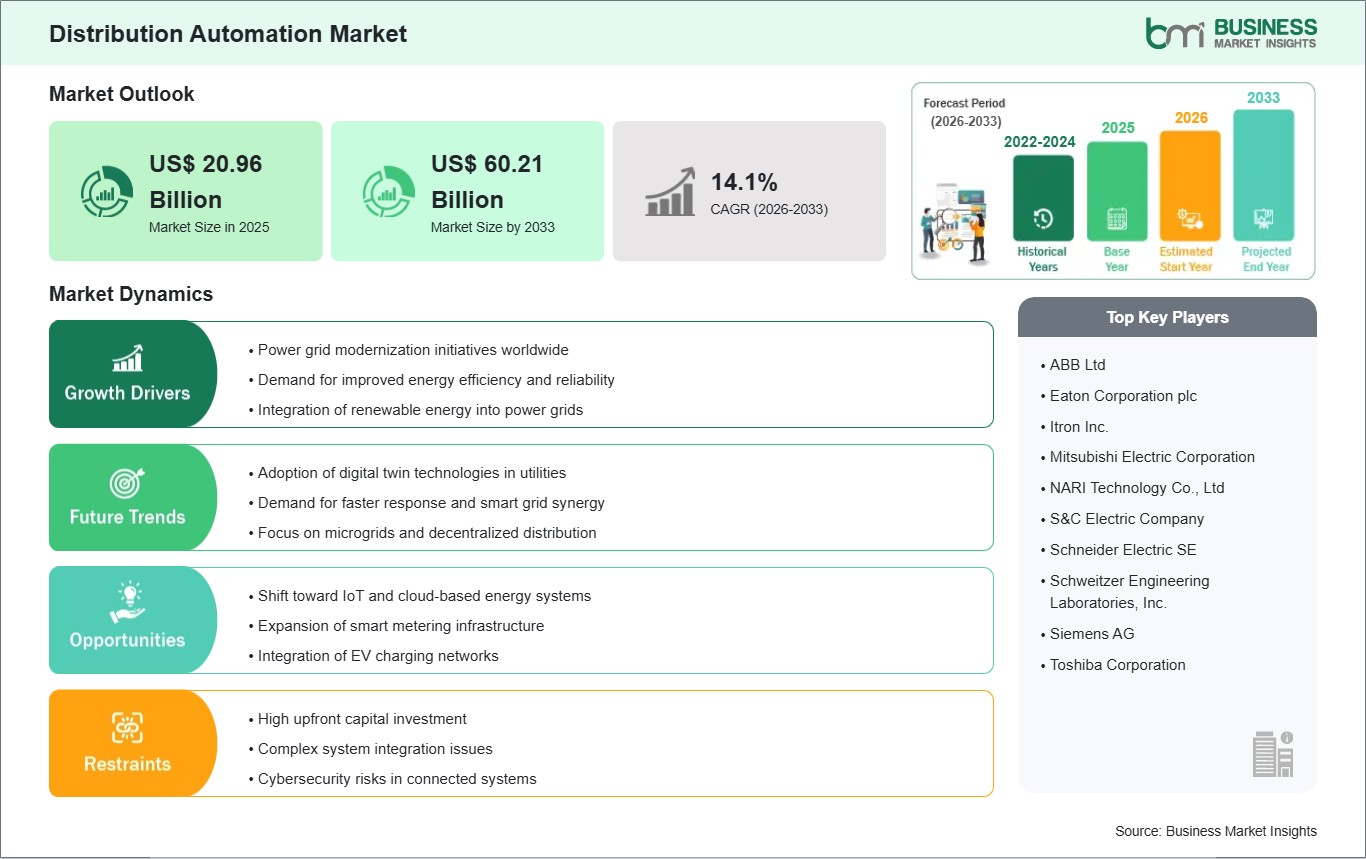
Distribution automation refers to the use of advanced technologies and control systems to monitor, control, and optimize the electrical power distribution network. It enables utilities to detect faults, manage voltage, and restore power remotely, improving reliability, efficiency, and safety. The usage of distribution automation spans smart grids, real-time monitoring, remote switching, and automated outage management, allowing operators to respond quickly to changes in load and minimize downtime. Several demand factors are driving the growth of the distribution automation market. Increasing electricity consumption, the integration of renewable energy sources, and the need for reliable and resilient power supply are primary contributors. Additionally, regulatory support for smart grid initiatives, rising urbanization, and technological advancements in sensors, communication networks, and intelligent electronic devices are accelerating adoption. As utilities seek to reduce operational costs while enhancing energy efficiency, the distribution automation market is poised for substantial growth globally.
Segment Analysis
Distribution Automation Market Segmentation
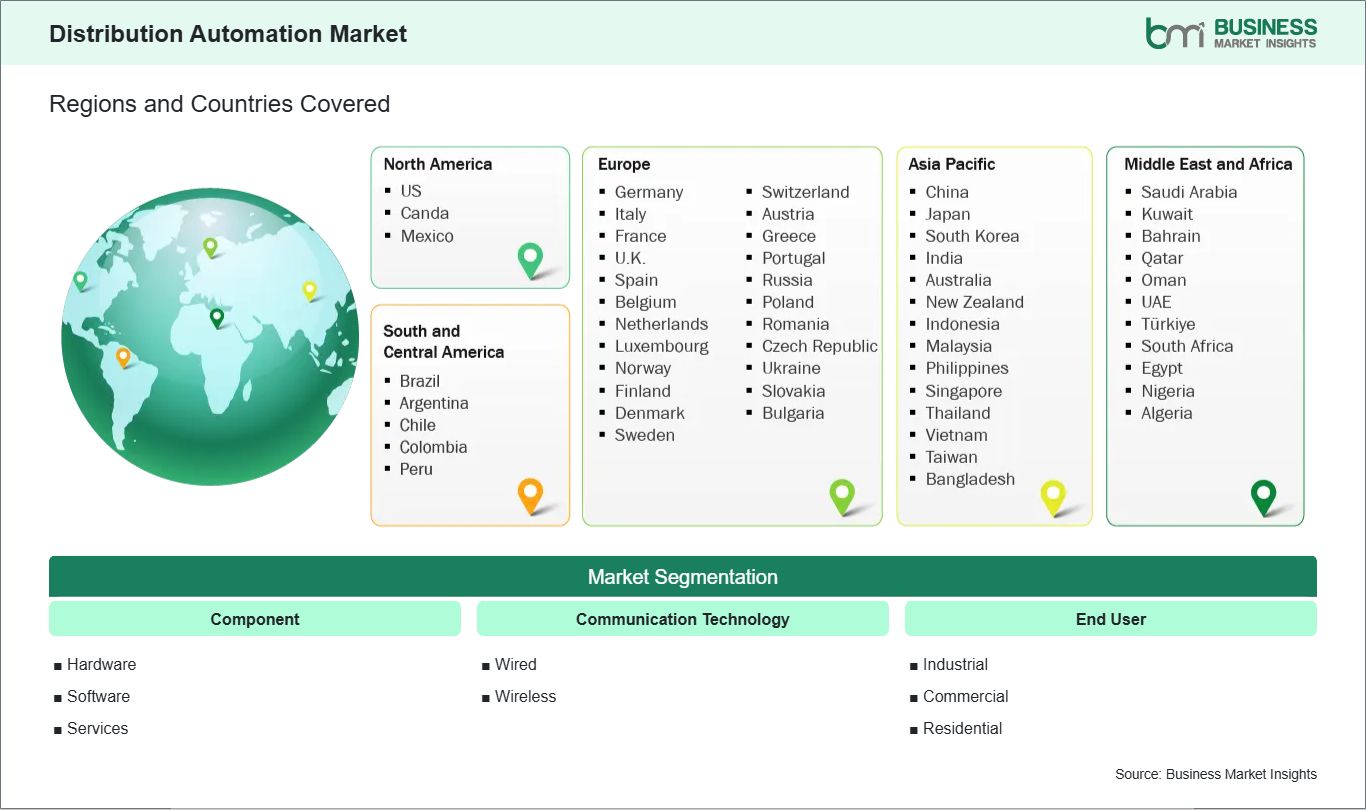
Key segments that contributed to the derivation of the distribution automation market analysis are component, communication technology, and end user.
- By component, the market is segmented into hardware, software, and services. The hardware held the largest share of the market in 2025.
- By communication technology, the market is segmented into wired and wireless. The wired segment held the largest share of the market in 2025.
- By end user, the market is segmented into industrial, commercial, and residential. The industrial segment held the largest share of the market in 2025.
Market Forces
Distribution Automation Market Drivers and Opportunities
Grid Modernization Initiatives
The global push for grid modernization initiatives is primarily driven by the increasing demand for smart grids and upgraded electrical infrastructure, which are essential to support rising electricity consumption, renewable energy integration, and urbanization. Key driver factors include the need for enhanced grid reliability, real-time monitoring, and efficient energy management, enabling utilities to respond rapidly to outages and optimize power flow. Regulatory policies and government incentives promoting sustainable energy and decarbonization also accelerate investment in advanced grid technologies. Moreover, the proliferation of distributed energy resources, electric vehicles, and IoT-enabled devices necessitates more intelligent and automated distribution networks. These factors collectively drive the distribution automation market, as utilities adopt advanced sensors, automated switches, and communication systems to improve operational efficiency, reduce losses, and enhance customer service. The convergence of technological innovation, regulatory support, and evolving energy demand ensures sustained growth in smart grid and distribution automation deployment worldwide.
Shift Towards IoT and Cloud-Based Solutions
The shift towards IoT and cloud-based solutions is a key driver in the distribution automation (DA) market, enabling utilities to achieve real-time monitoring, predictive maintenance, and enhanced operational efficiency. IoT-enabled DA systems integrate sensors and smart devices across the distribution network, providing continuous data on equipment performance, energy consumption, and grid conditions. Coupled with cloud-based platforms, this data can be analyzed remotely, offering actionable insights, faster fault detection, and improved decision-making. This transformation not only reduces downtime and operational costs but also supports scalable and flexible grid management. The adoption of these technologies creates significant opportunities in the DA market, as utility companies increasingly invest in smart infrastructure, software platforms, and cybersecurity solutions to manage cloud-connected networks. Vendors offering IoT devices, analytics tools, and integrated cloud services are thus well-positioned to capitalize on this growing demand for intelligent, connected, and automated distribution networks.
Size and Share Analysis
Distribution Automation Market Size and Share Analysis
By component, the market is segmented into hardware, software, and services. The hardware segment held the largest share of the market in 2025, due to increasing grid modernization, rising demand for reliable electricity, integration of renewable energy, enhanced real-time monitoring, improved fault detection, and regulatory incentives promoting efficient, resilient, and intelligent power distribution systems.
By communication technology, the market is segmented into wired and wireless. The wired segment held the largest share of the market in 2025, driven by their enhanced reliability, high-speed data transmission, robust security, reduced interference, and seamless integration with legacy infrastructure, enabling utilities to optimize grid efficiency, monitor real-time performance, and ensure stable power delivery.
By end user, the market is segmented industrial, commercial, and residential. The industrial segment held the largest share of the market in 2025. Distribution automation in the industrial sector enhances operational efficiency, reduces downtime, enables real-time monitoring, optimizes energy usage, improves reliability, lowers maintenance costs, facilitates predictive maintenance, and strengthens safety, ultimately boosting productivity, cost-effectiveness, and overall competitiveness in industrial operations.
Report Coverage
Distribution Automation Market Report Coverage and Deliverables
The "Distribution Automation Market Size and Forecast (2022 - 2033)" report provides a detailed analysis of the market covering below areas:
- Distribution automation market size and forecast at global, regional, and country levels for all the key market segments covered under the scope
- Distribution automation market trends, as well as market dynamics such as drivers, restraints, and key opportunities
- Distribution automation market analysis covering key market trends, global and regional framework, major players, regulations, and recent market developments
- Industry landscape and competition analysis covering market concentration, heat map analysis, prominent players, and recent developments for the air circuit breaker market
- Detailed company profiles, including SWOT analysis
Geographic Insights
Distribution Automation Market Geographic Insights
The geographical scope of the distribution automation market report is divided into five regions: North America, Asia Pacific, Europe, Middle East & Africa, and South & Central America. The distribution automation market in North America is expected to grow significantly during the forecast period.
The North America distribution automation market is segmented into US, Canada, and Mexico. The adoption of distribution automation in North America is primarily driven by the need for enhanced grid reliability, operational efficiency, and integration of renewable energy sources. Utilities are increasingly investing in DA technologies, such as smart switches, sensors, and automated reclosers, to reduce outage durations and improve system resiliency. Regulatory pressures and incentives from bodies like the North American Electric Reliability Corporation (NERC) further encourage utilities to modernize their networks. Growing consumer demand for reliable electricity and real-time monitoring of power quality also motivates deployment. Additionally, the rising integration of distributed energy resources, including solar and battery storage, requires advanced control and communication systems, which DA provides. Economic considerations, such as reduced operational costs and deferred infrastructure investments, make automation attractive. Advances in digital technologies, including artificial intelligence and IoT-enabled monitoring, also facilitate decision-making and predictive maintenance, accelerating adoption across North American distribution networks.
Industry Activity
Recent Developments
The distribution automation market is evaluated by gathering qualitative and quantitative data post primary and secondary research, which includes important corporate publications, association data, and databases. A few of the key developments in the distribution automation market are:
- In May 2025, Toshiba International Corporation (TIC) announced the launch of the Toshiba 3000 SP (single phase) Series Uninterruptible Power System (UPS). The 3000 SP Series UPS offers unparalleled reliability and efficiency for mission-critical applications, making it ideal for edge data centers, enterprise IT systems, and commercial/retail markets. The system supports N+X redundancy, enabling continued operation during a component failure.
- In February 2025, Schneider Electric SE reaffirmed its commitment to accelerate its contribution to India`s growth ambitions at ELECRAMA 2025, the largest electrical show in the world. The company showcased a comprehensive range of electrical and automation products and solutions to accelerate India`s energy transition and empower customers across industries, infrastructure, data centers, buildings, and homes to accelerate their digitization and sustainability journey.
Trust & Transparency
Research Methodology
The market analysis combines proprietary research with secondary data from government agencies, company disclosures, regulatory filings, industry databases and expert interviews. Market estimates are validated through data triangulation, cross-market benchmarking and analyst
review.
View Full Research Methodology
Key Sources Referred:
World Bank - Global Trade IndicatorsWorld Trade Organization (WTO)International Monetary Fund (IMF)International Trade Administration (ITA)Company websiteCompany annual reportsCompany investor presentations