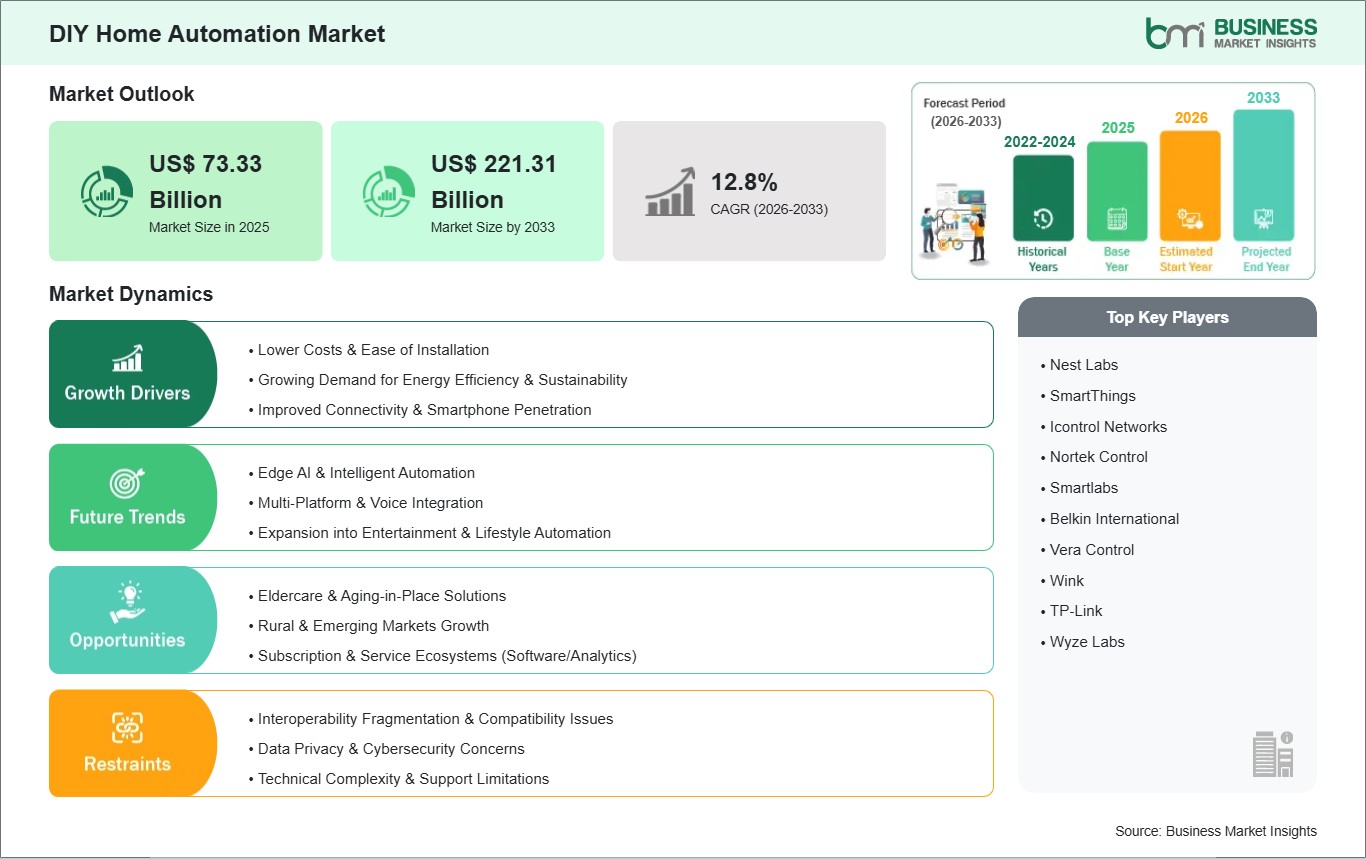
The DIY home automation market size is expected to reach US$ 221.31 billion by 2033 from US$ 73.33 billion in 2025. The market is estimated to record a CAGR of 12.8% from 2026 to 2033.
The global DIY Home Automation market is experiencing significant growth as consumers increasingly seek convenient, customizable, and energy-efficient solutions for their homes. Demand is driven by the desire for enhanced security, comfort, and seamless control through mobile apps and voice assistants. Key segments such as lighting control and residential applications dominate, while wireless communication technologies and online retail channels expand accessibility. Innovation in smart devices and interoperable systems continues to improve user experience, making automation more intuitive and cost-effective. Emerging markets are adopting these solutions rapidly, reflecting a shift toward consumer-driven, technology-enabled smart living worldwide.
The global DIY Home Automation market reflects a transformative shift toward consumer‑led automation, bolstered by advancements in wireless technologies like Wi‑Fi and Bluetooth, and interoperable ecosystems. Energy savings, convenience, and security are major demand factors. Lighting control, mobile app interfaces, and residential applications dominate segment share, while online retail channels accelerate accessibility worldwide. Although professional installations remain significant, DIY solutions’ lower cost and flexibility appeal to tech‑savvy users. Regionally, North America leads in market maturity, with Europe and Asia‑Pacific poised for growth due to rising disposable incomes and IoT adoption. Industry innovation continues to enhance user experience and functionality.

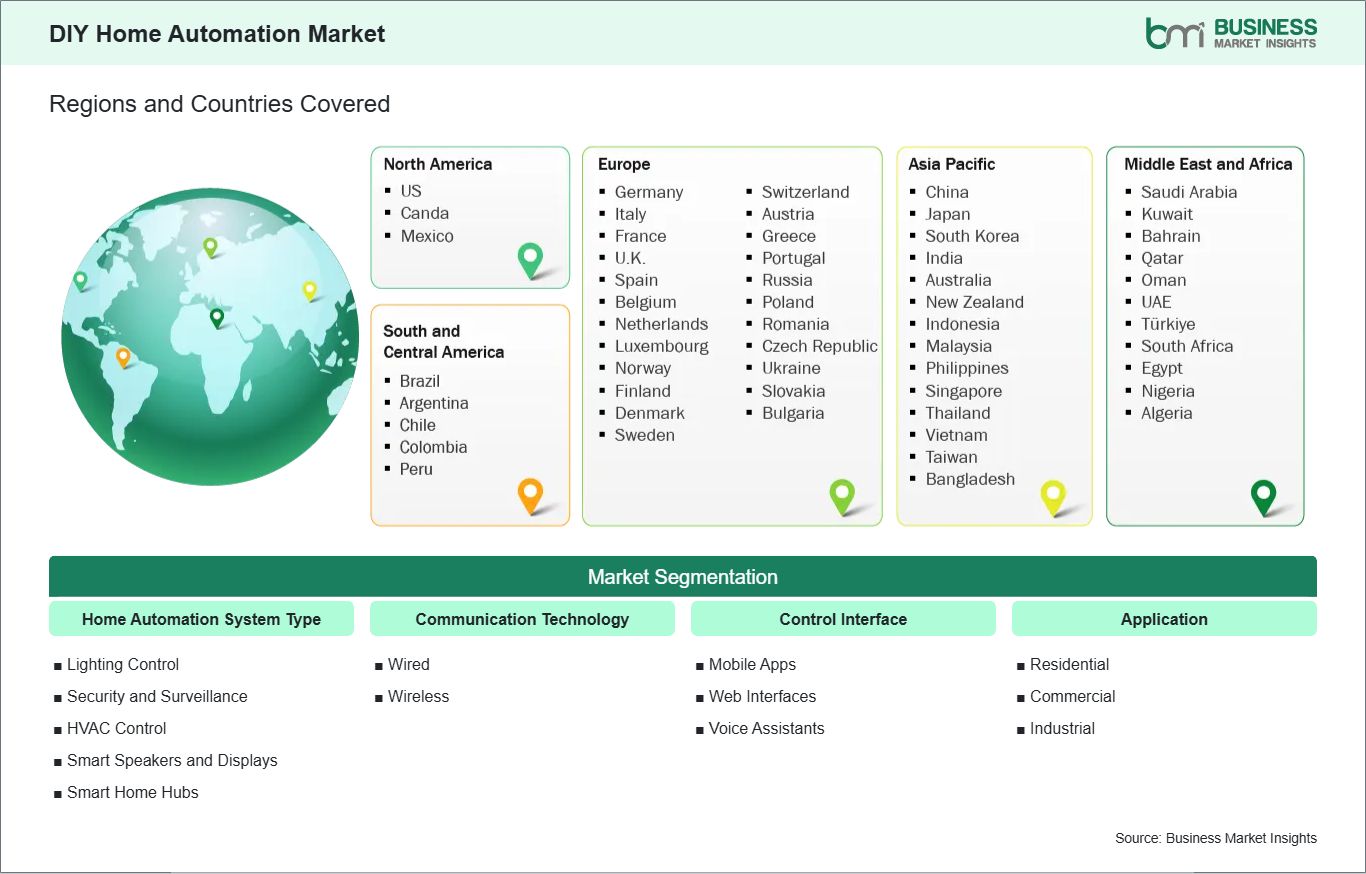
Key segments that contributed to the derivation of the DIY Home Automation market analysis are Type, Deployment, and Application.
Consumers are increasingly seeking homes that offer convenience, security, and energy efficiency. DIY home automation solutions, such as smart lighting, climate control, and security systems, fulfill these needs by providing easy installation and intuitive control via mobile apps or voice assistants. Homeowners are motivated by the ability to monitor and manage their environment remotely, reduce energy costs, and enhance comfort. The growing awareness of sustainable living and the appeal of personalized, tech-driven solutions drive market adoption, making DIY automation an essential part of modern residential lifestyles.
Emerging markets present significant growth opportunities for DIY home automation due to rising disposable incomes, urbanization, and increasing smartphone and internet penetration. Consumers in these regions are becoming more tech-savvy and open to adopting smart home technologies for convenience, security, and energy management. Affordable and scalable DIY solutions enable wider adoption, bridging the gap between high-end automation and mass-market accessibility. Companies can capitalize by tailoring products to local preferences, offering multilingual interfaces, and leveraging e-commerce channels to reach a broader audience, creating long-term growth potential in underpenetrated regions.
By Home Automation System Type, the market is segmented into Lighting Control, Security and Surveillance, HVAC Control, Smart Speakers and Displays, and Smart Home Hubs. The Lighting Control segment dominated the market in 2025. The Lighting Control segment dominates the DIY home automation market due to widespread use of smart bulbs and automated lighting solutions. Consumers favor these systems for ease of installation, energy savings, customizable ambiance, and integration with mobile apps or voice tools, making them the most adopted automation choice globally.
By Communication Technology, the market is segmented into Wired, Wireless. The Wired segment held the largest share of the market in 2025. The Wired communication segment holds the largest share in the market because it offers stable, secure, and reliable connectivity ideal for extensive home automation networks. While installation can be complex, its robust performance makes it preferred for systems requiring consistent data transmission across multiple devices and zones.
By Control Interface, the market is segmented into Mobile Apps, Web Interfaces, and Voice Assistants. The Mobile Apps segment held the largest share of the market in 2025. The Mobile Apps segment leads as users primarily control DIY automation systems through intuitive smartphone applications. These apps provide remote access, ease of setup, and real‑time management of lighting, security, and temperature controls, aligning with consumers' preferences for convenience and ubiquitous device connectivity.
By Application, the market is segmented into Residential, Commercial, and Industrial. The Residential segment held the largest share of the market in 2025. The Residential segment is the largest market share, driven by strong demand for smart home conveniences such as automated lighting, climate control, and security. Growth is propelled by tech‑savvy homeowners seeking energy efficiency, cost savings, and customizable automation tailored to individual living spaces.

| Report Attribute | Details |
|---|---|
| Market size in 2025 | US$ 73.33 Billion |
| Market Size by 2033 | US$ 221.31 Billion |
| Global CAGR (2026 - 2033) | 12.8% |
| Historical Data | 2022-2024 |
| Forecast period | 2026-2033 |
| Segments Covered | By Home Automation System Type
|
|
Regions and Countries Covered
| |
| North America | US, Canada, Mexico |
| Europe | Belgium, Austria, Finland, Denmark, Greece, Poland, Romania, Russia, Ukraine, Czech Republic, Slovakia, Bulgaria, Italy, Luxembourg, Germany, Switzerland, France, Netherlands, Norway, Portugal, Spain, Sweden, United Kingdom |
| Asia-Pacific | Australia, China, India, Japan, South Korea, Indonesia, Malaysia, Philippines, Singapore, Thailand, Vietnam, Bangladesh, New Zealand, Taiwan |
| South and Central America | Brazil, Argentina, Peru, Chile, Colombia |
| Middle East and Africa | Bahrain, Kuwait, Oman, Qatar, Saudi Arabia, United Arab Emirates, Turkiye, South Africa, Egypt, Algeria, Nigeria |
| Market leaders and key company profiles |
|
The "DIY Home Automation Market Size and Forecast (2022-2033)" report provides a detailed analysis of the market covering below areas:
The geographical scope of the DIY home automation market report is divided into five regions: North America, Asia Pacific, Europe, Middle East & Africa, and South & Central America. The DIY home automation market in Asia Pacific is expected to grow significantly during the forecast period.
The Asia-Pacific DIY home automation market is witnessing rapid growth, driven by increasing urbanization, rising disposable incomes, and growing consumer awareness of smart home technologies. Countries such as China, Japan, India, and South Korea are leading adoption, fueled by tech-savvy populations and expanding internet and smartphone penetration. Affordable, easy-to-install DIY solutions appeal to homeowners seeking convenience, energy efficiency, and security. E-commerce platforms and retail partnerships enhance accessibility across the region.
Additionally, government initiatives promoting energy conservation and smart cities further support market expansion, positioning the Asia-Pacific as a key growth hub for DIY home automation solutions.

The DIY home automation market is evaluated by gathering qualitative and quantitative data post primary and secondary research, which includes important corporate publications, association data, and databases. A few of the key developments in the DIY Home Automation market are:
The DIY Home Automation Market is valued at US$ 73.33 Billion in 2025, it is projected to reach US$ 221.31 Billion by 2033.
As per our report DIY Home Automation Market, the market size is valued at US$ 73.33 Billion in 2025, projecting it to reach US$ 221.31 Billion by 2033. This translates to a CAGR of approximately 12.8% during the forecast period.
The DIY Home Automation Market report typically cover these key segments-
The historic period, base year, and forecast period can vary slightly depending on the specific market research report. However, for the DIY Home Automation Market report:
The DIY Home Automation Market is populated by several key players, each contributing to its growth and innovation. Some of the major players include:
The DIY Home Automation Market report is valuable for diverse stakeholders, including:
Essentially, anyone involved in or considering involvement in the DIY Home Automation Market value chain can benefit from the information contained in a comprehensive market report.
Please tell us your area of interest
(Market Segments/ Regions and Countries/ Companies)