Market Summary
Executive Summary and Global Market Analysis
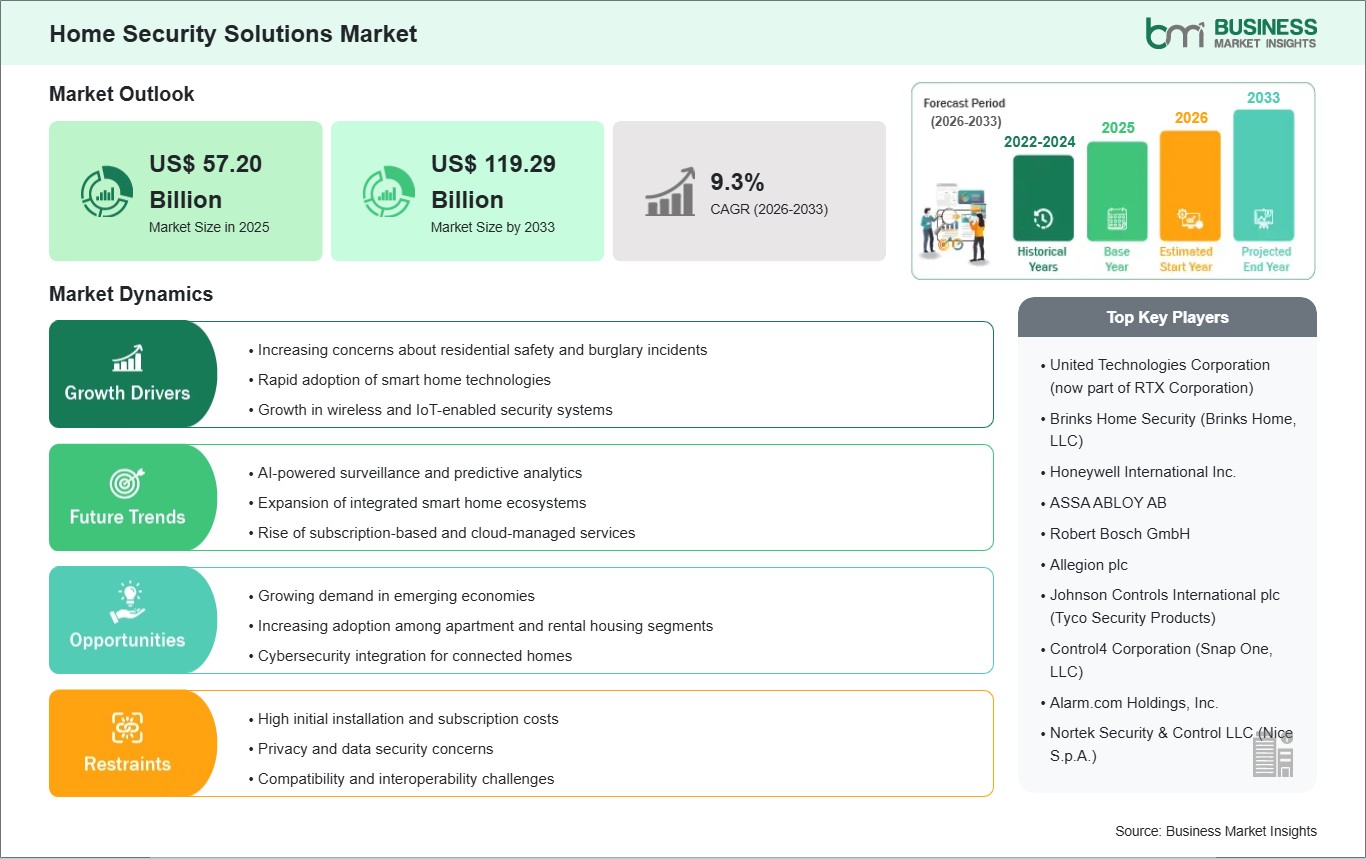
Home security solutions refer to the integrated application of electronic hardware, software, and monitoring services engineered to protect residential properties from intrusion, fire, and environmental hazards. By utilizing a network of interconnected devices, including AI-enabled video cameras, smart locks, motion sensors, and smoke detectors, these systems provide real-time surveillance and automated emergency response. This technology is fundamental to the modern smart home ecosystem, offering homeowners remote visibility and control through unified mobile applications. Market expansion is being propelled by the rising global requirement for proactive property protection, the rapid integration of Edge AI for precise threat detection, and the increasing institutional adoption of interoperability standards like the Matter protocol to ensure seamless multi-vendor device connectivity.
However, several factors may restrain market progression. The high capital intensity associated with professionally installed systems, which often include significant upfront hardware costs and ongoing monthly subscription fees, remains a primary hurdle for middle-income households. The industry also faces persistent technical challenges regarding cybersecurity vulnerabilities, as the proliferation of cloud-connected cameras and locks has intensified concerns regarding unauthorized data access and household privacy. Additionally, the complexity of integrating legacy home infrastructure with modern wireless protocols can lead to reliability issues in areas with inconsistent network coverage. These hurdles, compounded by stringent data privacy mandates such as the GDPR and a global scarcity of skilled technicians for high-end system integration, increase the total cost of ownership and may lengthen the adoption cycle for comprehensive residential security suites.
Despite these hurdles, the market outlook remains highly favorable as the sector transitions toward intelligent and decentralized protection. Opportunities are emerging through the adoption of Edge AI and Local Processing; as of March 2026, the market is witnessing a surge in cameras that process video data on-device, significantly enhancing user privacy by reducing cloud dependency. The DIY (Do-It-Yourself) segment is gaining significant traction, allowing consumers to bypass traditional installation fees through modular, plug-and-play components that offer professional-grade features. Furthermore, the growth of multimodal sensor fusion, combining acoustic detection with thermal and optical imaging, aligns with global goals for zero-false-alarm environments. Collectively, these innovations position the home security solutions industry for sustained long-term development as a cornerstone of the modern, connected, and resilient global residential landscape.
Segment Analysis
Home Security Solutions Market Segmentation
Key segments that contributed to the derivation of the Home Security Solutions market analysis are system, services, and vertical.
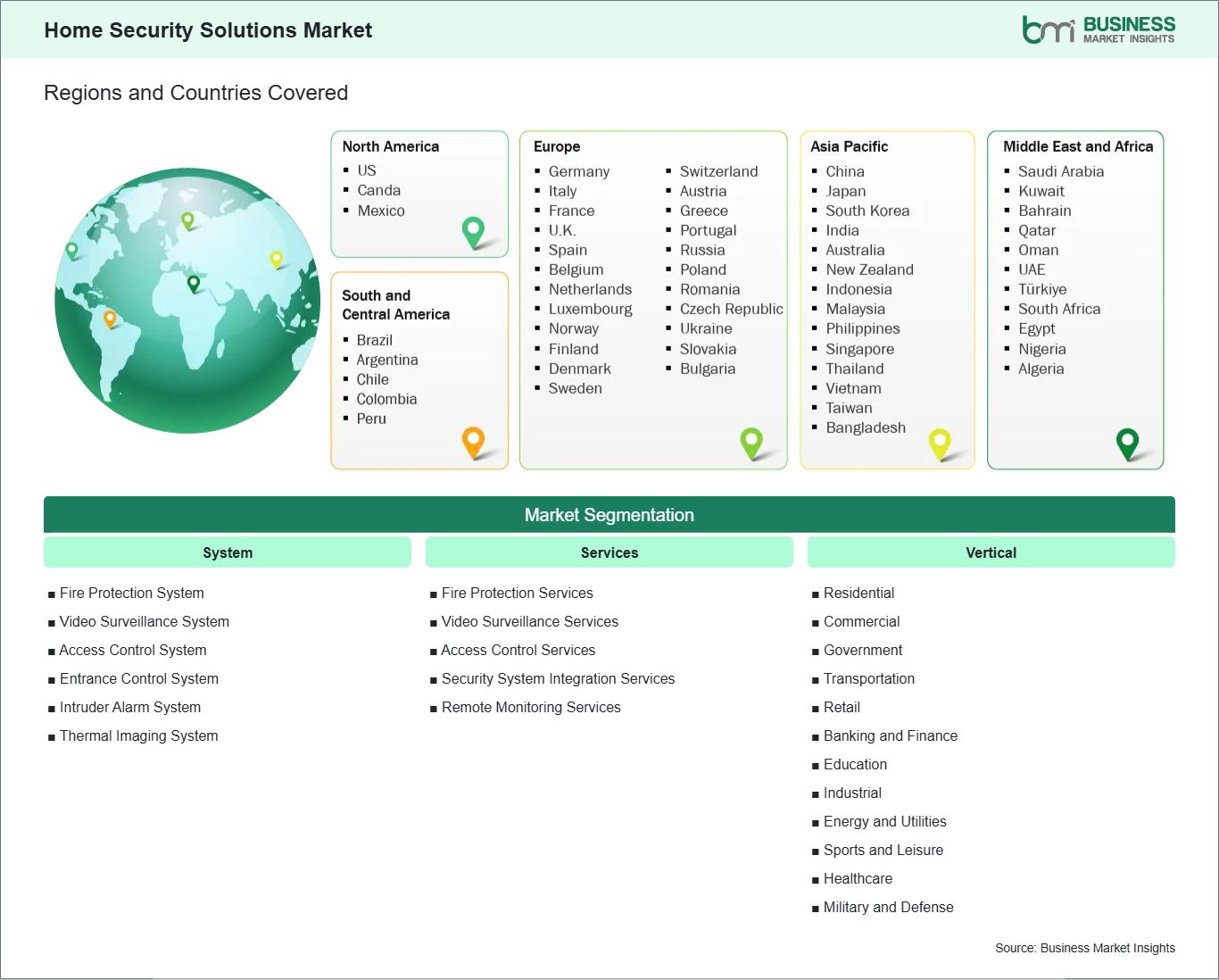
- By System, the market is segmented into Fire Protection System, Video Surveillance System, Access Control System, Entrance Control System, Intruder Alarm System, and Thermal Imaging System.
- By Services, the market is divided into Fire Protection Services, Video Surveillance Services, Access Control Services, Security System Integration Services, and Remote Monitoring Services.
- By Vertical, the market is categorized into Residential, Commercial, Government, Transportation, Retail, Banking and Finance, Education, Industrial, Energy and Utilities, Sports and Leisure, Healthcare, and Military and Defense.
Market Forces
Home Security Solutions Market Drivers and Opportunities
Rising Demand for Safety, Smart Homes, and Regulatory Compliance
The home security solutions market is being driven by the growing need for safety, smart living, and compliance with insurance and regulatory standards. Rising concerns about burglary, theft, and personal safety are amplifying adoption of advanced security systems such as surveillance cameras, motion detectors, smart locks, and alarm systems. The expansion of urbanization and residential construction is reinforcing demand, as homeowners increasingly prioritize integrated security solutions. The rapid rise of smart homes and connected devices is propelling investment in IoT‑enabled security platforms that provide real‑time monitoring and remote access. Insurance companies are also encouraging adoption by offering premium discounts for homes equipped with certified security systems. Additionally, heightened awareness of child safety, elderly care, and emergency preparedness is driving demand for personalized solutions. Collectively, safety priorities, smart home integration, and regulatory compliance are fueling sustained growth in the global home security solutions market.
Rising Integration of AI, IoT, and Emerging Applications
Opportunities in the home security solutions market are expanding through the integration of artificial intelligence, IoT ecosystems, and emerging cross‑industry applications. AI‑enabled security platforms are opening lucrative opportunities by delivering adaptive threat detection, facial recognition, and predictive analytics for enhanced protection. IoT‑driven systems are gaining traction, enabling seamless connectivity with smart devices, mobile apps, and cloud platforms for real‑time alerts and remote control. The growing emphasis on smart cities is fueling demand for interoperable home security solutions that integrate with broader urban safety and surveillance networks. Emerging applications in healthcare are driving innovation, as home security systems are adapted to monitor elderly residents, detect falls, and provide emergency alerts. Additionally, sustainability trends are encouraging deployment of energy‑efficient, eco‑friendly security devices that align with global environmental goals. The expansion of subscription‑based monitoring services and DIY security kits is creating new pathways for adoption, offering flexibility and affordability to homeowners. Vendors who focus on AI‑driven, IoT‑ready, and user‑centric solutions are well‑positioned to capture growth. The convergence of AI, IoT, and smart infrastructure underscores a transformative trajectory for the global home security solutions market.
Size and Share Analysis
Home Security Solutions Market Size and Share Analysis
The Home Security Solutions market demonstrates steady growth, with size and share analysis revealing evolving trends and competitive positioning among key players. The report examines subsegments categorized within system, services, and vertical, offering insights into their contribution to overall market performance.
Based on System, the Fire Protection System subsegment holds a strong presence, as it is indispensable for safeguarding residential and commercial properties against fire hazards. The Video Surveillance System subsegment dominates adoption, driven by demand for real‑time monitoring, crime prevention, and evidence collection. The Access Control System subsegment is essential for regulating entry into sensitive areas, ensuring security in government, banking, and industrial facilities. The Entrance Control System anchors demand in high‑traffic zones such as airports and stadiums. The Intruder Alarm System is critical for immediate alerts against unauthorized access, while the Thermal Imaging System supports advanced detection in low‑visibility environments.
Report Coverage
Home Security Solutions Market Report Coverage and Deliverables
The “Home Security Solutions Market Size and Forecast (2022–2033)” report provides a detailed analysis of the market covering below areas:
- Market size and forecast at global, regional, and country levels for all market segments covered under the scope
- Market trends, as well as drivers, restraints, and opportunities
- Market analysis covering key trends, global and regional framework, major players, and recent developments
- Market concentration, heat map analysis, prominent players, and recent developments
- Detailed company profiles, including SWOT analysis
Geographic Insights
Home Security Solutions Market Geographic Insights
The geographical scope of the Home Security Solutions market report is divided into five regions: North America, Asia Pacific, Europe, Middle East & Africa, and South & Central America.
North America maintains a preeminent position within the global industry, a status reinforced by high levels of consumer awareness and the rapid adoption of integrated smart home ecosystems. The regional landscape is characterized by significant investments in the United States and Canada, where North America holds a commanding share of the global market. This leadership is supported by a robust presence of industry pioneers, including ADT Inc., Honeywell International, and Vivint Smart Home, who drive the commercialization of sophisticated monitoring platforms and interconnected hardware.
Industrial and consumer trends in the region reflect a decisive shift toward Self-Installed (DIY) Systems and Professional Monitoring Convergence. While traditional professionally installed systems remain a cornerstone for high-end residential properties, there is an escalating demand for user-friendly, wireless kits that offer smartphone-guided setup and flexible, contract-free subscription models. Furthermore, the region is witnessing a rapid integration of Artificial Intelligence and Edge Computing within video surveillance. This focus on Proactive Deterrence allows homeowners to utilize advanced analytics for facial recognition, package detection, and the filtering of non-threatening motion, effectively reducing false alarms and enhancing situational awareness.
Industry Activity
Recent Developments
The Home Security Solutions market is evaluated by gathering qualitative and quantitative data post primary and secondary research, which includes important corporate publications, association data, and databases. A few of the key developments in the Home Security Solutions market are:
- In October 2025, SimpliSafe launched SimpliSafe Business Security, a new suite of AI-powered security solutions designed to protect small and medium-sized businesses. The platform integrates features such as advanced indoor and outdoor cameras, proactive threat detection through live agent monitoring, and customizable access controls, enhancing real-time surveillance, threat prevention, and overall security management across residential and commercial environments.
- In March 2024, Hikvision launched the AX HOME Series wireless alarm system, a smart home security solution designed for residential use. The system features seamless integration with third-party devices, energy-efficient operation, real-time remote monitoring via mobile applications, and compliance with European intruder alarm standards, enhancing reliability, scalability, and user-friendly home protection.
Trust & Transparency
Research Methodology
The market analysis combines proprietary research with secondary data from government agencies, company disclosures, regulatory filings, industry databases and expert interviews. Market estimates are validated through data triangulation, cross-market benchmarking and analyst
review.
View Full Research Methodology
Key Sources Referred:
World Bank & Global Trade IndicatorsWorld Trade Organization (WTO)International Monetary Fund (IMF)International Trade Administration (ITA)Company WebsitesCompany Annual ReportsCompany Investor Presentations