Building Automation System Market Outlook (2022-2033)

Historic Data: 2022-2024   |   Base Year: 2025   |   Forecast Period: 2026-2033
Report Content: Market Scope, Market Segmentation, Market Dynamics, and Competitive Analysis

Report Coverage:
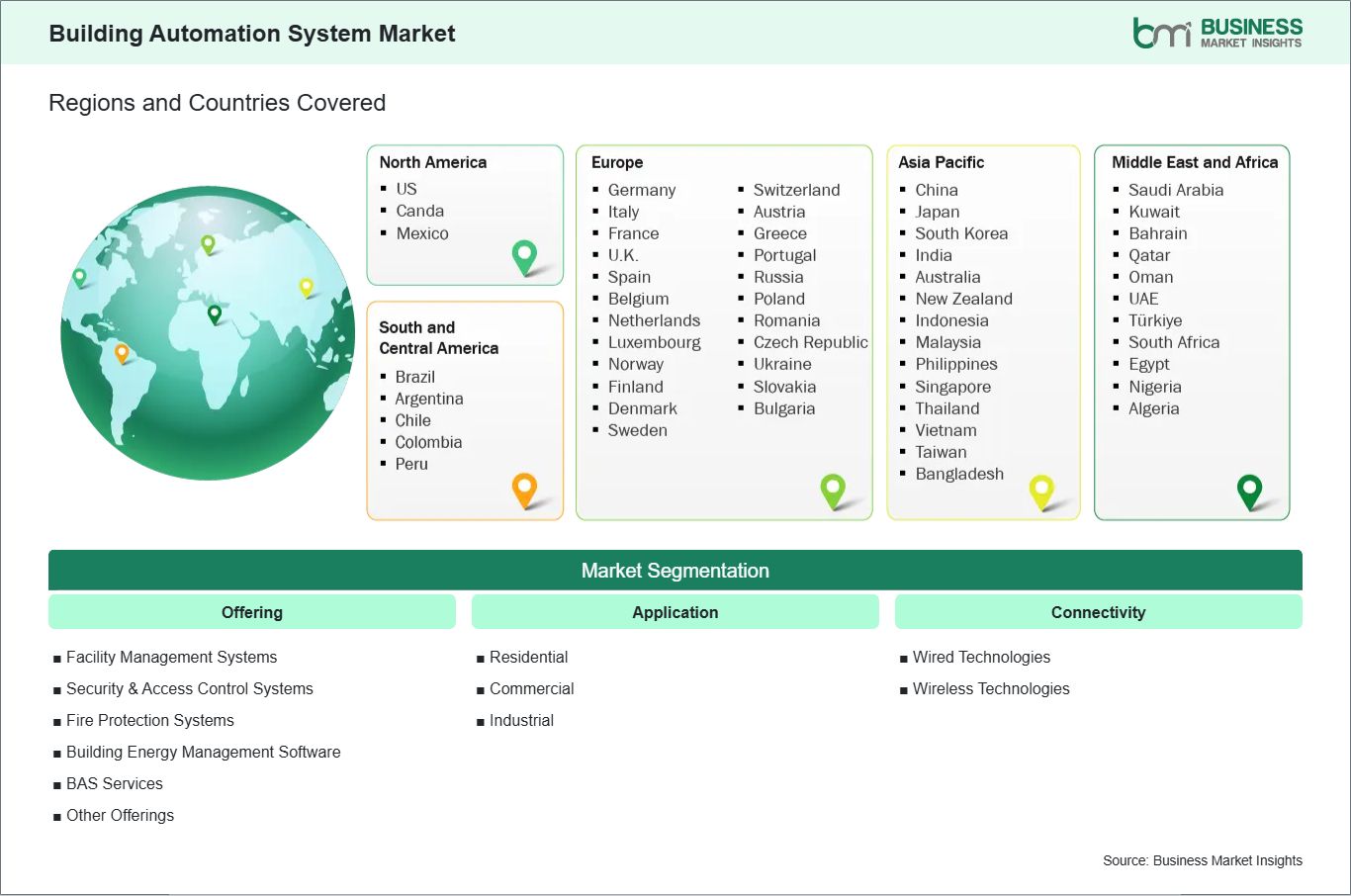
  • Offering (Facility Management Systems, Security & Access Control Systems, Fire Protection Systems, Building Energy Management Software, BAS Services, Other Offerings)
  • Application (Residential, Commercial, Industrial)
  • Connectivity (Wired Technologies, Wireless Technologies)

No. of Pages: 418
Report Code: BMIPUB00033802
Category: Electronics and Semiconductor
Building Automation System Market

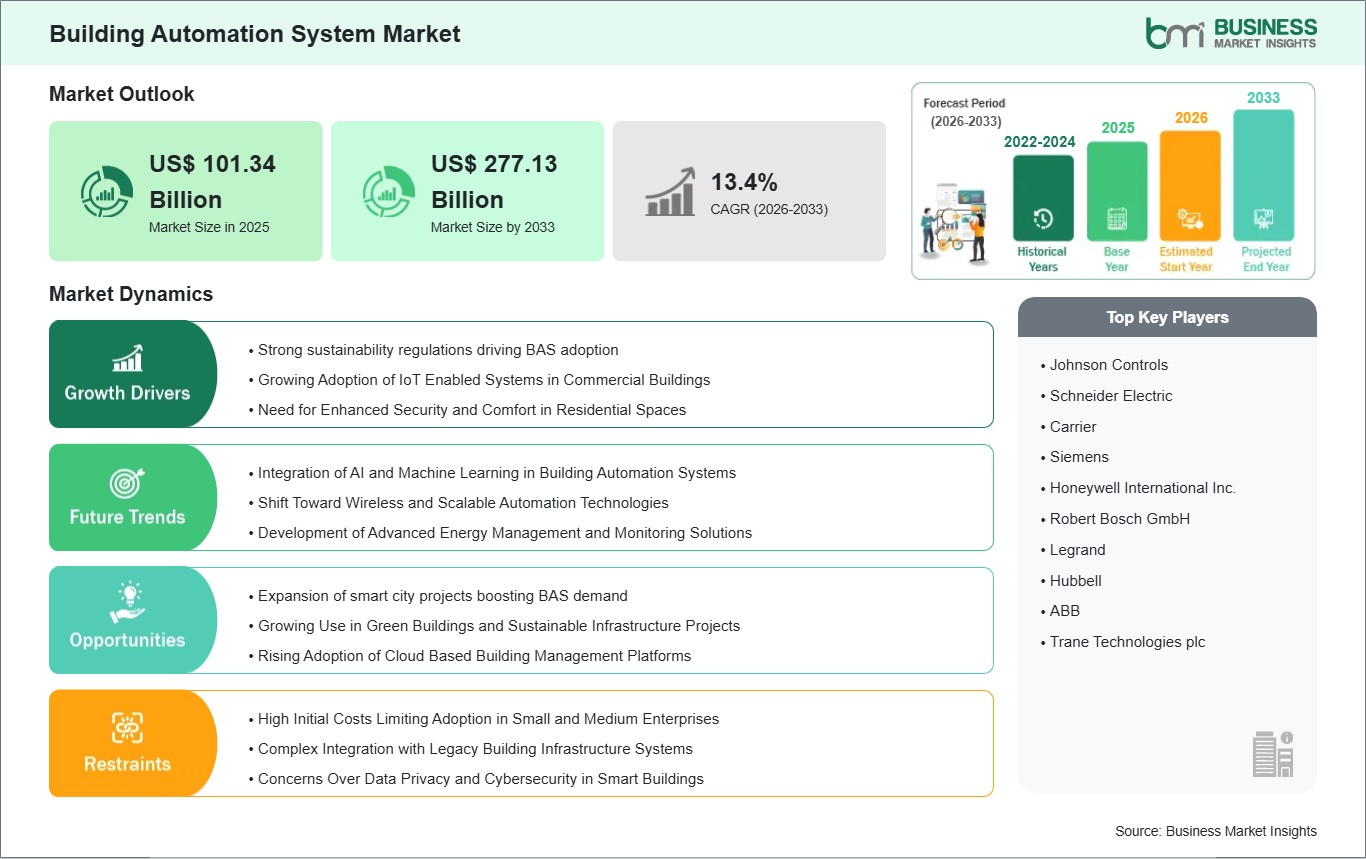
The Building Automation System Market is expected to reach US$ 277.13 Billion by 2033 from US$ 101.34 Billion in 2025 The market is estimated to record a CAGR of 13.4% from 2026 to 2033

Executive Summary and Global Market Analysis:

The global building automation system (BAS) market is currently witnessing a major transformation due to the integration of digital innovations, sustainable building practices, and intelligent building development. BAS solutions have come to be regarded as an essential part of building development due to their ability to optimize energy consumption, minimize operational expenses, as well as provide a comfortable living experience while ensuring safety and security within commercial, residential, and industrial buildings. Moreover, the integration of IoT technology, AI technology, and cloud technology has enabled building managers to effectively control building operations while monitoring energy consumption in real-time, thereby addressing equipment inefficiencies before they become major problems. Furthermore, building awareness regarding global warming has led to an increase in net-zero building standards, making BAS solutions a strategic part of building development. The major drivers for this market include the increasing smart city initiatives, the upgrade of existing legacy building infrastructure, and the rise in investments in energy-efficient HVAC, lighting, and security systems. The advanced BAS systems not only allow for remote monitoring but also help in predictive maintenance, analysis of occupants’ behavior, and the utilization of renewable energy sources. Additionally, the recent advancements in technology have helped in making the implementation of BAS solutions much simpler for different types of buildings. Despite the growth prospects in this market, there are certain challenges faced in this industry. One major challenge is the integration of new automation technologies with existing legacy technologies. Another challenge is the data security and privacy concerns due to the increased interconnectedness in building technologies. In addition, regional regulation variations may create difficulties in the global acceptance of BAS, especially in emerging countries with low regulation enforcement. However, the driving factors of operational efficiency, regulation, and innovation will continue to propel the global adoption of BAS as a foundation for the future of intelligent buildings and infrastructure.

Building Automation System Market - Strategic Insights:

global-market-strategic-framework
Get more information on this report

Building Automation System Market Segmentation Analysis:

Key segments that contributed to the derivation of the building automation system market analysis are offering, application and connectivity.

  • By offering, the building automation system market is segmented into facility management systems, security & access control systems, fire protection systems, building energy management software, BAS services, other offerings. The building energy management software segment dominated the market in 2025.
  • In terms of application, the building automation system market is categorized into residential, commercial, industrial. The commercial segment dominated the market in 2025.
  • Based on connectivity, the building automation system market is categorized into wired technologies, wireless technologies. The wired technologies segement dominated the market in 2025.

Building Automation System Market Drivers and Opportunities:

Strong sustainability regulations driving BAS adoption

Sustainability regulations and energy efficiency standards are becoming a major catalyst for the adoption of Building Automation Systems (BAS) worldwide. Governments and international regulatory bodies are increasingly implementing policies that require buildings to reduce energy consumption, improve operational efficiency, and minimize carbon emissions. In response, building owners and facility managers are deploying BAS solutions to monitor and control HVAC systems, lighting, security, and energy usage through centralized platforms. These systems enable real-time tracking of building performance and allow operators to optimize energy consumption while maintaining occupant comfort and safety. As environmental accountability becomes a core component of infrastructure development, BAS technologies are increasingly integrated into both new construction projects and building retrofits. In addition, sustainability initiatives led by corporations and global institutions are reinforcing BAS deployment across commercial and institutional buildings. As sustainability commitments continue to expand across industries, the need for intelligent building management solutions is expected to remain a key driver supporting long-term BAS market growth globally.

Expansion of smart city projects boosting BAS demand

The global expansion of smart city initiatives is significantly increasing demand for Building Automation Systems as cities adopt digital infrastructure to enhance efficiency, safety, and sustainability. Smart city programs focus on integrating connected technologies such as IoT sensors, intelligent energy systems, and centralized monitoring platforms to manage urban infrastructure more effectively. Within this framework, BAS solutions play a critical role by enabling automated control of building operations, optimizing energy consumption, and supporting real-time monitoring of building environments. As urban populations grow and cities pursue smarter infrastructure development, BAS platforms are becoming essential components of connected building ecosystems. Smart city developments are also encouraging the construction of intelligent commercial complexes, residential communities, and public facilities that rely heavily on automation technologies. As governments and urban planners continue investing in digitally enabled urban infrastructure, BAS technologies are expected to play a vital role in enabling intelligent, sustainable, and data-driven city operations worldwide.

Building Automation System Market Size and Share Analysis:

The building automation system market demonstrates steady growth, with size and share analysis highlighting evolving trends and competitive dynamics among key players. The report examines subsegments categorized within offering, application and connectivity, offering insights into their contribution to overall market performance.

By offering, the building energy management software subsegment dominated the market in 2025, driven by the increasing demand for real-time energy monitoring, IoT integration, and energy efficiency in buildings.

Based on application, the commercial subsegment dominated the market in 2025, driven by extensive deployment of BAS in offices, retail spaces, hospitals, and large facilities.

Based on connectivity, the wired technologies subsegment dominated the market in 2025, driven by its reliability, high-speed data transmission, and suitability for large-scale commercial and industrial infrastructure.

Building Automation System Market Report Highlights:

Report Attribute Details
Market size in 2025 US$ 101.34 Billion
Market Size by 2033 US$ 277.13 Billion
Global CAGR (2026 - 2033)13.4%
Historical Data 2022-2024
Forecast period 2026-2033
Segments Covered By Offering
  • Facility Management Systems
  • Security & Access Control Systems
  • Fire Protection Systems
  • Building Energy Management Software
  • BAS Services
  • Other Offerings
By Application
  • Residential
  • Commercial
  • Industrial
By Connectivity
  • Wired Technologies
  • Wireless Technologies
Regions and Countries Covered
North America US, Canada, Mexico
Europe Belgium, Austria, Finland, Denmark, Greece, Poland, Romania, Russia, Ukraine, Czech Republic, Slovakia, Bulgaria, Italy, Luxembourg, Germany, Switzerland, France, Netherlands, Norway, Portugal, Spain, Sweden, United Kingdom
Asia-Pacific Australia, China, India, Japan, South Korea, Indonesia, Malaysia, Philippines, Singapore, Thailand, Vietnam, Bangladesh, New Zealand, Taiwan
South and Central America Brazil, Argentina, Peru, Chile, Colombia
Middle East and Africa Bahrain, Kuwait, Oman, Qatar, Saudi Arabia, United Arab Emirates, Turkiye, South Africa, Egypt, Algeria, Nigeria
Market leaders and key company profiles
  • Johnson Controls
  • Schneider Electric
  • Carrier
  • Siemens
  • Honeywell International Inc.
  • Robert Bosch GmbH
  • Legrand
  • Hubbell
  • ABB
  • Trane Technologies plc
Get more information on this report

Building Automation System Market Report Coverage and Deliverables:

The "Building Automation System Market Size and Forecast (2022 - 2033)" report provides a detailed analysis of the market covering below areas:

  • Building Automation System Market size and forecast at global, regional, and country levels for all the key market segments covered under the scope
  • Building Automation System Market trends, as well as drivers, restraints, and opportunities
  • Building Automation System Market analysis covering key trends, global and regional framework, major players, regulations, and recent developments
  • Industry landscape and competition analysis covering market concentration, heat map analysis, prominent players, and recent developments for the Building Automation System Market
  • Detailed company profiles, including SWOT analysis

Building Automation System Market Geographic Insights:

The geographical scope of the Building Automation System Market report is divided into North America, Asia Pacific, Europe, Middle East & Africa, and South & Central America. North America held the largest share in 2025.

The Building Automation System (BAS) market is highly regionalized, with the North American region leading the global BAS market in terms of growth. This is attributed to the region’s strong infrastructure, the relatively earlier adoption of smart technologies in buildings, and the strong regulation of energy efficiency in the region. Additionally, the region is also home to a large number of BAS solution providers. In the region, there is a growing trend of integrating energy management, security, and fire protection solutions in commercial and institutional buildings to minimize costs and meet the strict sustainability requirements. The Asia Pacific region is growing rapidly in the global BAS market, with urbanization and industrialization leading the region in terms of BAS solution adoption. The region is also witnessing a large number of smart city projects in countries like China, India, Japan, and South Korea. The European region is strong in the global BAS market, with the region witnessing a strong push for sustainability and the construction of green buildings. The region is also witnessing a strong trend of energy-efficient retrofitting of existing commercial and residential buildings. Similarly, the Middle East & Africa region is gradually adopting BAS technologies, driven by factors such as infrastructure modernization, growth of luxury commercial projects, and extreme climatic conditions that require sophisticated climate control solutions. On the other hand, South & Central America is considered to be an emerging market, where growth is driven by factors such as increasing commercial construction activities, awareness about energy efficiency, and government initiatives towards green buildings, especially in countries such as Brazil and Mexico. Thus, regional dynamics of the BAS market are influenced by factors such as technological, economic, and urbanization developments, where North America leads, followed by regions such as Asia Pacific, which offer immense growth opportunities.

global-market-geography
Get more information on this report

Building Automation System Market Research Report Guidance:

  • The report includes qualitative and quantitative data in the Building Automation System Market across offering, application, connectivity and geography.
  • The report starts with the key takeaways (chapter 2), highlighting key trends and outlook of the Building Automation System Market .
  • Chapter 3 focuses on the research methodology of the study.
  • Chapter 4 includes ecosystem analysis.
  • Chapter 5 highlights the major industry dynamics in the Building Automation System Market , including factors that are driving the market, prevailing deterrents, potential opportunities, as well as future trends. Impact analysis of these drivers and restraints is also covered in this section.
  • Chapter 6 discusses the Building Automation System Market scenario, in terms of historical market revenues, and forecast till the year 2033.
  • Chapters 7 to 10 cover Building Automation System Market segments by offering, application, connectivity and geography across North America, Asia Pacific, Europe, Middle East & Africa, and South & Central America. They cover the market revenue forecast and factors driving the market.
  • Chapter 11 describes the competitive analysis along with the heat map analysis for the key players operating in the market.
  • Chapter 12 describes the industry landscape analysis. It provides detailed descriptions of business activities such as market initiatives, new developments, mergers, and joint ventures globally, along with a competitive landscape.
  • Chapter 13 provides detailed profiles of the major companies operating in the Building Automation System Market . Companies have been profiled on the basis of their key facts, business descriptions, products, financial overview, SWOT analysis, and key developments.
  • Chapter 14, i.e., the appendix, is inclusive of a brief overview of the company, a list of abbreviations, and a disclaimer.

Building Automation System Market News and Key Development:

The Building Automation System Market is evaluated by gathering qualitative and quantitative data post primary and secondary research, which includes important corporate publications, association data, and databases. A few of the key developments in the building automation system market are:

  • In November 2025, Johnson Controls International plc announced that it launched Metasys 15.0, an open building automation system with enhanced scalability, resiliency, and energy intelligence, aimed at optimized building performance and compliance. This update supports more IP devices, offers advanced energy insights, and improves overall BAS capabilities for large campuses and mission‑critical environments, reinforcing Johnson Controls’ leadership in smart building systems.
  • In March 2025, Siemens AG announced that it would showcase its innovative building automation technologiesincluding the Wireless Plug and Play Automation Bundle and Connect Box IoT‑based systemat ISH 2025, positioning scalable and sustainable BAS solutions for buildings of all sizes. This reflects Siemens’ ongoing expansion of IoT‑driven Building Automation solutions across global markets.

Key Sources Referred:

  • World Health Organization (WHO)
  • Organisation for Economic Cooperation and Development (OECD)
  • The World Bank Group
  • Worldometer
  • The Lancet
  • International Bar Association
  • International Trade Administration
The List of Companies - Building Automation System Market
  • Johnson Controls
  • Schneider Electric
  • Carrier
  • Siemens
  • Honeywell International Inc.
  • Robert Bosch GmbH
  • Legrand
  • Hubbell
  • ABB
  • Trane Technologies plc
Frequently Asked Questions
How big is the Building Automation System Market?

The Building Automation System Market is valued at US$ 101.34 Billion in 2025, it is projected to reach US$ 277.13 Billion by 2033.

What is the CAGR for Building Automation System Market by (2026 - 2033)?

As per our report Building Automation System Market, the market size is valued at US$ 101.34 Billion in 2025, projecting it to reach US$ 277.13 Billion by 2033. This translates to a CAGR of approximately 13.4% during the forecast period.

What segments are covered in this report?

The Building Automation System Market report typically cover these key segments-

  • Offering (Facility Management Systems, Security & Access Control Systems, Fire Protection Systems, Building Energy Management Software, BAS Services, Other Offerings)
  • Application (Residential, Commercial, Industrial)
  • Connectivity (Wired Technologies, Wireless Technologies)

What is the historic period, base year, and forecast period taken for Building Automation System Market?

The historic period, base year, and forecast period can vary slightly depending on the specific market research report. However, for the Building Automation System Market report:

  • Historic Period : 2022-2024
  • Base Year : 2025
  • Forecast Period : 2026-2033
  • Who are the major players in Building Automation System Market?

    The Building Automation System Market is populated by several key players, each contributing to its growth and innovation. Some of the major players include:

  • Johnson Controls
  • Schneider Electric
  • Carrier
  • Siemens
  • Honeywell International Inc.
  • Robert Bosch GmbH
  • Legrand
  • Hubbell
  • ABB
  • Trane Technologies plc
  • Who should buy this report?

    The Building Automation System Market report is valuable for diverse stakeholders, including:

    • Investors: Provides insights for investment decisions pertaining to market growth, companies, or industry insights. Helps assess market attractiveness and potential returns.
    • Industry Players: Offers competitive intelligence, market sizing, and trend analysis to inform strategic planning, product development, and sales strategies.
    • Suppliers and Manufacturers: Helps understand market demand for components, materials, and services related to concerned industry.
    • Researchers and Consultants: Provides data and analysis for academic research, consulting projects, and market studies.
    • Financial Institutions: Helps assess risks and opportunities associated with financing or investing in the concerned market.

    Essentially, anyone involved in or considering involvement in the Building Automation System Market value chain can benefit from the information contained in a comprehensive market report.

    Available Report Formats

    pdf-format excel-format pptx-format
    Buy Now
    Sales Assistance
    +1 646 791 7070 (US & UK)
    Customization Form

    Please tell us your area of interest
    (Market Segments/ Regions and Countries/ Companies)