Market Summary
Executive Summary and Global Market Analysis
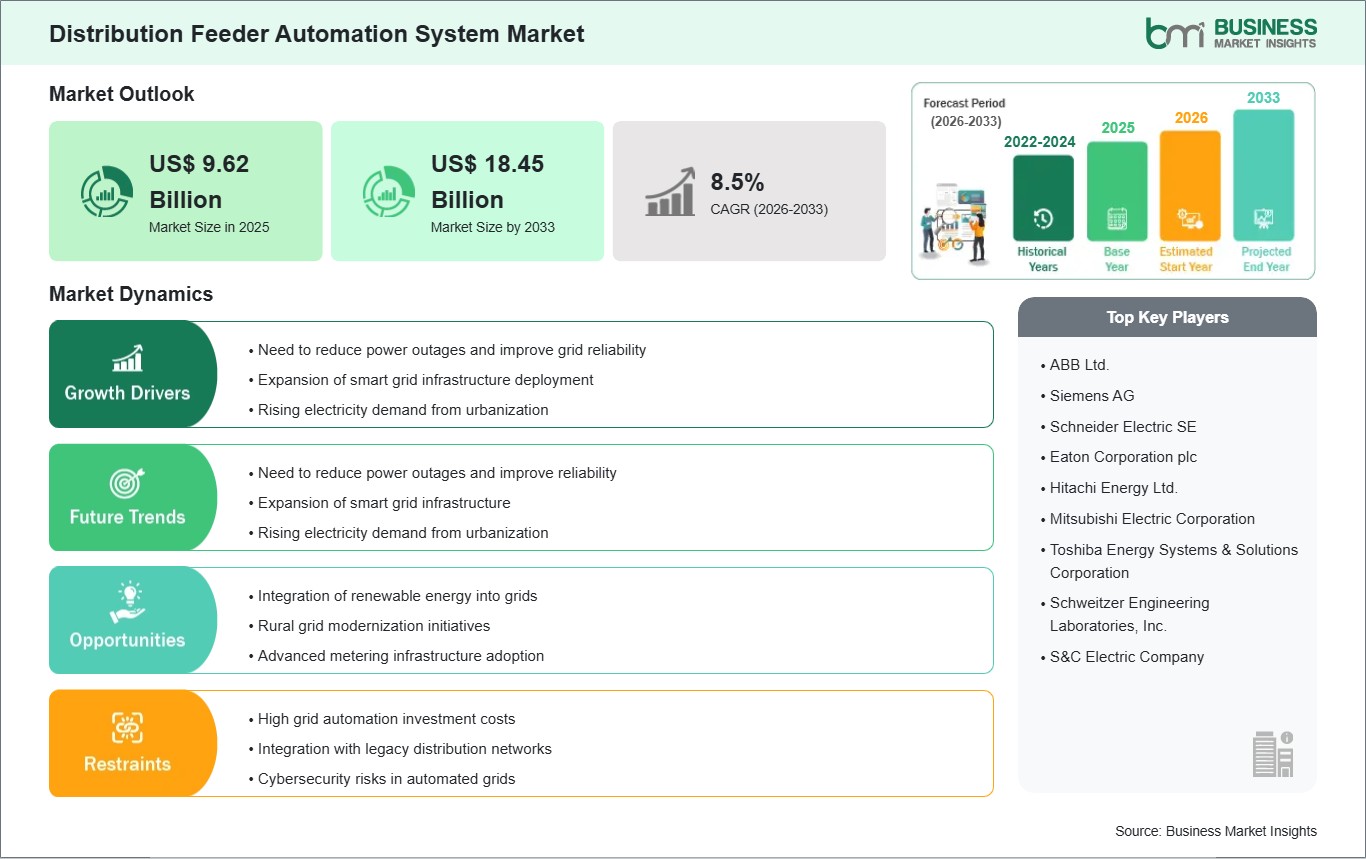
The global distribution feeder automation system market is a critical component of the smart grid evolution, focused on enhancing the reliability, efficiency, and resilience of medium-voltage (MV) power distribution networks. These systems integrate intelligent electronic devices (IEDs), sensors, communication networks, and control software to monitor, protect, and automatically control distribution feeders—the backbone lines that deliver electricity from substations to end-users. The market is driven by the urgent need to modernize aging grid infrastructure, reduce System Average Interruption Duration Index (SAIDI) and Frequency Index (SAIFI) metrics, and integrate distributed energy resources (DERs) like solar PV and electric vehicle (EV) charging stations. Utilities worldwide are investing in feeder automation to achieve self-healing grid capabilities, where faults can be automatically detected, isolated, and power restored to unaffected sections within minutes, drastically improving service reliability.
However, the market faces challenges including high capital investment for full-scale deployment, interoperability issues between legacy equipment and new automation technologies, and cybersecurity vulnerabilities in increasingly connected grid networks. Despite these hurdles, significant opportunities are emerging from government mandates and incentives for grid modernization, the growing adoption of IoT and cloud-based analytics for predictive maintenance, and the need to manage bidirectional power flows and voltage stability caused by high penetration of renewable energy sources.
Segment Analysis
Distribution Feeder Automation System Market Segmentation
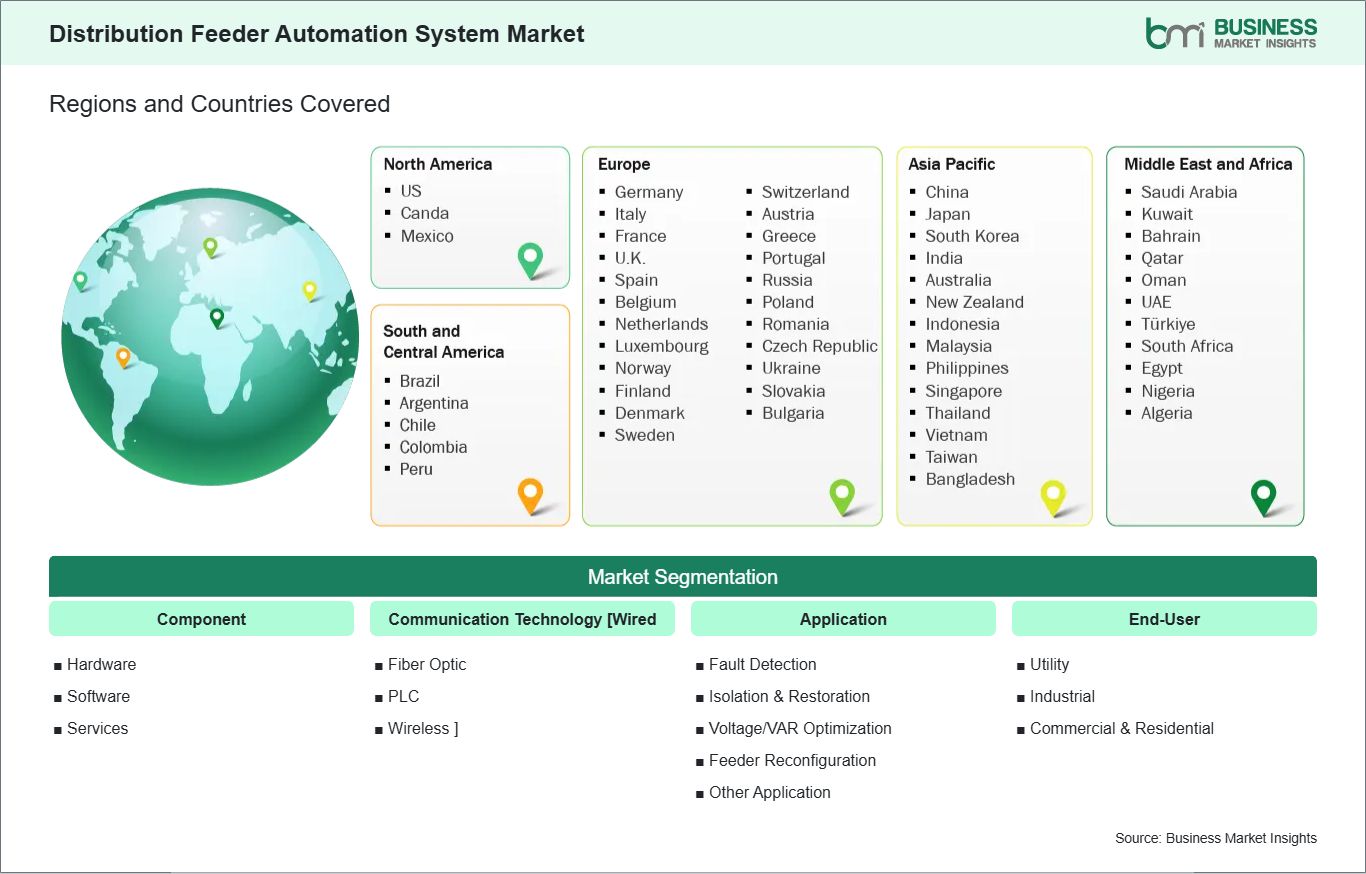
Key segments that contributed to the derivation of the distribution feeder automation system market analysis are component, communication technology, application, and end-user.
- By component, the market is segmented into hardware, software and firmware, and services. The hardware segment, comprising reclosers, sectionalizers, fault indicators, capacitor banks, and remote terminal units (RTUs), dominated the market in 2025, as these physical devices form the essential infrastructure for automation.
- By communication technology, the market is categorized into wired (fiber optic, power line carrier) and wireless (RF mesh, cellular, others). Wireless communication technologies, particularly RF mesh and cellular (4G/5G), held the largest and fastest-growing share in 2025. They offer lower deployment costs and greater flexibility for retrofitting existing infrastructure compared to trenching for fiber optics, making them ideal for expansive distribution networks.
- By application, the market is segmented into Fault Detection, Isolation & Restoration (FDIR), Voltage/VAR Optimization, Feeder Reconfiguration, and others. FDIR accounted for the dominant share in 2025, as it delivers the most immediate and measurable benefit to utilities by minimizing outage times and improving reliability metrics, which are key performance indicators for regulators and customers.
- By end-user, the market is segmented into utility, industrial, and commercial & residential. The utility segment held the overwhelming revenue share in 2025, as electric distribution companies are the primary owners and operators of feeder networks.
Market Forces
Distribution Feeder Automation System Market Drivers and Opportunities
Grid Modernization Mandates and Rising Demand for Reliability
The primary driver for feeder automation is the global push for grid modernization, often backed by regulatory mandates and government funding. Aging infrastructure is prone to failures, leading to costly outages. Regulators are increasingly holding utilities accountable through performance-based rates that reward improved reliability (SAIDI/SAIFI). Feeder automation directly addresses this by enabling a self-healing grid, making it a strategic investment for utilities to meet regulatory expectations, reduce operational costs from truck rolls for manual restoration, and enhance customer satisfaction. The integration of distributed energy resources (DERs) further complicates grid management, creating voltage fluctuations and reverse power flows that automation systems are uniquely positioned to monitor and mitigate.
Integration of Advanced Analytics and DER Management
A major growth opportunity lies in the convergence of feeder automation with Advanced Distribution Management Systems (ADMS) and Distributed Energy Resource Management Systems (DERMS). Modern automation systems are evolving from simple fault management to becoming data-rich platforms. By integrating advanced analytics, machine learning, and weather data, utilities can transition from reactive fault response to predictive maintenance—identifying potential failures (e.g., deteriorating insulation) before they cause outages. Furthermore, as EV penetration and rooftop solar increase, feeder automation systems equipped with DERMS capabilities can actively manage these resources to provide grid services (voltage support, peak shaving), unlocking new value streams and ensuring grid stability.
Size and Share Analysis
Distribution Feeder Automation System Market Size and Share Analysis
By component, hardware remains the largest segment due to the capital-intensive nature of grid equipment. However, the software segment is experiencing higher growth as the intelligence layer becomes more sophisticated, and utilities increasingly adopt cloud-based ADMS platforms. Services related to system integration, consulting, and maintenance are also expanding as deployments become more complex.
By communication technology, wireless solutions are rapidly gaining share due to their scalability and cost-effectiveness. Cellular technology (leveraging public 4G/5G networks) is particularly promising for wide-area coverage, while RF mesh is well-established for dense urban deployments. Fiber optics retains a strong position for high-bandwidth, high-reliability backbone communication in critical utility corridors.
By application, FDIR is the established core application driving initial investments. Voltage/VAR optimization is a high-growth segment as utilities focus on energy efficiency, loss reduction, and integrating renewables. Feeder reconfiguration for load balancing is becoming more important with the uneven load growth from EV clusters.
By end-user, the utility sector is the clear leader. The industrial segment represents a niche but high-value market for microgrids and campus-level automation to ensure process continuity. Commercial and residential influence is indirect, driven by their demand for reliable power and adoption of DERs.
Report Coverage
Distribution Feeder Automation System Market Report Coverage and Deliverables
The "Distribution Feeder Automation System Market Size and Forecast (2022-2033)" report provides a detailed analysis of the market covering below areas:
- Distribution Feeder Automation System Market size and forecast at global, regional, and country levels for all the key market segments covered under the scope
- Distribution Feeder Automation System Market trends, as well as market dynamics such as drivers, restraints, and key opportunities
- Distribution Feeder Automation System Market analysis covering key market trends, global and regional framework, major players, regulations, and recent market developments
- Industry landscape and competition analysis covering market concentration, heat map analysis, prominent players, and recent developments for the distribution feeder automation system market
- Detailed company profiles, including SWOT analysis
Geographic Insights
Distribution Feeder Automation System Market Geographic Insights
The geographical scope of the distribution feeder automation system market report is divided into five regions: North America, Asia Pacific, Europe, Middle East & Africa, and South & Central America. Asia Pacific is expected to witness the highest growth during the forecast period, while North America currently holds a significant share due to early adoption and regulatory pushes.
Asia Pacific, led by China, India, Japan, and Southeast Asian nations, is the fastest-growing market. This growth is fueled by massive investments in expanding and modernizing electricity infrastructure to support economic development, ambitious government smart grid initiatives, and the need to improve reliability in rapidly urbanizing areas with increasing power demand.
North America, particularly the United States and Canada, is a mature yet steadily growing market. Strong regulatory frameworks incentivizing grid resilience (e.g., following major weather events), significant utility investment cycles, and high penetration of DERs are key drivers. The U.S. Department of Energy's grid modernization programs provide further impetus.
Europe is a technologically advanced market with a strong focus on renewable integration and energy efficiency. EU directives and funding for smart grid projects, coupled with the need to manage a high share of intermittent renewables, are driving sophisticated feeder automation deployments in countries like Germany, the UK, France, and the Nordic nations.
Industry Activity
Recent Developments
The distribution feeder automation system market is evaluated by gathering qualitative and quantitative data post primary and secondary research, which includes important corporate publications, association data, and databases. A few of the key developments in the distribution feeder automation system market are:
- In January 2026, Hubbell Incorporated is set to introduce its newest advancements in grid automation and intelligent infrastructure at DTECH 2026, booth 3711. The company will highlight its long-established partnerships with utilities and its deep experience developing solutions shaped by real-world operational needs.
- In August 2025, Schneider Electric, the leader in the digital transformation of energy management and automation, announces the launch of FeederSeT - a new product range bringing advanced digital connectivity to circuit protection solutions. The FeederSeT range has been designed to support both sustainability and smart system intelligence. It features comprehensive asset health monitoring capabilities, while being adaptable and scalable in line with needs, making it a future-proof choice for any application.
Trust & Transparency
Research Methodology
The market analysis combines proprietary research with secondary data from government agencies, company disclosures, regulatory filings, industry databases and expert interviews. Market estimates are validated through data triangulation, cross-market benchmarking and analyst
review.
View Full Research Methodology
Key Sources Referred:
World Bank - Global Trade IndicatorsWorld Trade Organization (WTO)International Monetary Fund (IMF)International Trade Administration (ITA)Company websiteCompany annual reportsCompany investor presentations