Market Summary
Executive Summary and Global Market Analysis
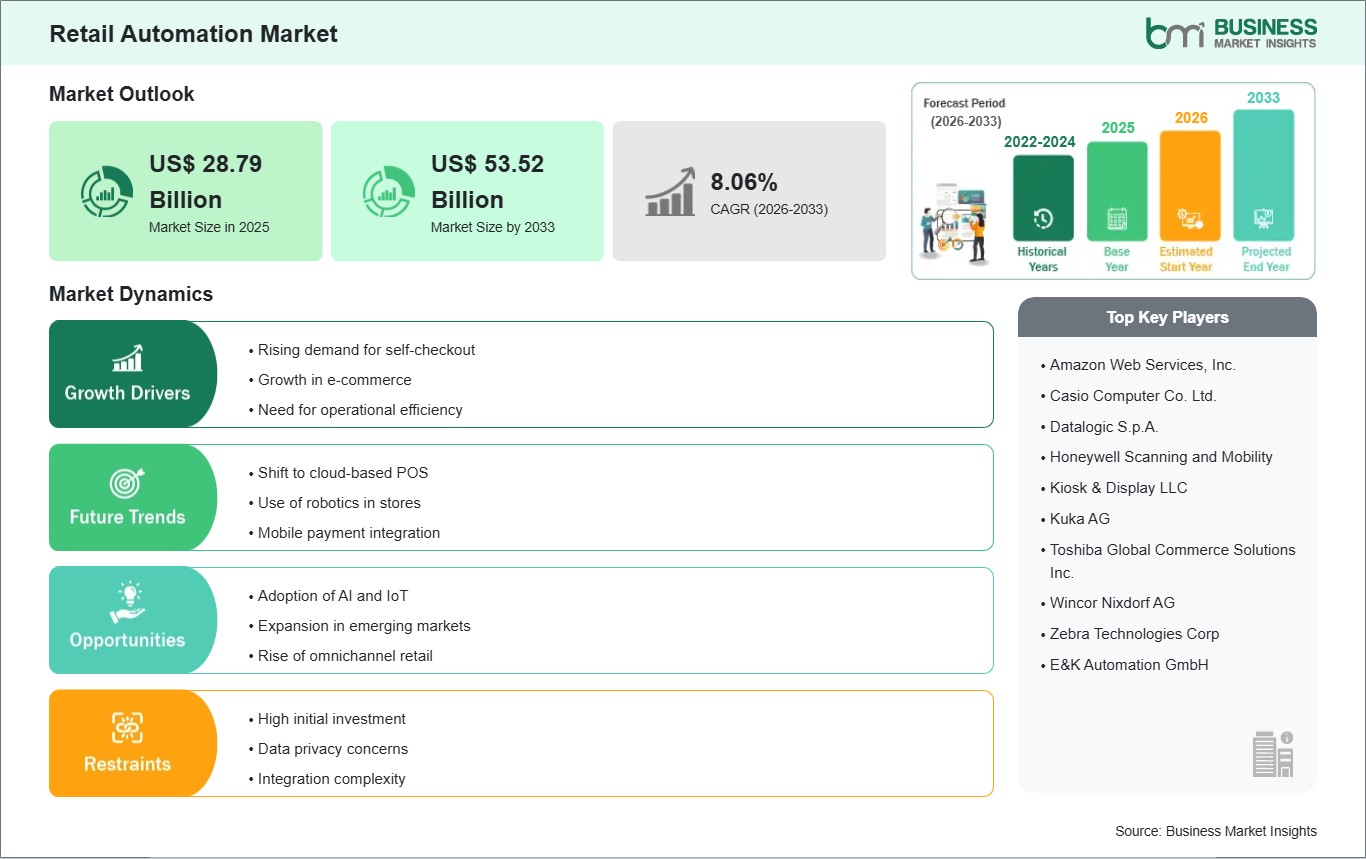
Retail Automation is a significant factor in the modernization of the shopping experience with smarter operations and better customer service. Retail automation is an absolute necessity in food and beverages, fashion, electronics, and pharmaceutical sectors. There are many benefits to retail automation, such as saving labor costs, minimizing human error, and allowing for the provision of a seamless checkout experience. Labor shortages, the evolution of the omnichannel approach, and the corresponding need for just-in-time inventory management systems are driving the market. Improvements in the areas of Artificial Intelligence, the Internet of Things, and computer vision are also increasing the efficiency of customer services and reliability.
However, some factors might impede the development of the industry, including high adoption costs, data concerns, and complexity in global supply chains. Moreover, it is affected by fluctuations in the economy and initial resistance towards displacement-related concerns. Despite some factors acting as impediments, there are immense opportunities in meeting personal shopping experiences, increasing organized retail in developing nations, and use cases in autonomous warehouse solutions. Moreover, strategic investment in hyper-local fulfillment networks and AI-driven demand forecasting can open additional avenues for operational efficiency and sustained industry growth.
Segment Analysis
Retail Automation Market Segmentation
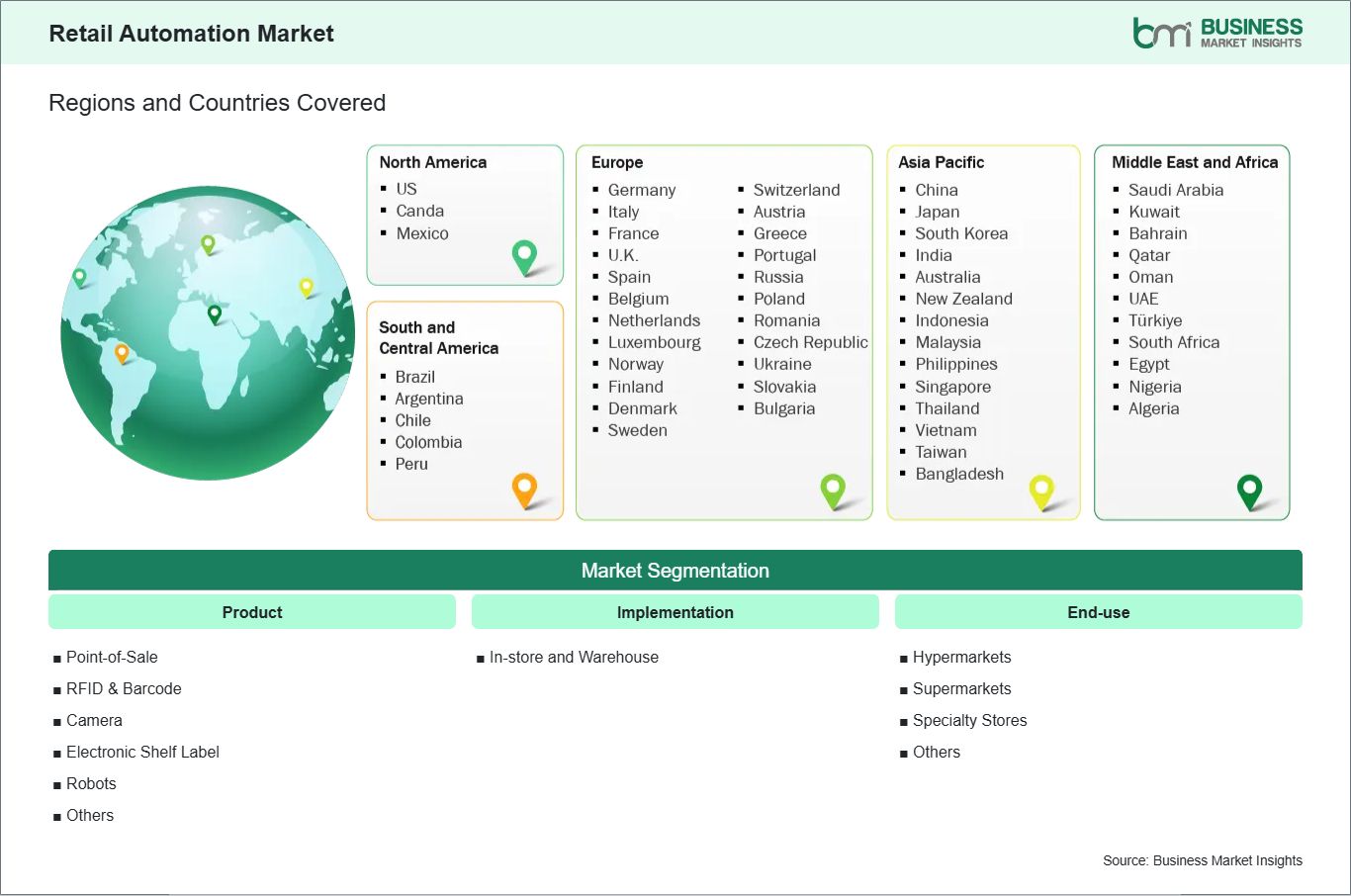
Key segments that contributed to the derivation of the Retail Automation market analysis are product, implementation, and end use.
- By Product, the market is segmented into Point-of-Sale, RFID & Barcode, Camera, Electronic Shelf Label, Robots, and Others.
- By Implementation, the market is segmented into In-store and Warehouse.
- By End Use, the market is segmented into Hypermarkets, Supermarkets, Specialty Stores, and Others.
Market Forces
Retail Automation Market Drivers and Opportunities
Rising Labor Costs and Workforce Shortages
The increasing cost of manual labor and persistent workforce shortages have emerged as pivotal factors positively driving the retail automation market. As minimum wages rise globally and retailers face a shrinking pool of available labor for repetitive tasks, automation provides a critical solution to maintain operational efficiency without inflating overhead costs.
By adopting technologies such as self-checkout kiosks and automated inventory systems, retailers can redirect their human capital toward higher-value customer service roles. This shift not only addresses the immediate challenge of labor scarcity but also enhances overall productivity. The adoption of these technologies leads to a reduction in operational costs by up to 30%, making it a vital strategy for businesses to remain competitive in a landscape where consumer expectations for speed and accuracy continue to climb.
Expansion of AI-Driven Hyper-Personalization
The integration of Artificial Intelligence and Machine Learning presents a significant opportunity for the retail automation market to evolve from operational efficiency toward value-added customer engagement. Beyond just automating transactions, retailers are now using AI-powered cameras and sensors to analyze shopper behavior in real-time, allowing for a level of "hyper-personalization" that was previously unattainable.
Retailers are increasingly deploying AI-enabled systems that recognize loyal customers and push tailored promotions directly to their mobile devices or electronic shelf labels as they browse. This trend is highly lucrative, as studies indicate that 91% of consumers are more likely to shop with brands that provide relevant, personalized offers and recommendations. By leveraging big data and predictive analytics, retailers can anticipate consumer needs before they even enter the store. This opportunity allows physical retail locations to match the data-driven precision of e-commerce platforms, creating a "phygital" environment that fosters deeper brand loyalty and significantly increases conversion rates.
Size and Share Analysis
Retail Automation Market Size and Share Analysis
The retail automation market demonstrates steady growth, with size and share analysis revealing evolving trends and competitive positioning among key players. The report further examines subsegments categorized within product, implementation, and end use, offering insights into their contribution to overall market performance.
For instance, Point-of-Sale (POS) systems hold a significant market share, as they are fundamental to every retail transaction. Modern POS solutions are increasingly cloud-enabled, offering integrated payment gateways and real-time sales analytics. In-store implementation involves the deployment of customer-facing technologies like self-checkout kiosks and smart mirrors. This segment benefits from the rising demand for contactless shopping experiences and reduced wait times. Supermarkets utilize retail automation for high-volume inventory management and automated shelf replenishment, ensuring that perishables are tracked accurately and stock-outs are minimized through automated ordering.
Report Coverage
Retail Automation Market Report Coverage and Deliverables
The "Retail Automation Market Size and Forecast (2022 - 2033)" report provides a detailed analysis of the market covering below areas:
- Retail Automation market size and forecast at global, regional, and country levels for all the key market segments covered under the scope
- Retail Automation market trends, as well as market dynamics such as drivers, restraints, and key opportunities
- Retail Automation market analysis covering key market trends, global and regional framework, major players, regulations, and recent market developments
- Industry landscape and competition analysis covering market concentration, heat map analysis, prominent players, and recent developments for the Retail Automation market
- Detailed company profiles, including SWOT analysis
Geographic Insights
Retail Automation Market Geographic Insights
The geographical scope of the Retail Automation market report is divided into five regions: North America, Asia Pacific, Europe, Middle East & Africa, and South & Central America.
The Asia-Pacific Retail Automation market is segmented into China, Japan, South Korea, India, Australia, New Zealand, and the Rest of Asia. The Asia-Pacific region is experiencing the fastest growth, driven by the rapid expansion of organized retail and the surge in e-commerce fulfillment needs. Major economies like China and India are leading the way, fueled by massive digital transformation efforts and the development of "unmanned" convenience stores.
The region is witnessing increased adoption of advanced logistics technologies, including Warehouse Robotics and AI-based inventory tracking. Growth is also supported by the rising middle-class population and increased disposable income, leading to higher demand for sophisticated shopping experiences. Additionally, the proliferation of mobile payment ecosystems in the region has created a seamless environment for the integration of automated POS and self-service kiosks. Governments in the region are also encouraging the adoption of smart city and smart retail initiatives, further solidifying Asia-Pacific's position as a high-growth hub in the global retail automation ecosystem.
Industry Activity
Recent Developments
The Retail Automation market is evaluated by gathering qualitative and quantitative data post primary and secondary research, which includes important corporate publications, association data, and databases. A few of the key developments in the Retail Automation market are:
- In June 2025, Amazon unveiled three ground-breaking AI innovations that create real-world value for our customers, employees, and delivery partners. The new advancements, which include Wellspring, a generative AI mapping technology; an AI-powered demand forecasting model that’s powering Amazon’s supply chain; and new agentic AI capabilities for robotics, represent Amazon's continued investment in cutting-edge, practical AI applications that solve real-world logistics challenges.
- In January 2025, Datalogic, a global leader in automatic data capture and industrial automation markets, announced the launch of Shopevolution™ 8, the latest version of its cutting-edge self-shopping software solution. Shopevolution™ 8 revolutionizes the way retailers can provide the ultimate self-service customer shopping experience without the worry of increasing shrinkage. Datalogic has embedded its loss prevention solution with machine learning technologies and AI that learn from every shopper’s journey, and trigger audits and rescans whenever needed.
Trust & Transparency
Research Methodology
The market analysis combines proprietary research with secondary data from government agencies, company disclosures, regulatory filings, industry databases and expert interviews. Market estimates are validated through data triangulation, cross-market benchmarking and analyst
review.
View Full Research Methodology
Key Sources Referred:
World Bank - Global Trade IndicatorsWorld Trade Organization (WTO)International Monetary Fund (IMF)International Trade Administration (ITA)Company WebsitesCompany Annual ReportsCompany Investor Presentations