
Tungsten Market Outlook: Size, Share, Trends, Growth Analysis, Competitive Landscape & Forecast, 2026-2033

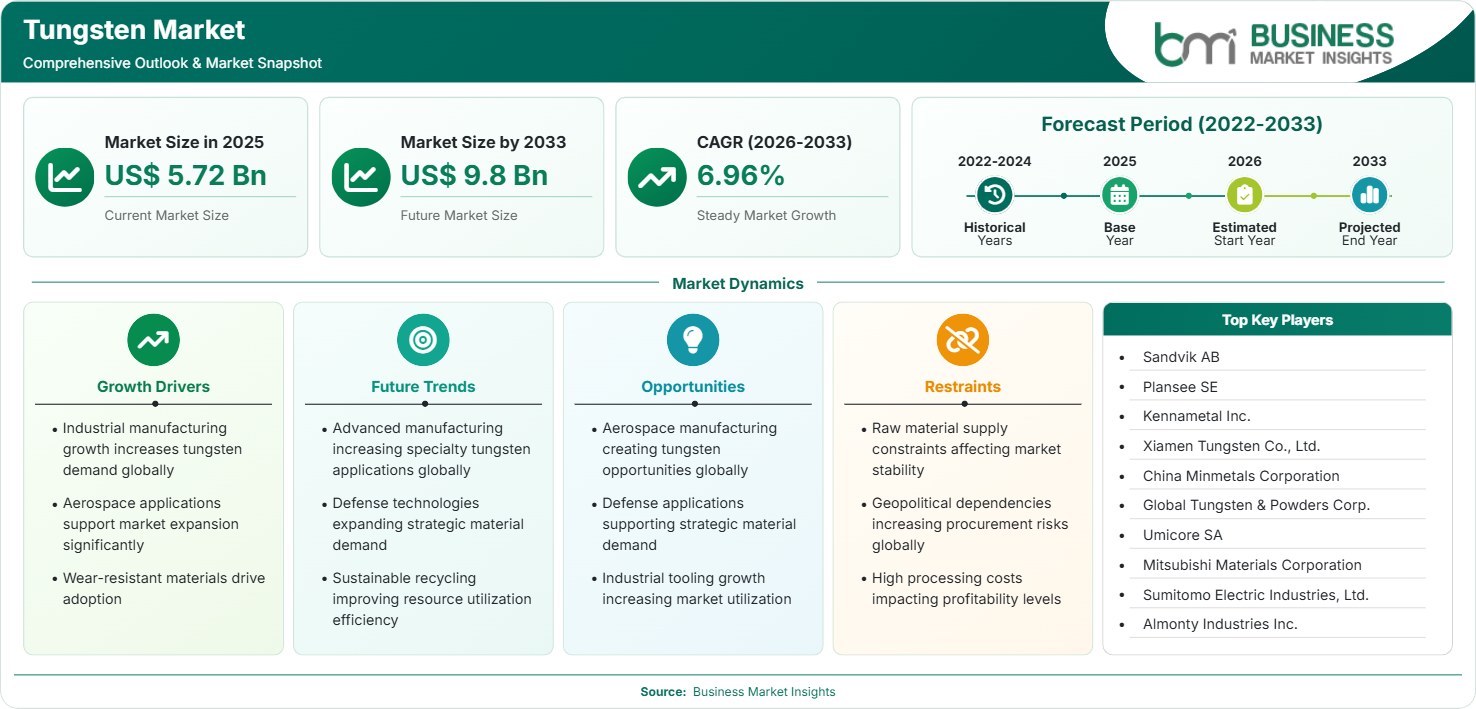
The Tungsten Market size was valued at US$ 5.72 Billion in 2025 and is projected to reach US$ 9.8 Billion by 2033, growing at a CAGR of 6.96% during 2026–2033, driven by carbide tooling demand, aerospace applications, supply-chain diversification, recycling investments, and critical-mineral strategies.

Report Coverage
  • Product: Carbide, Mill Products, Alloys, Others
  • End-Use Industry: Automotive, Construction, Mining, Aerospace & Defense, Others
US$ 5.72 Bn Market size in 2025
US$ 9.8 Bn Market Size by 2033
6.96% CAGR, 2026 - 2033
2026-2033 Forecast Period

AI Overview

Tungsten Market Summary

  • North America Region: North America holds a market share of 10%–13% in 2025, growing with a CAGR of 5.8%–6.4%, influenced by defense procurement, aerospace machining, domestic supply initiatives, recycling capacity, and strategic stockpiling opportunities. US demand is supported by aerospace, defense, mining equipment, and precision machining, with a CAGR estimated at 5.9%–6.5% during 2026–2033.
  • Fastest Growing Region: Asia Pacific holds Tungsten Market share of 70%–73% in 2025, expanding at a CAGR of 7.0%–7.5%, supported by integrated mining, refining, carbide production, automotive manufacturing, construction activity, electronics, infrastructure development, and expanding regional tooling demand.
  • Leading Segment: Carbide holds a market share of 56%–60% in 2025, advancing at a CAGR of 7.2%–7.7%, supported by cutting tools, drilling equipment, wear components, machining productivity, longer tool life, automated manufacturing, and expanding industrial production.
  • High Growth Segment: Aerospace and Defense represents 13%–17% of demand in 2025, expanding at a CAGR of 7.8%–8.4%, driven by turbine machining, defense manufacturing, high-temperature components, kinetic applications, precision tooling, and strategic domestic sourcing requirements.
  • Key Market Opportunity: Supply diversification outside China creates opportunities for integrated miners, recyclers, refiners, and downstream manufacturers to develop traceable tungsten chains supporting aerospace, defense, semiconductors, energy, and advanced manufacturing applications.
  • Major Market Players: Sandvik AB; Plansee SE; Kennametal Inc.; Xiamen Tungsten Co., Ltd.; China Minmetals Corporation; Global Tungsten & Powders Corp.; Umicore SA; Mitsubishi Materials Corporation; Sumitomo Electric Industries, Ltd.; Almonty Industries Inc.
Strategic Insights

Tungsten Market: Strategic Insights

Tungsten Market Strategic Framework
FREE PDF
Request your free sample
Request free sample
Stakeholder View

Key Takeaways

  • Supply chain resilience is now turning into a competitive advantage since manufacturers are looking to obtain their concentrate, powder, carbide, and recycled materials from a variety of sources rather than depending on procurement systems that rely on a single country.
  • The strongest near-term opportunity for volume lies with carbide products since the industries involved, cutting, drilling, mining, construction, and precision machining, need wear-resistant materials that are able to keep up their productivity under tough operating conditions.
  • The focus of research is now turning towards higher material efficiency and greater performance consistency in a variety of demanding applications because of recycling, the use of fine-grain carbide grades, cobalt-reduced formulations, powder optimization, and automated processing.
  • South Korea offers a highly attractive investment opportunity since Sangdong is resuming production, thereby enhancing the availability of non-Chinese tungsten while linking together mining, concentrate production, downstream processing, and long-term off-take agreements.
  • Money is being directed towards vertical integration. Recent transactions and agreements have increasingly linked mines with refiners and downstream powder producers, which improves insight into the availability of feedstock and reduces vulnerability to fluctuations in raw materials.
  • In aerospace, defense, semiconductor, medical, and energy applications, there is a demand for premium value since component qualification, dimensional stability, heat resistance, and material traceability are more important than mere commodity pricing.
Geographic Outlook

Tungsten Market Regional Highlights

North America Tungsten Market

North America represented 10%–13% Tungsten Market share in 2025 and is projected to expand at a 5.8%–6.4% CAGR through 2033. Demand centers on aerospace machining, defense production, mining equipment, industrial tooling, and strategic-material programs.

  • Premium tungsten products are required in the aerospace and defense industries for use in qualified manufacturing applications since they need high density, thermal resistance, dimensional stability, and good wear performance.
  • Since production is concentrated on a global scale, US manufacturers are placing greater emphasis on secure sourcing because defense, precision tooling, and advanced industrial applications need a reliable supply of materials.
  • Recycling offers a practical means of reducing reliance on imported concentrates while helping to establish circular manufacturing processes for carbide tools, machining scrap, and tungsten-containing production residues.
  • Investments in strategic stockpiling and in domestic processing can help to enhance supply resilience, especially since government procurement requirements are placing greater emphasis on the origin, traceability, and availability of critical mineral inputs.

US Tungsten Market

The US represented approximately 65%–70% of North American Tungsten Market demand in 2025, with consumption expanding at a 5.9%–6.5% CAGR through 2033. Aerospace, defense, industrial machinery, mining, and precision manufacturing underpin demand.

  • The need for defense procurement is leading to a better commercial reason for obtaining tungsten via traceable and strategically aligned supply chains, especially in the case of applications that require high density, hardness, and temperature resistance.
  • Aerospace production uses special mill products and carbide tooling since manufacturers need consistent performance when machining difficult-to-cut alloys and high-value components.
  • Recycling schemes are able to boost the amount of material available in the country by retrieving tungsten from carbide tooling and industrial scrap, thus lessening the need for imported primary concentrates.

Europe Tungsten Market

Europe accounted for 9%–12% Tungsten Market share in 2025 and is expected to expand at a 6.1%–6.7% CAGR. Germany, Italy, France, Austria, and Sweden remain important consumption centers, while Austria has strategic relevance through integrated tungsten mining and processing.

  • Germany is still the leading demand center since automotive manufacturing, industrial machinery, tooling, and engineering applications need carbide products, which are able to keep up productivity in high-volume production environments.
  • Austria is important strategically because of the way in which it combines mining, refining, recycling, and downstream manufacturing, offering Europe a fully developed tungsten value chain apart from China.
  • Because of the demand from France and Italy in the fields of aerospace, defense, automotive industries, and industrial machinery, there are opportunities for high-performance mill products, carbide tooling, and specialized tungsten alloys.
  • Sweden has a combination of advanced engineering, experience in the production of mining equipment, and expertise in cemented carbides, which meets the demand for high-quality tungsten powders and wear-resistant tooling in a range of industrial applications.

Asia Pacific Tungsten Market

Asia Pacific accounted for 70%–73% Tungsten Market share in 2025 and is forecast to grow at a 7.0%–7.5% CAGR, making it the leading regional market. China dominates upstream production and downstream processing, while Japan, South Korea, India, and Southeast Asian manufacturing centers support consumption. China remains central to mining, refining, powder, and carbide production.

  • China is still the main regional distribution center, involving itself in mining, refining, the production of powder, the manufacture of carbide, and the production of downstream tools, and as a result achieves significant economies of scale throughout the value chain.
  • Japan meets premium demand in the fields of automobiles, electronics, machinery, and precision manufacturing by using fine-grain carbide and specialized tungsten products to enhance machining performance.
  • As South Korea becomes more strategically important, Sangdong is once again entering production and thus providing an extra source of concentrate that is not Chinese for downstream customers in the region and elsewhere.
  • India is a high-growth market when it comes to consumption since the rise in automotive production, infrastructure investment, mining, engineering, and the modernization of manufacturing is increasing the demand for durable tooling.

Rest of World Tungsten Market

South and Central America together represented a smaller portion of global demand in 2025, while Middle East and Africa consumption remained concentrated in mining, construction, oilfield services, and industrial equipment. Regional Tungsten Market demand is supported by infrastructure investment and extractive industries.

  • The modernization of mining in Latin America leads to an increased demand for carbide drill components, wear parts, cutting tools, and tungsten-containing equipment that are used in highly abrasive operating conditions.
  • Since Brazil has a demand in the areas of mining, construction, manufacturing, and infrastructure, suppliers have the opportunity to expand their business beyond those specialized applications relating to the extractive industry.
  • South Africa has a well-developed ecosystem of mining equipment, whereas Saudi Arabia and the UAE offer growth opportunities as a result of their industrial diversification and infrastructure development.
  • Because imported tungsten products are still vulnerable to disruptions in logistics, currency, pricing, and the upstream supply chain, regional buyers are increasingly able to benefit from long-term relationships with their suppliers.
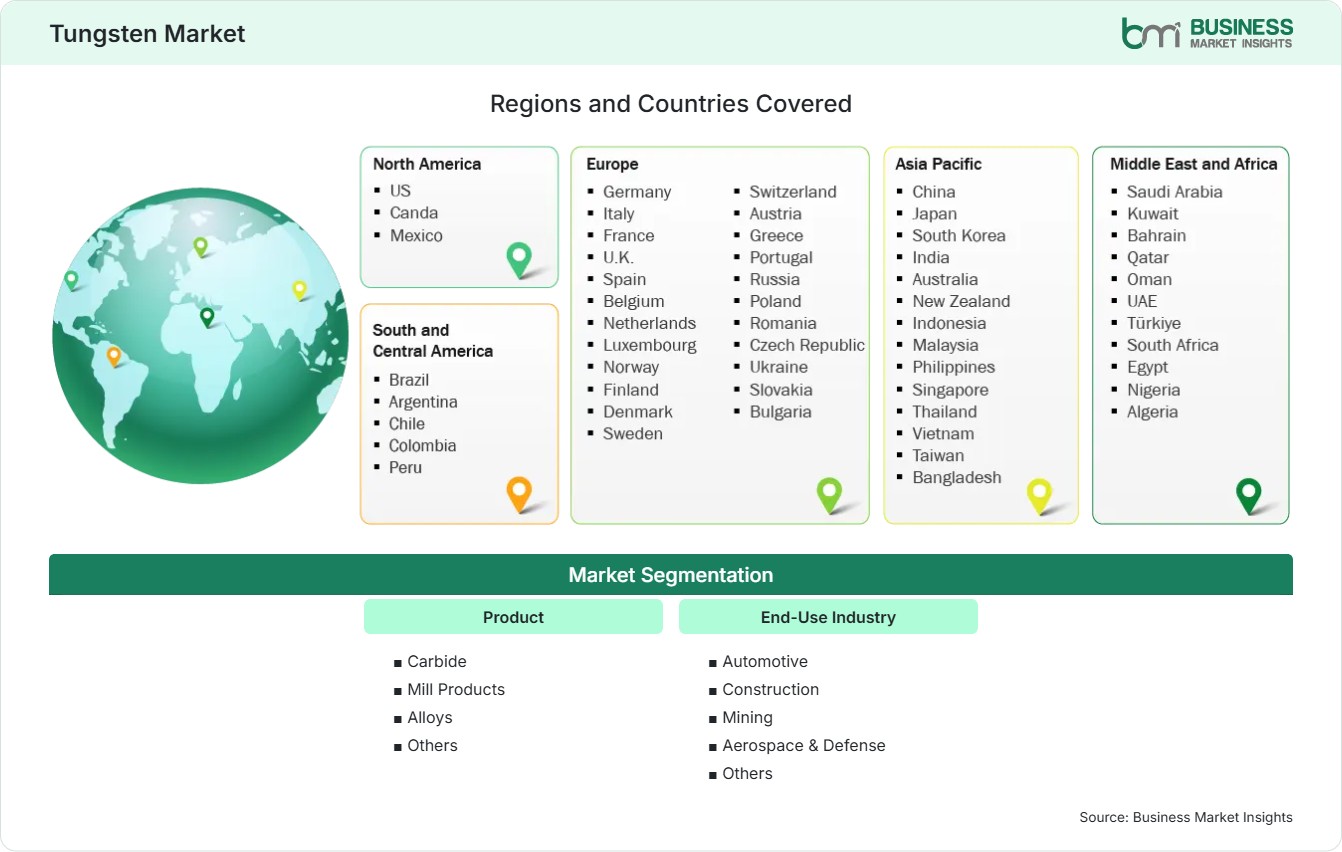
Global Market Geography
FREE PDF
Request your free sample
Request free sample
Segment Analysis

Tungsten Market Segmentation

Product

Product demand is led by carbide, which held a 56%–60% Tungsten Market share in 2025 and is projected to grow at a 7.2%–7.7% CAGR through 2034. Carbide benefits from cutting, drilling, mining, and wear applications, while mill products and alloys serve specialized industrial requirements.

  • Carbide: Cemented carbide supports cutting, drilling, mining, and wear applications where hardness and abrasion resistance extend component life. Automation and precision machining strengthen adoption across industrial manufacturing.
  • Mill Products (Sheet, Rods, Plates): Sheets, rods, and plates serve high-temperature, electrical, aerospace, medical, and industrial components requiring dimensional stability, density, and thermal performance under demanding operating conditions.
  • Alloys: Tungsten alloys combine high density with engineered mechanical properties for counterweights, radiation shielding, defense components, and specialized industrial applications. Performance requirements support continued product customization.

End-Use Industry

End-use demand is diversified across automotive, construction, mining, aerospace and defense, and other industries. Aerospace and defense represented 13%–17% of the Tungsten Market demand in 2025 and is projected to achieve a 7.8%–8.4% CAGR through 2034, supported by specialized high-performance applications.

  • Automotive: Automotive manufacturing uses carbide cutting and forming tools extensively, while electric-vehicle production creates additional precision-machining requirements for drivetrain, motor, battery, and lightweight-material components.
  • Construction: Construction equipment requires wear-resistant drilling and cutting components capable of operating against concrete, rock, and reinforced structures. Infrastructure expansion supports replacement and maintenance demand.
  • Mining: Mining remains a core application because drilling, crushing, cutting, and excavation expose tools to extreme abrasion. Higher productivity requirements favor premium carbide grades and durable wear components.
  • Aerospace and Defense: Aerospace and defense applications demand dense, thermally stable, wear-resistant materials for precision tooling, specialized components, and demanding manufacturing environments where qualification and reliability outweigh commodity-cost considerations.
Market Forces

Tungsten Market Dynamics

Key Market Drivers

Rising Demand for High-Performance Carbide Tooling

Demand for carbide tooling is a principal structural driver because manufacturers increasingly prioritize machining productivity, tool life, dimensional accuracy, and reduced downtime. Tungsten Market growth benefits from the concentration of tungsten carbide applications in cutting, drilling, milling, mining, and wear protection. Automotive, aerospace, construction equipment, and general engineering manufacturers increasingly machine harder alloys and complex geometries, raising the value of premium carbide grades. Fine-grain structures, optimized binders, coatings, and precision grinding improve tool performance without proportionally increasing material consumption.

Expansion of Aerospace and Defense Manufacturing

Aerospace and defense manufacturing is supporting demand for tungsten because extreme operating environments require materials with high density, thermal stability, hardness, and wear resistance. Tungsten Market trends are reinforced by aircraft production, engine manufacturing, precision machining, defense equipment, and specialized components. Plansee reported continued demand from aviation and defense while expanding production capacity for tungsten powders, heavy metals, wires, and sheets during fiscal 2025/26.

Increasing Strategic Focus on Supply Security

Supply concentration is driving procurement diversification, recycling, and long-term contracting across the tungsten value chain. China accounts for more than 80% of global tungsten supply according to industry disclosures, making geopolitical developments highly relevant to international buyers. Tungsten Market growth, therefore, increasingly reflects supply-security investment as well as end-use consumption. Plansee has pursued long-term mine agreements, recycling, and vertically integrated processing, while Sandvik has emphasized diversified sourcing and its Austrian tungsten operation.

Key Market Opportunities

Expansion of Tungsten Recycling and Circular Supply Chains

Recycling provides an effective structural opportunity owing to the fact that scrap metals containing tungsten are economically valuable and can be reused through the process of powder manufacturing. Plansee managed to recycle 92 percent of its tungsten in the fiscal year 2025/26. Tungsten Market opportunities extend across carbide tooling scrap, machining residues, production offcuts, and end-of-life industrial components. Suppliers that combine collection networks with chemical processing, powder production, and downstream manufacturing can capture value at several stages.

Development of Non-Chinese Tungsten Mining Capacity

Reactivating mines that are not located within China represents a very significant window of opportunity for companies operating on an integrated basis and end-users looking to diversify their sources. The example of Sangdong in South Korea shows just how big such a window is. Processing operations commenced at the mine in June 2026, and it was then certified for commercial processing operations. Phase I has been based on the processing of about 640,000 tonnes of ore per year. Tungsten Market Forecasts are therefore increasingly linked to mine development schedules, processing ramp-up, offtake commitments, and downstream conversion capacity.

Growth of Integrated Powder-to-Product Manufacturing

Vertical integration provides an opportunity to enhance quality control, cut down on intermediate handling, and obtain greater value from the tungsten feedstock. Producers who are integrated are able to coordinate the various stages involving concentrate conversion, the production of oxides, powder manufacturing, pressing, sintering, machining, recycling, and the making of custom components. This method is especially appealing for use in aerospace, defense, semiconductor, and medical applications since material qualification and traceability are essential there. The fact that Plansee has made investments in tungsten oxide, powders, heavy metals, sheets, wires, and industrial furnaces shows how wide the range of downstream expansion opportunities is.

Market Restraints and Challenges

High Supply Concentration and Geopolitical Exposure

The fact is that global tungsten mining and processing are still very much concentrated in China, which means that companies are vulnerable to changes in export policies, geopolitical tensions, disruptions to the supply chain, and shifts in domestic priorities. As a result, buyers who are not within the main supply region might have to pay higher prices, face longer procurement cycles, suffer delays in qualification, and need to hold larger inventories. Sandvik has stated that China accounts for about 80% of the world's tungsten supply, and Plansee has indicated that tungsten availability in the West is becoming more restricted.

Capital Intensity and Technical Complexity of New Supply

The need for specialized processing equipment, metallurgical knowledge, environmental safeguards, and customer approval applies to tungsten mining, refining, recycling, and powder production. This results in very high initial capital costs, which can slow down projects, raise financing risks, and limit the number of new suppliers who can operate commercially. Additionally, downstream customers will not approve alternative materials until they have confirmed the powder's chemistry, particle features, density, grain structure, and mechanical performance.

Company Analysis

Competitive Landscape

Competitive dynamics increasingly center on vertical integration, supply security, powder quality, recycling, carbide expertise, and long-term customer relationships. Tungsten Market analysis indicates that leading participants are strengthening positions across mining, refining, powder production, carbide manufacturing, recycling, and specialized mill products.

Company Name

Overview

Products and Services relevant to this market

Sandvik AB

Global engineering group with strong positions in machining, mining, and powder solutions, supported by integrated tungsten capabilities.

Tungsten powders, carbide-related products, cutting tools, mining tooling, recycling solutions, and advanced powder technologies.

Plansee SE

Specialist high-performance materials producer with extensive tungsten and molybdenum processing expertise and integrated supply-chain capabilities.

Tungsten powders, sheets, wires, heavy metals, components, recycling, and customized high-performance tungsten products.

Kennametal Inc.

Global tooling and industrial technology company serving metalworking, infrastructure, energy, and transportation customers worldwide.

Tungsten carbide cutting tools, wear products, drilling solutions, machining systems, and engineered components.

Xiamen Tungsten Co., Ltd.

Major Chinese tungsten producer with integrated upstream and downstream capabilities across the tungsten value chain.

Tungsten concentrates, tungsten compounds, powders, carbide products, alloys, and related advanced materials.

China Minmetals Corporation

Large diversified metals group with extensive mineral resources, processing capabilities, and global industrial supply networks.

Tungsten concentrates, refined materials, tungsten products, trading, processing, and strategic mineral supply services.

Global Tungsten & Powders Corp.

Specialist tungsten powder producer serving demanding industrial and advanced-material applications with established processing expertise.

Tungsten powders, tungsten carbide powders, tungsten alloys, recycled tungsten materials, and engineered powder solutions.

Umicore SA

The Materials Technology Group focuses on circularity, specialty materials, recycling, and advanced industrial applications.

Tungsten recycling, specialty materials, metal recovery, advanced powders, and circular-material solutions.

Mitsubishi Materials Corporation

Japanese materials and manufacturing group with strong expertise in cemented carbide and precision cutting technologies.

Cemented-carbide products, cutting tools, tungsten carbide materials, wear-resistant solutions, and precision machining systems.

Sumitomo Electric Industries, Ltd.

Diversified technology company with substantial advanced-materials and cutting-tool capabilities serving global manufacturing industries.

Cemented carbide, cutting tools, sintered materials, tungsten-related components, and engineered industrial solutions.

Almonty Industries Inc.

Tungsten producer developing integrated supply outside traditional dominant sources, centered on the Sangdong operation in South Korea.

Tungsten concentrate, mining, processing, downstream tungsten oxide development, and long-term supply agreements.

Trust & Transparency

Research Methodology

The market analysis combines proprietary research with secondary data from government agencies, company disclosures, regulatory filings, industry databases and expert interviews. Market estimates are validated through data triangulation, cross-market benchmarking and analyst review.

View Full Research Methodology

Questions Answered

Frequently Asked Questions

What should buyers consider when selecting a tungsten supplier?

Buyers should evaluate feedstock security, product chemistry, powder characteristics, recycling capability, qualification history, geographic diversification, traceability, delivery reliability, technical support, and long-term contracting capacity rather than comparing suppliers solely on quoted material prices.

Which applications can generate premium tungsten demand?

Aerospace, defense, semiconductor manufacturing, medical equipment, precision tooling, and specialized industrial machinery can generate premium demand because these applications place greater emphasis on material consistency, qualification, reliability, dimensional stability, and thermal performance.

How does South Korea affect the global tungsten supply chain?

The restart of Sangdong creates an important non-Chinese source of tungsten concentrate. Its development can improve supply diversification for Asian and Western customers while supporting downstream processing and long-term procurement agreements.

Why is tungsten recycling becoming increasingly important?

Recycling provides an alternative source of tungsten feedstock without requiring new mining capacity. Carbide tooling scrap, manufacturing residues, and tungsten-containing components can be recovered and converted into usable materials, improving supply resilience while supporting circular manufacturing objectives.

What makes tungsten strategically important for advanced manufacturing?

The Tungsten Market Report highlights that Tungsten combines very high melting temperature, density, hardness, wear resistance, and thermal stability. These characteristics make it difficult to replace in demanding machining, aerospace, defense, mining, electronics, medical, and high-temperature applications where conventional metals cannot provide equivalent performance.

Access the Full Tungsten Market Report

Get segment-level forecasts, regional estimates, competitive benchmarking, company profiles and downloadable Excel datasets.

Access the full Tungsten Market Report
350 pages PDF & Excel | 2026-10-22
Similar Research

Related Market Reports