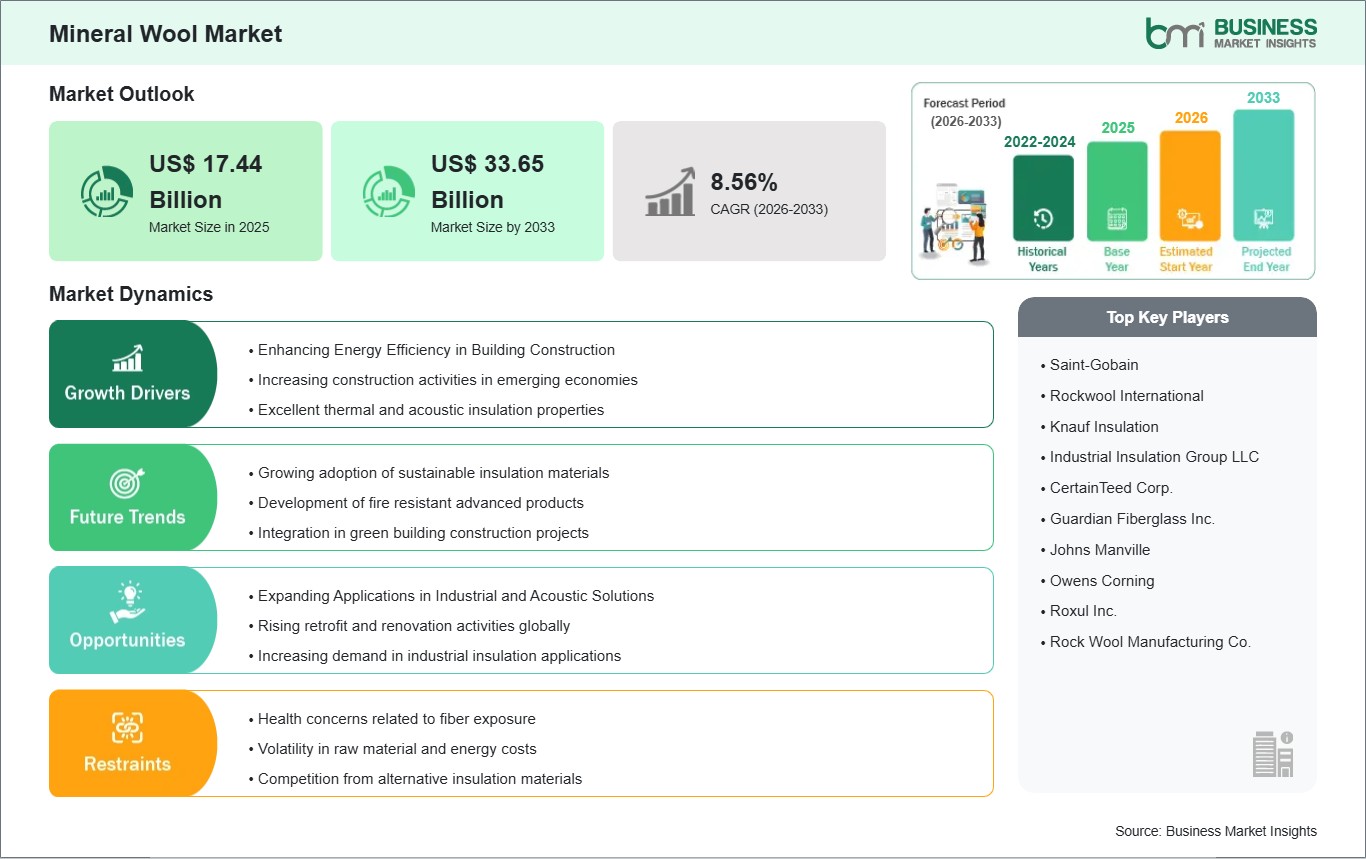
The Mineral Wool Market size is expected to reach US$ 33.65 Billion by 2033 from US$ 17.44 Billion in 2025. The market is estimated to record a CAGR of 8.56% from 2026 to 2033.
The mineral wool market is growing consistently as there is a significant demand for the use of mineral wool products, which provide thermal, acoustic, and fire-resistant insulation for buildings in a variety of applications, including industrial, commercial and residential sectors. Mineral wool is created from either basalt or slag fibres, and is recognised for its high-temperature stability, sound absorption performance, and energy-efficient properties; therefore, it is used extensively as an insulation material, primarily in construction, power generation and industrial facilities. Building codes and energy efficiency policies are also helping to drive mineral wool's acceptance and use as a necessary part of sustainable construction practices. New technology advancements, such as lightweight and flexible mats, rigid high-density boards, and pre-manufactured insulation panels, are improving the ease of installation, performance and adaptability of mineral wool products in many different applications.
There is an increasing emphasis on fire safety codes and the development of resilient infrastructure for buildings, particularly in commercial and high-rise buildings, which is also enhancing the overall growth of the mineral wool market. Mineral wool products are being used extensively for heat containment, process safety and operational efficiency in industrial sectors, specifically in petrochemical processing, power generation and manufacturing plants. The challenges faced by the mineral wool market include fluctuating prices for raw materials, dealing with safety issues when handling mineral wool products, and competition from alternative insulation materials (i.e., polyurethane and polystyrene foams). The participants in the mineral wool market are focusing their research and development efforts to develop "green" products, reduce production costs, and improve the thermal and acoustic performance of mineral wool products. Participants are also engaging in strategic partnerships with construction companies, industrial end-users, and distributors to enhance their market position.

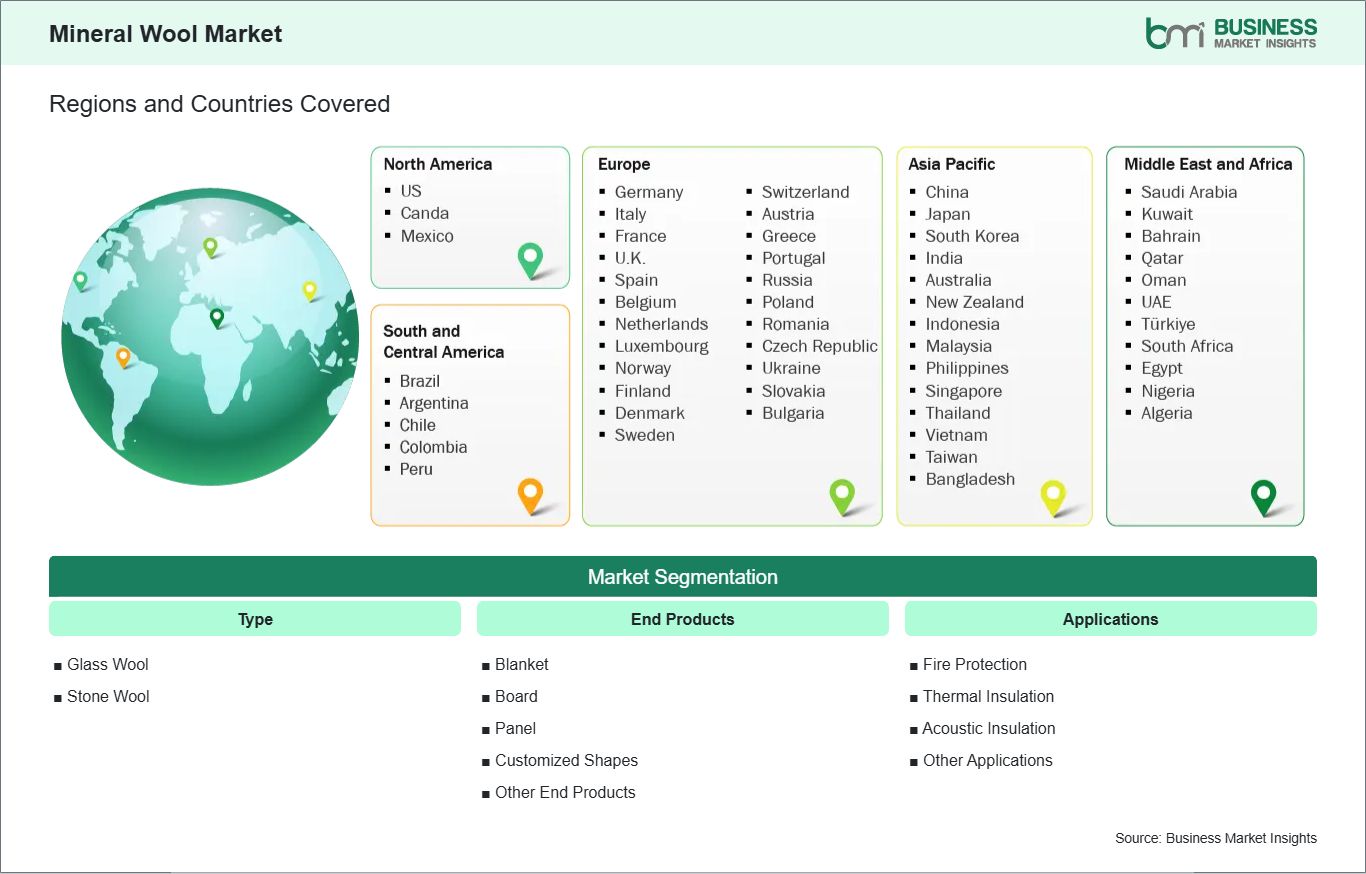
Key segments that contributed to the derivation of the mineral wool market analysis are type, end products, and applications.
The use of mineral wool insulation is becoming more common in the construction industry, especially due to the improved thermal and acoustic properties it offers. The thermal conductivity and resistance to fire are excellent, meaning it can be used to insulate walls, roofs, ceilings, and floors, ensuring that the indoor environment remains at a consistent temperature without compromising on energy efficiency, which is becoming a major criterion in modern constructions.
The fibrous composition of the material also offers excellent sound absorption, making it a suitable choice for commercial and residential constructions where sound absorption is a major criterion for building designs. In addition, the material is highly durable and resistant to moisture, mold, and pests, making it a suitable choice for constructions where long-term performance is a major criterion.
The material is highly versatile, meaning it can be used in a range of constructions, from commercial complexes to single-family homes, making it a suitable choice for architects and designers looking to provide the best insulation options to their clients.
In addition to thermal and acoustic benefits, mineral wool supports sustainable construction practices. It can be produced from natural and recycled raw materials, reducing environmental impact and contributing to green building certifications. Its fire-resistant properties enhance safety, protecting both occupants and property from potential hazards. With increasing awareness of energy efficiency, sustainability, and occupant comfort, mineral wool is positioned as a critical material in modern construction, offering a combination of performance, durability, and environmental responsibility that supports long-term operational efficiency.
Beyond construction, mineral wool is also used in various industrial processes where thermal insulation, fire resistance, and sound reduction are of primary concern. For instance, in manufacturing plants, power plants, and refineries, mineral wool is often utilized to offer insulation to high-temperature pipelines, boilers, and other equipment, ensuring their efficient working while minimizing heat loss.
In addition to this, sound reduction is also a significant application of mineral wool, and this sector is witnessing a surge in demand for this type of insulation material, particularly in soundproofing materials, sound studios, and theaters, among others. This is because of its density, which is capable of absorbing sound, thus reducing sound pollution in various commercial and domestic settings. This is where mineral wool scores over other insulation materials, owing to its versatility in meeting sound reduction and thermal insulation standards.
Sustainability and safety considerations further enhance the market potential for mineral wool. It is non-combustible, chemically stable, and often manufactured from recycled materials, supporting environmental and regulatory goals. As industries and public infrastructure increasingly focus on energy efficiency, fire protection, and noise management, mineral wool continues to emerge as a versatile, high-performance insulation solution. Its combination of durability, adaptability, and safety positions it as a key material across construction, industrial, and acoustic applications.

The mineral wool market demonstrates steady growth, with size and share analysis highlighting evolving trends and competitive dynamics among key players. The report examines subsegments categorized within type, end products, and applications, offering insights into their contribution to overall market performance.
By Type, the glass wool subsegment dominated the market in 2025, driven by its cost-effectiveness and high thermal insulation performance.
Based on End Products, the blanket subsegment dominated the market in 2025, supported by widespread adoption in construction and industrial insulation applications.
Based on Applications, the thermal insulation subsegment dominated the market in 2025, fueled by rising demand for energy-efficient building solutions.
| Report Attribute | Details |
|---|---|
| Market size in 2025 | US$ 17.44 Billion |
| Market Size by 2033 | US$ 33.65 Billion |
| Global CAGR (2026 - 2033) | 8.56% |
| Historical Data | 2022-2024 |
| Forecast period | 2026-2033 |
| Segments Covered | By Type
|
|
Regions and Countries Covered
| |
| North America | US, Canada, Mexico |
| Europe | Belgium, Austria, Finland, Denmark, Greece, Poland, Romania, Russia, Ukraine, Czech Republic, Slovakia, Bulgaria, Italy, Luxembourg, Germany, Switzerland, France, Netherlands, Norway, Portugal, Spain, Sweden, United Kingdom |
| Asia-Pacific | Australia, China, India, Japan, South Korea, Indonesia, Malaysia, Philippines, Singapore, Thailand, Vietnam, Bangladesh, New Zealand, Taiwan |
| South and Central America | Brazil, Argentina, Peru, Chile, Colombia |
| Middle East and Africa | Bahrain, Kuwait, Oman, Qatar, Saudi Arabia, United Arab Emirates, Turkiye, South Africa, Egypt, Algeria, Nigeria |
| Market leaders and key company profiles |
|
The "Mineral Wool Market Size and Forecast (2022 - 2033)" report provides a detailed analysis of the market covering below areas:
The geographical scope of the Mineral Wool Market report is divided into North America, Asia Pacific, Europe, Middle East & Africa, and South & Central America. North America held the largest share in 2025.
Regional-level dynamics in the mineral wool market reveal differentiated growth influenced by industrialization, regulatory standards, and adoption in key sectors. North America is the dominant region, benefiting from stringent building codes, widespread industrial applications, and a mature construction market. The United States and Canada are leading markets, with significant adoption in commercial construction, industrial plants, and retrofitting projects.
Europe shows steady growth due to energy efficiency directives, fire safety regulations, and sustainability initiatives across Germany, France, and the UK, where mineral wool is extensively used in building envelopes and industrial insulation.
Asia Pacific is the fastest-growing region, driven by rapid urbanization, large-scale infrastructure projects, and industrial expansion in China, India, and Japan. Rising awareness of energy conservation and fire safety further fuels demand.
Middle East & Africa demonstrates moderate growth, supported by industrialization, petrochemical facilities, and commercial construction projects, with high-temperature insulation requirements driving adoption.
South & Central America is an emerging market, where growing construction and industrial modernization in Brazil, Argentina, and Chile are gradually increasing demand, though adoption is constrained by price sensitivity and limited technical awareness.
Across all regions, growth is shaped by regulatory compliance, energy efficiency initiatives, and increasing demand for high-performance, fire-resistant insulation solutions.

The Mineral Wool Market is evaluated by gathering qualitative and quantitative data post primary and secondary research, which includes important corporate publications, association data, and databases. A few of the key developments in the mineral wool market are:
The Mineral Wool Market is valued at US$ 17.44 Billion in 2025, it is projected to reach US$ 33.65 Billion by 2033.
As per our report Mineral Wool Market, the market size is valued at US$ 17.44 Billion in 2025, projecting it to reach US$ 33.65 Billion by 2033. This translates to a CAGR of approximately 8.56% during the forecast period.
The Mineral Wool Market report typically cover these key segments-
The historic period, base year, and forecast period can vary slightly depending on the specific market research report. However, for the Mineral Wool Market report:
The Mineral Wool Market is populated by several key players, each contributing to its growth and innovation. Some of the major players include:
The Mineral Wool Market report is valuable for diverse stakeholders, including:
Essentially, anyone involved in or considering involvement in the Mineral Wool Market value chain can benefit from the information contained in a comprehensive market report.
Please tell us your area of interest
(Market Segments/ Regions and Countries/ Companies)