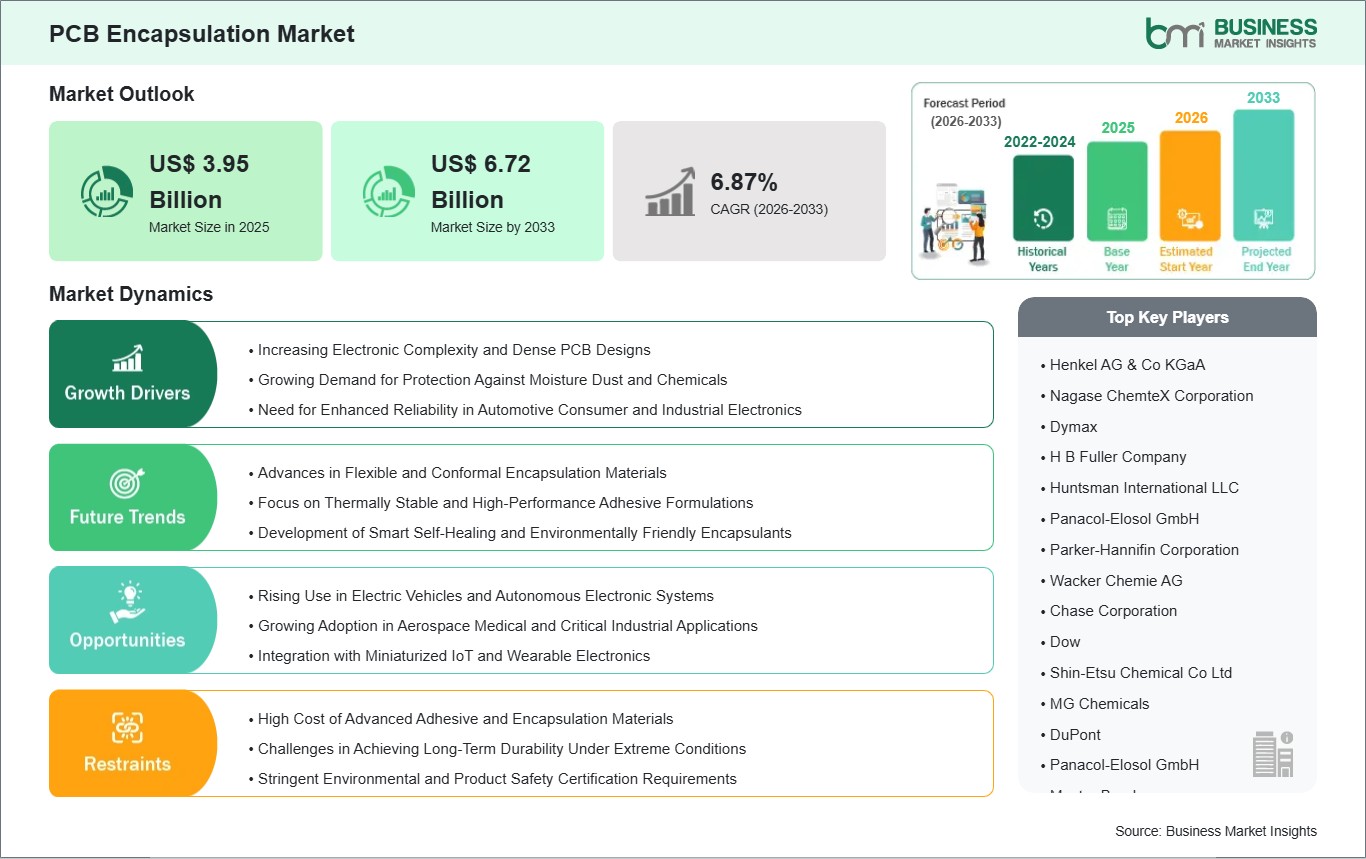
The PCB Encapsulation Market size is expected to reach US$ 6.72 billion by 2033 from US$ 3.95 billion in 2025. The market is estimated to record a CAGR of 6.87% from 2026 to 2033.
The global market for PCB encapsulation plays a significant role in ensuring the reliability and durability of electronic devices in different industries. PCB encapsulation is a process of applying a protective coating to a printed circuit board to prevent damage from moisture, dust, chemicals, vibrations, and heat. With the development of modern electronic devices that are complex, compact, and high-performance-based, the requirement for encapsulation has seen a significant rise.
The driving forces for the global market for PCB encapsulation include the rapid development of electronic devices and technologies, the increasing use of smart devices in different industries, and the growing use of automation and electrification in industries such as the automotive sector, aerospace industry, industrial equipment, and electronic devices.
The development of new materials such as resins and hybrids for encapsulation has shown improvement in thermal conductivity, chemical resistance, and mechanical properties. However, high-performance encapsulation materials and methods may be complex and require specialized knowledge. Environmental issues may also be a problem for manufacturers, who have to strike a balance between material performance and environmentally friendly and sustainable practices.
The demand for PCB encapsulation is increasing due to the increasing use of electronic devices in daily life and critical systems, which makes encapsulation a key driver for the reliability of electronic devices and the development of new technologies.

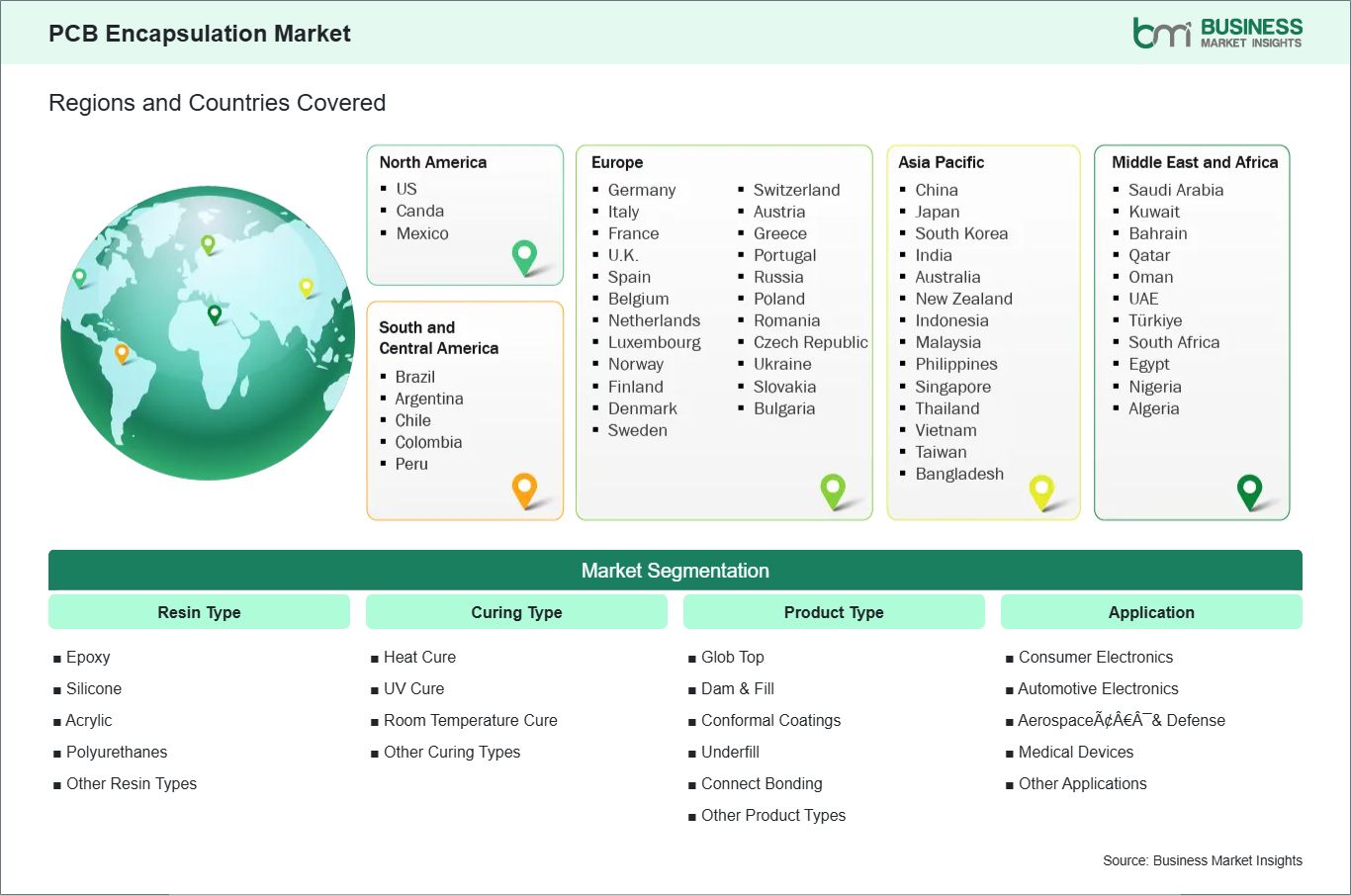
Key segments that contributed to the derivation of the PCB encapsulation market analysis are resin type, curing type, product type, and application.
The global PCB encapsulation market is strongly influenced by the rapid rise in electronic complexity and dense printed circuit board (PCB) designs. As electronic products become smaller and more powerful, PCB assemblies now often include extremely compact layouts, multilayer structures, embedded components, and miniaturized circuitry to meet performance targets while reducing footprint. These high‑density boards require advanced encapsulation techniques to provide robust physical protection, thermal management, and electrical insulation in environments where traditional conformal coatings may fall short. PCB encapsulation materials now must accommodate tighter component spacing, complex geometries, and higher component counts to prevent short circuits, moisture ingress, and mechanical stress.
In highly complex PCBs used in advanced electronic systems, the presence of microvias, blind vias, and higher‑layer counts increases the risk of dielectric breakdown and signal interference if protective materials are inadequate. As PCB designs push the limits of density to support high‑speed data transfer, multi‑layer boards, and embedded power semiconductors, encapsulation solutions are adapted to fill voids, absorb vibration, and strengthen solder joints. Modern encapsulants, like epoxies, polyurethanes, and silicones, provide thick protective layers that resist mechanical shock, moisture, and thermal cycling, ensuring reliability in demanding applications.
The push to densely integrate components has also accelerated the adoption of more sophisticated encapsulation techniques globally. Designers increasingly incorporate potting and overmolding into PCB manufacturing workflows to protect sensitive electronics against environmental threats, particularly in devices with long life expectations. Whether in industrial automation controls or high‑performance computing, encapsulation supports dense PCB architectures by enhancing reliability without compromising circuit integrity or adding excessive bulk.
The global PCB encapsulation market is also propelled by the rapid adoption of electric vehicles (EVs) and autonomous electronic systems, which depend heavily on high‑performance, reliable PCB assemblies. Modern EV powertrains, battery management units, inverters, and autonomous sensor arrays integrate sophisticated PCBs that must withstand harsh electrical, thermal, and mechanical operating conditions. Encapsulation becomes critical in these applications to ensure insulation at high voltages, stability under vibration, and moisture resistance for electronics that are subjected to wide temperature and humidity variations.
In autonomous electronic systems, such as advanced driver assistance or machine vision modules, sensor PCBs are tasked with processing vast amounts of data in real time. These boards are increasingly complex, featuring fine pitch components, high‑speed interconnects, and sensitive microelectronics. Encapsulation in such use cases serves not only to protect against environmental exposure but also to support thermal management and electromagnetic compatibility—reducing signal interference that could undermine real‑time processing and system accuracy.
As electric mobility and autonomous technologies mature across industries spanning from connected vehicles to robotics and industrial automation PCB encapsulation has transitioned from a protective option to a core engineering requirement. Encapsulation materials are selected not just for basic barrier protection but for performance under high electrical stress, thermal cycling, and continuous mechanical motion. This evolution underscores how rising integration of power electronics and autonomous functions directly shapes the demand for advanced encapsulation solutions that support durable, reliable electronic systems in real‑world applications.

The PCB encapsulation market is experiencing steady growth, with market size and share analysis reflecting evolving treatment preferences and competitive dynamics among key players. The report evaluates important subsegments categorized within resin type, curing type, product type, and application, highlighting their respective contributions to overall market performance.
By resin type, the Epoxy subsegment dominated the PCB Encapsulation market in 2025. Epoxy resins provide excellent mechanical strength, thermal stability, and chemical resistance, making them highly suitable for protecting sensitive electronic components, which drives their widespread adoption.
Based on curing type, the UV Cure subsegment dominated the PCB Encapsulation market in 2025. UV cure technologies offer rapid processing, energy efficiency, and precise application control, supporting strong demand for advanced PCB encapsulation solutions.
In terms of product type, the Conformal Coatings subsegment dominated the PCB Encapsulation market in 2025. Conformal coatings provide uniform protection against moisture, dust, and chemical exposure, enhancing the reliability and longevity of electronic assemblies, which reinforces the segment’s dominance.
On the basis of application, the Consumer Electronics subsegment dominated the PCB Encapsulation market in 2025. Consumer electronics require lightweight, durable, and highly reliable protection for circuit boards, driving strong adoption of PCB encapsulation materials in this sector.
| Report Attribute | Details |
|---|---|
| Market size in 2025 | US$ 3.95 Billion |
| Market Size by 2033 | US$ 6.72 Billion |
| Global CAGR (2026 - 2033) | 6.87% |
| Historical Data | 2022-2024 |
| Forecast period | 2026-2033 |
| Segments Covered | By Resin Type
|
|
Regions and Countries Covered
| |
| North America | US, Canada, Mexico |
| Europe | Belgium, Austria, Finland, Denmark, Greece, Poland, Romania, Russia, Ukraine, Czech Republic, Slovakia, Bulgaria, Italy, Luxembourg, Germany, Switzerland, France, Netherlands, Norway, Portugal, Spain, Sweden, United Kingdom |
| Asia-Pacific | Australia, China, India, Japan, South Korea, Indonesia, Malaysia, Philippines, Singapore, Thailand, Vietnam, Bangladesh, New Zealand, Taiwan |
| South and Central America | Brazil, Argentina, Peru, Chile, Colombia |
| Middle East and Africa | Bahrain, Kuwait, Oman, Qatar, Saudi Arabia, United Arab Emirates, Turkiye, South Africa, Egypt, Algeria, Nigeria |
| Market leaders and key company profiles |
|
The "PCB Encapsulation Market Size and Forecast (2022 - 2033)" report provides a detailed analysis of the market covering below areas:
The geographical scope of the PCB Encapsulation market report is divided into five regions: North America, Asia Pacific, Europe, Middle East & Africa, and South & Central America. The PCB Encapsulation market in North America is expected to grow during the forecast period.
North America is the leading region in PCB encapsulation due to its advanced electronics ecosystem, early adoption of innovative technologies, and presence of high-value industries. The region is home to a wide range of sectors that rely heavily on reliable electronics, including aerospace, automotive, medical devices, telecommunications, and industrial automation. These industries demand PCB protection solutions that can withstand harsh conditions such as vibration, high temperatures, humidity, and chemicals.
The focus for North American companies is on the development of encapsulation materials that not only withstand the above-mentioned conditions but also address the changing demands for the performance requirements of emerging technologies such as electric vehicles, smart infrastructure, and high-speed communication networks. Innovation is another important aspect where companies are focusing on the development of advanced resin materials, hybrid compounds, and coating technologies to enhance the performance requirements for PCB protection solutions.
The dominance of the North American region is also due to the strong association between companies, research institutions, and technology suppliers, which helps in the quick adoption of advanced PCB protection technologies. The challenges for the region include cost efficiency, high performance requirements, and environmental regulations. North America’s emphasis on technological innovation, quality, and sustainability continues to shape the global PCB encapsulation landscape and set benchmarks for other regions.

The PCB encapsulation market is evaluated by gathering qualitative and quantitative data post primary and secondary research, which includes important corporate publications, association data, and databases. A few of the key developments in the PCB encapsulation market are:
The PCB Encapsulation Market is valued at US$ 3.95 Billion in 2025, it is projected to reach US$ 6.72 Billion by 2033.
As per our report PCB Encapsulation Market, the market size is valued at US$ 3.95 Billion in 2025, projecting it to reach US$ 6.72 Billion by 2033. This translates to a CAGR of approximately 6.87% during the forecast period.
The PCB Encapsulation Market report typically cover these key segments-
The historic period, base year, and forecast period can vary slightly depending on the specific market research report. However, for the PCB Encapsulation Market report:
The PCB Encapsulation Market is populated by several key players, each contributing to its growth and innovation. Some of the major players include:
The PCB Encapsulation Market report is valuable for diverse stakeholders, including:
Essentially, anyone involved in or considering involvement in the PCB Encapsulation Market value chain can benefit from the information contained in a comprehensive market report.
Please tell us your area of interest
(Market Segments/ Regions and Countries/ Companies)