Market Summary
Executive Summary and Global Market Analysis
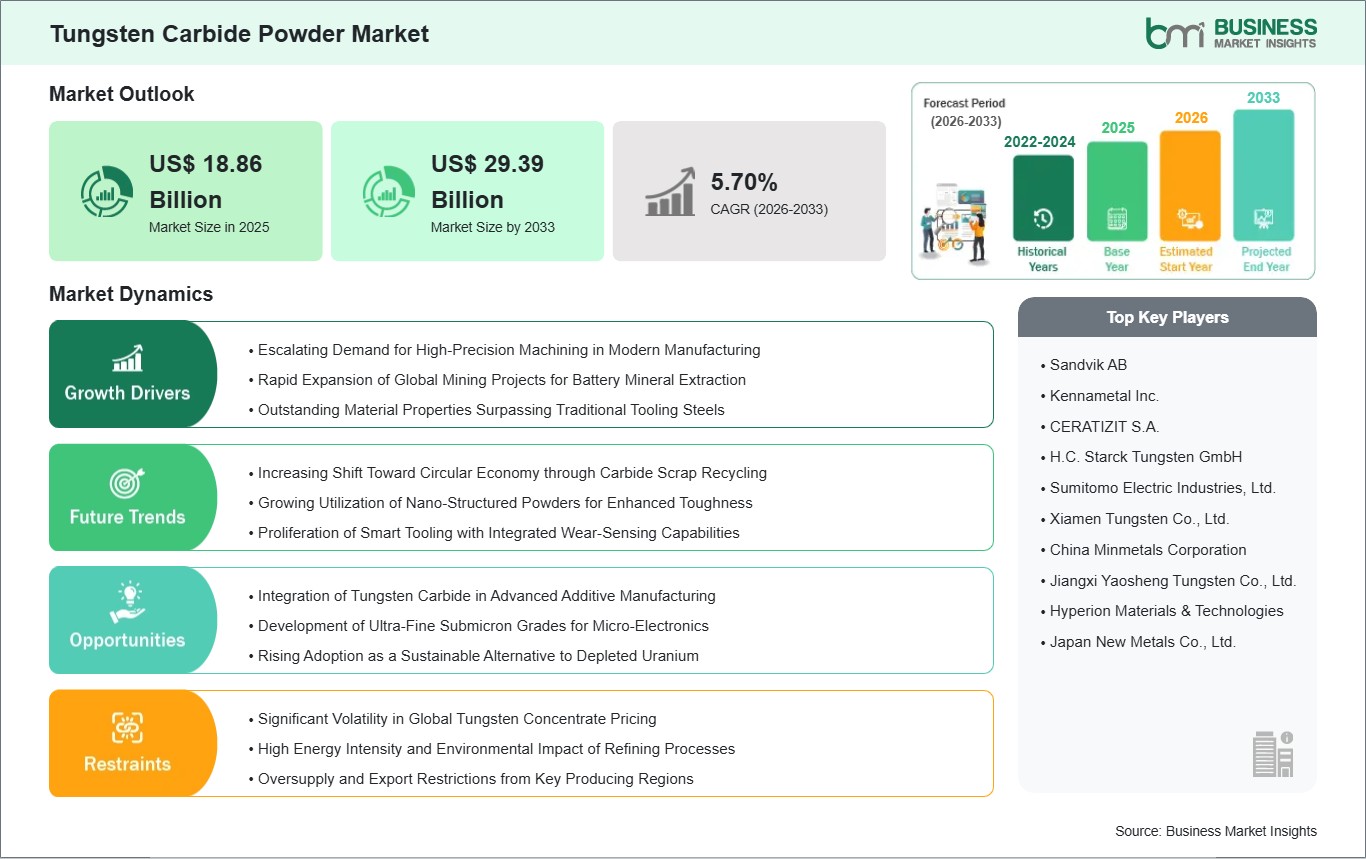
The overall market for tungsten carbide powder is marked by rapid expansion and is fueled by the inherent importance of the product as the backbone of the heavy industries sector. Renowned for its unmatched hardness and resistance to thermal deformation, the product is the first choice for a variety of applications ranging from deep-sea oil drilling operations to the micro-machining of smartphone components. At present, the market is dominated by the mining and construction sectors, where the physical demands of rock excavation require frequent replacement of the product in the form of carbide-tipped tools. At the same time, the drive for lighter and stronger materials in the aerospace and automotive sectors is driving the market for submicron and nano-grade powders with superior fracture toughness.
Despite a strong market driven by industrial demand, it is vulnerable to geopolitical events and raw material supply concentrations. There is a growing trend towards a more sustainable production model, where recycling operations currently supply a significant proportion of the market, thus reducing the ecological footprint of traditional raw material extraction. Innovations in powder metallurgy, including additive manufacturing of carbides, are offering new opportunities for high-value uses. Looking forward, it is likely that this market will continue to grow, driven by infrastructure development in emerging economies and a move towards electric vehicles that will require high-precision machined parts.
Segment Analysis
Tungsten Carbide Powder Market Segmentation
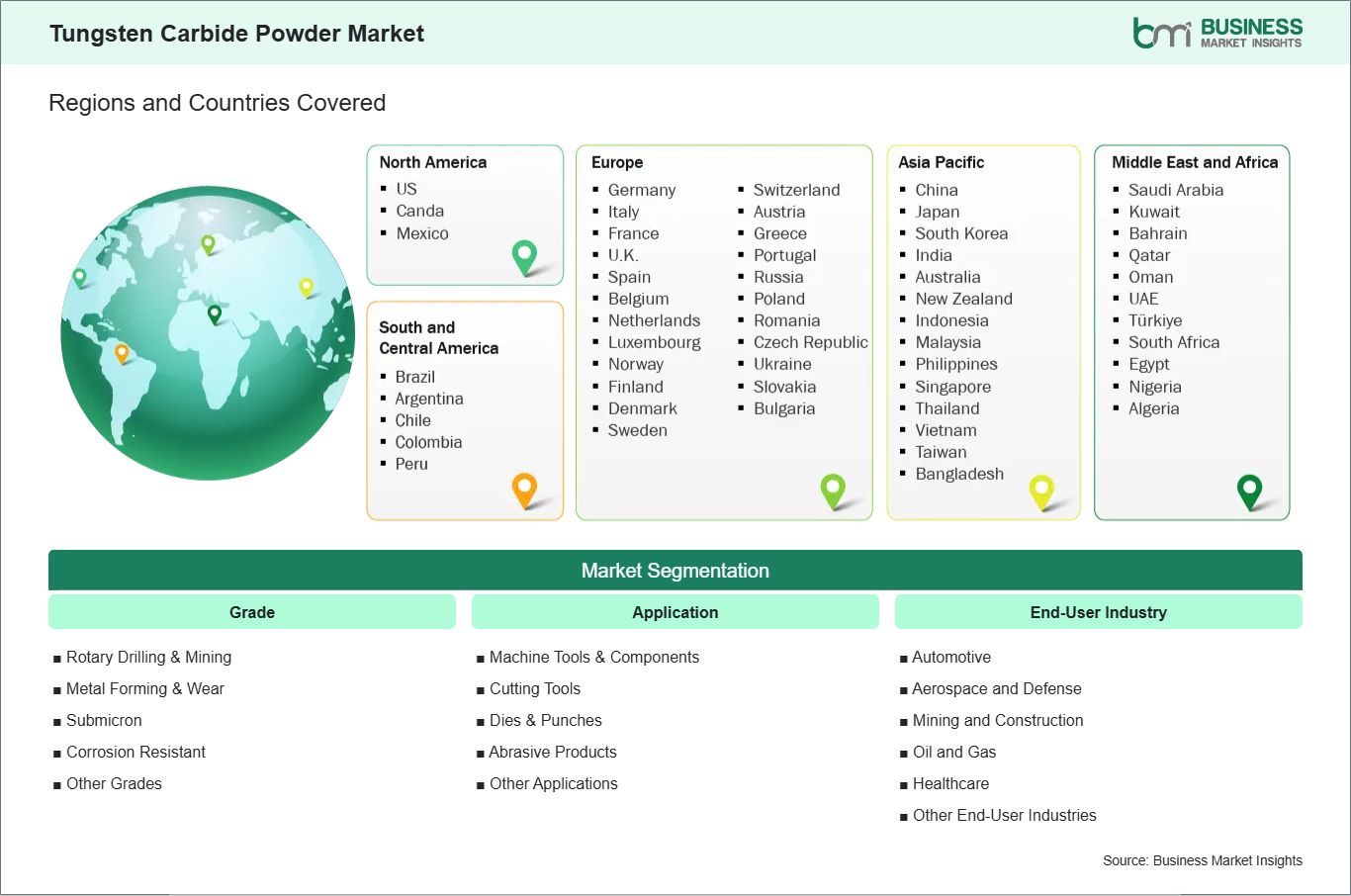
Key segments that contributed to the derivation of the Tungsten Carbide Powder market analysis are grade, application, and end-user industry.
- By grade, the tungsten carbide powder market is segmented into Rotary Drilling & Mining, Metal Forming & Wear, Submicron, Corrosion Resistant, and Other The Rotary Drilling & Mining segment dominated the market in 2025.
- By application, the tungsten carbide powder market is segmented into Machine Tools & Components, Cutting Tools, Dies & Punches, Abrasive Products, and Other The Cutting Tools segment dominated the market in 2025.
- By end-user industry, the tungsten carbide powder market is segmented into Automotive, Aerospace and Defense, Mining and Construction, Oil and Gas, Healthcare, and Other End-User Industries. The Mining and Construction segment dominated the market in 2025.
Market Forces
Tungsten Carbide Powder Market Drivers and Opportunities
Escalating Demand for High-Precision Machining in Modern Manufacturing
The world manufacturing scene is in the midst of a revolution that promises greater accuracy and speed in the products that it produces, and in the middle of it all, tungsten carbide has emerged as the focal point of the manufacturing industry's strategic planning. As the world continues to advance in the fields of electronics and automotive manufacturing, with a need for tighter tolerances and increasingly intricate component geometries, the tools used to shape these parts must be of extraordinary dimensional stability, and the sintered tungsten carbide powder used in the manufacture of cutting tools and end mills provides the necessary rigidity that prevents the tool from deflecting under the stress of high-speed machining, allowing for a mirror-finish product that meets exact specifications without the need for secondary processing.
Furthermore, the rise of industrial automation and the widespread adoption of computer numerical control (CNC) machines have amplified the requirement for reliable, long-lasting tooling. In a fully automated production line, a single tool failure can lead to costly downtime and significant material waste. Tungsten carbide’s ability to maintain a sharp cutting edge even when exposed to the intense frictional heat of continuous machining ensures that production runs can proceed with minimal interruption. This reliability is particularly critical in the mass production of engine components and structural aerospace parts, where consistency across thousands of units is a non-negotiable requirement for safety and performance.
Integration of Tungsten Carbide in Advanced Additive Manufacturing
The emergence of 3D printing for high-performance industrial components represents a significant frontier for the tungsten carbide powder market. Traditionally, carbide parts were limited to relatively simple shapes due to the constraints of conventional pressing and sintering techniques. However, advancements in binder jetting and selective laser melting have made it possible to create complex, internally cooled, or topologically optimized carbide structures. This technology allows for the production of customized wear parts and specialized nozzles that were previously impossible to manufacture, opening new revenue streams in specialized engineering niches.
By using tungsten carbide in additive manufacturing, companies can produce lightweight yet extremely durable components for the aerospace and energy sectors. For instance, internal cooling channels can be integrated directly into a drill bit or a cutting tool during the printing process, significantly improving thermal management and extending the lifespan of the equipment in extreme environments. This opportunity is further bolstered by the ability to use spherical tungsten carbide powders, which offer better flowability and packing density in 3D printing beds. As the cost of additive hardware decreases and material science evolves, the transition from subtractive to additive carbide fabrication is expected to redefine the supply chain for high-wear industrial components.
Size and Share Analysis
Tungsten Carbide Powder Market Size and Share Analysis
The global Tungsten Carbide Powder market is experiencing steady growth, with market size and share analysis reflecting evolving treatment preferences and competitive dynamics among key players. The report evaluates important subsegments categorized within grade, application, and end-user industry, highlighting their respective contributions to overall market performance.
By grade, the Rotary Drilling & Mining subsegment dominated the market in 2025 due to the extreme hardness and impact resistance required for heavy-duty rock excavation. Its ability to maintain structural integrity under high-pressure drilling environments makes it indispensable for global mineral exploration and large-scale tunneling projects.
By application, the Cutting Tools subsegment dominated the market in 2025 because of the widespread shift toward high-speed machining in precision engineering. Tungsten carbide provides a superior balance of thermal stability and edge retention compared to high-speed steel, which is vital for automated CNC manufacturing processes.
By end-user industry, the Mining and Construction subsegment dominated the market in 2025 owing to massive global investments in public infrastructure and the rising demand for metals. The constant wear and tear on excavation machinery necessitates a continuous supply of carbide-tipped tools to ensure operational efficiency.
Report Coverage
Tungsten Carbide Powder Market Report Coverage and Deliverables
The "Tungsten Carbide Powder Market Size and Forecast (2022 - 2033)" report provides a detailed analysis of the market covering below areas:
- Tungsten Carbide Powder market size and forecast at the regional and country levels for segments covered under the scope
- Tungsten Carbide Powder market trends, as well as drivers, restraints, and opportunities
- Tungsten Carbide Powder market analysis covering key trends, regional framework, major players, regulations, and recent developments
- Industry landscape and competition analysis covering market concentration, heat map analysis, prominent players, and recent developments for the Tungsten Carbide Powder market
- Detailed company profiles, including SWOT analysis
Geographic Insights
Tungsten Carbide Powder Market Geographic Insights
The geographical scope of the Tungsten Carbide Powder market report is divided into: North America, Asia Pacific, Europe, Middle East & Africa, and South & Central America. North America held the largest share in 2025.
North America holds a dominant position in the tungsten carbide powder market, primarily due to the region's massive aerospace, defense, and specialized manufacturing base. The United States is a global leader in the production of mission-critical components that require the extreme density and heat resistance provided by tungsten-based alloys. Significant federal investments in defense modernization and the domestic expansion of semiconductor fabrication facilities have created a consistent and high-volume demand for precision carbide tooling. Furthermore, the region’s mature oil and gas sector relies heavily on high-grade carbide for horizontal drilling and hydraulic fracturing equipment, where durability in abrasive environments is a key driver of operational success.
The leadership of North America is also reinforced by a highly advanced research and development ecosystem that focuses on material science innovation. Local manufacturers are at the forefront of developing recycled carbide solutions and ultra-high purity powders to meet stringent environmental and performance standards. The presence of major global players headquartered in the region facilitates a rapid transition from laboratory innovation to industrial application. Additionally, the growing focus on "near-shoring" manufacturing back to North America is revitalizing the domestic machine tool industry, further cementing the region's status as a central hub for high-performance material consumption and technological leadership.
Industry Activity
Recent Developments
The Tungsten Carbide Powder market is evaluated by gathering qualitative and quantitative data post primary and secondary research, which includes important corporate publications, association data, and databases. A few of the key developments in the Tungsten Carbide Powder market are:
- In May 2024, Sandvik AB announced continued investments in its powder metallurgy and hard materials segment, including tungsten carbide powders, to strengthen its tooling and mining solutions business.
- In November 2023, Xiamen Tungsten Co., Ltd. announced expansion of its tungsten materials production capacity, including carbide powders, to meet rising demand from cutting tools and advanced manufacturing industries.
- In September 2023, China Minmetals Corporation advanced its tungsten resource integration and downstream processing capabilities, supporting increased supply of tungsten carbide powder products.
Trust & Transparency
Research Methodology
The market analysis combines proprietary research with secondary data from government agencies, company disclosures, regulatory filings, industry databases and expert interviews. Market estimates are validated through data triangulation, cross-market benchmarking and analyst
review.
View Full Research Methodology
Key Sources Referred:
American Chemistry Council (ACC)International Council of Chemical Associations (ICCA)European Chemical Industry Council (Cefic)China National Packaging Industry Association (CNPIA)Indian Institute of Packaging (IIP)Gulf Petrochemicals and Chemicals Association (GPCA)Company WebsitesCompany Annual ReportsCompany Investor Presentations