
Torque Vectoring Market Outlook: Size, Share, Trends, Growth Analysis, Competitive Landscape & Forecast, 2026-2033

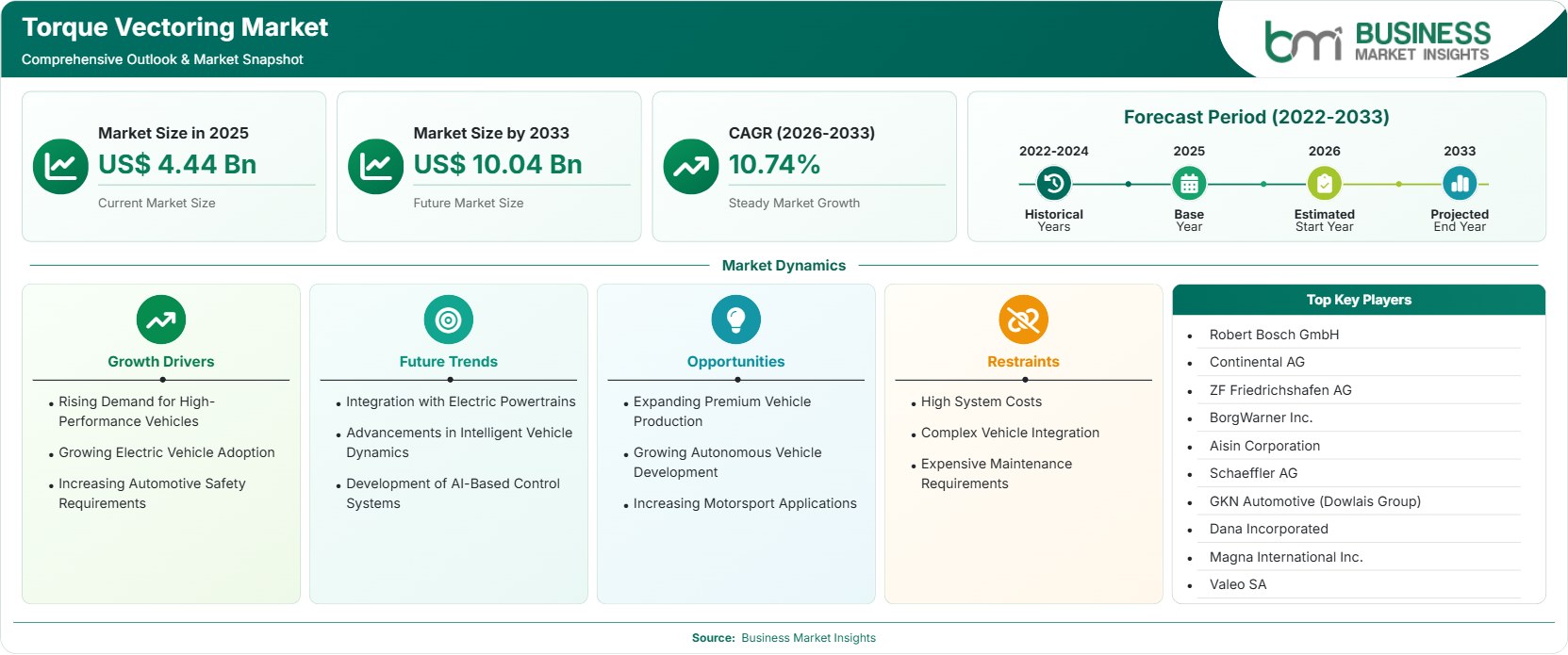
The Torque Vectoring Market size was valued at US$ 4.44 Billion in 2025 and is projected to reach US$ 10.04 Billion by 2033, growing at a CAGR of 10.74% during 2026–2033. Increasing electric vehicle adoption, rising demand for advanced driving performance, growing safety requirements, and integration of intelligent drivetrain technologies are driving adoption, while premium vehicle expansion and autonomous mobility create new opportunities.

Report Coverage
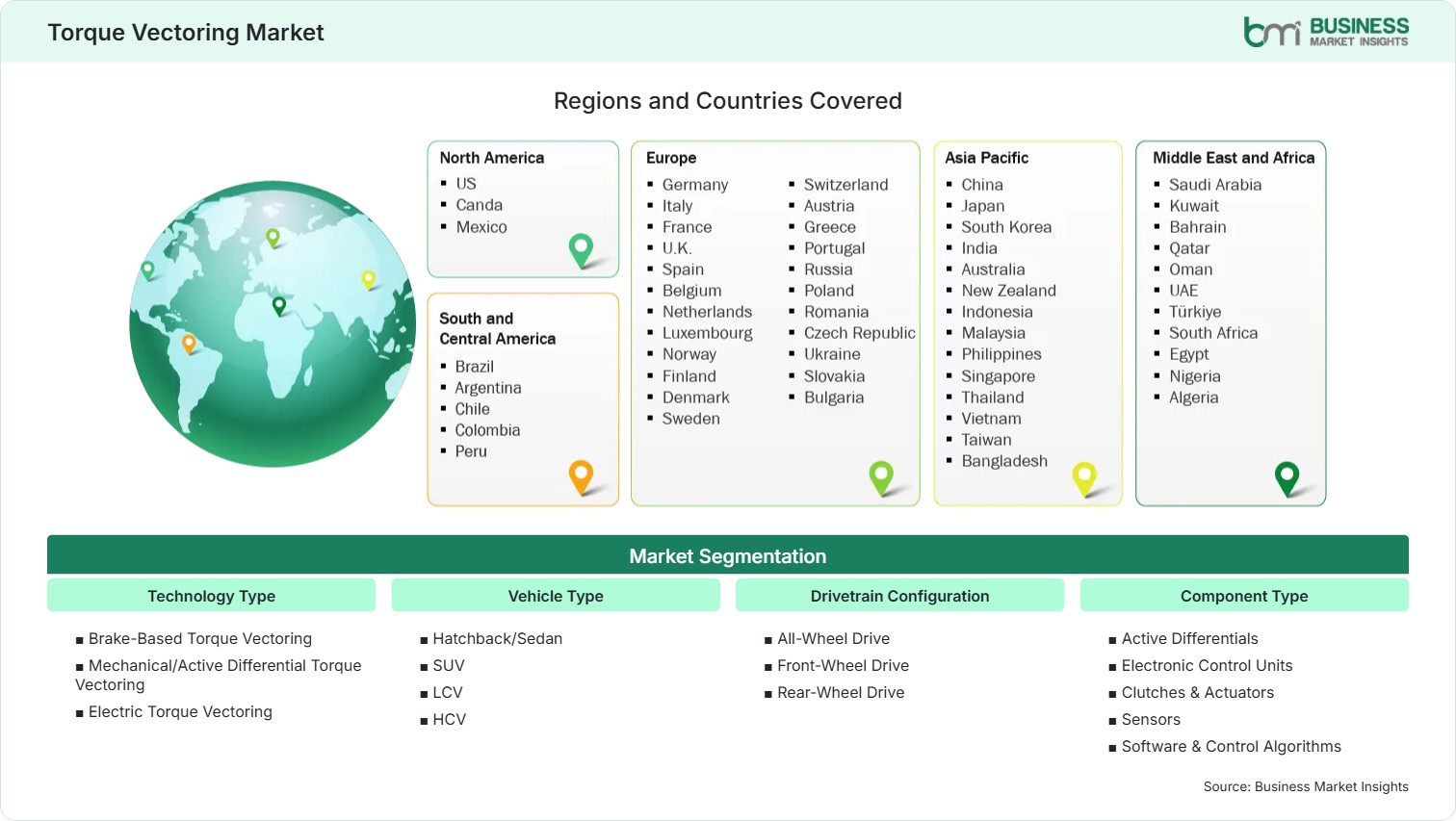
  • Technology Type: Brake-Based Torque Vectoring, Mechanical/Active Differential Torque Vectoring, Electric Torque Vectoring
  • Vehicle Type: Hatchback/Sedan, SUV, LCV, HCV
  • Drivetrain Configuration: All-Wheel Drive, Front-Wheel Drive, Rear-Wheel Drive
  • Component Type: Active Differentials, Electronic Control Units, Clutches & Actuators, Sensors, Software & Control Algorithms
US$ 4.44 Bn Market size in 2025
US$ 10.04 Bn Market Size by 2033
10.74% CAGR, 2026 - 2033
2026-2033 Forecast Period

AI Overview

Torque Vectoring Market Summary

  • North America Region: North America holds 31%–34% share in 2025, expanding at a 9.4%–10.1% CAGR during 2026–2033, supported by premium vehicle demand, EV development, advanced drivetrain adoption, automotive R&D investments, and intelligent chassis integration. The U.S. market is driven by electric SUV production, luxury vehicle demand, and performance applications, growing at a 9.6%–10.3% CAGR through 2033.
  • Fastest Growing Region: Asia Pacific accounts for 28%–31% share in 2025 and is projected to grow at 12.1%–12.8% CAGR through 2033, driven by EV manufacturing expansion, automotive localization, rising vehicle production, smart mobility investments, and increasing adoption of electronic drivetrain systems.
  • Leading Segment: All-Wheel Drive (AWD/4WD) captures 44%–47% share in 2025 with a 10.8%–11.5% CAGR through 2033, supported by premium SUVs, performance vehicles, enhanced traction requirements, electrified platforms, and demand for improved vehicle stability.
  • High Growth Segment: Electric Torque Vectoring represents 24%–27% share in 2025 and grows at 13.4%–14.2% CAGR, driven by dual-motor EV platforms, software-defined vehicles, efficient power distribution, battery optimization, and advanced mobility solutions.
  • Key Market Opportunity: Electrification, autonomous vehicles, software-based chassis control, premium vehicle production, and advanced vehicle electronics are creating opportunities for suppliers developing scalable torque management systems across multiple automotive platforms.
  • Major Market Players: Robert Bosch GmbH, Continental AG, ZF Friedrichshafen AG, BorgWarner Inc., Aisin Corporation, Schaeffler AG, GKN Automotive Limited (Dowlais Group), Dana Incorporated, Magna International Inc., and Valeo SA.
Strategic Insights

Torque Vectoring Market: Strategic Insights

Torque Vectoring Market Strategic Framework
FREE PDF
Request your free sample
Request free sample
Stakeholder View

Key Takeaways

  • Automotive value chains are shifting toward integrated electronic drivetrain ecosystems, increasing collaboration between OEMs, semiconductor suppliers, software developers, and component manufacturers to deliver advanced vehicle control solutions.
  • Electric vehicles represent the strongest growth opportunity as dual-motor architectures and independent wheel control enable improved traction, efficiency, and performance compared with conventional drivetrain systems.
  • Software innovation is becoming a competitive differentiator, with manufacturers investing in predictive algorithms, sensor integration, and intelligent control platforms that improve vehicle responsiveness and adaptability.
  • Asia Pacific offers significant investment potential due to large-scale EV manufacturing, expanding automotive electronics production, and increasing localization of drivetrain components in China, India, Japan, and South Korea.
  • Strategic partnerships and technology collaborations are increasing as automotive suppliers seek capabilities in electrification, vehicle software, and advanced chassis systems to compete in future mobility markets.
Geographic Outlook

Torque Vectoring Market Regional Highlights

North America Torque Vectoring Market

North America accounted for 31%–34% share in 2025 and is estimated to expand at a 9.4%–10.1% CAGR during 2026–2033. The region benefits from strong premium vehicle demand, electric SUV adoption, advanced automotive research, and established Tier-1 supplier networks. The Torque Vectoring Market share in North America is supported by manufacturers integrating intelligent drivetrain systems into luxury, performance, and electric vehicle platforms. The U.S. remains the primary contributor due to high vehicle technology adoption and continuous investment in advanced mobility solutions.

  • Premium vehicle manufacturers are increasing adoption of active differentials and electronic torque control systems to improve handling, stability, and performance across luxury and sports vehicle categories.
  • Electric vehicle expansion in the U.S. and Canada is encouraging development of advanced torque distribution systems for dual-motor and high-performance EV platforms.
  • Automotive technology companies are investing in vehicle software, sensors, and control units to support integrated chassis management and next-generation mobility solutions.
  • Safety regulations and consumer preference for advanced vehicle features are accelerating adoption of intelligent drivetrain technologies across passenger vehicle segments.

US Torque Vectoring Market

The United States represents 78%–82% Torque Vectoring Market of North American demand and is projected to grow at a 9.6%–10.3% CAGR between 2026 and 2033. The country maintains a strong position due to premium vehicle production, electric pickup and SUV development, and increasing integration of advanced vehicle control technologies. U.S. automakers and suppliers are investing in software-defined vehicles, autonomous mobility, and electrified drivetrains, creating a favorable environment for advanced torque management systems.

  • Growing production of electric trucks and SUVs is increasing demand for efficient torque distribution technologies that improve traction and vehicle performance.
  • Strong presence of automotive technology companies supports innovation in electronic control units, sensors, and software-based vehicle dynamics systems.
  • Increasing investment in autonomous driving technologies is encouraging integration of advanced chassis control solutions with future mobility platforms.

Europe Torque Vectoring Market

Europe held 27%–30% share in 2025 and is expected to grow at a 9.8%–10.6% CAGR through 2033. The region remains a major technology hub due to premium automotive manufacturing, strict safety standards, and rapid electrification initiatives. Germany leads regional adoption through strong engineering capabilities and luxury vehicle production, while France and the United Kingdom are expanding electric mobility investments. The Torque Vectoring Market growth in Europe is supported by advanced drivetrain development and increasing demand for high-performance vehicle systems.

  • Germany continues leading adoption through premium automakers, advanced vehicle engineering, and strong supplier ecosystems focused on intelligent drivetrain technologies.
  • European emission reduction policies are encouraging manufacturers to integrate efficient vehicle control systems supporting electrified mobility.
  • Luxury and performance vehicle segments are increasingly adopting active differential systems to enhance driving dynamics and customer experience.
  • Expansion of EV manufacturing in France and the United Kingdom is creating opportunities for electric torque vectoring solutions.

Asia Pacific Torque Vectoring Market

Asia Pacific accounted for 28%–31% share in 2025 and is projected to register the highest growth rate of 12.1%–12.8% CAGR from 2026 to 2033. The region benefits from large automotive production volumes, expanding electric vehicle manufacturing, and increasing investment in automotive electronics. China, Japan, South Korea, and India are major contributors, with China leading EV deployment and component manufacturing. The region represents a key growth center due to increasing localization and technology development.

  • China’s EV ecosystem is accelerating demand for electric torque vectoring through dual-motor platforms and advanced vehicle control architectures.
  • Japan continues supporting adoption through hybrid technology expertise, automotive innovation, and established drivetrain engineering capabilities.
  • South Korea’s automotive electronics sector is strengthening development of sensors, software, and intelligent vehicle control systems.
  • India offers emerging opportunities through EV investments, premium vehicle growth, and increasing adoption of advanced safety technologies.

Rest of World Torque Vectoring Market

Rest of World represents 8%–11% share in 2025 and is expected to grow at 8.5%–9.3% CAGR through 2033. South and Central America are experiencing gradual adoption due to premium vehicle imports, improving automotive infrastructure, and increasing demand for advanced safety features. Middle East and Africa markets are developing through luxury vehicle demand, mobility modernization projects, and emerging EV initiatives. Brazil, Mexico, UAE, and Saudi Arabia represent important opportunity areas.

  • Brazil and Mexico are strengthening automotive manufacturing capabilities, creating demand for advanced drivetrain technologies and supplier partnerships.
  • Middle Eastern countries are adopting premium performance vehicles and supporting electric mobility initiatives through infrastructure investments.
  • African markets are gradually integrating advanced vehicle technologies as mobility requirements and automotive investments increase.
  • Emerging economies are creating opportunities for global suppliers through localization programs and regional technology collaborations.
Global Market Geography
FREE PDF
Request your free sample
Request free sample
Segment Analysis

Torque Vectoring Market Segmentation

Technology Type

Technology Type segmentation is influenced by increasing adoption of electronic drivetrain solutions, vehicle electrification, and demand for improved handling performance. The segment represents the complete technology landscape in 2025 and expands at a 10.74% CAGR during 2026–2033. The Torque Vectoring Market trends indicate growing preference for electric and software-controlled solutions as manufacturers focus on intelligent chassis systems, energy efficiency, and advanced vehicle dynamics.

  • Brake-Based Torque Vectoring: Brake-based systems improve stability by selectively applying braking force to individual wheels. They offer cost-effective integration with existing electronic stability systems and remain widely adopted in passenger vehicles.
  • Mechanical/Active Differential Torque Vectoring: Active differential systems enable precise torque distribution between wheels, improving cornering performance and traction. They are mainly used in premium, sports, and high-performance vehicle applications.
  • Electric Torque Vectoring: Electric torque vectoring enables independent wheel torque control through electric motors. It supports EV platforms, dual-motor architectures, improved efficiency, and advanced software-driven vehicle management systems.

Vehicle Type

Vehicle Type segmentation is expanding as torque vectoring technologies move beyond premium vehicles into broader passenger and commercial applications. Increasing safety requirements, electrification, and demand for enhanced driving performance are supporting adoption across different vehicle categories. The Torque Vectoring Market scope continues widening as manufacturers integrate advanced drivetrain technologies into SUVs, electric vehicles, and commercial mobility platforms.

  • Hatchback/Sedan: Hatchbacks and sedans increasingly adopt torque vectoring for improved handling, stability, and driving comfort. Premium variants and electric sedans represent key adoption areas for advanced drivetrain solutions.
  • SUV: SUVs represent a major application category due to demand for superior traction, all-wheel-drive capability, and enhanced stability. Electric SUV production is further accelerating technology adoption.
  • LCV: Light commercial vehicles are adopting torque vectoring systems to improve operational safety, handling, and efficiency. Electrified delivery fleets are creating additional opportunities for advanced drivetrain technologies.
  • HCV: Heavy commercial vehicles are exploring torque management solutions for improved traction, stability, and specialized applications requiring enhanced vehicle control capabilities.

Drivetrain Configuration

Drivetrain Configuration segmentation is shaped by vehicle architecture evolution, electrification strategies, and performance requirements. All-wheel-drive systems maintain strong adoption due to their ability to optimize traction and stability across different driving conditions. The Torque Vectoring Market share continues shifting toward electronically controlled configurations offering adaptive performance and improved efficiency.

  • All-Wheel Drive (AWD/4WD): AWD and 4WD systems lead adoption due to superior traction control, premium vehicle usage, and compatibility with advanced torque distribution technologies.
  • Front-Wheel Drive (FWD): FWD platforms utilize torque vectoring to enhance cornering stability, driving response, and safety while maintaining cost-efficient vehicle architectures.
  • Rear-Wheel Drive (RWD): RWD systems benefit from torque vectoring through improved acceleration control, handling balance, and performance enhancement in sports and premium vehicles.

Component Type

Component Type segmentation reflects increasing integration of hardware and software components within modern vehicle architectures. The Torque Vectoring Market analysis highlights expanding opportunities for suppliers developing electronic systems, actuators, and software platforms that enable precise torque distribution across future vehicle platforms.

  • Active Differentials: Active differentials provide dynamic torque distribution between wheels, improving vehicle stability and performance. They are essential in premium vehicles, sports cars, and advanced AWD platforms.
  • Electronic Control Units (ECUs): ECUs process vehicle data and manage torque distribution decisions. Growing electrification and connectivity are increasing demand for advanced automotive computing systems.
  • Clutches & Actuators: Clutches and actuators enable controlled torque transfer between wheels. They support responsive drivetrain operation and improved handling performance across multiple vehicle applications.
  • Sensors: Sensors monitor wheel speed, steering angle, acceleration, and vehicle conditions. Increasing ADAS integration is driving demand for accurate sensing technologies.
  • Software & Control Algorithms: Software and control algorithms enable predictive torque management, adaptive driving modes, and integration with broader vehicle control systems. They are becoming critical for software-defined vehicles.
Market Forces

Torque Vectoring Market Dynamics

Key Market Drivers

Rising Demand for High-Performance Vehicles

The growing need for high-end automobiles, performance-based SUVs, and sports car models is fueling the adoption of modern drivetrain technologies. The manufacturers are installing torque vectoring systems to enhance the capabilities of cornering, acceleration, and stability. The Torque Vectoring Market growth is gaining traction from the increasing customer demands for improved performance and controllability of cars. Premium car manufacturers are increasingly relying on the combination of active differentials, sensors, and electronic systems to create an adaptive performance of their cars. The trend towards intelligent chassis systems is further enhancing the market dynamics through the incorporation of technologies that improve handling while retaining efficiency.

Growing Electric Vehicle Adoption

The growing popularity of electric cars is making the need for torque distribution technology even more urgent, especially that of electric torque vectoring. Electric car systems featuring two motors and independently controlled wheels require a torque management system to be used. All this stimulates the development of software-based drivetrain systems combined with the battery management system and the vehicle control unit, along with special sensors. Electric vehicle proliferation opens new doors for those companies that concentrate on scalable technology capable of being used for future mobility platforms and autonomous functionality.

Increasing Automotive Safety Requirements

An increasing focus on the development of vehicle safety standards and advanced driver assistance systems is contributing to the uptake of systems that offer better stability and control. The torque vectoring system works with electronic stability control to ensure that torque is managed at the wheel level during acceleration, turns, and in difficult driving situations. Various regulating authorities and automotive associations have been advocating for safer automobiles through improved safety systems. There is increased consciousness among consumers on safety systems, prompting their uptake in passenger cars as well as commercial vehicles.

Key Market Opportunities

Expanding Premium Vehicle Production

The growth in the manufacture of premium vehicles creates prospects for torque vectoring providers since luxury and performance automakers are progressively incorporating more advanced chassis technology. Premium SUVs, sports cars, and performance EVs need accurate torque control to provide good driving performance. According to the Torque Vectoring Market Forecasts, there is more scope for adoption as manufacturers continue to develop an integrated vehicle platform with integrated propulsion, braking, and stability systems. Tier-1 suppliers are developing flexible systems that are less complex and can be easily integrated into different vehicle architectures. Premium automakers are competing, which is driving innovation in drivetrain technology.

Growing Autonomous Vehicle Development

Autonomous vehicle development is creating opportunities for advanced torque management systems as future mobility platforms require precise control over acceleration, traction, and vehicle movement. Torque vectoring technologies can support autonomous functions by improving vehicle stability and response during complex driving situations. Automobile manufacturers are making use of artificial intelligence, sensor fusion, and software-defined vehicle systems, which need motion control systems integrated into their design. OEMs, tech vendors, and semiconductor firms working together are hastening intelligent vehicle system development. With increasing sophistication of autonomous driving systems, torque vectoring is likely to be an integral part of such systems.

Increasing Motorsport Applications

The applications in motorsport still offer potential for advancing technology and bringing advanced torque management solutions to the market. Motorsport environments enable automotive companies to experiment with technologies of high-performing drivetrains, control algorithms, and electric powertrains in tough situations. The innovations achieved in motorsport programs may affect the technologies used in regular vehicles, especially luxury and electric performance cars. The rise of electric racing platforms encourages innovation in effective torque management systems as well.

Market Restraints and Challenges

High System Costs

Factor: Advanced torque vectoring systems require expensive sensors, actuators, electronic control units, software development, and integration processes. Impact: Higher component and engineering costs restrict adoption in cost-sensitive vehicle segments where manufacturers prioritize affordability. Premium vehicles currently represent the strongest application area because they can absorb additional technology expenses. Although increasing production volumes may reduce costs over time, suppliers continue facing challenges in balancing advanced functionality with competitive pricing. Development testing, calibration requirements, and specialized engineering expertise further increase implementation expenses.

Complex Vehicle Integration

Factor: Torque vectoring systems require coordination between drivetrains, braking systems, sensors, ECUs, and software platforms. Impact: Complex integration increases development time, calibration requirements, and engineering challenges for manufacturers. Modern vehicles contain interconnected electronic systems, making compatibility and cybersecurity critical considerations during deployment. Differences between combustion, hybrid, and electric architectures create additional complexity for suppliers developing flexible solutions. Automakers must ensure reliable communication between multiple control modules while maintaining safety standards.

Company Analysis

Competitive Landscape

The Torque Vectoring Market analysis shows increasing competition among automotive technology providers focusing on electrification, intelligent drivetrain systems, software integration, and advanced vehicle dynamics solutions. Leading companies are strengthening capabilities through research and development, OEM partnerships, and expansion of electric mobility portfolios.

Company Name

Overview

Products and Services relevant to this market

Robert Bosch GmbH

Robert Bosch GmbH is a global automotive technology provider offering mobility solutions, vehicle electronics, and intelligent control systems for modern vehicles.

Provides vehicle dynamics systems, sensors, ECUs, electronic stability technologies, and software solutions supporting torque distribution applications.

Continental AG

Continental AG develops automotive electronics, chassis technologies, and mobility solutions focused on safety, efficiency, and intelligent vehicle control.

Supplies sensors, electronic control systems, chassis solutions, and vehicle dynamics technologies enabling advanced torque management.

ZF Friedrichshafen AG

ZF Friedrichshafen AG specializes in driveline, chassis, and active safety technologies for passenger and commercial vehicles worldwide.

Offers active differentials, driveline systems, chassis control technologies, and software solutions for precise torque distribution.

BorgWarner Inc.

BorgWarner Inc. develops propulsion and electrification technologies for automotive manufacturers transitioning toward hybrid and electric mobility.

Provides electric drivetrain systems, propulsion components, control technologies, and torque management solutions for EV applications.

Aisin Corporation

Aisin Corporation manufactures drivetrain, transmission, and automotive technology solutions serving global vehicle manufacturers.

Supplies drivetrain components, electronic control technologies, and vehicle performance systems supporting torque vectoring integration.

Schaeffler AG

Schaeffler AG develops precision automotive systems, electrification technologies, and chassis solutions for future mobility applications.

Provides intelligent chassis components, actuators, mechanical systems, and vehicle control solutions.

GKN Automotive Limited (Dowlais Group)

GKN Automotive Limited specializes in driveline technologies and electrified mobility solutions for global automotive manufacturers.

Offers all-wheel-drive systems, eDrive technologies, driveline components, and advanced torque management solutions.

Dana Incorporated

Dana Incorporated develops drivetrain, thermal management, and vehicle technologies for automotive and commercial mobility markets.

Provides axle systems, electric propulsion components, drivetrain solutions, and integration technologies.

Magna International Inc.

Magna International Inc. is a global automotive supplier providing vehicle systems, engineering services, and advanced mobility technologies.

Offers drivetrain systems, electronic modules, vehicle engineering services, and integrated automotive solutions.

Valeo SA

Valeo SA develops automotive technologies focused on electrification, driver assistance, sensing, and intelligent mobility.

Provides sensors, electronic systems, software solutions, and vehicle control technologies supporting advanced drivetrain applications.

Trust & Transparency

Research Methodology

The market analysis combines proprietary research with secondary data from government agencies, company disclosures, regulatory filings, industry databases and expert interviews. Market estimates are validated through data triangulation, cross-market benchmarking and analyst review.

View Full Research Methodology

Questions Answered

Frequently Asked Questions

What role do automotive suppliers play in this industry?

Automotive suppliers provide critical components including ECUs, sensors, actuators, software platforms, and drivetrain systems. Their collaboration with vehicle manufacturers helps accelerate development, reduce integration complexity, and improve scalability across multiple vehicle categories.

Which technologies will influence future torque vectoring systems?

Future systems will be influenced by artificial intelligence, software-defined vehicles, sensor integration, and electric drivetrain innovation. These technologies will enable predictive control, adaptive performance, and improved integration with autonomous driving platforms.

How do active differentials improve vehicle performance?

Active differentials distribute torque between wheels based on driving conditions, improving cornering response, traction, and stability. They are widely used in performance vehicles where manufacturers prioritize enhanced handling characteristics and dynamic driving experiences.

Why are SUVs important for torque vectoring adoption?

SUVs require enhanced traction and stability due to their size, weight, and diverse operating conditions. Manufacturers are integrating torque vectoring systems into SUVs to improve handling, safety, and all-wheel-drive performance, particularly in premium and electric SUV segments.

What is driving adoption of torque vectoring market report in electric vehicles?

Electric vehicle platforms enable precise wheel-level torque control through independent motors, allowing improved traction, stability, and efficiency. Dual-motor EV architectures are increasing demand for advanced torque distribution solutions that enhance performance and support intelligent vehicle control.

Access the Full Torque Vectoring Market Report

Get segment-level forecasts, regional estimates, competitive benchmarking, company profiles and downloadable Excel datasets.

Access the full Torque Vectoring Market Report
350 pages PDF & Excel | 2026-08-07
Similar Research

Related Market Reports