
Thermoplastic Pipe Market Outlook: Size, Share, Trends, Growth Analysis, Competitive Landscape & Forecast, 2022-2033

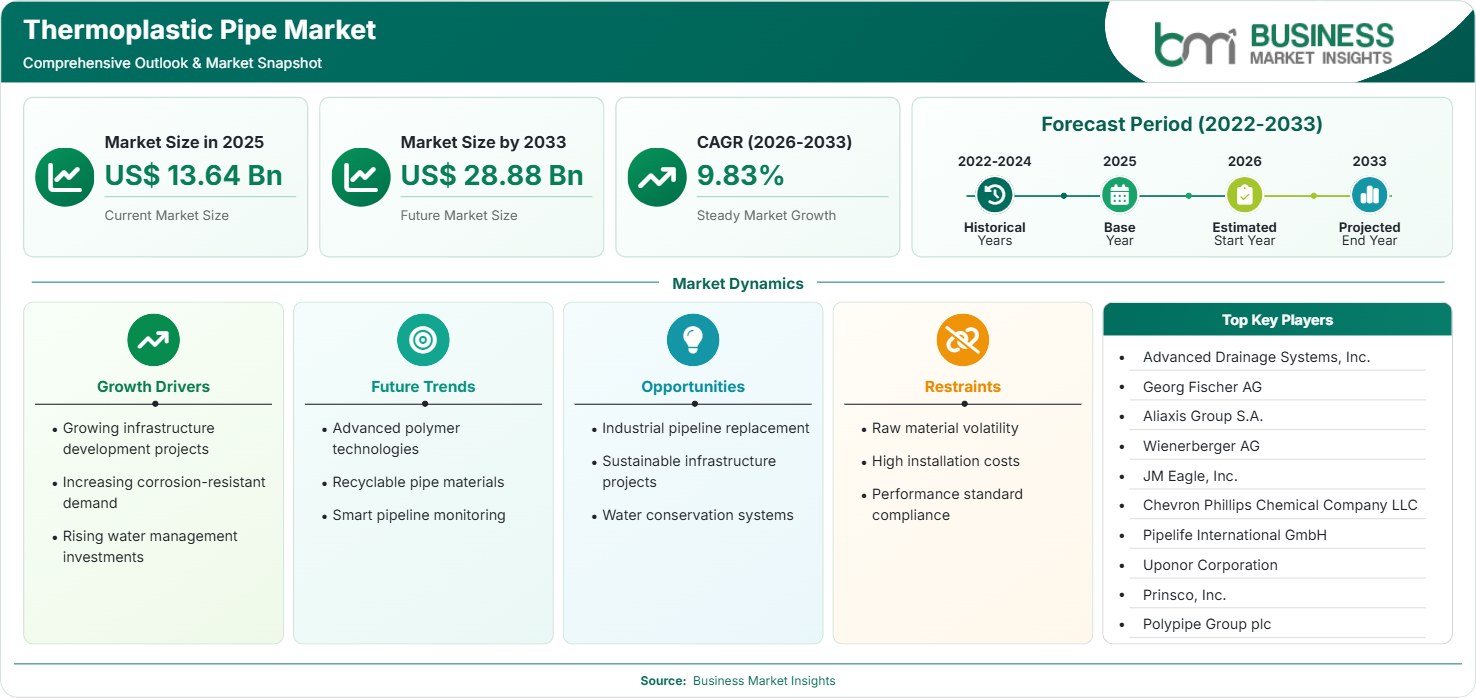
The Thermoplastic Pipe Market size was valued at US$ 13.64 billion in 2025 and is projected to reach US$ 28.88 billion by 2033, growing at a CAGR of 9.83% during 2026–2033. Growing infrastructure development projects, increasing demand for corrosion-resistant piping systems, and rising investments in water management continue driving market expansion. Opportunities associated with industrial pipeline replacement, sustainable infrastructure projects, and water conservation systems are expected to further support long-term market growth.

Report Coverage
  • Product Type: RTP, TCP
  • Polymer Type: PE, PVC, PP, PVDF, Others
  • Application: Oil & Gas, Water & Wastewater, Mining & Dredging, Utilities & Renewables
US$ 13.64 Bn Market size in 2025
US$ 28.88 Bn Market Size by 2033
9.83% CAGR, 2026 - 2033
2026-2033 Forecast Period

AI Overview

Thermoplastic Pipe Market Summary

  • North America: North America holds 30%–33% market share in 2025 and is projected to grow at a CAGR of 9.3%–10.1% during 2026–2033. Aging pipeline replacement programs, expanding shale oil and gas activities, and investments in municipal water infrastructure continue supporting regional demand. The U.S. market is expected to register a CAGR of 9.5%–10.3% through 2033.
  • Fastest Growing Region: Asia Pacific accounts for 34%–37% of the global market in 2025 and is forecast to register the highest CAGR of 10.6%–11.4% during the Thermoplastic Pipe Market forecast period. Rapid urbanization, industrial development, water infrastructure expansion, and increasing investments in energy projects continue accelerating regional growth.
  • Leading Segment: Reinforced Thermoplastic Pipe (RTP) represents 56%–59% market share in 2025 and is anticipated to grow at a CAGR of 9.7%–10.5% during 2026–2033. Superior corrosion resistance, lightweight construction, and lower maintenance requirements continue strengthening segment leadership.
  • High Growth Segment: Water & Wastewater accounts for 31%–34% of the Thermoplastic Pipe market share in 2025 and is projected to register a CAGR of 10.8%–11.6% through 2033. Increasing investments in clean water supply, wastewater treatment infrastructure, and sustainable pipeline networks continue supporting rapid expansion.
  • Key Market Opportunity: Growing investments in industrial pipeline replacement, smart water infrastructure, sustainable construction, and advanced thermoplastic materials are creating significant opportunities for manufacturers and infrastructure developers.
  • Major Market Players: Advanced Drainage Systems Inc., Georg Fischer AG, Aliaxis Group S.A., Wienerberger AG, JM Eagle Inc., Chevron Phillips Chemical Company LLC, Pipelife International GmbH, Uponor Corporation, Prinsco Inc., and Polypipe Group plc.
Strategic Insights

Thermoplastic Pipe Market: Strategic Insights

Thermoplastic Pipe Market Strategic Framework
FREE PDF
Request your free sample
Request free sample
Stakeholder View

Key Takeaways

  • The Thermoplastic Pipe market value chain continues expanding through polymer production, pipe manufacturing, engineering services, distribution networks, infrastructure installation, and lifecycle maintenance solutions.
  • Water and wastewater infrastructure, oil and gas operations, mining, and renewable energy projects represent the strongest long-term growth opportunities for thermoplastic pipe manufacturers.
  • Continuous innovation in reinforced composite materials, advanced polymer technologies, leak detection systems, and sustainable manufacturing processes is improving pipeline performance and operational efficiency.
  • Asia Pacific offers the strongest investment potential due to rapid infrastructure development, urbanization, expanding industrial activities, and increasing government spending on water management projects.
  • Strategic collaborations among polymer manufacturers, pipe producers, engineering companies, and infrastructure developers continue accelerating product innovation and adoption of advanced thermoplastic piping systems worldwide.
Geographic Outlook

Thermoplastic Pipe Market Regional Highlights

North America Thermoplastic Pipe Market

North America accounts for 30%–33% of the global market in 2025 and is projected to expand at a CAGR of 9.3%–10.1% through 2033. Extensive investments in water infrastructure modernization, pipeline replacement, and shale energy development continue supporting market expansion. The Thermoplastic Pipe Market share remains significant owing to increasing adoption of corrosion-resistant piping systems across municipal and industrial applications.

  • Aging pipeline replacement programs drive market demand.
  • Water infrastructure modernization supports long-term investments.
  • Oil and gas projects increase demand for RTP solutions.
  • Sustainable construction initiatives accelerate thermoplastic pipe adoption.

US Thermoplastic Pipe Market

The United States dominates regional revenue and is expected to register a CAGR of 9.5%–10.3% during the forecast period. Rising investments in municipal water systems, energy infrastructure, industrial pipeline replacement, and advanced pipeline technologies continue driving the Thermoplastic Pipe market growth.

  • Municipal water projects expand pipeline installations.
  • Energy sector investments strengthen product demand.
  • Industrial modernization supports pipeline replacement activities.

Europe Thermoplastic Pipe Market

Europe represents 25%–28% of the global Thermoplastic Pipe market in 2025 and is projected to grow at a CAGR of 9.1%–9.9% during 2026–2033. Germany leads regional demand, while Poland records the fastest growth supported by infrastructure modernization, wastewater treatment investments, and sustainable construction initiatives.

  • Water conservation policies strengthen pipeline investments.
  • Germany leads advanced infrastructure modernization projects.
  • Poland expands wastewater treatment infrastructure rapidly.
  • Circular economy initiatives encourage sustainable materials adoption.

Asia Pacific Thermoplastic Pipe Market

Asia Pacific accounts for 34%–37% of global revenue in 2025 and is expected to register the fastest CAGR of 10.6%–11.4% through 2033. China dominates regional demand, while India records the highest growth due to rapid urbanization, industrial expansion, irrigation projects, and increasing investments in water supply and sanitation infrastructure.

  • Urbanization accelerates pipeline infrastructure development.
  • Water management projects expand thermoplastic pipe demand.
  • Industrial expansion supports utility network investments.
  • Government infrastructure programs strengthen market growth.

Rest of World Thermoplastic Pipe Market

The Rest of World region accounts for 8%–10% of the global market in 2025 and is projected to grow at a CAGR of 8.9%–9.7% during the forecast period. Brazil, Saudi Arabia, and South Africa continue investing in water distribution networks, industrial facilities, mining operations, and energy infrastructure, supporting sustained demand for thermoplastic pipe systems.

  • Mining projects increase durable pipeline requirements.
  • Water supply investments strengthen market expansion.
  • Industrial diversification supports infrastructure development.
  • Energy sector projects create long-term growth opportunities.
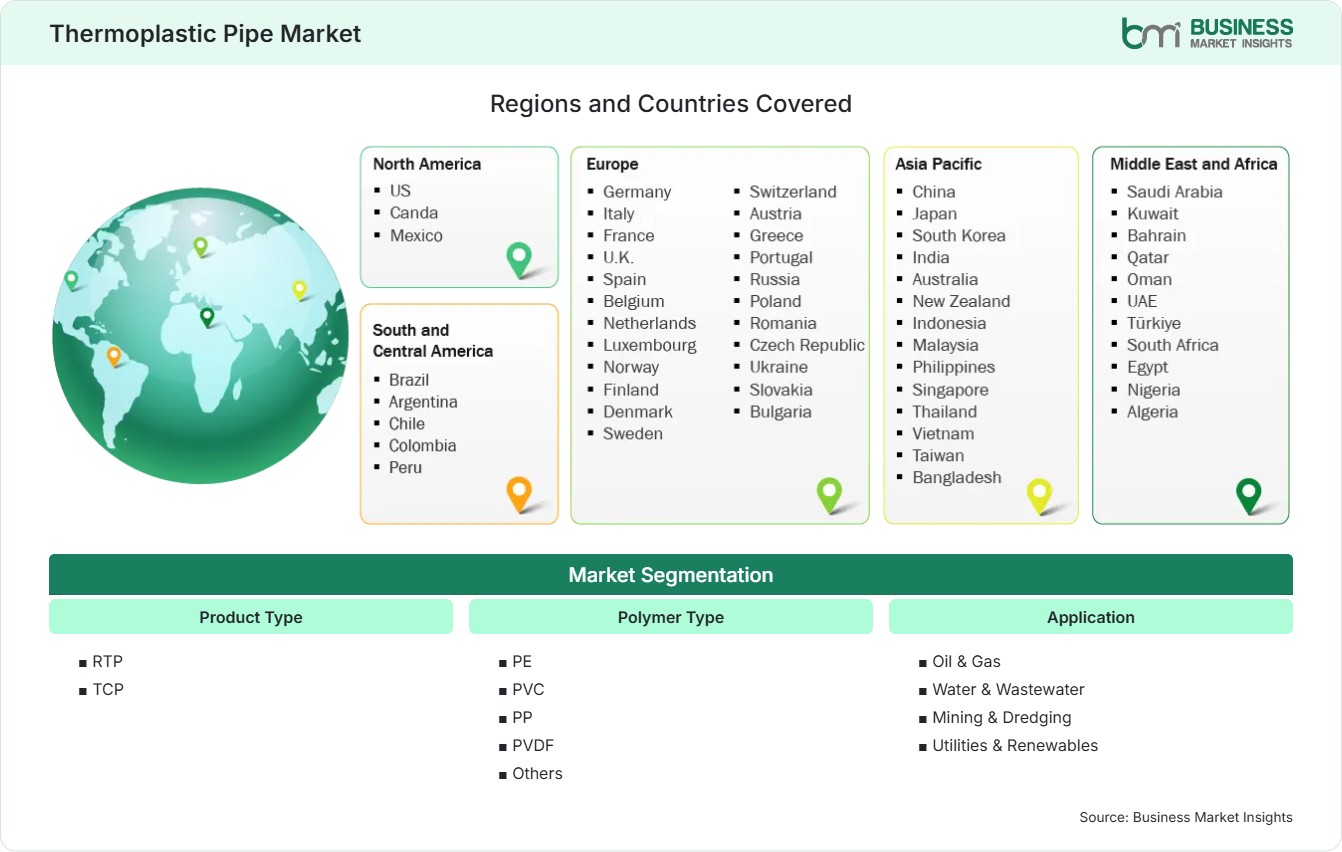
Global Market Geography
FREE PDF
Request your free sample
Request free sample
Segment Analysis

Thermoplastic Pipe Market Segmentation

Product Type

The Product Type segment accounted for 56%–59% of the overall market in 2025 and is projected to grow at a CAGR of 9.7%–10.5% during 2026–2033. Growing investments in water infrastructure, industrial pipeline modernization, oil & gas transportation, mining operations, and utility expansion continue driving demand for advanced thermoplastic piping systems across global markets. Manufacturers are increasingly developing reinforced and composite pipe technologies that provide superior corrosion resistance, lightweight construction, high pressure tolerance, flexibility, and extended service life compared with conventional steel and concrete pipelines. Continuous technological advancements in reinforcement materials, polymer formulations, and manufacturing processes are improving pipe durability, operational efficiency, and installation flexibility while reducing lifecycle maintenance costs. These advantages continue encouraging infrastructure developers and industrial operators to replace aging pipeline systems with high-performance thermoplastic alternatives.

  • Reinforced Thermoplastic Pipe (RTP): RTP dominates the market owing to its excellent corrosion resistance, high flexibility, lightweight design, reduced installation time, lower maintenance requirements, outstanding pressure performance, and suitability for oil & gas transmission, industrial process pipelines, water distribution systems, and offshore applications requiring durable long-term performance.
  • Thermoplastic Composite Pipe (TCP): TCP continues witnessing strong adoption due to its exceptional strength-to-weight ratio, superior fatigue resistance, high mechanical strength, enhanced chemical resistance, and ability to perform efficiently under demanding offshore, subsea, industrial, and high-pressure operating environments where conventional pipeline materials often experience performance limitations.

Polymer Type

The Polymer Type segment accounted for 46%–49% of the market in 2025 and is projected to expand at a CAGR of 9.9%–10.7% through 2033. Continuous advancements in polymer science, increasing focus on sustainable infrastructure development, and growing demand for durable piping materials continue supporting market expansion. Manufacturers are investing in advanced polymer formulations that improve thermal stability, chemical resistance, mechanical strength, pressure tolerance, and long-term operational reliability across multiple industrial environments. The Thermoplastic Pipe Market trends indicate increasing adoption of high-performance polymer materials capable of reducing maintenance requirements, minimizing leakage risks, improving installation efficiency, and supporting environmentally sustainable infrastructure development while extending the operational lifespan of critical pipeline networks.

  • Polyethylene (PE) Pipe: PE pipes represent the largest polymer segment owing to excellent flexibility, corrosion resistance, impact strength, low installation costs, long operational life, and widespread deployment across water distribution, gas transmission, irrigation systems, industrial facilities, and municipal infrastructure projects.
  • Poly Vinyl Chloride (PVC) Pipe: PVC pipes continue to witness substantial demand due to their affordability, high chemical resistance, durability, lightweight construction, ease of installation, and broad utilization in potable water supply, wastewater treatment, drainage, construction, and utility infrastructure applications.
  • Polypropylene Pipe (PP): PP pipes are increasingly utilized across industrial processing, chemical manufacturing, hot water systems, and specialized engineering applications because of their excellent thermal stability, superior chemical resistance, lightweight properties, and long-term mechanical performance.
  • Polyvinylidene Fluoride (PVDF): PVDF pipes support highly specialized industrial applications requiring exceptional chemical resistance, purity, UV stability, high-temperature tolerance, and reliable performance across pharmaceutical manufacturing, semiconductor fabrication, biotechnology, and chemical processing industries.
  • Others: Other advanced thermoplastic materials continue expanding across specialized industrial applications requiring enhanced pressure resistance, mechanical durability, environmental stability, and customized engineering characteristics for demanding pipeline operating conditions.

Application

The Application segment accounted for 31%–34% of the market in 2025 and is projected to grow steadily throughout the forecast period. Increasing investments in municipal water infrastructure, industrial modernization, renewable energy projects, mining activities, and oil & gas transportation continue to strengthen demand across major application sectors. Governments, industries, and infrastructure contractors have begun to emphasize corrosion-resistant, leak-proof, and environmentally friendly piping materials that can provide cost savings, efficient resource use, and enhanced infrastructure reliability. Emphasis on sustainable water management, energy security, and industry productivity is also contributing to the increasing adoption of advanced thermoplastic pipes.

  • Oil & Gas: Oil & gas remains one of the largest application areas due to increasing deployment of corrosion-resistant thermoplastic pipes across upstream, midstream, and downstream operations, including flowlines, gathering systems, chemical injection pipelines, offshore production facilities, and enhanced oil recovery projects.
  • Water & Wastewater: Water & wastewater represents the fastest-growing application driven by expanding municipal water supply projects, wastewater treatment facilities, desalination plants, irrigation systems, flood management infrastructure, and increasing investments in sustainable water resource management.
  • Mining & Dredging: Mining and dredging applications use thermoplastic pipe products for their high abrasion resistance, flexibility, lightweight nature, corrosion resistance, and efficient transport of slurry, tailings, process water, and mining fluids in harsh environments.
  • Utilities & Renewables: Utilities and renewable energy projects continue to use thermoplastic pipelines for district energy networks, geothermal plants, utility systems, hydrogen plants, cooling plants, and renewable energy systems.
Market Forces

Thermoplastic Pipe Market Dynamics

Key Market Drivers

Growing infrastructure development projects

Urbanization, rapid industrialization, rising populations, and increased government investment in transport, water supplies, sanitation systems, industries, and energy systems have been fueling significant demand for high-quality thermoplastic pipe systems. Major infrastructure projects need pipelines that are tough, corrosion-resistant, lightweight, and cost-effective, ensuring long service life and minimal maintenance needs. Investment in public and private infrastructure, such as local utilities, industrial parks, smart cities, green power stations, and water distribution systems, is continually generating growth opportunities for makers of thermoplastic piping.

Increasing corrosion-resistant demand

Industrial operators are increasingly replacing conventional steel, iron, and concrete pipelines with advanced thermoplastic alternatives because of their outstanding resistance to corrosion, chemicals, abrasion, scaling, and environmental degradation. Oil & gas, water treatment, mining, chemical processing, power generation, and industrial manufacturing sectors continue to adopt thermoplastic pipes to improve operational reliability, minimize leakage risks, reduce maintenance expenses, extend infrastructure lifespan, and improve overall operational efficiency under highly demanding environmental and industrial operating conditions.

Rising water management investments

Governments and utility providers worldwide continue increasing investments in clean drinking water distribution, wastewater treatment, irrigation systems, desalination plants, stormwater management, and sustainable water resource infrastructure. Thermoplastic pipes play an increasingly important role in modern water management by providing leak-resistant, durable, environmentally sustainable, and cost-effective pipeline systems that support long-term water conservation objectives, improve distribution efficiency, and reduce operational losses in municipal and industrial water networks.

Key Market Opportunities

Industrial pipeline replacement

Massive replacement of deteriorated metal pipes, such as steel and cast iron, along with concrete pipelines, offers significant business potential for the worldwide manufacture of thermoplastic pipes. Modern-day industry requires flexible, lightweight, corrosion-resistant, and maintenance-friendly pipes to improve efficiency and lower costs, boosting productivity across the supporting, water, manufacturing, and chemical processing industries.

Sustainable infrastructure projects

Increased focus on environmentally friendly construction practices, carbon-cutting measures, and efforts to achieve a circular economy is promoting the use of environmentally friendly, energy-efficient, and durable thermoplastic piping solutions. Policymakers and planners are investing in cutting-edge plastic-based technologies that are less damaging to the environment, more resource-efficient, and resilient enough to support future urban development and climate adaptation objectives.

Water conservation systems

The ongoing growth in investment in smart irrigation solutions, leak-detection technologies, facilities for using reclaimed water, intelligent water distribution networks, and efficient water management by municipalities continues to offer exciting prospects for the manufacture of thermoplastic piping materials. These pipeline solutions minimize water wastage, enhance efficiency in operations, minimize maintenance costs, and promote sustainable water conservation efforts.

Market Restraints and Challenges

Raw material volatility

Factor: Prices of polymer resins, petrochemical feedstocks, specialty additives, and reinforcement materials continue fluctuating because of crude oil price movements, global supply chain disruptions, trade restrictions, transportation costs, and manufacturing capacity limitations affecting raw material availability. Impact: Raw material price volatility increases manufacturing costs, affects profit margins, creates pricing uncertainty, complicates long-term procurement planning, and may delay infrastructure investment decisions for large-scale industrial and municipal pipeline projects.

High installation costs

Factor: Although thermoplastic pipes provide lower lifecycle maintenance expenses, installation of advanced pipeline systems often requires specialized equipment, skilled labor, engineering expertise, project planning, and customized connection technologies that increase initial infrastructure investment requirements. Impact: Higher upfront installation costs may delay adoption across cost-sensitive infrastructure projects, limit investments among smaller municipalities and industrial operators, extend project approval timelines, and create financial challenges despite the significant long-term operational, maintenance, and sustainability benefits offered by advanced thermoplastic piping systems.

Company Analysis

Competitive Landscape

The Thermoplastic Pipe Market analysis is highly competitive, with intense rivalry among international producers of pipes and polymers, as well as infrastructure companies, competing on innovation, capacity development, and alliances. Companies have invested in advanced polymer technology, reinforced thermoplastic pipes, green production processes, and monitoring systems to improve pipeline performance, durability, and efficiency. Increased investments in water infrastructure, oil & gas transport, mining, and industrial pipelines have continued to spur manufacturers to increase production capacity and geographical coverage through partnerships and mergers.

Company Name

Overview

Products and Services Relevant to this Market

Advanced Drainage Systems Inc.

Leading manufacturer of water management and drainage solutions.

HDPE pipes, drainage systems, stormwater management solutions, water infrastructure products.

Georg Fischer AG

Global provider of piping systems and industrial flow solutions.

Thermoplastic piping systems, industrial pipes, fittings, valves, water management solutions.

Aliaxis Group S.A.

International manufacturer of advanced fluid management systems.

PVC pipes, PE pipes, water supply systems, wastewater infrastructure solutions.

Wienerberger AG

Global building materials company with infrastructure solutions portfolio.

Plastic pipe systems, drainage solutions, water infrastructure products, utility pipeline systems.

JM Eagle Inc.

One of the world's largest plastic pipe manufacturers.

PVC pipes, PE pipes, irrigation systems, potable water and sewer pipeline solutions.

Chevron Phillips Chemical Company LLC

Major petrochemical company supplying advanced polymer materials.

Polyethylene resins, pipeline-grade polymers, industrial plastic materials, infrastructure polymers.

Pipelife International GmbH

Global supplier of plastic pipe systems for utilities and infrastructure.

Water supply pipes, sewer systems, cable protection pipes, industrial piping solutions.

Uponor Corporation

Provider of sustainable water infrastructure and building solutions.

PEX piping systems, plumbing solutions, district energy piping, water distribution systems.

Prinsco Inc.

Manufacturer specializing in water management products.

HDPE pipes, drainage products, agricultural water management systems, utility piping.

Polypipe Group plc

Leading manufacturer of plastic piping and water management products.

Thermoplastic pipe systems, drainage solutions, sustainable water infrastructure products.

Industry Activity

Recent Developments

July 2025

Pipelife Norge launched a new customer initiative to improve productivity and efficiency across Norwegian construction and infrastructure projects through its thermoplastic pipe solutions, reinforcing its focus on sustainable pipeline systems.

February 2025

Pipelife Norge launched new Environmental Product Declarations (EPDs) based on Norwegian production data for its PVC pipe portfolio, providing more accurate environmental performance documentation for infrastructure and utility projects.

February 2025

GF Piping Systems completed a thermoplastic piping retrofit for the Swedish Maritime Administration's icebreaker Oden, replacing steel jet-thruster pipes with engineered thermoplastic piping to improve corrosion resistance, reduce weight, and extend service life.

February 2025

Pipelife Norge appointed Andreas Larem as Sales Manager for its HVAC business to strengthen its market position and support growth of its piping solutions portfolio in Norway.

Trust & Transparency

Research Methodology

The market analysis combines proprietary research with secondary data from government agencies, company disclosures, regulatory filings, industry databases and expert interviews. Market estimates are validated through data triangulation, cross-market benchmarking and analyst review.

View Full Research Methodology

Questions Answered

Frequently Asked Questions

What future opportunities are expected in the Thermoplastic Pipe Market?

Key future opportunities include industrial pipeline replacement, sustainable infrastructure projects, smart water management systems, renewable energy infrastructure, advanced composite pipe technologies, and water conservation initiatives.

Who are the major companies operating in the market?

Leading companies include Advanced Drainage Systems Inc., Georg Fischer AG, Aliaxis Group S.A., Wienerberger AG, JM Eagle Inc., Chevron Phillips Chemical Company LLC, Pipelife International GmbH, Uponor Corporation, Prinsco Inc., and Polypipe Group plc.

Which product type holds the largest market share?

Reinforced Thermoplastic Pipe (RTP) dominates the market with a 56%–59% share in 2025 owing to its superior corrosion resistance, lightweight construction, flexibility, high-pressure performance, and lower maintenance requirements.

Which region dominates the market?

Asia Pacific leads the market with a 34%–37% share in 2025 and is expected to register the fastest growth due to rapid urbanization, industrial expansion, large-scale infrastructure development, and increasing investments in water and energy projects.

What is driving the Thermoplastic Pipe Market growth?

The market is primarily driven by growing infrastructure development projects, increasing demand for corrosion-resistant piping systems, rising investments in water management infrastructure, rapid industrialization, and expanding oil & gas and utility projects.

Access the Full Thermoplastic Pipe Market Report

Get segment-level forecasts, regional estimates, competitive benchmarking, company profiles and downloadable Excel datasets.

Access the full Thermoplastic Pipe Market Report
350 pages PDF & Excel | 2026-08-03
Similar Research

Related Market Reports