
Pipe Seals Market Outlook: Size, Share, Trends, Growth Analysis, Competitive Landscape & Forecast, 2026-2033

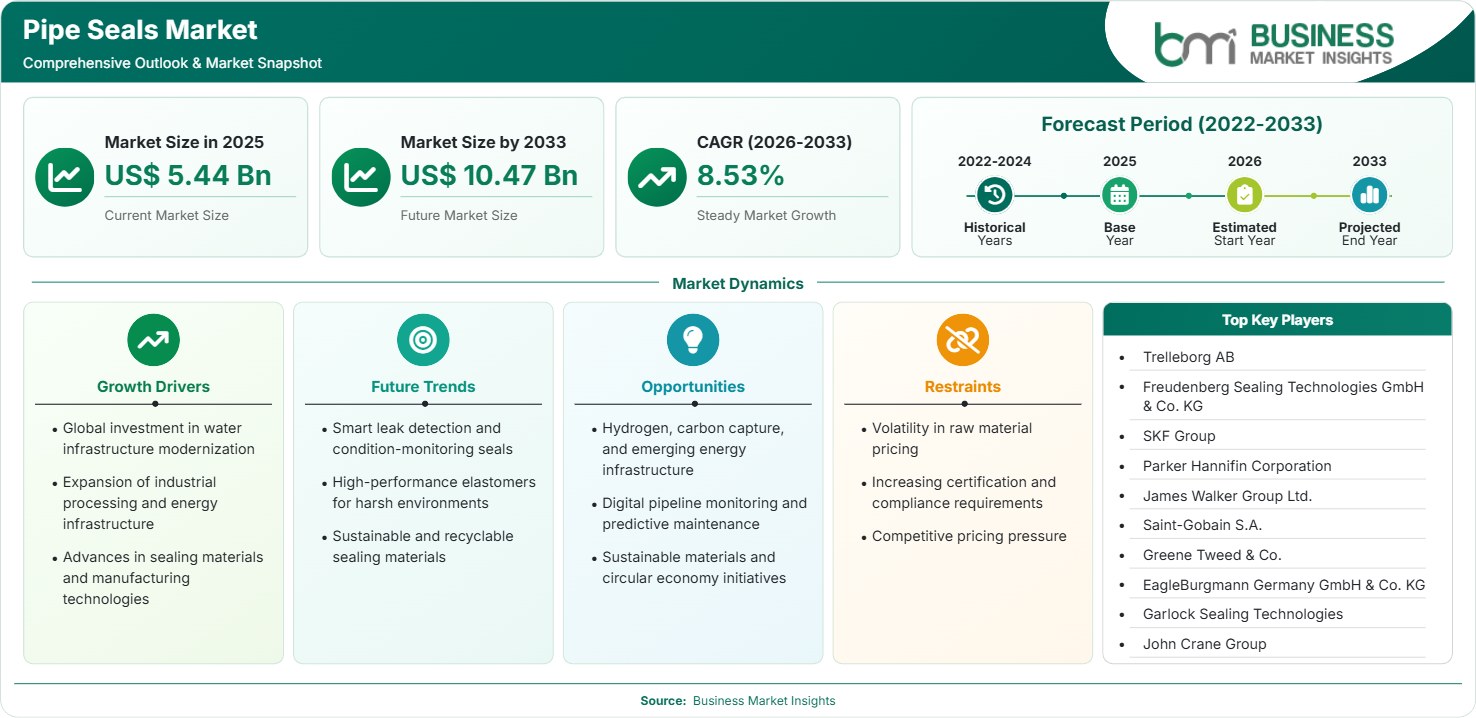
The Pipe Seals Market size was valued at US$ 5.44 billion in 2025 and is projected to reach US$ 10.47 billion by 2033, growing at a CAGR of 8.53% during 2026–2033. Demand is being supported by accelerating investments in water infrastructure, pipeline rehabilitation, industrial process modernization, and stricter leakage control regulations across utilities, oil and gas, and construction sectors.

Report Coverage
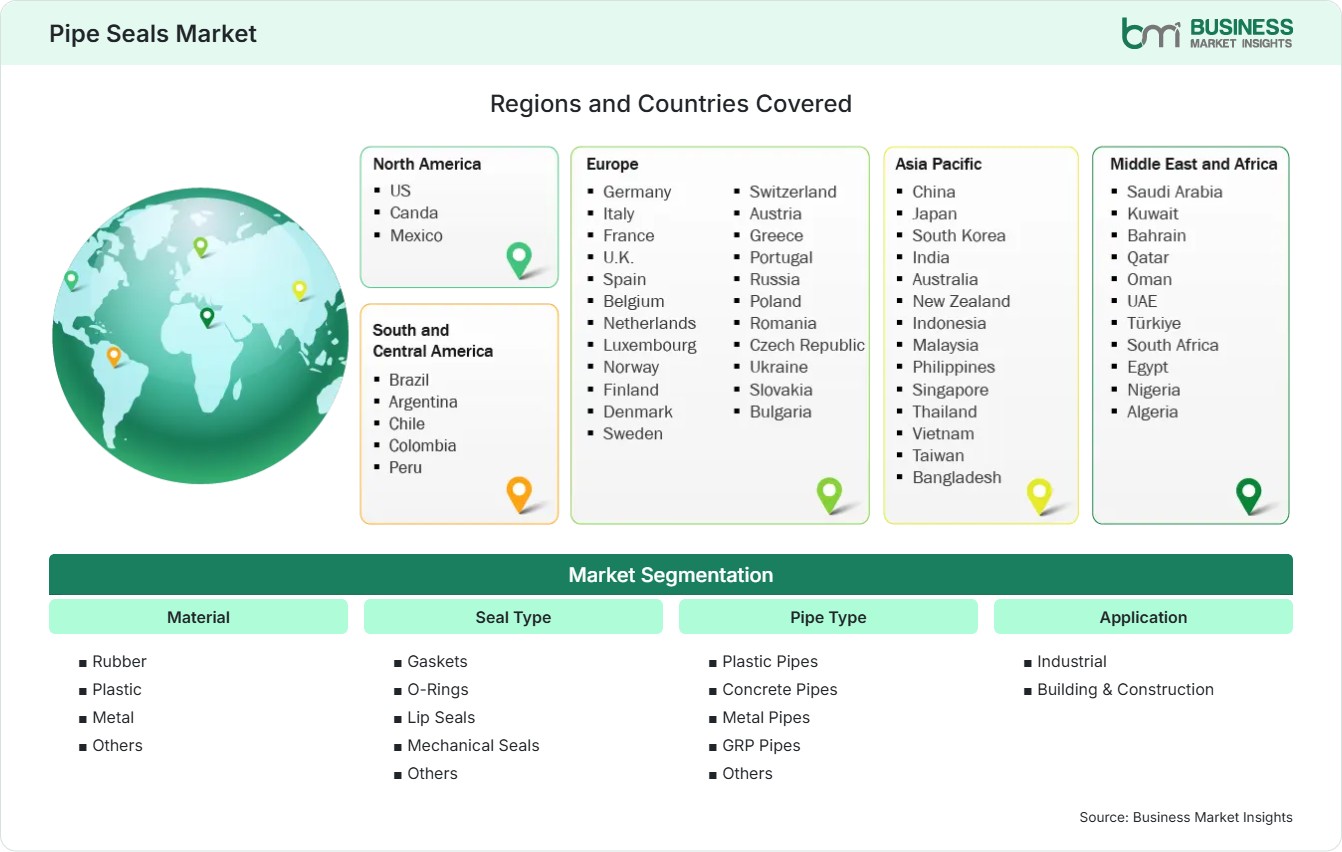
  • Material: Rubber, Plastic, Metal, Others
  • Seal Type: Gaskets, O-Rings, Lip Seals, Mechanical Seals, Others
  • Pipe Type: Plastic Pipes, Concrete Pipes, Metal Pipes, GRP Pipes, Others
  • Application: Industrial, Building & Construction
US$ 5.44 Bn Market size in 2025
US$ 10.47 Bn Market Size by 2033
8.53% CAGR, 2026 - 2033
2026-2033 Forecast Period

AI Overview

Pipe Seals Market Summary

  • North America Region: North America accounts for 34%–37% of global revenue in 2025 and is projected to expand at a 7.5%–8.1% CAGR during 2026–2033. Replacement of aging pipeline infrastructure, wastewater modernization programs, and stringent environmental regulations continue supporting premium sealing technologies. The United States remains the largest contributor, advancing at a 7.6%–8.2% CAGR through sustained municipal and industrial pipeline investments.
  • Fastest Growing Region: Asia Pacific represents 27%–30% of global revenue in 2025 while expanding at a 10.1%–10.8% CAGR during 2026–2033. Rapid urbanization, industrial manufacturing growth, expanding municipal water networks, and energy infrastructure development continue generating strong demand for advanced sealing solutions.
  • Leading Segment: Rubber materials contribute 42%–45% of revenue in 2025 and are forecast to grow at a 7.9%–8.5% CAGR. Their flexibility, durability, chemical resistance, and cost effectiveness make them suitable across municipal water, industrial processing, and construction pipeline applications.
  • High Growth Segment: Industrial applications account for 58%–61% of revenue while advancing at 9.0%–9.6% CAGR. Water treatment expansion, refinery upgrades, chemical processing investments, and stricter operational safety standards continue increasing adoption of high-performance sealing systems.
  • Key Market Opportunity: Digital water management initiatives, pipeline rehabilitation projects, hydrogen infrastructure investments, and advanced polymer engineering create long-term opportunities in pipe seals market, for high-performance sealing technologies capable of delivering extended service life and reduced leakage.
  • Major Market Players: Trelleborg AB, Freudenberg Sealing Technologies GmbH & Co. KG, SKF Group, Parker Hannifin Corporation, James Walker Group Ltd., Saint-Gobain S.A., Greene Tweed & Co., EagleBurgmann Germany GmbH & Co. KG, Garlock Sealing Technologies, John Crane Group.
Strategic Insights

Pipe Seals Market: Strategic Insights

Pipe Seals Market Strategic Framework
FREE PDF
Request your free sample
Request free sample
Stakeholder View

Key Takeaways

  • Raw material suppliers, compound formulators, seal manufacturers, pipe producers, EPC contractors, distributors, and infrastructure operators collectively shape an integrated value chain where product quality, certification, and long-term reliability strongly influence procurement decisions in pipe seals market growth.
  • Industrial wastewater treatment, chemical processing, district water distribution, and pipeline rehabilitation projects present the strongest medium-term commercial opportunities as operators increasingly prioritize leakage reduction and lifecycle operating efficiency.
  • Material innovation is shifting toward advanced elastomer formulations, PTFE composites, engineered thermoplastics, and digitally monitored sealing systems capable of extending maintenance intervals while improving operational reliability.
  • Asia Pacific offers the most attractive long-term investment potential because expanding urban populations, industrial production, and government-funded water infrastructure projects continue driving sustained demand growth across multiple application sectors.
  • Strategic acquisitions, regional manufacturing expansion, localized production capabilities, and collaborative engineering partnerships are becoming increasingly important competitive strategies as customers seek customized sealing solutions with shorter delivery timelines.
Geographic Outlook

Pipe Seals Market Regional Highlights

North America Pipe Seals Market

North America remains the largest regional market with 2025 Pipe Seals Market share of 34%–37%, supported by aging pipeline replacement, municipal wastewater investments, industrial automation, and stringent environmental regulations. The region is projected to register CAGR of 7.5%–8.1% between 2026 and 2033 as utilities continue upgrading water transmission and industrial pipeline infrastructure.

  • Federal infrastructure funding continues accelerating rehabilitation of aging drinking water and wastewater networks while increasing procurement of durable sealing technologies capable of reducing leakage and maintenance frequency.
  • Industrial operators across oil and gas, chemicals, and power generation increasingly specify premium sealing materials that improve operational reliability under demanding pressure and temperature conditions.
  • Digital pipeline monitoring solutions encourage adoption of longer-life sealing products that minimize unplanned maintenance and reduce lifecycle operating expenditures.
  • Sustainability initiatives encourage municipalities to prioritize leak prevention technologies supporting water conservation objectives while lowering energy consumption associated with distribution systems.

US Pipe Seals Market

The United States represents the largest national market within North America, accounting for a regional share of 78%–82% and expanding at a CAGR of 7.6%–8.2% through 2033. Water infrastructure modernization, industrial manufacturing expansion, and pipeline integrity management remain the principal demand generators in pipe seals market.

  • Water utilities continue replacing legacy distribution networks to reduce non-revenue water losses and improve long-term operational resilience.
  • Petrochemical and LNG investments support demand for high-performance mechanical sealing technologies capable of operating in challenging industrial environments.
  • Building renovation activity increases demand for modern sealing systems meeting stricter construction and plumbing performance standards.

Europe Pipe Seals Market

Europe accounts for 2025 market share of 25%–28% while advancing at CAGR of 7.8%–8.4% through the forecast period. Environmental regulations, circular economy objectives, and investments in sustainable water infrastructure continue supporting premium sealing solutions across industrial and municipal applications.

  • Germany remains the regional leader due to its advanced industrial manufacturing base and extensive process engineering sector.
  • Poland is projected to record one of the fastest regional growth rates as infrastructure modernization and industrial investments accelerate.
  • Utilities increasingly prioritize leakage reduction technologies supporting climate resilience and water conservation initiatives.
  • Growing adoption of advanced polymer sealing materials improves durability while reducing maintenance costs across pipeline networks.

Asia Pacific Pipe Seals Market

Asia Pacific represents 2025 share of 27%–30% and is expected to achieve the fastest expansion with CAGR of 10.1%–10.8% through 2033. Urbanization, manufacturing growth, expanding utility infrastructure, and government investment programs continue strengthening regional demand.

  • China maintains the largest regional market through extensive municipal infrastructure and industrial production capacity.
  • India is expected to register the fastest regional expansion due to significant investments in water supply, sanitation, and industrial corridors.
  • Southeast Asian economies continue expanding wastewater treatment and urban pipeline infrastructure.
  • Rising manufacturing output increases demand for high-performance industrial sealing technologies.
  • Large infrastructure programs continue supporting long-term procurement opportunities across residential, commercial, and industrial sectors.

Rest of World Pipe Seals Market

South & Central America and the Middle East & Africa collectively account for 2025 share of 10%–13% while expanding at CAGR of 8.4%–9.0% through 2033. Water security initiatives, mining investments, and energy infrastructure projects continue supporting regional demand.

Middle Eastern countries increasingly invest in desalination facilities, pipeline transmission systems, and industrial diversification projects. Meanwhile, South & Central America continues benefiting from municipal water upgrades and expanding mining operations requiring reliable sealing technologies.

  • Saudi Arabia remains the largest Middle Eastern market through extensive infrastructure development.
  • Brazil leads South & Central America with ongoing investments in sanitation and industrial modernization.
  • Mining activities increase demand for abrasion-resistant sealing products across processing facilities.
  • Desalination capacity expansion strengthens procurement of corrosion-resistant sealing technologies.
  • Public infrastructure investment continues improving long-term market fundamentals across emerging economies.
Global Market Geography
FREE PDF
Request your free sample
Request free sample
Segment Analysis

Pipe Seals Market Segmentation

Material

The Material segment accounts for an estimated 42%–45% pipe seals market share in 2025 and is projected to expand at CAGR of 8.2%–8.8% through 2033. Material selection directly influences sealing performance, pressure tolerance, chemical compatibility, service life, and maintenance costs. Manufacturers increasingly invest in engineered elastomers and advanced polymer compounds to address demanding industrial operating environments while supporting sustainability objectives and longer asset lifecycles. Market scope continues expanding as specialized material formulations enable broader adoption across municipal, industrial, and infrastructure applications.

  • Rubber: Rubber remains the preferred material due to its flexibility, resilience, and compatibility with water distribution, wastewater systems, industrial processing facilities, and construction pipelines requiring dependable long-term sealing performance.
  • Plastic: Plastic-based sealing materials gain traction through corrosion resistance, lightweight construction, chemical stability, and cost-efficient installation across municipal infrastructure, residential plumbing, and low-pressure industrial pipeline applications.
  • Metal: Metal seals serve high-pressure and high-temperature environments including refineries, petrochemical plants, power generation facilities, and specialized industrial applications requiring exceptional structural integrity and durability.

Seal Type

Seal Type represents one of the industry's most technologically diverse segments, contributing a pipe seals market share of 31%–34% while registering a CAGR of 8.5%–9.1%. Product innovation increasingly focuses on minimizing leakage, extending maintenance intervals, improving installation efficiency, and supporting higher operating pressures across industrial and utility infrastructure. Demand continues growing as operators prioritize lifecycle cost reduction and enhanced operational reliability.

  • Gaskets: Gaskets remain widely adopted across flange connections because they provide dependable sealing, accommodate dimensional variations, and simplify maintenance activities across industrial processing and municipal infrastructure.
  • O-Rings: O-rings continue experiencing strong adoption owing to compact designs, effective pressure sealing, affordability, and compatibility with hydraulic, pneumatic, and fluid transfer systems.
  • Lip Seals: Lip seals support rotating equipment by preventing lubricant leakage and contaminant ingress, making them valuable across pumps, compressors, motors, and industrial machinery.
  • Mechanical Seals: Mechanical seals increasingly replace traditional packing solutions by reducing leakage, improving energy efficiency, extending equipment reliability, and supporting stricter environmental compliance requirements.

Pipe Type

Pipe Type contributes approximately 26%–29% of overall demand with a projected CAGR of 8.4%–9.0%. Material compatibility between seals and pipe systems significantly influences installation quality, operational longevity, and maintenance frequency. Infrastructure modernization programs continue expanding demand across both replacement and greenfield pipeline projects.

  • Plastic Pipes: Plastic pipeline installations continue increasing because of corrosion resistance, simplified installation, lower maintenance costs, and expanding residential and municipal water infrastructure.
  • Concrete Pipes: Concrete pipe applications remain significant within stormwater drainage, wastewater collection, and large municipal infrastructure projects requiring durable sealing performance.
  • Metal Pipes (Ductile Iron & Others): Metal pipelines continue supporting water transmission, industrial processing, and energy transportation where higher structural strength and pressure resistance remain essential.
  • GRP Pipes: Glass-reinforced plastic pipes experience rising adoption within desalination, chemical processing, and marine infrastructure because of corrosion resistance and extended operational lifespan.

Application

Application remains the largest revenue-generating segment with an estimated 58%–61% market share in 2025 and a projected CAGR of 9.0%–9.6%. The Pipe Seals Market trends increasingly reflect stronger investment across industrial infrastructure, wastewater treatment, energy transportation, and commercial construction, where reliable sealing systems directly improve operational continuity, environmental compliance, and lifecycle asset performance.

  • Industrial: Industrial applications dominate demand through continuous investments in process industries, pipeline integrity, water treatment, refinery modernization, and chemical production infrastructure.
    • Water & Wastewater Treatment: Expanding treatment capacity, stricter environmental regulations, and aging infrastructure rehabilitation continue strengthening long-term demand for advanced sealing technologies.
    • Oil & Gas: Pipeline transportation, upstream production, refining operations, and LNG infrastructure require high-performance sealing systems capable of operating under demanding pressure and temperature conditions.
    • Chemical Processing: Chemical facilities increasingly adopt specialized sealing materials designed to withstand aggressive media while minimizing leakage risks and maintenance requirements.
  • Building & Construction: Construction activity supports sustained demand through residential developments, commercial buildings, hospitals, transport infrastructure, and utility expansion projects.
    • Residential: Urban housing developments continue increasing installations of reliable water distribution and drainage systems requiring durable sealing products.
    • Commercial: Office complexes, healthcare facilities, industrial parks, and educational institutions increasingly utilize advanced pipeline systems supporting efficient water management.
    • Infrastructure: Public infrastructure projects including transportation networks, water supply systems, and sanitation facilities remain long-term demand generators for engineered sealing solutions.
Market Forces

Pipe Seals Market Dynamics

Key Market Drivers

Global investment in water infrastructure modernization

Public authorities around the world are continuously raising investment in the supply of drinking water, wastewater management, flood control, and sanitation infrastructure. In the case of developed countries, aging pipeline networks need major renovations, whereas, in the case of developing nations, the expansion of network coverage needs to be pursued further in order to cope up with the rising urban populations. An effective sealing system has become a vital component for saving water losses, maintaining the required pressure level, and cutting down on maintenance expenses.

Expansion of industrial processing and energy infrastructure

The requirement of sophisticated sealing technology able to function at high temperatures, pressures, and aggressive conditions is increasing day by day in industrial units. In oil and gas pipelines, petrochemical processes, mining operations, power generation, and manufacturing plants, there is a shift toward using engineering sealants instead of conventional sealants because these help increase life expectancy as well as increase operational performance. The increased spending on automation and optimization of industrial processes further motivates the use of engineered sealing systems.

Advances in sealing materials and manufacturing technologies

The continuous improvement in elastomer compounds, engineered thermoplastics, composite materials, precise molding, and computerized quality control enhances durability and efficiency of products. It is becoming increasingly common for manufacturers to come up with tailored sealing solutions to meet the unique needs of the specific industries while adhering to environmental regulations. The advanced technology allows enhanced chemical, mechanical, pressure, and thermal resistance, thereby enabling users to increase the intervals of maintenance.

Key Market Opportunities

Hydrogen, carbon capture, and emerging energy infrastructure

Investments made globally in the manufacturing of hydrogen, construction of infrastructure for capturing carbon dioxide, production of alternative fuels, and development of innovative energy infrastructure for industries generate lucrative prospects for manufacturers of niche seals. Such applications necessitate the use of high-end material which can retain its performance characteristics even under demanding conditions. With the decarbonization efforts being made by governments, there will be a significant rise in demand for engineered seals, thereby bolstering the Pipe Seals Market Forecasts.

Digital pipeline monitoring and predictive maintenance

Integrating digital technology for monitoring purposes is becoming more common among utility and industrial users within pipeline systems to enhance asset management and maintenance. Advanced inspection systems help identify the potential for leakage and wear at an earlier stage, thus motivating organizations to purchase high-quality seals with longer lifespans. Companies that can offer integrated predictive maintenance, engineering solutions, and specialized seals will benefit from lucrative projects.

Sustainable materials and circular economy initiatives

Increasingly, environmental standards push firms to lower their emission levels and ensure that their products are more easily recyclable, along with being more resource efficient during production. The development of recyclable elastomers, biopolymers, and sustainable manufacturing techniques provides an avenue for product differentiation in environmentally responsible sourcing programs. Companies that can prove their commitment to sustainability will be at an advantage when it comes to government infrastructure and multinational industrial projects.

Market Restraints and Challenges

Volatility in raw material pricing

Factor: The prices of synthetic rubber, specialty polymers, fluoropolymers, carbon black, metal alloys, and other materials remain subject to changes in energy prices, international logistics, and geopolitical events.

Impact: The cost of production becomes more difficult to predict, making the price unstable and squeezing the margins of profit. Small manufacturers find themselves under financial stress since they lack the leverage to negotiate with customers.

Increasing certification and compliance requirements

Factor: Ongoing trend towards increasingly strict regulatory requirements concerning the material safety, leakage prevention, product testing, traceability, and operational reliability in key infrastructure industries.

Impact: Manufacturers have to incur more costs for certifications, long product development times, and more testing before bringing the products to the market. Though this ensures higher product quality, these standards create higher barriers to entry into the market.

Company Analysis

Competitive Landscape

The competitive environment remains moderately consolidated, with multinational sealing technology providers competing through product innovation, material engineering, manufacturing expansion, digital engineering support, and customized application development. This Pipe Seals Market analysis indicates increasing emphasis on lifecycle performance, regulatory compliance, sustainability, and strategic partnerships across municipal, industrial, and infrastructure applications.

Company Name

Overview

Products and Services Relevant to this Market

Trelleborg AB

Global engineered polymer specialist serving industrial, infrastructure, transportation, and energy markets through advanced sealing technologies.

Elastomer seals, pipe sealing systems, O-rings, custom engineered sealing components, infrastructure sealing solutions.

Freudenberg Sealing Technologies GmbH & Co. KG

International sealing technology company with strong material science capabilities supporting demanding industrial applications.

Industrial seals, elastomer compounds, hydraulic seals, rotary seals, engineered sealing systems.

SKF Group

Global bearing and rotating equipment manufacturer offering integrated sealing technologies across industrial sectors.

Rotary shaft seals, industrial sealing products, bearing seals, lubrication solutions, engineering services.

Parker Hannifin Corporation

Diversified motion and control technologies company serving industrial, aerospace, and infrastructure markets globally.

O-rings, hydraulic seals, fluid sealing products, engineered polymer components, industrial sealing systems.

James Walker Group Ltd.

Specialist sealing engineering company serving critical process industries with high-performance sealing products.

Gaskets, compression packings, elastomer seals, expansion joints, engineered sealing services.

Saint-Gobain S.A.

Advanced materials manufacturer supplying engineered polymer solutions for industrial and infrastructure applications.

High-performance polymer seals, PTFE components, engineered plastics, industrial sealing materials.

Greene Tweed & Co.

High-performance material specialist serving semiconductor, energy, aerospace, and chemical industries worldwide.

Advanced composite seals, thermoplastic components, engineered elastomer products, custom sealing solutions.

EagleBurgmann Germany GmbH & Co. KG

Mechanical sealing specialist supporting pumps, compressors, process industries, and energy infrastructure.

Mechanical seals, seal supply systems, expansion joints, industrial sealing technologies.

Garlock Sealing Technologies

Industrial sealing manufacturer specializing in high-performance fluid containment and process reliability.

Gaskets, expansion joints, compression packing, industrial sealing materials, flange sealing systems.

John Crane Group

Global provider of rotating equipment technologies emphasizing reliability and industrial asset performance.

Mechanical seals, filtration systems, engineered sealing technologies, reliability services, asset optimization solutions.

Industry Activity

Recent Developments

July 2026

United Drilling Tools successfully supplied and deployed 5,000 metres of 7-inch premium production casing pipes for Oil India at a gas well in Assam. The premium connections incorporate advanced metal-to-metal sealing technology to provide leak-proof performance under high-pressure, high-temperature, and corrosive operating conditions, marking the company's entry into the premium casing and tubing segment.

June 2026

Henkel introduced a PFAS-free version of its LOCTITE 55 sealing cord at InstallerSHOW 2026, providing an instant sealing solution for metal and plastic pipe systems used in gas, water, LPG, and compressed air applications while supporting evolving environmental compliance requirements.

February 2026

Sigma Polymer Group completed the acquisition of M.O.L. ROMGUM, strengthening its pipe sealing portfolio with high-precision rubber seals for drinking water and wastewater infrastructure while expanding its capabilities in technical rubber and extruded polymer products.

February 2026

Interpipe launched production of oil country tubular goods (OCTG) tubing equipped with PTFE sealing rings at its Interpipe Niko Tube facility. The enhanced sealing technology improves resistance to external pressure and provides additional internal pressure sealing, expanding the company's premium product offering for oil and gas applications.

Trust & Transparency

Research Methodology

The market analysis combines proprietary research with secondary data from government agencies, company disclosures, regulatory filings, industry databases and expert interviews. Market estimates are validated through data triangulation, cross-market benchmarking and analyst review.

View Full Research Methodology

Questions Answered

Frequently Asked Questions

What information does a Pipe Seals Market Report typically provide?

A comprehensive Report generally includes market sizing, competitive benchmarking, segmentation analysis, technology trends, regional outlook, investment opportunities, regulatory considerations, and future growth projections supporting strategic decision-making.

Which industries represent the largest application opportunities?

Water and wastewater treatment, oil and gas, chemical processing, manufacturing, commercial construction, and public infrastructure remain the principal end-use industries generating sustained demand for engineered sealing technologies.

Which region offers the strongest future growth potential?

Based on estimates, Asia Pacific offers the strongest long-term growth potential because of rapid urbanization, industrial expansion, government infrastructure investment, and increasing construction of water and wastewater networks.

Which material category currently leads industry demand?

Rubber-based sealing materials continue to dominate due to their flexibility, durability, chemical compatibility, affordability, and suitability across municipal water, industrial processing, and building infrastructure applications.

What are the primary factors driving demand for the Pipe Seals Market?

Demand is supported by investments in municipal water infrastructure, wastewater treatment facilities, industrial process expansion, pipeline rehabilitation programs, and stricter environmental regulations emphasizing leakage reduction and long-term operational reliability.

Access the Full Pipe Seals Market Report

Get segment-level forecasts, regional estimates, competitive benchmarking, company profiles and downloadable Excel datasets.

Access the full Pipe Seals Market Report
350 pages PDF & Excel | 2026-07-31
Similar Research

Related Market Reports