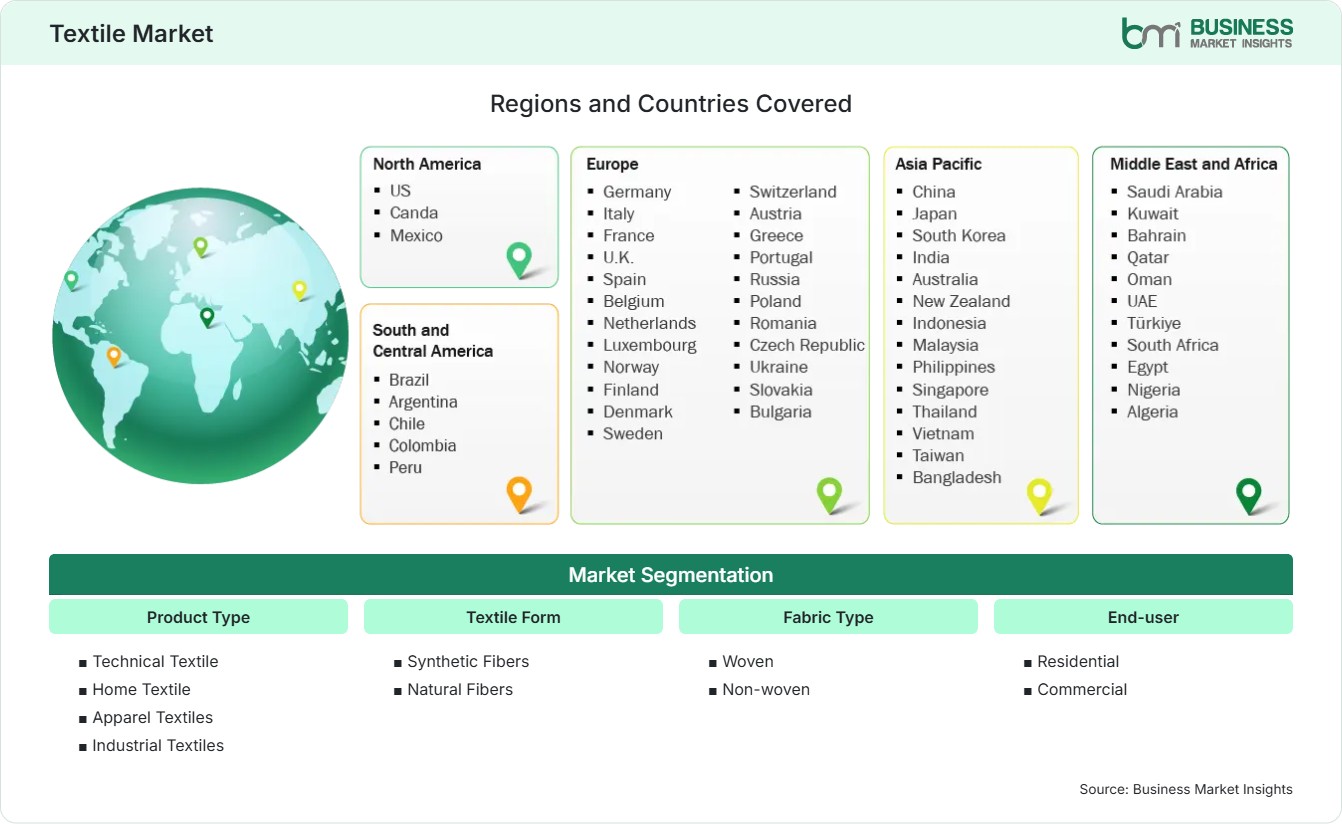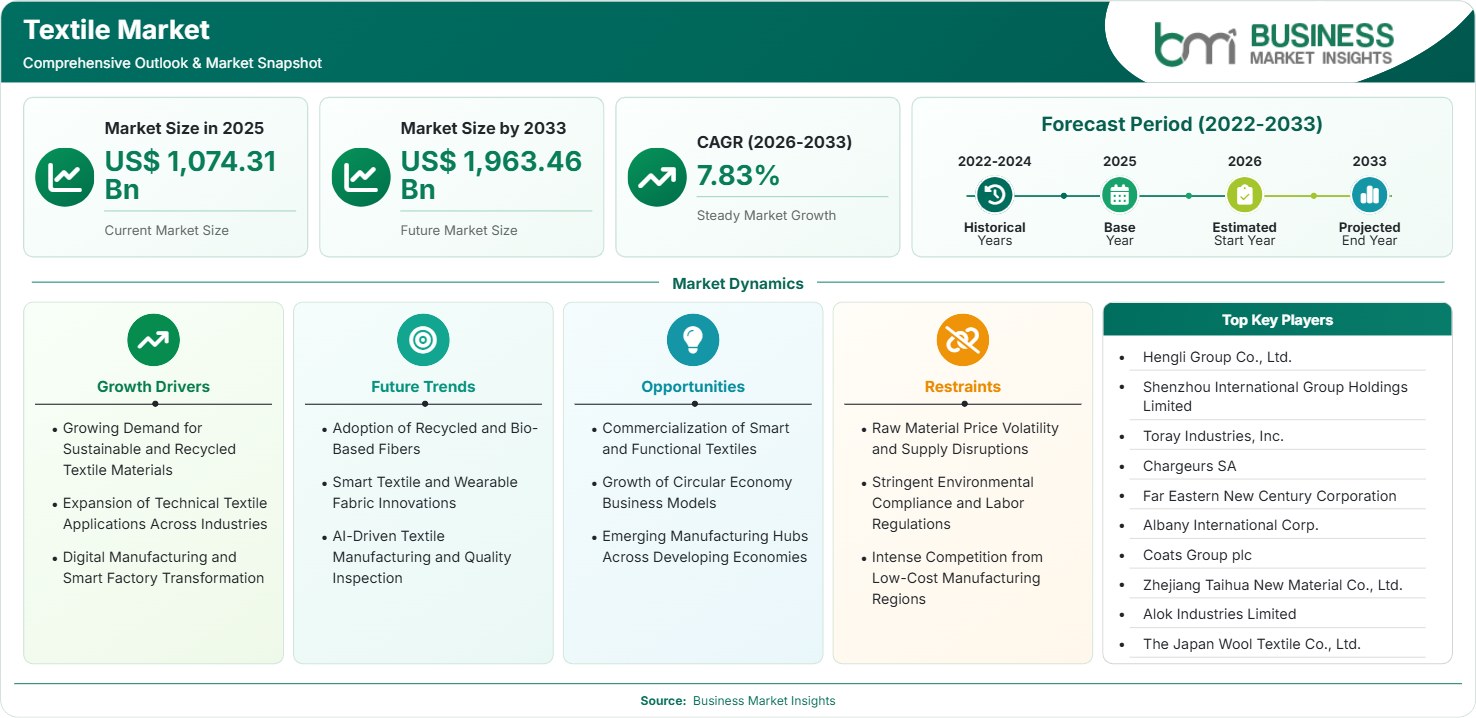
Textile Market Regional Highlights
North America Textile Market
North America accounted for 23%–26% of global revenue in 2025 and is anticipated to expand at a 6.6%–7.1% CAGR during 2026–2033. Demand remains supported by advanced technical textile manufacturing, healthcare applications, aerospace materials, and increasing reshoring initiatives. The region also benefits from strong research capabilities, high-value industrial textile demand, and government support for domestic manufacturing resilience, strengthening the Textile Market share across premium textile applications.
- The increase in the use of technology related to Industry 4.0 helps companies to improve the efficiency of their production process, reduce wastage of materials, improve product quality, and ensure resilience of supply chains in textile manufacturing companies.
- The health care industry, defense, and automotive industry keep buying more and more engineered fabrics, protective clothing, filtration media, and lightweight composites; therefore, the demand for high-quality textile products remains stable for a long period of time.
- Sustainability laws motivate companies to make investments in recycled polyesters, organic fiber production, water-efficient dyeing methods, and circular production; therefore, manufacturers can improve their environmental performance and meet the needs of customers and regulators.
- The expansion of local fiber production and local sourcing strategies makes manufacturers less dependent on foreign suppliers; therefore, they can increase their competitiveness.
US Textile Market
The United States represents 72%–76% of North American revenue in 2025 while advancing at a 6.8%–7.2% CAGR through 2033. High investments in advanced manufacturing, medical textiles, aerospace composites, defense applications, and sustainable material innovation continue supporting premium product demand.
- The requirement of technical textile is growing steadily via the medical, filtering, aerospace and defense sectors, motivating manufacturers to emphasize high performance fabrics with better durability and safety features.
- The introduction of digital textile printing, AI-based quality control systems and robotics helps improve production accuracy and cut down expenses, allowing manufacturers to handle rising demands for customization and shortened development cycles effectively.
- Actions of sustainability lead to increased usage of recycled fibers, renewable energy usage and water saving technologies, ensuring compliance with environmental regulations and improved operational performance for manufacturers.
- Growing investments into research partnerships help promote innovative fibers, smart textiles and wearable technology solutions providing manufacturers with additional opportunities.
Europe Textile Market
Europe held 21%–24% of worldwide revenue during 2025 and is projected to record a 6.9%–7.4% CAGR through 2033. Germany remains the leading textile market owing to industrial textile demand, while Italy maintains leadership in luxury textiles. Poland demonstrates the fastest regional expansion with a projected CAGR between 7.8%–8.3%, supported by manufacturing investments and export growth.
- Sustainability standards enforced in the European Union encourage more investment in recycled fiber content, sustainable dyeing methods, and the circular economy model, prompting manufacturers to become more resource efficient and compliant with environmental policies.
- As a leader in industrial and automotive textiles, Germany sustains the growth in engineered fabrics and composite materials thanks to investment in manufacturing technologies for value-added exports.
- To boost the competitiveness of premium textiles, Italy integrates traditional techniques with digital manufacturing tools, which is helpful in producing fashion and luxury apparel and specialty fabrics.
- The region experiences the most intense growth in Poland due to manufacturing investments of global companies that benefit from low operating costs and labor skills.
Asia Pacific Textile Market
Asia Pacific dominated global revenue with 43%–46% market share in 2025 and is forecast to achieve the highest 9.0%–9.6% CAGR during 2026–2033. China remains the largest manufacturing and exporting country, while India demonstrates the strongest growth momentum with an estimated CAGR between 9.8%–10.4%. Rising domestic consumption, expanding industrialization, government-backed textile parks, export competitiveness, and investments in sustainable manufacturing continue reinforcing regional leadership throughout the global textile value chain.
- China maintains leadership through integrated supply chains, large-scale manufacturing capacity, advanced automation, and substantial investments in recycled fiber production supporting global apparel and industrial textile exports.
- India records the fastest expansion driven by government incentives, expanding technical textile adoption, rising domestic apparel demand, and increasing foreign direct investment supporting modernization across textile manufacturing clusters.
- Vietnam, Bangladesh, and Indonesia continue strengthening export competitiveness through capacity expansion, skilled labor availability, and favorable trade agreements attracting multinational apparel and textile manufacturers.
- Regional manufacturers increasingly adopt digital production technologies, AI-enabled quality inspection, and automated weaving systems to improve productivity while addressing evolving sustainability and customer quality expectations.
Rest of World Textile Market
The Rest of World region accounted for 9%–12% of global revenue in 2025 and is anticipated to register a 7.5%–8.1% CAGR during the forecast period. Brazil leads regional demand, whereas Saudi Arabia records the fastest growth with a projected CAGR between 8.2%–8.8%, supported by industrial development programs and manufacturing investments.
- Brazil remains the largest regional textile producer through strong domestic consumption, integrated cotton production, and expanding investments in modern manufacturing technologies serving apparel and home textile industries.
- Saudi Arabia demonstrates the strongest growth supported by industrial diversification strategies, petrochemical integration for synthetic fibers, and government-backed manufacturing investments enhancing regional production capabilities.
- African countries continue attracting apparel manufacturing investments due to competitive labor costs, preferential export agreements, and growing industrial zones supporting global supply chain diversification.
- Increasing infrastructure investments, urbanization, and hospitality development stimulate demand for commercial textiles, technical fabrics, interior furnishings, and industrial materials across emerging regional economies.
- Sustainability initiatives and regional recycling investments improve resource efficiency while encouraging manufacturers to adopt environmentally responsible production processes aligned with international customer procurement standards.