
Textile Colorant Market Outlook: Size, Share, Trends, Growth Analysis, Competitive Landscape & Forecast, 2026-2033

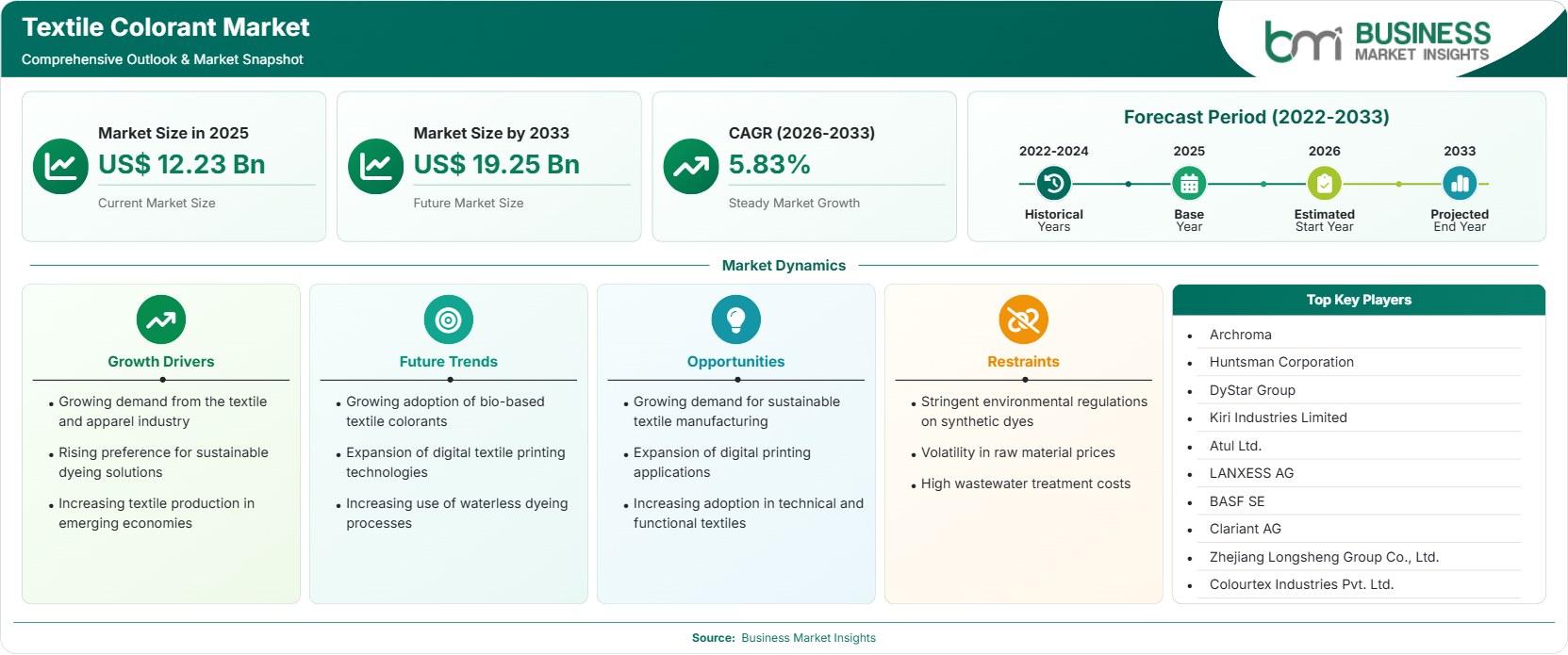
The Textile Colorant Market size was valued at US$ 12.23 Billion in 2025 and is projected to reach US$ 19.25 Billion by 2033, growing at a CAGR of 5.83% from 2026 to 2033, driven by textile industry expansion, sustainable dyeing adoption, emerging economy production growth, digital printing advancements, and increasing demand for functional textile applications.

Report Coverage
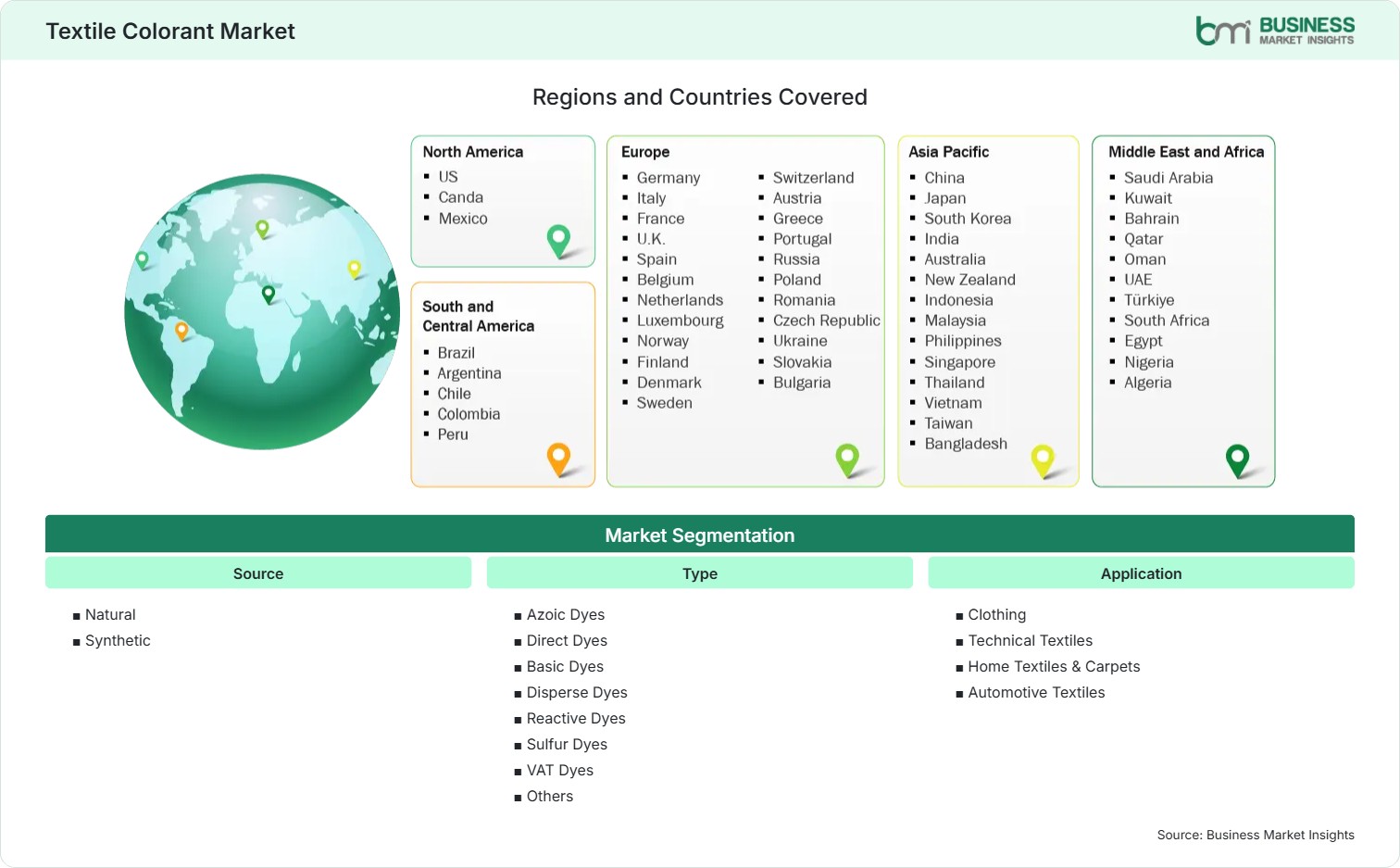
  • Source: Natural, Synthetic
  • Type: Azoic Dyes, Direct Dyes, Basic Dyes, Disperse Dyes, Reactive Dyes, Sulfur Dyes, VAT Dyes, Others
  • Application: Clothing, Technical Textiles, Home Textiles & Carpets, Automotive Textiles
US$ 12.23 Bn Market size in 2025
US$ 19.25 Bn Market Size by 2033
5.83% CAGR, 2026 - 2033
2026-2033 Forecast Period

01 AI Overview

Textile Colorant Market Summary

  • North America Region: North America holds a market share of 22%–26% in 2025, growing with a CAGR of 5.0%–5.5% influenced by sustainable textile initiatives, advanced manufacturing practices, specialty textile demand, and regulatory-driven adoption of environmentally responsible color solutions. The U.S. market demonstrates steady growth with a CAGR of 5.2%–5.7% from 2026–2033, supported by technical textiles, apparel innovation, and sustainable production investments.
  • Fastest Growing Region: Asia Pacific holds a market share of 42%–46% in 2025, growing with a CAGR of 6.2%–6.8% influenced by expanding textile manufacturing capacity, rising apparel exports, growing consumer markets, and increasing adoption of advanced dyeing technologies across emerging economies.
  • Leading Segment: Synthetic Source holds a market share of 70%–74% in 2025, growing with a CAGR of 5.5%–6.0% influenced by cost efficiency, wide color availability, industrial scalability, and strong adoption across apparel, home textiles, and technical textile applications.
  • High Growth Segment: Natural Source holds a market share of 26%–30% in 2025, growing with a CAGR of 6.8%–7.4% influenced by sustainable manufacturing goals, consumer preference for eco-friendly products, and increasing demand for biodegradable textile solutions.
  • Key Market Opportunity: Sustainable textile manufacturing, digital printing technologies, and functional textile applications are creating opportunities for colorant producers through innovation in eco-friendly formulations, precision coloring, and specialized textile performance requirements.
  • Major Market Players: Archroma, Huntsman Corporation, DyStar Group, Kiri Industries Limited, Atul Ltd., LANXESS AG, BASF SE, Clariant AG, Zhejiang Longsheng Group Co., Ltd., and Colourtex Industries Pvt. Ltd.
02 Strategic Insights

Textile Colorant Market: Strategic Insights

Textile Colorant Market Strategic Framework
FREE PDF
Request your free sample
Request free sample
03 Stakeholder View

Key Takeaways

  • The textile colorant value chain is evolving from conventional dye supply toward integrated solutions combining formulation expertise, sustainable chemistry, manufacturing efficiency, and compliance capabilities.
  • Sustainable colorants and advanced dyeing technologies represent major growth opportunities as textile producers respond to consumer preferences, environmental regulations, and demand for lower-impact manufacturing processes.
  • Innovation priorities are shifting toward bio-based colorants, digital printing compatibility, improved dye fixation technologies, and formulations designed for technical textile performance requirements.
  • Asia Pacific remains a strategic investment region due to its dominant textile manufacturing ecosystem, expanding export capacity, rising domestic consumption, and increasing adoption of modern production technologies.
  • Market participants are strengthening competitive positions through technology development, production expansion, strategic partnerships, and investments focused on sustainable textile chemistry.
  • Technical textiles, automotive applications, and digital textile printing are emerging as important diversification areas beyond traditional apparel-focused colorant demand.
04 Geographic Outlook

Textile Colorant Market Regional Highlights

North America Textile Colorant Market

North America accounted for a 22%–26% share of the in 2025 and is projected to grow at a CAGR of 5.0%–5.5% from 2026–2033. The Textile Colorant Market share in North America is influenced by regulatory compliance, premium textile production, and innovation in environmentally responsible dyeing technologies across apparel and industrial textile segments.

  • The United States remains the largest contributor in North America due to advanced textile research, technical textile demand, and investments in sustainable production processes.
  • Regulatory pressure on chemical usage is encouraging manufacturers to adopt cleaner dyeing technologies, reduced water consumption methods, and environmentally responsible colorant formulations.
  • Demand for performance textiles in healthcare, automotive, and industrial applications is increasing the adoption of specialty color solutions across regional manufacturers.
  • Textile companies are collaborating with colorant suppliers to improve product sustainability, color performance, and compliance with environmental standards.

US Textile Colorant Market

The US represented a 18%–22% share of the global market in 2025 and is expected to expand at a CAGR of 5.2%–5.7% during 2026–2033. The country benefits from advanced textile innovation, increasing demand for sustainable materials, and growth in technical applications. The Textile Colorant Market growth in the US is supported by specialty textiles, digital printing adoption, and environmentally focused manufacturing strategies.

  • US textile producers are increasingly adopting sustainable dyeing methods to reduce environmental impact and meet consumer expectations for responsible products.
  • Technical textile applications across automotive, healthcare, and industrial sectors are creating demand for high-performance colorants with improved durability.
  • Digital printing technologies are gaining adoption among manufacturers seeking flexible production, reduced waste, and customized textile designs.
  • Partnerships between textile companies and colorant suppliers are supporting development of advanced formulations with improved performance characteristics.

Europe Textile Colorant Market

Europe accounted for a 24%–28% share of the Textile Colorant Market in 2025 and is expected to register a CAGR of 4.8%–5.4% from 2026–2033. The region is influenced by strict environmental regulations, sustainable textile initiatives, and demand for premium textile products. Germany, Italy, France, and the United Kingdom are key contributors, with Germany and Italy supporting innovation in sustainable textile manufacturing and specialty applications.

  • Germany is advancing sustainable textile production through investments in efficient dyeing technologies, circular economy practices, and environmentally compliant color solutions.
  • Italy’s premium fashion industry supports demand for high-quality colorants offering consistent performance, enhanced aesthetics, and specialized textile characteristics.
  • France and the United Kingdom are promoting sustainable textile practices through environmental policies and increased adoption of responsible manufacturing processes.
  • European regulations related to chemical management are encouraging suppliers to develop safer formulations and improve production transparency.
  • Growing demand for recycled and eco-friendly textiles is supporting innovation in low-impact dye technologies across regional markets.

Asia Pacific Textile Colorant Market

Asia Pacific represented a 42%–46% share in 2025 and is projected to expand at a CAGR of 6.2%–6.8% during 2026–2033. China, India, Bangladesh, Vietnam, and Indonesia are major contributors. The Textile Colorant Market trends in Asia Pacific are influenced by industrial expansion, sustainability adoption, and modernization of textile processing facilities.

  • China maintains leadership through extensive textile manufacturing infrastructure, strong dye production capabilities, and investments in advanced processing technologies.
  • India is expanding textile production through government initiatives, export growth, and increasing adoption of sustainable dyeing practices.
  • Bangladesh and Vietnam are strengthening apparel manufacturing capabilities, increasing demand for reliable and efficient textile colorant solutions.
  • Southeast Asian textile producers are investing in modern dyeing facilities to improve productivity, quality control, and environmental performance.
  • Regional manufacturers are adopting digital printing technologies to support customization, reduce waste, and improve production flexibility.

Rest of World Textile Colorant Market

Rest of World accounted for a 5%–8% share of the Textile Colorant Market in 2025 and is projected to grow at a CAGR of 4.5%–5.2% from 2026–2033. South and Central America are supported by textile manufacturing development and apparel demand, while Middle East and Africa markets are expanding through industrial diversification and increasing textile investments.

  • Brazil is supporting regional textile demand through domestic apparel production, industrial textile applications, and increasing interest in efficient dyeing technologies.
  • Latin American manufacturers are improving production standards through modernization initiatives and adoption of environmentally responsible colorant solutions.
  • Middle Eastern countries are investing in textile diversification projects, creating demand for advanced color technologies and specialty applications.
  • African textile markets are developing through manufacturing investments, increasing apparel production, and improved access to modern processing technologies.
  • Regional suppliers are focusing on sustainable solutions to address environmental requirements and improve competitiveness in international textile markets.
Global Market Geography
FREE PDF
Request your free sample
Request free sample
05 Segment Analysis

Textile Colorant Market Segmentation

Source

The Source segment accounted for a significant portion in 2025, with Synthetic colorants holding a 70%–74% share and expanding at a CAGR of 5.5%–6.0% during 2026–2033. The segment benefits from cost efficiency, broad shade availability, manufacturing scalability, and compatibility with industrial textile production. The Textile Colorant Market scope continues expanding as manufacturers balance performance requirements with sustainability objectives through improved synthetic formulations.

  • Natural: Natural colorants are gaining adoption due to rising sustainability awareness, biodegradable characteristics, consumer preference for eco-friendly textiles, and increasing research into plant-based and renewable coloring solutions.
  • Synthetic: Synthetic colorants remain dominant due to consistent quality, extensive color range, affordability, durability, and strong utilization across apparel, home textiles, automotive textiles, and industrial textile applications.

Type

The Type segment plays a major role in shaping the Textile Colorant Market, with Reactive Dyes representing the leading category with a 30%–34% share in 2025 and a CAGR of 5.8%–6.3% from 2026–2033. Growing demand for durable colors, improved fabric quality, and efficient textile processing supports adoption across apparel and specialty applications.

  • Azoic Dyes: Azoic dyes are used for specialized textile coloring applications due to their vibrant shades, strong color properties, and suitability for selected fabric processing requirements.
  • Direct Dyes: Direct dyes support textile applications requiring simple processing methods, affordability, and compatibility with cellulose-based fabrics including cotton and blended materials.
  • Basic Dyes: Basic dyes are utilized for acrylic and synthetic fibers, offering bright shades, strong color intensity, and applications in specialty textile manufacturing.
  • Disperse Dyes: Disperse dyes are essential for polyester and synthetic fibers, providing excellent color penetration, durability, and resistance properties in modern textile production.
  • Reactive Dyes: Reactive dyes are widely adopted for cotton and cellulose fibers due to superior color bonding, wash resistance, and high-quality textile finishing capabilities.
  • Sulfur Dyes: Sulfur dyes are preferred for economical cotton dyeing applications, providing durability, cost advantages, and suitability for large-scale textile manufacturing processes.
  • VAT Dyes: VAT dyes provide high color fastness and durability, making them suitable for premium textile applications requiring long-lasting performance characteristics.

Application

The Application segment demonstrates diversified demand across apparel, industrial, household, and automotive textile sectors. Clothing accounted for a leading 45%–49% share in 2025, expanding at a CAGR of 5.5%–6.0% from 2026–2033 due to rising apparel consumption and fashion industry development. Increasing demand for functional fabrics and customized textile solutions is encouraging broader colorant adoption across multiple applications. The Textile Colorant Market trends indicate increasing focus on performance-oriented and sustainable textile applications.

  • Clothing: Clothing applications represent the largest demand area due to fashion trends, rising apparel consumption, and continuous requirement for innovative colors, finishes, and sustainable dyeing solutions.
  • Technical Textiles: Technical textiles are expanding through automotive, healthcare, construction, and industrial applications requiring specialized colorants with durability, performance, and functional characteristics.
  • Home Textiles & Carpets: Home textiles and carpets utilize colorants for aesthetic appeal, durability, and design flexibility, supported by residential development and consumer preferences for customized interiors.
  • Automotive Textiles: Automotive textiles require advanced color solutions offering durability, heat resistance, and long-term appearance retention across vehicle interiors and specialized automotive applications.
06 Market Forces

Textile Colorant Market Dynamics

Key Market Drivers

Growing demand from the textile and apparel industry

The expansion of global apparel consumption and increasing textile manufacturing capacity are driving demand for diverse color solutions across fabrics and fibers. Rising fashion trends, shorter product cycles, and growing customization requirements are encouraging textile producers to adopt advanced colorant technologies. The Textile Colorant Market growth is supported by increasing demand for consistent shades, improved color durability, and efficient processing methods. Apparel manufacturers are focusing on solutions that enhance product quality while reducing production complexities. Emerging textile hubs in Asia Pacific are further strengthening demand through increased manufacturing output, export activities, and modernization of dyeing facilities. These factors are encouraging colorant suppliers to develop innovative formulations aligned with evolving textile industry requirements.

Rising preference for sustainable dyeing solutions

Increasing environmental awareness among textile manufacturers and consumers is accelerating adoption of sustainable dyeing solutions. Concerns regarding wastewater generation, chemical discharge, and resource consumption are encouraging companies to invest in eco-friendly colorant formulations and cleaner processing technologies. The Textile Colorant Market forecasts are influenced by rising demand for biodegradable dyes, low-water dyeing methods, and improved chemical management practices. Textile brands are incorporating sustainability targets into sourcing strategies, increasing pressure on suppliers to provide environmentally responsible alternatives. Colorant manufacturers are responding through development of bio-based solutions, improved dye fixation technologies, and formulations designed to reduce environmental impact while maintaining performance standards required by modern textile applications.

Increasing textile production in emerging economies

An increase in the production of textiles in emerging markets has resulted in high demands for dyes owing to higher manufacturing capacity, exports, and higher domestic consumption. Several countries in the Asia Pacific region, Latin America, and other emerging markets have been expanding their investments in textiles to improve their foothold in the global supply chains. The increased production of apparels necessitates dyes that ensure quality, efficiency, and scalability. The government policies related to the growth of textile industries and industrialization have further encouraged production. Dye manufacturers have been increasing their presence in the region to cater to the needs of textile manufacturers.

Key Market Opportunities

Growing demand for sustainable textile manufacturing

Growing emphasis on sustainable textile production is opening up possibilities for companies involved in developing eco-friendly colorant solutions. There is a growing demand for solutions which involve minimal water usage, lower chemical effect, and help achieve the necessary environmental standards around the world. Innovations related to the development of green chemistry, renewable resources, and sustainable production processes are being made by companies working in the field of colorants. Such companies have potential to benefit through collaboration with apparel companies and textile manufacturers who pursue environmental goals.

Expansion of digital printing applications

The development of digital printing will open opportunities for companies that manufacture textile colorants by enabling them to customize and design products more quickly and reduce waste. Fashion companies, home textile producers, and textile companies are increasingly adopting digital textile printing, which is increasing the need for inks and colorants that match the process. Digital printing enables companies to manufacture small quantities of their products without compromising creativity in design and personalization. Improved printing technology and color matching are motivating more textile companies to adopt digital printing.

Increasing adoption in technical and functional textiles

The rise in use of technical and functional textiles presents opportunities for specialized colorants to be used in these applications. Colorants for automotive, protective, healthcare, and industrial textiles need to offer higher performance in terms of resistance and durability. Producers are increasingly focusing on developing more sophisticated colorants to help maintain performance under difficult conditions. Growing applications of technical textiles will reduce dependence on conventional apparel consumption and open new avenues for income for producers of colorants.

Market Restraints and Challenges

Stringent environmental regulations on synthetic dyes

Factor: Stringent environmental regulations on synthetic dyes are increasing compliance requirements for textile colorant manufacturers. Impact: Companies may face higher operational costs, additional testing requirements, and slower product approval processes when developing conventional dye solutions. The regulatory bodies have been tightening their restrictions over the use of chemicals, discharge of wastewater, and the management of harmful materials in the textile supply chain. It is necessary for the manufacturers to adopt more advanced technology and processes for treatment and formulation of their products. Such demands may pose problems for small manufacturers but will benefit large firms.

Volatility in raw material prices

Factor: Volatility in raw material prices creates uncertainty for textile colorant manufacturers dependent on chemical intermediates and specialty inputs. Impact: Fluctuating costs can affect production expenses, pricing strategies, and profit margins across the colorant supply chain. The availability of raw materials depends on energy costs, geopolitical factors, and the chemical industry's supply chain. Companies must adopt efficient methods to overcome cost-related problems. Price instability may affect investment decisions and pose difficulties in offering competitive pricing and high-quality products to textile companies worldwide.

07 Company Analysis

Competitive Landscape

The Textile Colorant Market analysis highlights a competitive environment shaped by global dye manufacturers, specialty chemical companies, and regional color solution providers. Market participants are focusing on sustainable formulations, advanced dye technologies, production expansion, and application-specific solutions to address evolving textile industry requirements. Companies are investing in environmentally responsible products, digital printing capabilities, and improved color performance to strengthen their positions across apparel, technical textiles, home textiles, and industrial applications.

Company Name

Overview

Products and Services relevant to this market

Archroma

Archroma is a global specialty chemicals company focused on sustainable solutions for textiles, packaging, and performance materials.

Provides textile dyes, pigments, color management solutions, sustainable dyeing technologies, and specialty chemical solutions for textile applications.

Huntsman Corporation

Huntsman Corporation is a diversified chemical manufacturer supplying advanced materials and specialty solutions across multiple industries.

Offers textile dyes, digital inks, performance chemicals, and color solutions supporting apparel and industrial textile applications.

DyStar Group

DyStar Group is a leading textile chemical supplier specializing in dyes, pigments, and sustainable textile solutions.

Provides reactive dyes, disperse dyes, specialty colorants, digital printing solutions, and textile processing chemicals.

Kiri Industries Limited

Kiri Industries Limited is an Indian chemical manufacturer specializing in dyes and dye intermediates for textile applications.

Supplies reactive dyes, dye intermediates, and specialty textile color solutions for global textile manufacturers.

Atul Ltd.

Atul Ltd. is a diversified chemical company producing products for agriculture, textiles, and specialty chemical industries.

Provides textile dyes, dye intermediates, and customized chemical solutions supporting textile processing requirements.

LANXESS AG

LANXESS AG is a specialty chemicals company offering advanced solutions for industrial and consumer applications.

Supplies specialty chemicals, pigments, and color-related solutions used in textile and industrial applications.

BASF SE

BASF SE is a global chemical company developing sustainable and performance-focused solutions across industries.

Provides specialty chemicals, pigments, and innovative solutions supporting textile coloration and processing efficiency.

Clariant AG

Clariant AG develops specialty chemicals focused on sustainability, innovation, and industrial performance applications.

Offers pigments, additives, and specialty solutions enhancing textile color quality and processing performance.

Zhejiang Longsheng Group Co., Ltd.

Zhejiang Longsheng Group Co., Ltd. is a major Chinese chemical manufacturer with strong textile dye capabilities.

Provides reactive dyes, disperse dyes, dye intermediates, and textile chemical products for global markets.

Colourtex Industries Pvt. Ltd.

Colourtex Industries Pvt. Ltd. is an Indian manufacturer specializing in dyes and textile chemical solutions.

Supplies reactive dyes, acid dyes, direct dyes, and customized coloration solutions for textile industries.

10 Trust & Transparency

Research Methodology

The market analysis combines proprietary research with secondary data from government agencies, company disclosures, regulatory filings, industry databases and expert interviews. Market estimates are validated through data triangulation, cross-market benchmarking and analyst review.

View Full Research Methodology

11 Questions Answered

Frequently Asked Questions

How does the Textile Colorant Market Report support business decisions?

The Report provides insights into market size, competitive positioning, segmentation trends, regional opportunities, and growth factors that help companies evaluate investments, partnerships, and strategic expansion opportunities.

Why is digital printing important for textile colorant manufacturers?

Digital printing enables customized designs, shorter production cycles, reduced waste, and efficient small-batch manufacturing. Growing adoption among fashion, home textile, and specialty textile producers is increasing demand for compatible color technologies.

Which application segment offers future growth opportunities?

Technical textiles, automotive textiles, and functional fabrics offer strong opportunities due to increasing requirements for durability, specialized performance, and advanced coloration properties beyond conventional apparel applications.

How are sustainable solutions changing textile coloration?

Sustainable solutions are encouraging adoption of low-impact dyes, reduced-water processing methods, renewable color sources, and improved chemical management practices. Textile companies are increasingly evaluating suppliers based on environmental performance and regulatory compliance.

What factors are increasing demand for textile colorants?

The increasing use of textiles across apparel, technical applications, home furnishings, and automotive interiors is driving demand for advanced color solutions. Sustainability requirements and improved dyeing technologies are also influencing purchasing decisions among manufacturers.

Access the Full Textile Colorant Market Report

Get segment-level forecasts, regional estimates, competitive benchmarking, company profiles and downloadable Excel datasets.

Access the full Textile Colorant Market Report
350 pages PDF & Excel | 2026-08-12