Market Summary
Executive Summary and Global Market Analysis
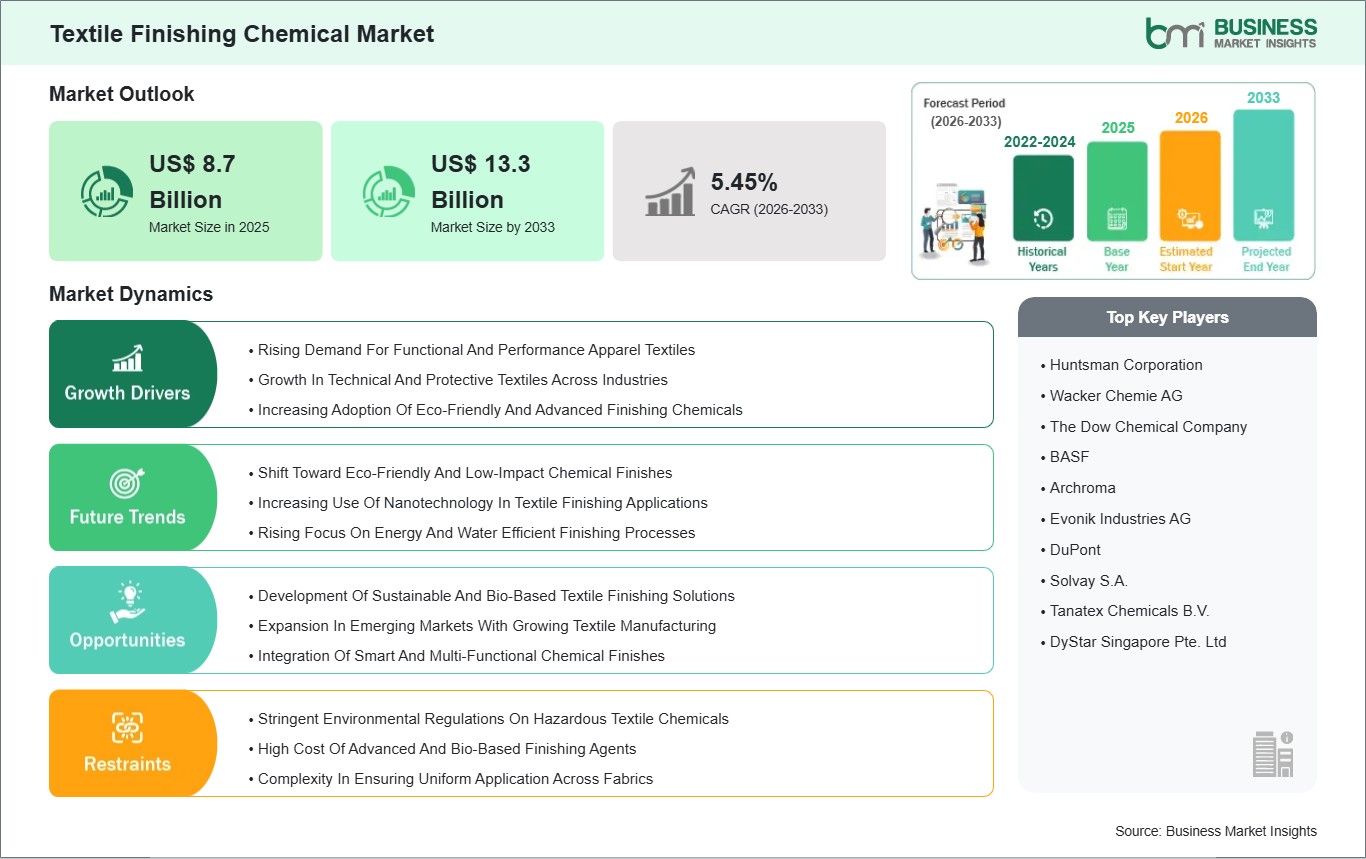
The global textile finishing chemical market serves as a vital component that enhances textile products through improved performance and appearance, and increased durability across various industries that include apparel, home furnishings, technical textiles and industrial fabrics. Textile finishing chemicals include a complete selection of functional agents, which contain softeners and flame retardants, anti-wrinkle agents, water repellents and antimicrobial coatings and dye fixatives that enable specific fabric properties to achieve better functionality and consumer attractiveness. The textile industry requires manufacturers to use finishing chemicals because modern society demands higher quality multifunctional fabrics, which need finishing to create distinct products for competitive markets.
North America maintains its position as the primary market for textile finishing chemicals because the region possesses an established textile and apparel industry and demonstrates high usage of performance textiles, while companies focus on developing innovative and sustainable products. In the United States and Canada, brands and manufacturers increasingly use advanced finishing chemistries to achieve functionalities like enhanced comfort, odor control, UV protection, and stain resistance, driven by consumer demand for premium and performance‑oriented textiles.
North America maintains its leading position because chemical manufacturers in the region work together with textile companies to develop customized finishing solutions that meet the specific requirements of local markets and their associated regulatory frameworks. The global market experiences its main growth factors through the increasing need for high-performance smart textiles, the expansion of technical protective textile markets and the rising demand for premium clothing items, which need specialized finishing processes. The increasing consumer understanding of comfort and hygiene, together with their awareness of fabric performance, encourages them to use specialized finishing chemicals that provide better functional capabilities. The rising interest in industrial textiles and healthcare textiles, which includes medical fabric materials with antimicrobial finishes, has created a higher demand for cutting-edge chemical finishing solutions.
The market must deal with two main obstacles, which stem from environmental concerns and regulatory requirements, because traditional finishing chemicals face strict examination due to their potential harmful effects, environmental durability and chemical remains. Europe has implemented more stringent rules that require manufacturers to create products using environmentally friendly materials that have less negative impact on the environment. The textile finishing chemical market worldwide will develop through the current development of ecological finishing agents, bio-based chemicals and efficient processing solutions, which provide balanced alternatives that fulfill performance standards while meeting environmental requirements.
Segment Analysis
Textile Finishing Chemical Market Segmentation
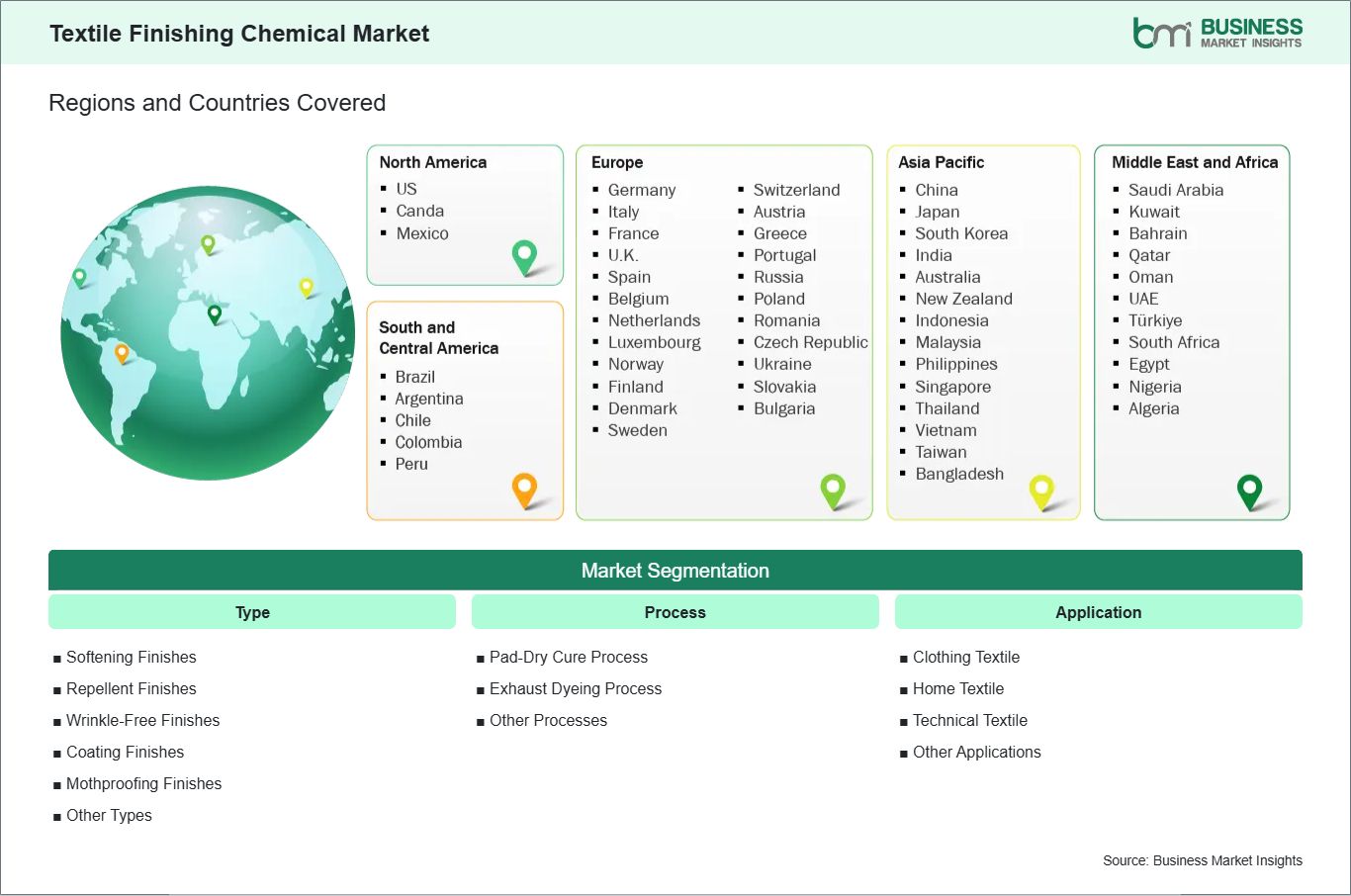
Key segments that contributed to the derivation of the textile finishing chemical market analysis are type, process and application.
- By type, the textile finishing chemical market is segmented into softening finishes, repellent finishes, wrinkle‑free finishes, coating finishes, mothproofing finishes, other types. The softening finishes segment dominated the market in 2025.
- Based on process, the textile finishing chemical market is categorized into pad‑dry cure process, exhaust dyeing process, other processes. The pad‑dry cure process segment dominated the market in 2025.
- In terms of application, the textile finishing chemical market is categorized into clothing textile, home textile, technical textile, other applications. The clothing textile segment dominated the market in 2025.
Market Forces
Textile Finishing Chemical Market Drivers and Opportunities
Rising Demand For Functional And Performance Apparel Textiles
The worldwide increase of active outdoor activities and athleisure fashion trends has created a greater need for high-performance clothing. Consumers across various geographic areas now demand apparel that provides moisture control and flexible movement, odor protection, ultraviolet light defense and body temperature control. The finishing chemicals known as textile finishing chemicals function as vital components that transform standard fabrics into advanced materials used for sportswear, outdoor equipment, and professional uniforms. The standard apparel requirements now include functional finishes, which encompass anti-wrinkle agents, hydrophilic coatings and antimicrobial treatments to create products that deliver both comfort and utility.
Premium textile markets in North America and Europe enable established brands to work closely with chemical suppliers for the development of finishing chemistries that meet both their premium market needs and regulatory requirements. The region focuses on developing new performance finishes that improve user experience through better comfort without affecting product design. Performance textiles find their way into daily wear in North America while also serving specific applications such as healthcare uniforms and work protective equipment, which drives the need for modern finishing technologies.
The South American market and Asia Pacific region show increasing adoption of performance textile finishes through their developing markets. The local manufacturing industry has embraced value-added finishes because rising disposable incomes, urban expansion and manufacturing capacity growth have driven market demand for these enhancements. The global consumer tendency to choose comfort and durability, and multiple uses will maintain textile finishing chemicals as essential elements for market growth in all key regions.
Development Of Sustainable And Bio‑Based Textile Finishing Solutions
Growing environmental concerns and tightening regulations on chemical usage have catalyzed the development of sustainable and bio‑based textile finishing solutions worldwide. Traditional finishes often rely on petrochemical‑derived agents that face scrutiny due to potential toxicity and ecological persistence. This has encouraged chemical producers and textile manufacturers to invest in greener chemistries, such as bio‑based softeners, fluorine‑free water repellents, and enzymatic finishes that reduce environmental burden. Sustainable finishing solutions aim to balance high performance with low ecological impact.
In Europe, stringent chemical regulations and strong consumer demand for eco‑friendly products have positioned the region as an early adopter of bio‑based finishing technologies. Textile producers are increasingly using finishes derived from renewable sources, and brands are highlighting eco‑certifications to differentiate their offerings. North America follows similar sustainability trajectories, with manufacturers and retailers emphasizing low‑impact finishes that support broader environmental commitments and regulatory compliance.
Emerging markets in Asia Pacific and Latin America are also advancing sustainable finishing adoption as export markets demand compliance with global environmental standards. Initiatives promoting circularity, such as recyclable finish systems and reduced water and energy consumption during processing, are becoming integral to textile supply chains. As global awareness around environmental stewardship grows, sustainable and bio‑based textile finishing solutions will continue to evolve, offering both compliance and market appeal.
Size and Share Analysis
Textile Finishing Chemical Market Size and Share Analysis
The textile finishing chemical market demonstrates steady growth, with size and share analysis highlighting evolving trends and competitive dynamics among key players. The report examines subsegments categorized within type, process and application, offering insights into their contribution to overall market performance.
By type, the softening finishes subsegment dominated the market in 2025, driven by their extensive use in enhancing softness, flexibility, and fabric feel across clothing and home textiles.
Based on process, the pad‑dry cure process subsegment dominated the market in 2025, driven by its wide adoption as the most common and efficient method for applying various textile finishing chemicals.
In terms of application, the clothing textile subsegment dominated the market in 2025, driven by the high consumption of finishing chemicals in garment and apparel production worldwide.
Report Coverage
Textile Finishing Chemical Market Report Coverage and Deliverables
The "Textile Finishing Chemical Market Size and Forecast (2022 - 2033)" report provides a detailed analysis of the market covering below areas:
- Textile Finishing Chemical Market size and forecast at global, regional, and country levels for all the key market segments covered under the scope
- Textile Finishing Chemical Market trends, as well as drivers, restraints, and opportunities
- Textile Finishing Chemical Market analysis covering key trends, global and regional framework, major players, regulations, and recent developments
- Industry landscape and competition analysis covering market concentration, heat map analysis, prominent players, and recent developments for the Textile Finishing Chemical Market
- Detailed company profiles, including SWOT analysis
Geographic Insights
Textile Finishing Chemical Market Geographic Insights
The geographical scope of the Textile Finishing Chemical Market report is divided into North America, Asia Pacific, Europe, Middle East & Africa, and South & Central America. North America held the largest share in 2025.
The global textile finishing chemical market is primarily controlled by North America because its textile and apparel industry has reached full development, and its market has established a strong demand for functional and technical textiles while its companies pursue innovative methods and sustainable solutions. The advanced chemical finishing applications of the United States and Canada include both water repellency and antimicrobial treatments, flame retardancy and softeners that manufacturers use to create performance apparel, healthcare textiles and industrial fabrics. The manufacturers of this area create high-value fabrics that they use to meet both environmental standards and consumer preferences for sustainable premium products.
The European market operates through its advanced development status, which establishes strict regulations to promote environmentally friendly chemical alternatives that produce minimal environmental damage. The countries of Germany, France and Italy assign high importance to bio-based and recyclable finishing agents which they use for both apparel and industrial textiles, while research programs and sustainability-focused partnerships drive the quick adoption of new chemical innovations.
The Asia Pacific region exhibits rapid growth because China, India, Japan and South Korea are developing new textile production centers. The region grows because people increasingly want functional apparel and technical fabrics and home textiles, while chemical suppliers boost their investment to develop advanced finishing solutions that meet local production requirements.
The Middle East and Africa market currently operates as an emerging market because building construction, hotel development and industrial operations create demand for specialty finished fabrics, which are not yet widely used because supply chains remain disorganized and local manufacturers cannot meet production needs. Textile finishing chemicals used for performance apparel, home textiles and industrial applications are being adopted mostly in Brazil, Mexico and Argentina, which are driving the market growth of South and Central America.
The textile industry develops new finishing chemistries because all regions demand sustainable fabrics that provide high performance and multiple functions, while environmental regulations and consumer demands shape market growth.
Industry Activity
Recent Developments
The Textile Finishing Chemical Market is evaluated by gathering qualitative and quantitative data post primary and secondary research, which includes important corporate publications, association data, and databases. A few of the key developments in the textile finishing chemical market are:
- In November 2025, BW Converting announced that it will promote sustainable textile finishing solutions with its Baldwin TexCoat® G4 precision spray finishing system at Techtextil India 2025, in collaboration with its India representative A.T.E. Enterprises Pvt. Ltd. The company highlighted how the technology can help mills and finishers reduce chemical waste, water usage, and energy consumption while improving product quality and process control.
- In June 2025, Archroma announced the launch of its redesigned global website to support smarter, sustainable choices across textiles and other markets, reinforcing its commitment to sustainability and enabling customers to access innovations in textile finishing chemicals, low‑impact dye systems, and performance solutions more easily through interactive tools and detailed product information.
Trust & Transparency
Research Methodology
The market analysis combines proprietary research with secondary data from government agencies, company disclosures, regulatory filings, industry databases and expert interviews. Market estimates are validated through data triangulation, cross-market benchmarking and analyst
review.
View Full Research Methodology
Key Sources Referred:
World Health Organization (WHO) Organisation for Economic Cooperation and Development (OECD) The World Bank Group Worldometer The Lancet International Bar Association International Trade Administration