Market Summary
Executive Summary and Global Market Analysis
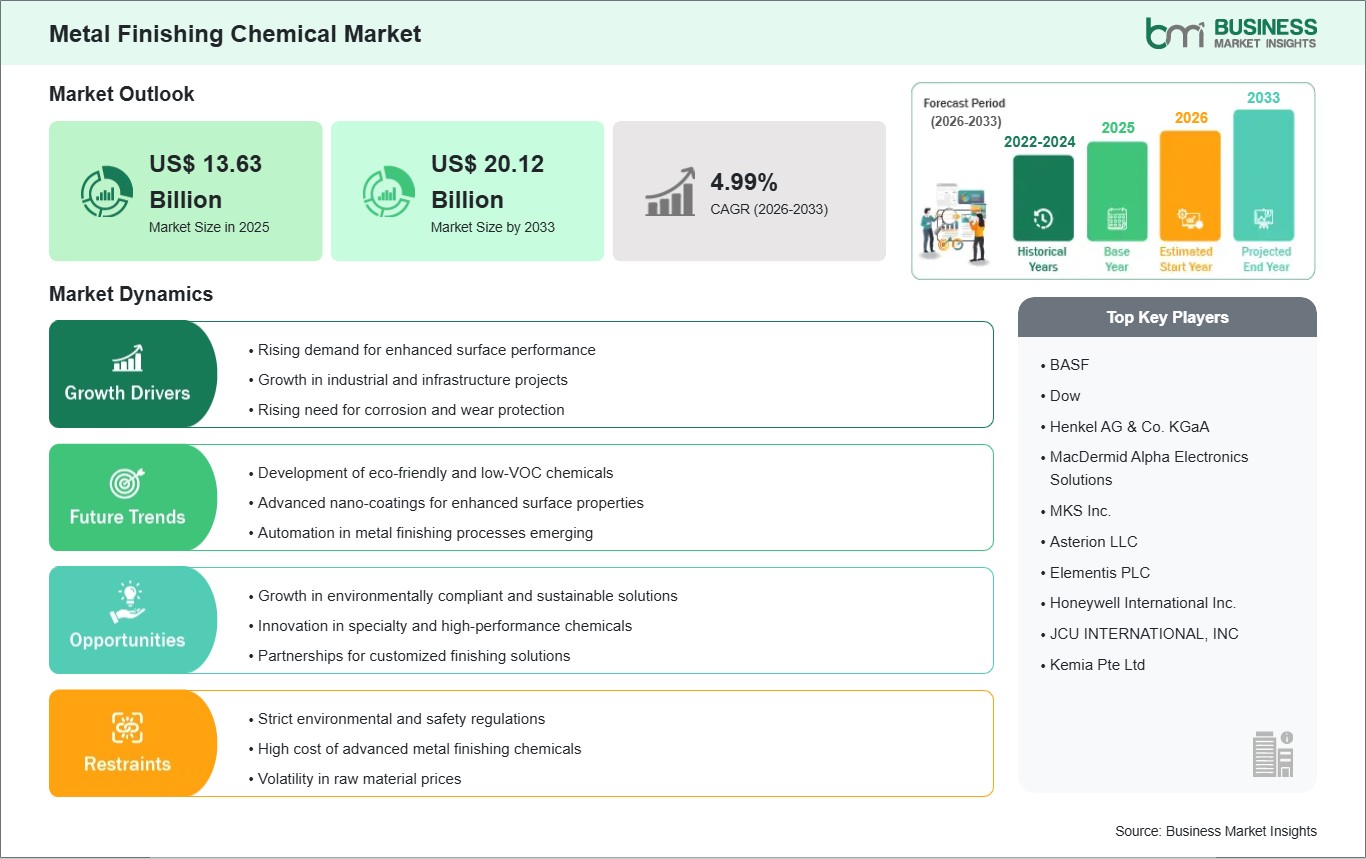
The global market for finishing chemicals used to treat metals is expanding thanks to growing demands from the industrial sectors for increased performance of substrates, greater surface durability, and compliance with local or international regulations regarding the environment. Metal finishing chemicals (e.g., cleaners, etchants, passivators and electroplating solutions) are vital to improving corrosion resistance, surface adhesion, and conductivity in applications in automotive, aerospace, electronics, and heavy machinery. Among the most active segments of the market is the need for high-quality surface preparation in advanced manufacturing, where precision and long-term reliability are of the utmost importance.
Technological developments are driving the market as formulators develop specialist chemical formulations that reduce the quantity of hazardous constituents while providing effective performance on a variety of different substrates (e.g., steel, aluminium and plated alloys). Water-based and low VOC products are increasing in popularity as a result of stricter environmental and occupational safety & health regulations, especially in mature economies. Strategic partnerships between chemical manufacturers and original equipment manufacturers (OEMs) are creating opportunities to provide tailored compound formulation solutions to meet specific process requirements such as uniformity of etching and reduced cycle time.
Other factors influencing the dynamics of the industry include operational efficiencies and supply chain resiliency, causing firms to implement automated dispensing systems, real-time monitoring technologies, and lean chemical management systems. Companies are increasingly differentiating themselves in the marketplace through service offerings, technical support, and lifecycle optimization of their finishing process.
Segment Analysis
Metal Finishing Chemical Market Segmentation
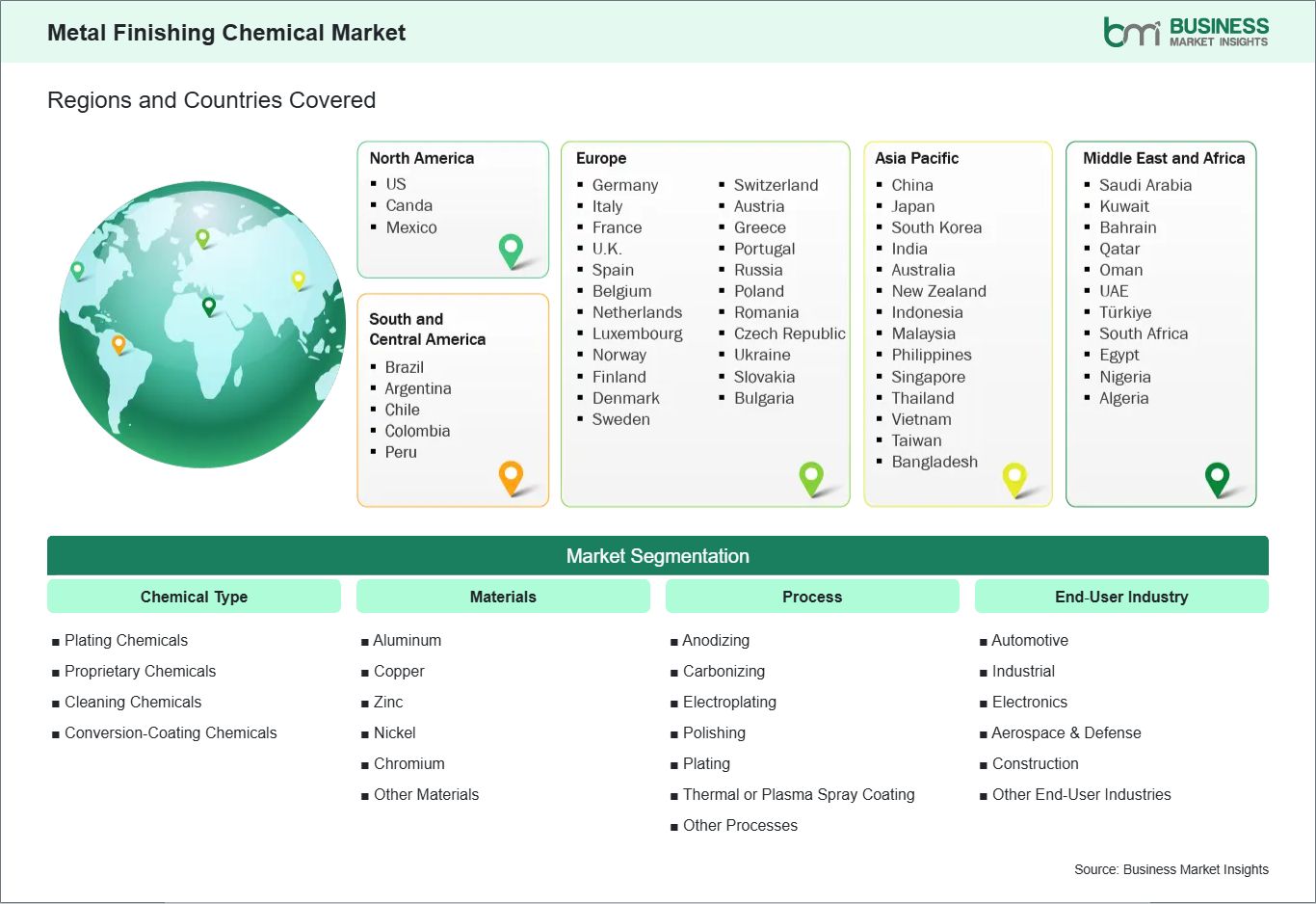
Key segments that contributed to the derivation of the metal finishing chemical market analysis are chemical type, materials, process, and end‑user industry.
- Chemical Type, the metal finishing chemical market is segmented into plating chemicals, proprietary chemicals, cleaning chemicals, and conversion‑coating chemicals. The plating chemicals segment dominated the market in 2025.
- Materials, the metal finishing chemical market is classified into aluminum, copper, zinc, nickel, chromium, and other materials. The aluminum materials segment dominated the market in 2025.
- Process, the metal finishing chemical market is categorized into anodizing, carbonizing, electroplating, polishing, plating, thermal or plasma spray coating, and other processes. The electroplating process segment dominated the market in 2025.
- End‑User Industry, the metal finishing chemical market is segmented into automotive, industrial, electronics, aerospace & defense, construction, and other end‑user industries. The automotive end‑user segment dominated the market in 2025.
Market Forces
Metal Finishing Chemical Market Drivers and Opportunities
Rising demand for enhanced surface performance
The growing demand for improved surface characteristics of parts manufactured from metals is influencing the global market for chemicals used in metal finishing. Metal finishing chemicals provide surface improvements to metal products and include cleaning chemicals, electroplating solutions, passivation agents, and conversion coatings. They enhance the corrosion resistance, wear characteristics, and aesthetically pleasing appearance of metal surfaces to support the performance and reliability of manufactured products across a variety of industries. Additionally, these metal finishing chemicals assist with the achievement of quality and long-term durability criteria for parts produced in the automotive, electronics, and machinery industries.
Furthermore, metal finishing chemicals provide manufacturers with the opportunity to precisely control surface properties, thereby allowing completed finished products to perform reliably in extreme conditions as well as withstand mechanical stresses. Metal finishing chemicals also support advanced process technologies, including electroplating and anodizing, which are critical for producing specialty components. Use of metal finishing chemicals significantly enhances projected product life performance, thereby reducing maintenance requirements and increasing demand for these advanced finishing solutions throughout the globe.
Growth in environmentally compliant and sustainable solutions
The growing concern for the environment and regulatory controls is influencing the way manufacturers are designing their custom coatings by providing more sustainable, environmentally friendly, low‑impact products (chemistries) that produce less hazardous waste and meet the international standards set for emissions. Manufacturers are utilizing more water-based systems and lower levels of volatile organic compounds (VOCs) and recyclable forms of chemical formulations to lessen their environmental impact while also maintaining high levels of performance in their products. Manufacturers have developed new types of metal finish products by utilizing advancements in "green technologies" (green chemistry) that have greater eco-friendly characteristics and the same or greater level of effectiveness than conventional technologies, such as biodegradable cleaners or non‑toxic surface treatments. These new developments enable companies to achieve their performance and sustainability objectives without compromising either area.
The amount of ongoing research and development of high-performance, low-impact chemistries will continue to result in more applications and products, ranging from corrosion-resistant coatings to precision cleaning agents. As manufacturing continues to move toward greener practices globally, more demand for environmentally compliant metal finishing chemicals will create continued growth for the long term in this industry.
Size and Share Analysis
Metal Finishing Chemical Market Size and Share Analysis
The metal finishing chemical market demonstrates steady growth, with size and share analysis highlighting evolving trends and competitive dynamics among key players. The report examines subsegments categorized within chemical type, materials, process, and end‑user industry, offering insights into their contribution to overall market performance.
By Chemical Type, the plating chemicals subsegment dominated the market in 2025, driven by its essential role in electrodeposition and surface finishing across multiple industries.
Based on Materials, the aluminum subsegment dominated the market in 2025, supported by widespread usage in lightweight structures particularly in automotive and electronics requiring specialized finishing chemistries.
On the basis of Process, the electroplating subsegment dominated the market in 2025, owing to its adaptability and extensive use in precision coatings from microelectronics to heavy industrial components.
On the basis of End‑User Industry, the automotive subsegment dominated the market in 2025, backed by strong demand for decorative and corrosion‑resistant finishes in vehicle components.
Report Coverage
Metal Finishing Chemical Market Report Coverage and Deliverables
The "Metal Finishing Chemical Market Size and Forecast (2022 - 2033)" report provides a detailed analysis of the market covering below areas:
- Metal Finishing Chemical Market size and forecast at global, regional, and country levels for all the key market segments covered under the scope
- Metal Finishing Chemical Market trends, as well as drivers, restraints, and opportunities
- Metal Finishing Chemical Market analysis covering key trends, global and regional framework, major players, regulations, and recent developments
- Industry landscape and competition analysis covering market concentration, heat map analysis, prominent players, and recent developments for the Metal Finishing Chemical Market
- Detailed company profiles, including SWOT analysis
Geographic Insights
Metal Finishing Chemical Market Geographic Insights
The geographical scope of the Metal Finishing Chemical Market report is divided into North America, Asia Pacific, Europe, Middle East & Africa, and South & Central America. North America held the largest share in 2025.
Regional dynamics in the metal finishing chemical market reveal differentiated growth patterns influenced by industrial modernization, environmental policy frameworks, and manufacturing density. North America stands as the dominant region, underpinned by an advanced industrial base, rigorous environmental standards, and strong demand for high‑performance metal finishing chemistries in automotive, aerospace, and electronics sectors. The focus on sustainable, low‑emission solutions and precision finishing processes enhances the region`s leadership in setting quality benchmarks.
Europe is a mature market shaped by strict regulatory compliance and a growing preference for environmentally safe formulations. The demand for water‑based, low‑VOC metal finishing chemicals is particularly strong, driven by both policy incentives and corporate sustainability agendas across manufacturing verticals.
Asia Pacific is experiencing rapid expansion, supported by substantial manufacturing growth, infrastructure development, and increasing adoption of surface finishing technologies. Cost competitiveness and expanding production hubs in this region are attracting global chemical suppliers, with significant uptake in automotive and industrial equipment applications.
The Middle East & Africa region is gradually evolving, with infrastructure investment and industrial diversification contributing to rising demand for corrosion protection and surface enhancement solutions. South & Central America shows consistent growth as manufacturing capabilities advance and regulatory frameworks strengthen, supporting broader deployment of metal finishing chemical technologies.
Industry Activity
Recent Developments
The Metal Finishing Chemical Market is evaluated by gathering qualitative and quantitative data post primary and secondary research, which includes important corporate publications, association data, and databases. A few of the key developments in the metal finishing chemical market are:
- In July 2024, Henkel AG & Co. KGaA introduced Bonderite M CR 1405, a combined metal passivation and pretreatment chemical that simplifies the surface preparation process by delivering both functions in one step while providing excellent corrosion resistance on galvanized and Galvalume substrates.
- In December 2025, Henkel AG & Co. KGaA launched a new colour variant of its thin organic coating (TOC) system for metal surfaces, designed to provide corrosion protection, adhesion, anti‑fingerprint properties, and aesthetic appeal (pilot golden finish) for metal coil applications.
Trust & Transparency
Research Methodology
The market analysis combines proprietary research with secondary data from government agencies, company disclosures, regulatory filings, industry databases and expert interviews. Market estimates are validated through data triangulation, cross-market benchmarking and analyst
review.
View Full Research Methodology
Key Sources Referred:
International Organization for Standardization (ISO) American Society for Testing and Materials (ASTM International) Bureau of Indian Standards (BIS) Environmental Protection Agency (EPA), USA European Chemicals Agency (ECHA) Central Pollution Control Board (CPCB), India Ministry of Chemicals and Fertilizers, India American Chemistry Council (ACC) Indian Chemical Council (ICC) European Chemical Industry Council (Cefic) Specialty Chemical Association of India (SCAI) Company Websites Company Annual Reports Company Investor Presentations