Market Summary
Executive Summary and Global Market Analysis
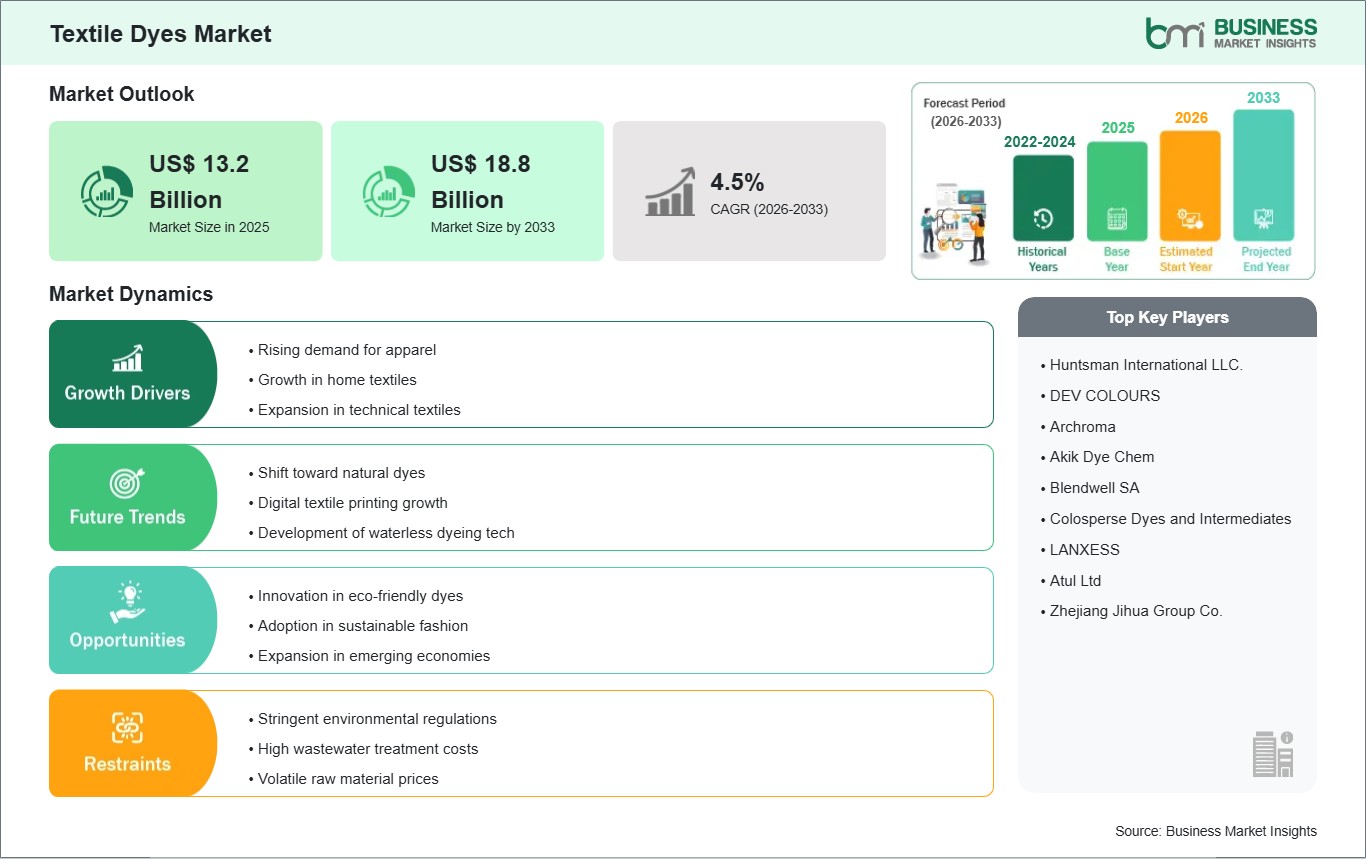
The Textile Dyes Market is defined as the production and supply chain for coloring materials that provide color to textile materials with high colorfastness. The Textile Dyes Market is currently characterized by a paradox: volume-driven demand with the fast fashion market and price-driven demand with the strict environmental regulations and increasing emphasis on sustainable textile materials with high performance.
Synthetic dyes include Reactive dyes, Disperse dyes, and Acid dyes. Currently, the transformation in the dye industry includes heavy developmental investments in the discovery of eco-friendly dyes. This dyeing process further gets segmented into bio-dyes, natural dyes, and other modern and efficient water-conserving dyeing processes like digital dyeing. The innovation pipeline in the dye industry is largely influenced by the increasing requirements of the textile industry, especially in the ever-growing sustainability drive.
Segment Analysis
Textile Dyes Market Segmentation
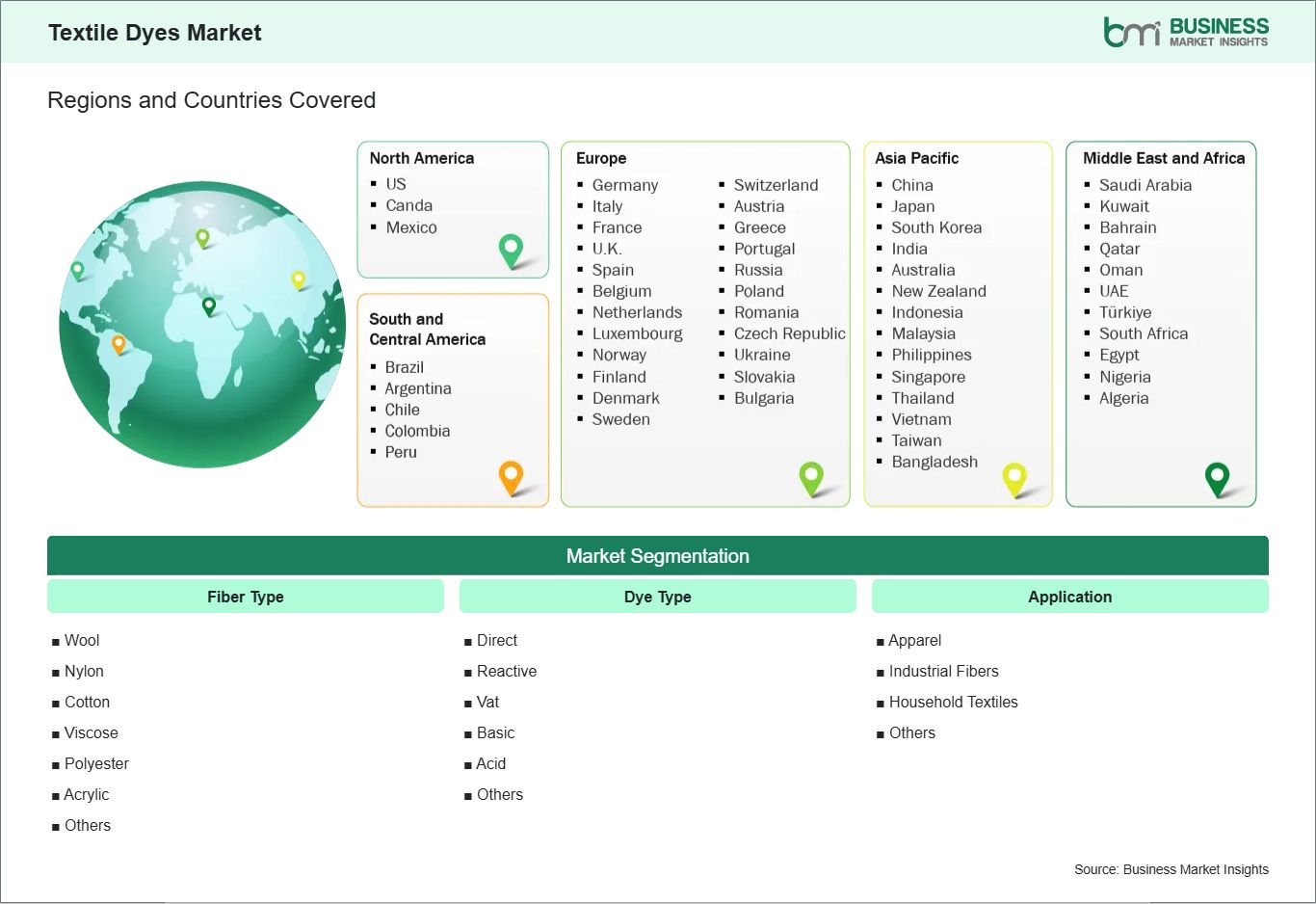
Key segments that contributed to the derivation of the Textile Dyes market analysis are fiber type, dye type, and Application.
- By Fiber Type, the market is segmented into Wool, Nylon, Cotton, Viscose, Polyester, Acrylic, and Others.
- By Dye Type, the market is divided into Direct, Reactive, Vat, Basic, Acid, and Others.
- By Application, the market is categorized into Apparel, Industrial Fibers, Household Textiles, and Others.
Market Forces
Textile Dyes Market Drivers and Opportunities
Rapid Growth in Global Textile and Apparel Production
Increased disposable incomes globally, particularly in emerging economies (China, India, Southeast Asia), are driving consumer spending on clothing and home furnishings. The acceleration of the fast-fashion cycle, fueled by e-commerce and social media trends, necessitates high-volume production of diverse, vibrant, and quick-turnaround dyed fabrics, ensuring consistent demand for synthetic dyes. The continued shift of textile and apparel production bases from mature markets (North America and Europe) to low-cost manufacturing centers in the Asia Pacific ensures that the bulk of dye consumption occurs in this region. This structural advantage contributes significantly to the market's overall volume growth.
Innovation in Sustainable Dyeing Technologies and Formulations
Significant R&D is focused on creating colorants derived from natural sources (plants, agricultural waste, non-food biomass) that are non-toxic, biodegradable, and low-impact. Manufacturers are developing next-generation synthetic dyes (e.g., low-salt reactive dyes, sulfur dyes with reduced sulfide content) that achieve excellent colorfastness while significantly reducing water, salt, and energy consumption in the dyeing process. Technologies utilizing supercritical carbon dioxide as a solvent eliminate water usage in the dyeing process. On-demand, small-batch production using specialized inkjet inks (acid, reactive, or disperse) reduces waste and drives demand for high-quality colorants.
Size and Share Analysis
Textile Dyes Market Size and Share Analysis
The Textile Dyes Market demonstrates steady growth, with size and share analysis revealing evolving trends and competitive positioning among key players. The report further examines subsegments categorized within fiber type, dye type, and Application, offering insights into their contribution to overall market performance.
The Textile Dyes Market is extensively divided to capture the essential interrelation between the material quality of the textile product being colored and its chemical compatibility requirements. The chemical requirements of each of these Textiles vary in a manner that demands specific dyes, such as Disperse dyes in the case of synthetic Polyester and Viscose, or Reactive dyes in the case of natural Cotton. These Textile dyes are, in turn, classified under a specific Dye Type: Direct dyes in Cotton and Wool, Vat dyes in polyester and nylon, and so on. Each of these dyes has its own chemical requirements and purposes. The demand for these Textile dyes ultimately originates from Apparel and Industrial Textile applications.
Report Coverage
Textile Dyes Market Report Coverage and Deliverables
The "Textile Dyes Market Size and Forecast (2022 - 2033)" report provides a detailed analysis of the market covering below areas:
- Textile Dyes Market size and forecast at global, regional, and country levels for all the key market segments covered under the scope.
- Textile Dyes Market trends, as well as market dynamics such as drivers, restraints, and key opportunities.
- Textile Dyes Market analysis covering key market trends, global and regional framework, major players, regulations, and recent market developments
- Industry landscape and competition analysis covering market concentration, heat map analysis, prominent players, and recent developments for the Textile Dyes Market
- Detailed company profiles, including SWOT analysis
Geographic Insights
Textile Dyes Market Geographic Insights
The geographical scope of the Textile Dyes Market report is divided into five regions: North America, Europe, Asia Pacific, the Middle East & Africa, and South & Central America.
The geographical landscape of the Textile Dyes Market includes Asia Pacific, which serves as the global manufacturing powerhouse for textiles and apparel, driving immense demand for all dye types. However, it simultaneously faces pressure to comply with tightening environmental and effluent discharge regulations, particularly in major producing countries, including China and India. Europe and North America are characterized as mature, high-value markets with stringent regulatory frameworks (REACH) that prioritize sustainable, eco-friendly, and high-performance dyes, focusing their consumption on specialized technical textiles and premium apparel, often leading adoption of innovative technologies like digital and waterless dyeing. Finally, the Middle East and Africa and South and Central America are emerging growth regions, capitalizing on investments in local textile production and growing domestic consumer bases, representing opportunities for core dye manufacturers to introduce modern, resource-efficient dyeing systems.
Industry Activity
Recent Developments
The Textile Dyes market is evaluated by gathering qualitative and quantitative data post-primary and secondary research, which includes important corporate publications, association data, and databases. A few of the key developments in the Textile Dyes market are:
- In August 2025, Archroma's EarthColors® technology creates bio-waste-based dyes derived from natural waste products of the agriculture and herbal industries, leaving the edible part still available for food consumption.
- In April 2024, Archroma launched new colors for its AVITERA® SE range, a line of reactive dyes that enable significant water and energy savings due to their low-temperature, high-speed wash-off technology.
Trust & Transparency
Research Methodology
The market analysis combines proprietary research with secondary data from government agencies, company disclosures, regulatory filings, industry databases and expert interviews. Market estimates are validated through data triangulation, cross-market benchmarking and analyst
review.
View Full Research Methodology
Key Sources Referred:
World Bank - Global Trade IndicatorsWorld Trade Organization (WTO)International Monetary Fund (IMF)International Trade Administration (ITA)Company WebsitesCompany Annual ReportsCompany Investor Presentations