
Tequila Market Outlook: Size, Share, Trends, Growth Analysis, Competitive Landscape & Forecast, 2026-2033

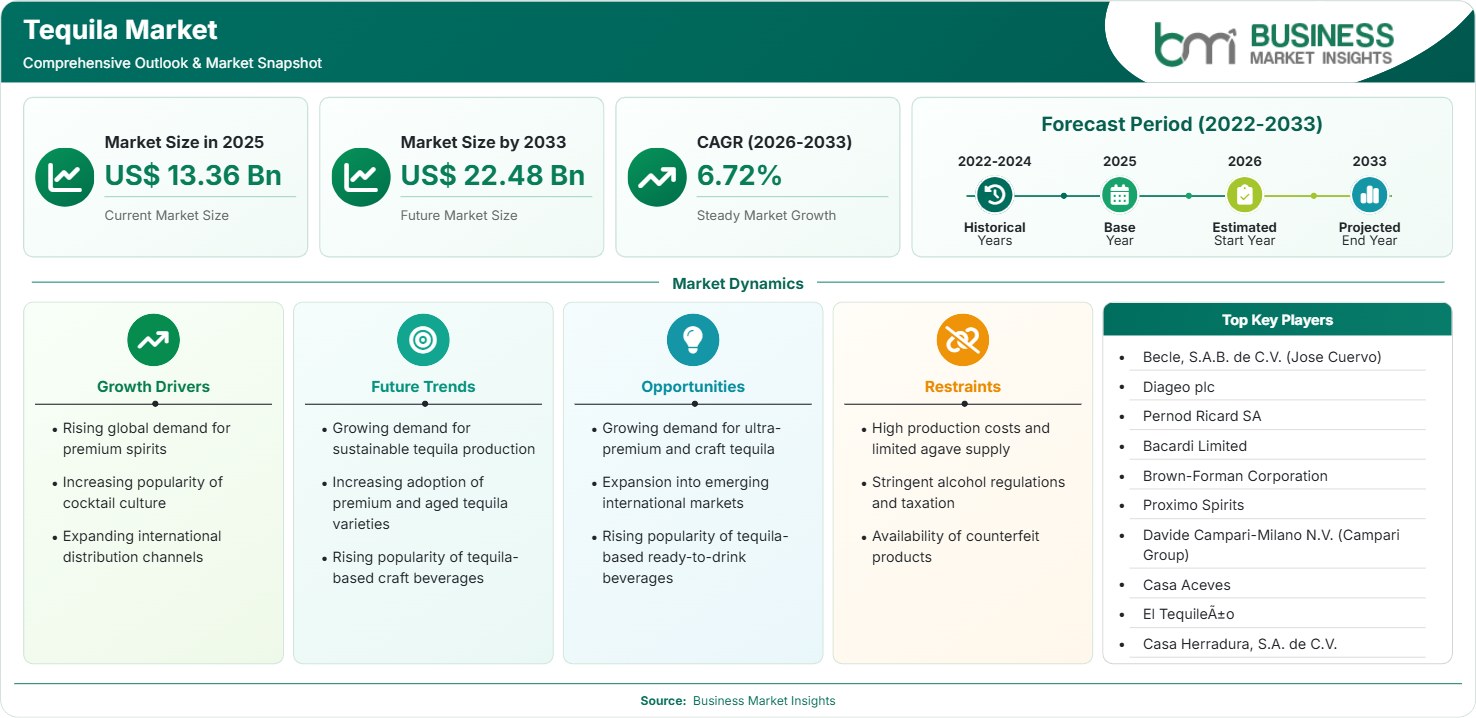
The Tequila Market size was valued at US$ 13.36 Billion in 2025 and is projected to reach US$ 22.48 Billion by 2033, growing at a CAGR of 6.72% during 2026–2033. Rising global demand for premium spirits, expanding cocktail culture, and broader international distribution continue supporting industry expansion, while premiumization, craft product innovation, and growing consumption across emerging markets create attractive long-term opportunities.

Report Coverage
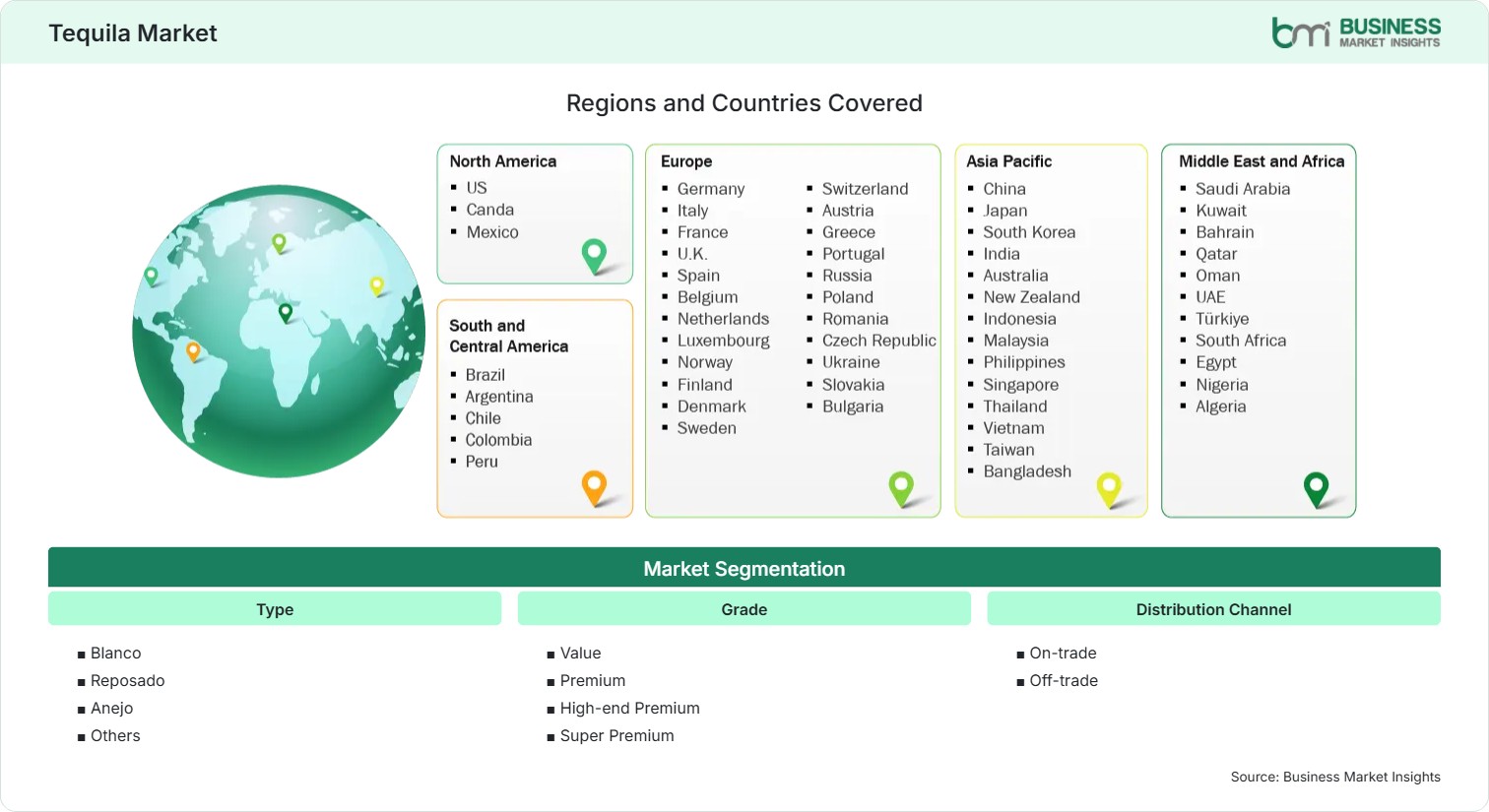
  • Type: Blanco, Reposado, Anejo, Others
  • Grade: Value, Premium, High-end Premium, Super Premium
  • Distribution Channel: On-trade, Off-trade
US$ 13.36 Bn Market size in 2025
US$ 22.48 Bn Market Size by 2033
6.72% CAGR, 2026 - 2033
2026-2033 Forecast Period

01 AI Overview

Tequila Market Summary

  • North America Region: North America holds 48%–50% share in 2025 and is projected to expand at a 6.2%–6.8% CAGR during 2026–2033. Strong consumer preference for premium spirits, an established retail network, and increasing cocktail consumption continue supporting regional leadership. The United States remains the largest contributor, advancing at a CAGR of 6.4%–7.0% owing to premiumization and growing demand for aged tequila varieties.
  • Fastest Growing Region: Asia Pacific accounts for 16%–18% share in 2025 while expanding at a 8.0%–8.6% CAGR through 2033. Rising disposable incomes, premium alcohol consumption, expanding hospitality industries, and growing awareness of Mexican spirits continue driving regional demand.
  • Leading Segment: Premium grade represents 34%–37% share in 2025 and is forecast to register a 7.1%–7.7% CAGR during 2026–2033. Consumer preference for authentic craftsmanship, superior taste profiles, and premium branding continues strengthening segment performance.
  • High Growth Segment: Añejo accounts for 18%–21% share in 2025 while expanding at a 7.8%–8.4% CAGR through 2033. Longer aging periods, premium positioning, and increasing appreciation for complex flavor profiles continue supporting strong demand.
  • Key Market Opportunity: Rising consumer interest in craft, ultra-premium, and ready-to-drink tequila products provides manufacturers with opportunities to diversify portfolios and expand into high-value international consumer segments.
  • Major Market Players: Becle, S.A.B. de C.V. (Jose Cuervo), Diageo plc, Pernod Ricard SA, Bacardi Limited, Brown-Forman Corporation, Proximo Spirits, Davide Campari-Milano N.V. (Campari Group), Casa Aceves, El Tequileño, Casa Herradura, S.A. de C.V.
02 Strategic Insights

Tequila Market: Strategic Insights

Tequila Market Strategic Framework
FREE PDF
Request your free sample
Request free sample
03 Stakeholder View

Key Takeaways

  • The value chain increasingly integrates agave cultivators, distilleries, bottling companies, distributors, retailers, hospitality businesses, and premium beverage brands to improve supply reliability and product differentiation.
  • Premium and aged tequila categories continue generating the strongest revenue opportunities as consumers increasingly prioritize authenticity, craftsmanship, and premium drinking experiences over standard spirit offerings.
  • Innovation focuses on ultra-premium expressions, sustainable production methods, premium packaging, limited-edition releases, and ready-to-drink tequila beverages designed for younger consumers.
  • Asia Pacific presents a compelling long-term investment opportunity due to expanding middle-class populations, premium alcohol consumption, and increasing penetration of international beverage brands.
  • Strategic acquisitions, premium brand partnerships, and expanded international distribution networks continue reshaping competitive dynamics while strengthening access to emerging consumer markets.
  • Sustainable agave cultivation, environmentally responsible distillation, and premium brand storytelling are becoming important competitive differentiators across global tequila producers.
04 Geographic Outlook

Tequila Market Regional Highlights

North America Tequila Market

North America accounts for 48%–50% Tequila Market share in 2025 and is projected to expand at a 6.2%–6.8% CAGR through 2033. Strong consumer demand for premium spirits, increasing cocktail consumption, and an established hospitality industry continue supporting regional leadership. Growing preference for aged tequila varieties and premium craft products further strengthens demand across retail, restaurants, bars, and specialty beverage channels.

  • Premium tequila consumption continues increasing as consumers seek authentic products with distinctive aging characteristics and higher perceived quality.
  • Cocktail culture across restaurants, bars, and premium hospitality venues continues supporting sustained demand for premium tequila brands.
  • Retail expansion and e-commerce availability improve accessibility while supporting broader consumer adoption across multiple demographic groups.
  • Beverage companies continue investing in marketing campaigns highlighting heritage, artisanal production, and premium brand positioning.
  • Increasing interest in sustainable production encourages manufacturers to strengthen responsible agave sourcing and environmentally conscious distillation practices.

US Tequila Market

The United States represents the world's largest tequila-consuming country, accounting for 41%–43% global share in 2025 while growing at a 6.4%–7.0% CAGR during the forecast period. Rising disposable incomes, premiumization trends, expanding cocktail culture, and increasing consumer appreciation for high-quality spirits continue supporting strong market expansion across both on-trade and off-trade channels.

  • Premium and super-premium tequila categories continue outperforming value products due to changing consumer purchasing preferences.
  • Restaurants and premium cocktail bars increasingly feature tequila-based beverages within evolving mixology menus.
  • Major distributors continue expanding premium tequila portfolios across supermarkets, specialty retailers, and online alcohol delivery platforms.
  • Celebrity-backed tequila brands continue increasing consumer awareness while attracting younger legal-age purchasers seeking premium experiences.

Europe Tequila Market

Europe contributes 22%–24% share in 2025 while registering a 6.5%–7.1% CAGR during 2026–2033. Premium spirits consumption, expanding cocktail culture, and growing appreciation for authentic Mexican beverages continue driving regional demand. Germany remains the leading European market, while Spain records the fastest expansion with a projected 7.3%–7.9% CAGR throughout the forecast period.

  • Premium hospitality venues increasingly incorporate tequila into signature cocktail offerings to meet evolving consumer preferences.
  • Importers continue strengthening distribution partnerships with Mexican distilleries to improve premium product availability.
  • Consumer interest in premium aged spirits supports increasing demand for reposado and añejo tequila categories.
  • Retailers continue expanding premium shelf space for imported spirits with strong brand heritage and authenticity.
  • Tourism and international dining experiences contribute to growing awareness of premium tequila across European consumers.

Asia Pacific Tequila Market

Asia Pacific accounts for 16%–18% share in 2025 while recording the fastest regional expansion at a 8.0%–8.6% CAGR through 2033. Rising urbanization, premium beverage consumption, expanding nightlife industries, and growing international tourism continue supporting demand. China leads regional consumption, while India records the highest projected growth with a 8.8%–9.4% CAGR during the forecast period.

  • Premium alcoholic beverage consumption continues increasing among affluent urban consumers seeking international spirit brands.
  • Expanding hospitality, tourism, and fine-dining industries strengthen tequila consumption across metropolitan markets.
  • International beverage companies continue investing in localized marketing strategies and premium retail partnerships.
  • Rising cocktail culture encourages broader adoption of tequila across restaurants, bars, and luxury hotels.
  • E-commerce alcohol retailing improves accessibility while expanding premium product availability across emerging cities.

Rest of World Tequila Market

The Rest of World region represents 10%–12% share in 2025 while expanding at a 6.8%–7.4% CAGR through 2033. South & Central America benefits from geographic proximity and increasing premium spirits consumption, while Middle East & Africa experience gradual market development through premium hospitality, tourism, and international retail expansion.

Growing premium beverage imports, expanding tourism infrastructure, and increasing consumer interest in international spirits continue supporting long-term regional demand despite varying regulatory environments.

  • Brazil remains the leading South & Central American market, while Mexico continues benefiting from strong domestic consumption and export-oriented production.
  • The United Arab Emirates leads Middle Eastern premium spirit demand, while South Africa records healthy growth supported by premium hospitality investments.
  • International distributors continue strengthening regional supply chains to improve premium tequila availability.
  • Luxury hotels, premium restaurants, and airport retail outlets increasingly contribute to tequila sales growth.
  • Premium product positioning and experiential marketing continue strengthening consumer awareness across developing international markets.
Global Market Geography
FREE PDF
Request your free sample
Request free sample
05 Segment Analysis

Tequila Market Segmentation

Type

The type segment reflects evolving consumer preferences for flavor profile, aging characteristics, and premium positioning. Blanco tequila continues to dominate global consumption due to its versatility in cocktails, affordability, and authentic agave flavor, while aged variants are gaining popularity among premium spirit enthusiasts. Blanco accounted for approximately 42%–45% market share in 2025 and is projected to register a 6.4%–7.0% CAGR during 2026–2033. The Tequila Market scope continues expanding as producers introduce differentiated aging techniques, limited-edition releases, and premium product portfolios to address changing consumer preferences.

  • Blanco: Blanco tequila remains the most widely consumed category because of its fresh agave flavor, affordability, and extensive use in cocktails, mixed drinks, and premium hospitality establishments.
  • Reposado: Reposado continues gaining popularity among consumers seeking balanced flavor profiles achieved through moderate barrel aging, making it suitable for both sipping and premium cocktail applications.
  • Añejo: Añejo tequila experiences robust demand owing to extended aging, richer flavor complexity, premium positioning, and increasing consumer appreciation for luxury spirit experiences.

Grade

The grade segment is increasingly influenced by premiumization trends, changing consumer purchasing behavior, and rising demand for authentic handcrafted spirits. Premium remains the leading grade, accounting for approximately 34%–37% market share in 2025 and is projected to expand at a 7.1%–7.7% CAGR during the forecast period. The Tequila Market trends continue favor higher-value products as consumers increasingly prioritize quality, heritage, aging process, and brand authenticity over lower-priced alternatives.

  • Value: Value-grade tequila maintains stable demand across mass-market retail channels by offering affordable options suitable for everyday consumption and high-volume cocktail preparation.
  • Premium: Premium tequila continues attracting consumers seeking superior taste, authentic production methods, and established brand reputation across both retail and hospitality sectors.
  • High-end Premium: High-end premium products benefit from limited production, extended maturation, premium packaging, and increasing demand among affluent consumers seeking differentiated drinking experiences.
  • Super Premium: Super premium tequila continues expanding through luxury positioning, exclusive product releases, collectible packaging, and growing consumer willingness to pay for exceptional craftsmanship.

Distribution Channel

Distribution channels continue evolving as consumers increasingly purchase premium alcoholic beverages through both traditional retail and digital commerce platforms. Off-trade remains the dominant channel, representing approximately 61%–64% market share in 2025 and is expected to register a 6.6%–7.2% CAGR during 2026–2033. The Tequila Market continues benefiting from broader product availability across supermarkets, specialty liquor stores, and e-commerce platforms while premium hospitality venues strengthen on-trade consumption.

  • On-trade: Restaurants, hotels, bars, lounges, and premium hospitality venues continue driving tequila consumption through cocktail innovation, premium tasting experiences, and expanding consumer exposure to aged varieties.
  • Off-trade: Supermarkets, liquor stores, specialty beverage retailers, and online alcohol platforms remain the largest sales channels owing to wider product selection, promotional activities, and growing convenience for consumers.
06 Market Forces

Tequila Market Dynamics

Key Market Drivers

Rising global demand for premium spirits

Premiumization has emerged as one of the key drivers of growth for the worldwide spirits industry, given the preference of customers for premium alcoholic drinks that are characterized by quality, craftsmanship, and unique flavors. As per the International Wine and Spirits Record (IWSR), premium and super-premium spirits have continued to perform better than standard products. Tequila market growth can be attributed to an increased consumer propensity to purchase aged and premium tequilas, higher disposable income levels, and a growing inclination towards purchasing genuine Mexican beverages. The producers have kept on making investments in the areas of premium packaging, limited edition production, and marketing their brands.

Increasing popularity of cocktail culture

Tequila consumption is still being driven by the fast-growing culture of cocktails in restaurants, bars, hotels, and top-class hospitality facilities around the world. Consumers are more interested in trying innovative tequila cocktails made with premium ingredients and unique preparation techniques, and beverage operators are motivated to introduce more tequila-based items to their menus. More tourism, nightlife activities, and social drinking events reinforce demand for tequila from the on-trade segment. Beverage manufacturers are still working with mixologists, hospitality companies, and retailers to market tequila.

Expanding international distribution channels

The leading global beverages companies keep improving their international distribution systems to ensure greater tequila availability in both established and new markets. Tequila market trends are becoming more influenced by expansion via supermarket chains, specialist spirits shops, travel retail facilities, and online beverage sellers, providing greater opportunities for consumers to purchase premium tequilas. Cooperation with local distributors, hotel and restaurant businesses, and online beverage stores is assisting in tapping into new markets. Better logistic services, exporting potential, and premium packaging practices keep driving strong international demand.

Key Market Opportunities


Growing demand for ultra-premium and craft tequila


The preference of customers for artisanal spirits is continuously offering opportunities in the ultra-premium tequila category. The importance of small-batch manufacturing, traditional distilling techniques, sourcing agave from a single property, and distinct flavors is increasing among customers for premium tequilas over regular ones. Tequila market forecasts indicate that wealthy people will invest in aged, collectible, and handcrafted tequilas. The companies having the ability to blend heritage with premium branding are likely to become more profitable and successful.

Expansion into emerging international markets

The rapid economic growth and higher levels of disposable income in Asia Pacific, Eastern Europe, and certain Latin American nations keep providing positive environment for high-quality tequilas. The changing preferences of consumers, growing middle classes, and greater awareness of global beverage culture are causing the increased demand from beyond the established regions of consumption. Manufacturers are developing relationships in regional distribution, organizing local marketing campaigns, and increasing their portfolios of high-end products.

Rising popularity of tequila-based ready-to-drink beverages

The market for ready-to-drink (RTD) alcoholic drinks still demonstrates high levels of consumer interest, especially from younger consumers of legal drinking age. The RTD tequila-based cocktails provide customers with quality drinks in a convenient and portable format, which is increasingly popular in the retail market. Producers of such beverages keep coming up with new flavors and low-calorie products. Diversification of product lines allows tequila companies to increase revenue sources and access other consumer groups.

Market Restraints and Challenges

High production costs and limited agave supply

Factor: Tequila production depends heavily on mature Blue Weber agave, which requires several years to reach harvest maturity, making raw material availability vulnerable to agricultural cycles, climate conditions, and cultivation costs

Impact: Variations in agave availability greatly raise the cost of production and cause pricing pressures throughout the entire chain. Limited availability of raw materials may limit production, impact the availability of products, and squeeze the margins of manufacturers. Small distilleries are especially vulnerable to variations in supply owing to lack of purchasing power and long growth periods. Consequently, manufacturers are becoming more interested in developing relationships with growers that are based on sustainability and effective production processes.

Stringent alcohol regulations and taxation

Factor: The tequila industry operates under strict regulations covering production standards, geographical indications, alcohol advertising, labeling requirements, distribution, and excise taxation across domestic and international markets.

Impact: Regulatory complexities have high cost implications, delayed time for market entry, and limited promotion opportunities in some countries. Higher rates of excise taxes and tariffs could result in higher pricing at the retail level. Manufacturers also require considerable efforts to meet the regulations, obtain necessary certifications, label modifications, and documentation in order to keep market access. Therefore, organizations will keep improving their regulatory competencies and distribution approaches.

07 Company Analysis

Competitive Landscape

The competitive analysis is based on expansion of high-end brands, diversification of product range, making strategic acquisitions, and sustainable cultivation of agave plant. Tequila market analysis shows that market leaders are developing global distribution channels, adding ultra-premium brands to their portfolio, and using legacy of their brand to satisfy the increasing demand for authentic tequilas in Mexico.

Company Name

Overview

Products and Services Relevant to this Market

Becle, S.A.B. de C.V. (Jose Cuervo)

World's largest tequila producer with extensive global distribution and a diversified premium spirits portfolio.

Blanco, Reposado, Añejo, Cristalino, ready-to-drink cocktails, premium tequila brands, and international distribution services.

Diageo plc

Global beverage leader with premium spirits portfolio and extensive international marketing and distribution capabilities.

Premium tequila brands, luxury spirits, RTD beverages, global sales, brand marketing, and hospitality partnerships.

Pernod Ricard SA

Multinational spirits company focusing on premiumization, brand innovation, and global beverage distribution.

Premium tequila, luxury spirits, cocktail solutions, international distribution, and premium brand development.

Bacardi Limited

International spirits producer expanding premium tequila offerings through strategic acquisitions and global distribution channels.

Premium tequila, ready-to-drink beverages, cocktail spirits, distribution services, and beverage portfolio management.

Brown-Forman Corporation

Premium spirits manufacturer emphasizing brand heritage, innovation, and global expansion across alcoholic beverage categories.

Premium tequila, aged spirits, international distribution, luxury beverages, and consumer brand development.

Proximo Spirits

Spirits company specializing in premium tequila brands and international portfolio expansion across key consumer markets.

Premium tequila, craft spirits, RTD cocktails, distribution solutions, and premium beverage marketing.

Davide Campari-Milano N.V. (Campari Group)

Global premium spirits company with diversified beverage portfolio and expanding market presence.

Premium tequila, cocktail spirits, alcoholic beverages, distribution services, and premium brand management.

Casa Aceves

Mexican tequila producer recognized for authentic production methods and premium handcrafted tequila offerings.

Blanco, Reposado, Añejo tequila, artisanal spirits, premium exports, and private-label production.

El Tequileño

Traditional tequila producer known for heritage craftsmanship and premium aged tequila expressions.

Premium tequila, aged expressions, artisanal spirits, hospitality products, and export-focused beverage solutions.

Casa Herradura, S.A. de C.V.

Historic tequila producer recognized for premium craftsmanship and extensive international market presence.

Blanco, Reposado, Añejo, Extra Añejo tequila, premium spirits, and global distribution services.


10 Trust & Transparency

Research Methodology

The market analysis combines proprietary research with secondary data from government agencies, company disclosures, regulatory filings, industry databases and expert interviews. Market estimates are validated through data triangulation, cross-market benchmarking and analyst review.

View Full Research Methodology

11 Questions Answered

Frequently Asked Questions

How does the Tequila Market Report benefit industry participants?

The report delivers detailed insights into market size, regional performance, competitive landscape, segmentation, emerging opportunities, consumer trends, and future growth prospects, enabling informed business planning and strategic investment decisions.

Which regional market is expected to grow the fastest?

Asia Pacific is projected to register the fastest growth because of rising disposable incomes, premium alcohol consumption, expanding hospitality industries, and increasing awareness of international spirit brands among younger consumers.

Why does North America lead the global market?

North America leads due to high consumer spending on premium spirits, mature retail infrastructure, expanding cocktail culture, and strong brand presence supported by widespread availability across on-trade and off-trade distribution channels.

Which grade segment dominates the Tequila Market?

The Premium grade segment holds the largest market share owing to strong consumer demand for superior quality, authentic production methods, premium branding, and enhanced drinking experiences across retail and hospitality channels.

What factors are driving the Market?

The market is driven by rising demand for premium spirits, expanding cocktail culture, wider international distribution, growing consumer preference for authentic Mexican beverages, and increasing innovation in premium and ready-to-drink tequila products.

Access the Full Tequila Market Report

Get segment-level forecasts, regional estimates, competitive benchmarking, company profiles and downloadable Excel datasets.

Access the full Tequila Market Report
350 pages PDF & Excel | 2026-08-04