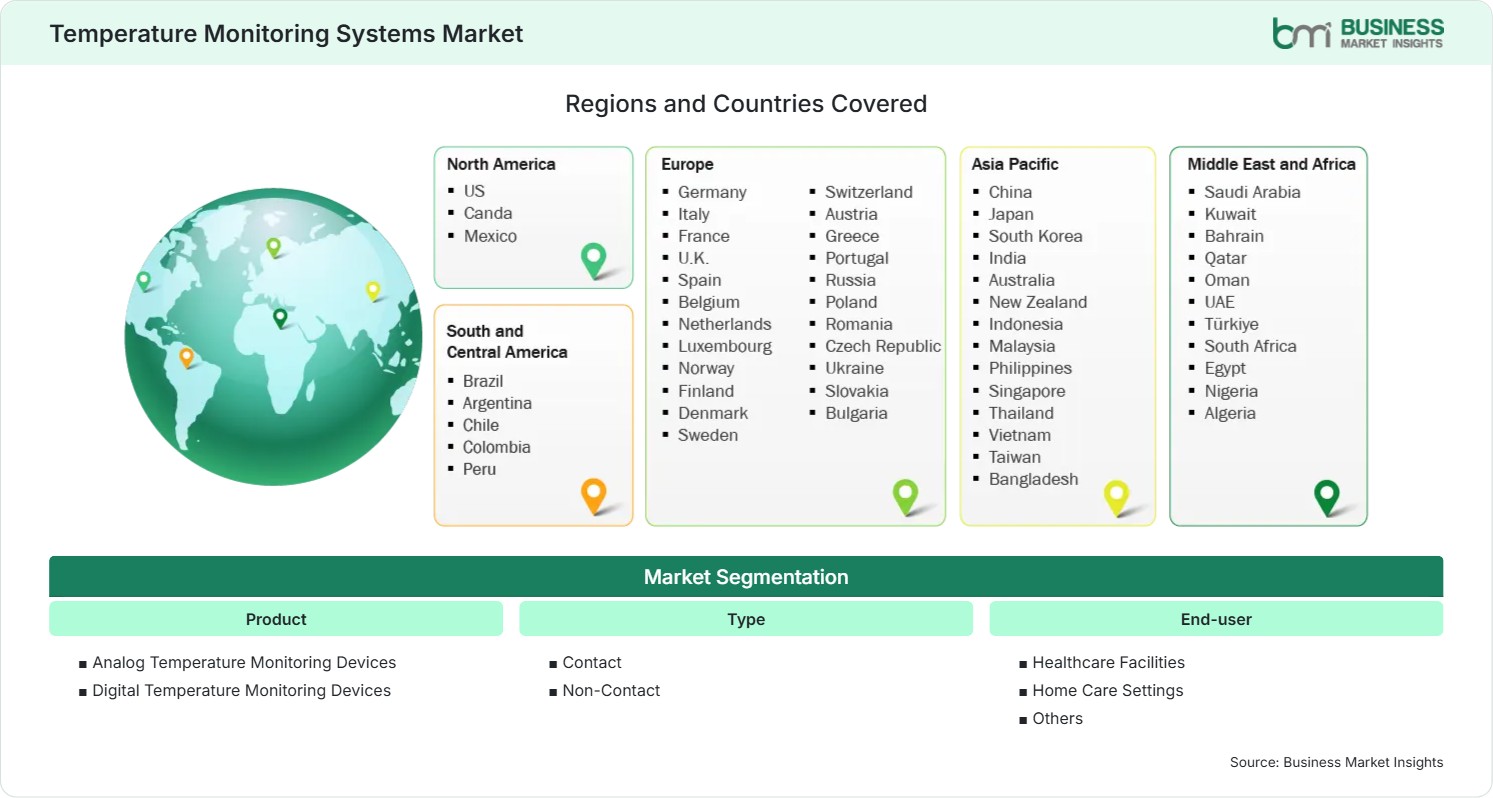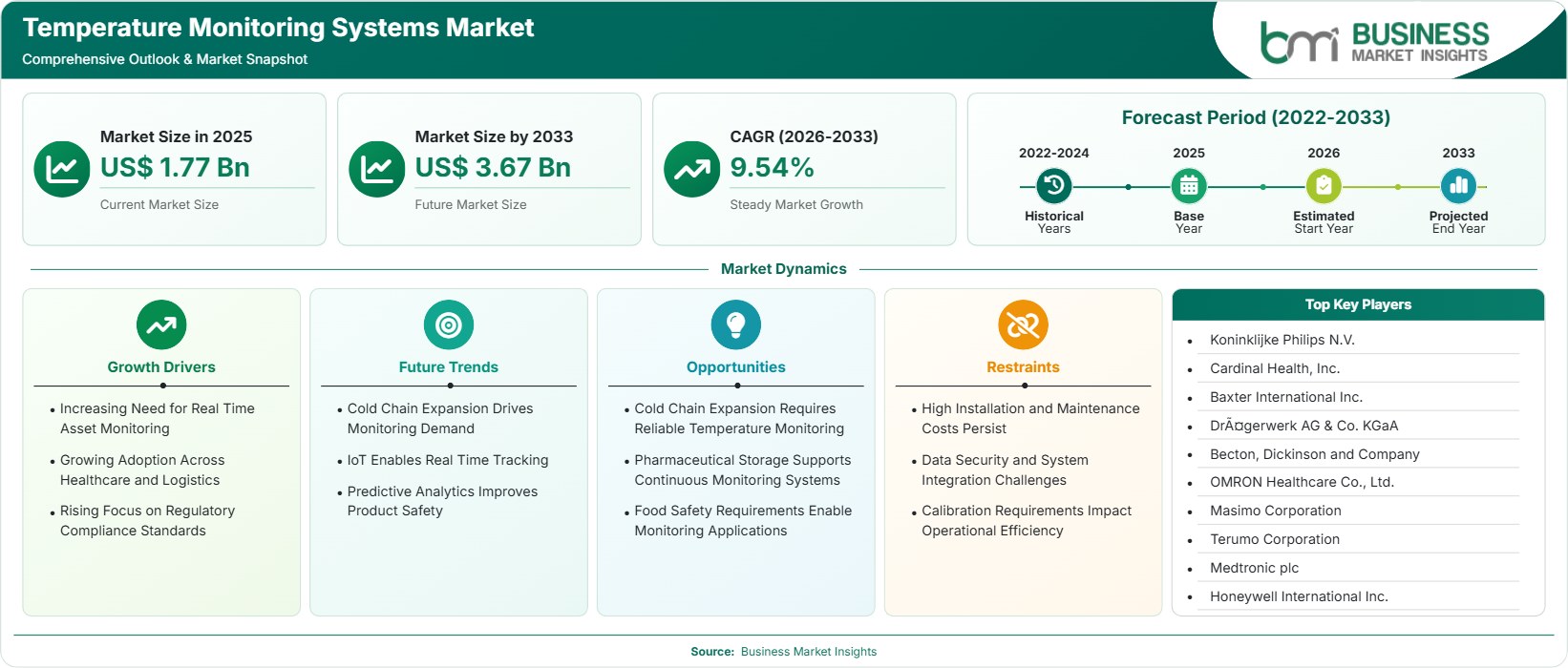
Temperature Monitoring Systems Market Regional Highlights
North America Temperature Monitoring Systems Market
North America accounted for approximately 36%–39% Temperature Monitoring Systems Market share in 2025 and is projected to grow at 8.5%–9.0% CAGR through 2033. Good infrastructure within hospitals, increased deployment of digital health solutions, and the increased use of remote monitoring solutions drive the demand. Standards in clinical monitoring and the use of connected health continue driving purchases. The temperature monitoring solution is incorporated within other patient management workflows.
- Healthcare systems increasingly deploy cloud-connected monitoring platforms to improve workflow efficiency and patient visibility.
- Vaccine and biologics supply chains require validated environmental tracking systems supporting regulatory compliance.
- Higher prevalence of chronic diseases strengthens demand for continuous monitoring technologies.
- Remote care expansion supports deployment of wearable and home-based solutions.
US Temperature Monitoring Systems Market
The United States represents roughly 74%–78% of North American revenue and advances at 8.6%–9.1% CAGR. Strong reimbursement frameworks, technology adoption rates, and healthcare spending sustain investment. Hospitals increasingly integrate temperature data into centralized monitoring environments. Remote patient management strategies, combined with preventive healthcare initiatives, continue supporting long-term demand across institutional and home-care applications.
- Hospitals prioritize connected monitoring solutions integrated with electronic medical records.
- Aging demographics increase monitoring requirements across acute and non-acute settings.
- Telehealth expansion supports wider deployment of continuous temperature assessment tools.
- Healthcare cybersecurity investment improves trust in connected medical devices.
Europe Temperature Monitoring Systems Market
Europe represents 27%–30% share in 2025 and is expected to record 8.8%–9.5% CAGR. Germany remains the leading national market, while Eastern European healthcare modernization contributes incremental demand. Infection-control standards, aging populations, and digital healthcare programs remain key influences. Healthcare providers increasingly utilize interoperable monitoring systems to improve patient outcomes and operational efficiency while meeting evolving regulatory expectations.
- Germany leads regional demand through advanced hospital infrastructure and technology adoption.
- France and the United Kingdom demonstrate stable replacement cycles for monitoring systems.
- Poland and Czech Republic exhibit above-regional expansion linked to healthcare investments.
- Connected healthcare initiatives support demand for digital monitoring ecosystems.
Asia Pacific Temperature Monitoring Systems Market
Asia Pacific accounted for 25%–28% share in 2025 and is the fastest-growing region at 11.0%–12.0% CAGR. China remains the largest market, while India records the strongest growth momentum. Expanding healthcare access, rising healthcare expenditure, and large patient populations support deployment. Manufacturers are benefiting from regional production capabilities and increasing adoption of digital healthcare technologies across hospitals and community care settings.
- China leads revenue generation through large-scale healthcare infrastructure investments.
- India records the fastest growth due to expanding telehealth and hospital modernization.
- Japan emphasizes high-accuracy monitoring technologies for aging populations.
- Southeast Asian markets show accelerating adoption of connected healthcare tools.
Rest of World Temperature Monitoring Systems Market
Rest of World maintains 8%–10% share and is projected to grow at 9.2%–10.0% CAGR. South and Central America benefit from healthcare digitization initiatives, while Middle East and Africa markets gain support from hospital investments and public-health programs. Brazil leads regional demand, whereas Saudi Arabia and the UAE demonstrate notable growth. Adoption remains linked to healthcare infrastructure improvements and monitoring-standard upgrades.
- Brazil benefits from expanding public and private healthcare investments.
- Saudi Arabia advances through healthcare transformation and smart-hospital initiatives.
- UAE supports digital monitoring adoption across advanced healthcare facilities.
- Cold-chain monitoring requirements strengthen demand across pharmaceutical supply networks.