
Blood Glucose Monitoring Market Outlook: Size, Share, Trends, Growth Analysis, Competitive Landscape & Forecast, 2026–2033

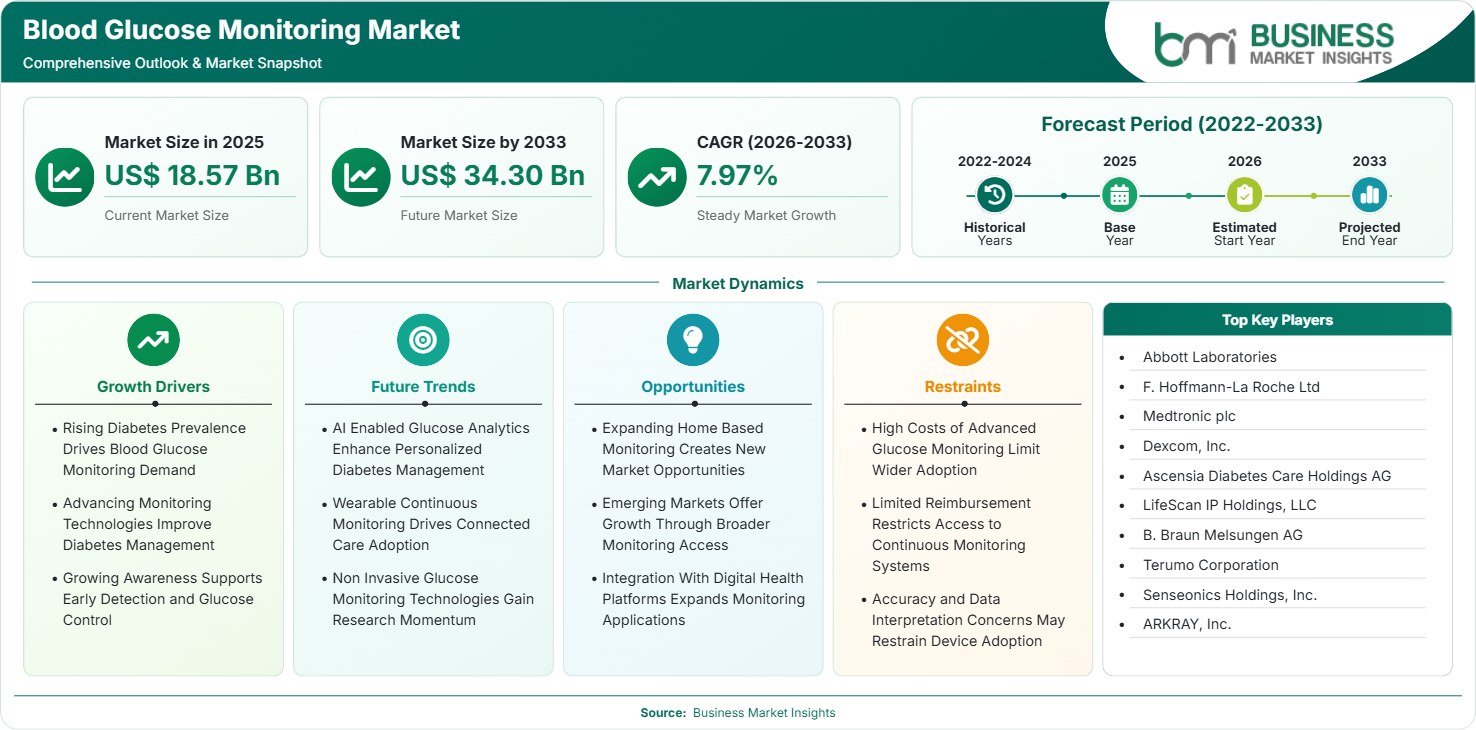
The Blood Glucose Monitoring Market size was valued at US$ 18.57 Billion in 2025 and is projected to reach US$ 34.30 Billion by 2033, growing at a CAGR of 7.97% during 2026–2033, driven by diabetes prevalence, technology adoption, home monitoring, and digital health integration.

Report Coverage
  • Device Type: Continuous Glucose Monitoring Systems, Self-Monitoring Blood Glucose Systems
  • Type: Non-invasive, Invasive
  • Modality: Wearable, Non-wearable
  • Patient Type: Type 1 Diabetes, Type 2 Diabetes
  • Distribution Channel: Retail Sales, Institutional Sales
US$ 18.57 Bn Market size in 2025
US$ 34.30 Bn Market Size by 2033
7.97% CAGR, 2026 - 2033
2026-2033 Forecast Period

AI Overview

Blood Glucose Monitoring Market Summary

  • North America: North America holds a 35%–39% share in 2025, growing at a 7.1%–7.8% CAGR through 2033, supported by CGM adoption, reimbursement coverage, connected devices, and established diabetes-care infrastructure. The U.S. market remains dominant, expanding at a 7.2%–7.9% CAGR as CGM access, home monitoring, and digital diabetes management gain wider use.
  • Fastest Growing Region: Asia Pacific accounts for a 16%–20% share in 2025 and is projected to expand at a 9.0%–10.2% CAGR, supported by rising diabetes prevalence, improving healthcare access, expanding domestic manufacturing, and increasing adoption of wearable monitoring.
  • Leading Segment: Self-Monitoring Blood Glucose Systems hold a 30%–34% share in 2025, with a 6.8%–7.5% CAGR, supported by affordability, established retail availability, routine testing requirements, and continued use among patients requiring regular glucose checks.
  • High Growth Segment: Continuous Glucose Monitoring Systems represent a 25%–29% share in 2025 and record a 10.5%–12.0% CAGR, driven by sensor innovation, wearable formats, real-time readings, connected applications, and increasing demand for continuous diabetes management.
  • Key Market Opportunity: Expansion of connected monitoring, wearable sensors, home-based care, and lower-cost devices can widen access while creating recurring revenue through sensors, test strips, digital platforms, and monitoring services.
  • Major Market Players: Abbott Laboratories, F. Hoffmann-La Roche Ltd., Medtronic plc, Dexcom, Inc., Ascensia Diabetes Care Holdings AG, LifeScan IP Holdings, LLC, B. Braun Melsungen AG, Terumo Corporation, Senseonics Holdings, Inc., and ARKRAY, Inc.
Strategic Insights

Blood Glucose Monitoring Market: Strategic Insights

Blood Glucose Monitoring Market Strategic Framework
FREE PDF
Request your free sample
Request free sample
Stakeholder View

Key Takeaways

  • The supply chain is becoming more integrated as sensor manufacturers, electronics suppliers, software developers, healthcare providers, and distributors coordinate around connected monitoring platforms.
  • CGM systems provide the strongest product-level upside because recurring sensor replacement, wearable formats, and mobile connectivity create higher engagement than conventional meter-only monitoring.
  • Product development is moving toward smaller sensors, longer wear periods, improved accuracy, simplified calibration, and stronger smartphone integration.
  • Asia Pacific offers an attractive expansion case as diabetes prevalence, healthcare investment, and awareness increase across major markets. Local distribution partnerships and affordable device portfolios can improve penetration.
  • Competition is increasingly influenced by recurring revenue models built around sensors, strips, software, and connected services. Companies with broad device ecosystems can strengthen customer retention and reduce dependence on one-time hardware sales.
  • Manufacturers that combine clinical performance with accessible pricing and straightforward user experiences are better positioned to expand monitoring beyond specialist care.
Geographic Outlook

Blood Glucose Monitoring Market Regional Highlights

North America Blood Glucose Monitoring Market

North America holds a 35%–39% share in 2025, with growth of 7.1%–7.8% CAGR through 2033. The region benefits from established diabetes-care systems, strong CGM adoption, reimbursement support, and high consumer awareness. The Blood Glucose Monitoring Market share remains concentrated in the U.S., while Canada contributes through expanding chronic-care programs. Product development emphasizes wearable sensors, remote monitoring, smartphone connectivity, and automated alerts. The region also maintains strong demand for both CGM and SMBG systems across clinical and home settings.

  • CGM adoption remains a central demand driver as patients and providers seek continuous readings, trend information, and alerts that support treatment decisions and reduce reliance on periodic manual measurements.
  • Reimbursement and established diabetes-care pathways support premium device adoption, particularly for connected systems that combine sensors, mobile applications, data sharing, and clinical monitoring.
  • The U.S. represents the principal regional market, supported by advanced healthcare infrastructure, established manufacturers, broad retail availability, and increasing regulatory acceptance of consumer-oriented monitoring technologies.
  • Canada provides additional growth through chronic disease management, home monitoring, and increasing interest in wearable technologies that reduce the burden associated with conventional testing routines.

US Blood Glucose Monitoring Market

The U.S. Blood Glucose Monitoring Market represents approximately 29%–33% of global revenue in 2025, with a 7.2%–7.9% CAGR through 2033. Strong diabetes-care infrastructure, insurance coverage, retail availability, and established CGM use support demand. Regulatory developments are also broadening access to monitoring devices. The market increasingly favors connected systems capable of sharing readings with smartphones and care teams. Professional and personal monitoring coexist, while home-based use remains an important channel for recurring sensor and test-strip demand.

  • OTC CGM clearance expands the addressable consumer base and reduces dependence on traditional prescription pathways, creating additional demand among adults seeking accessible glucose information.
  • Connected devices are gaining importance as users expect smartphone applications, alerts, trend analysis, and data sharing to become standard features within monitoring ecosystems.
  • Clinical adoption remains supported by diabetes specialists and healthcare facilities that require reliable glucose measurements for treatment monitoring, patient assessment, and ongoing disease management.

Europe Blood Glucose Monitoring Market

Europe accounts for a 24%–28% share in 2025 and is projected to expand at a 6.5%–7.3% CAGR through 2033. Germany and the United Kingdom remain leading markets, while Spain, Italy, and France provide additional demand. Germany is estimated at a 6.8%–7.5% CAGR, while the United Kingdom records approximately 7.0%–7.8% CAGR. The Blood Glucose Monitoring Market growth is supported by preventive care, diabetes screening, wearable monitoring, and expanding digital health integration.

  • Public healthcare systems support continued demand for glucose monitoring, although reimbursement decisions place greater emphasis on clinical value, device reliability, and cost effectiveness.
  • CGM adoption is expanding as healthcare providers increasingly use continuous data to support treatment adjustment, particularly for patients requiring intensive glucose management.
  • European manufacturers and healthcare institutions are placing greater emphasis on interoperability, cybersecurity, data privacy, and integration between monitoring devices and digital care platforms.
  • Germany maintains strong demand through established medical-device distribution and specialist care, while the U.K. benefits from structured diabetes management and broader digital-health adoption.

Asia Pacific Blood Glucose Monitoring Market

Asia Pacific Blood Glucose Monitoring Market holds a 16%–20% share in 2025 and is the fastest-growing region, recording a 9.0%–10.2% CAGR through 2033. China and Japan are leading markets, while India and Southeast Asia provide substantial expansion potential. China is estimated at 9.3%–10.4% CAGR, with India at 9.5%–10.7% CAGR. Rising diabetes prevalence, expanding healthcare infrastructure, increasing awareness, and improving device availability support regional demand.

  • China is strengthening domestic healthcare capacity while demand rises for both conventional meters and advanced wearable monitoring systems across urban and expanding regional healthcare networks.
  • India provides strong upside as diabetes screening, home monitoring, private healthcare spending, and awareness increase, creating demand for affordable devices and wider retail distribution.
  • Japan remains a technologically advanced market where compact devices, connected monitoring, and integration with established chronic-care systems support replacement and upgrade demand.
  • Southeast Asian markets offer additional potential as healthcare infrastructure improves and monitoring moves into primary-care and home-based settings.

Rest of World Blood Glucose Monitoring Market

South and Central America account for an estimated 8%–11% share in 2025, with a 7.4%–8.4% CAGR through 2033. Brazil and Mexico lead regional demand, while expanding private healthcare access supports device penetration. The Middle East and Africa represent approximately 7%–10% share, growing at 8.0%–9.2% CAGR. Saudi Arabia, the UAE, and South Africa provide important demand centers as diabetes-care capacity expands.

  • Brazil and Mexico provide the strongest Latin American opportunities as private healthcare networks, pharmacies, and home monitoring channels improve access to glucose-testing devices.
  • Middle Eastern markets are increasing diabetes-care capacity, supporting demand for connected monitoring, wearable devices, and technologies that help manage chronic conditions outside hospitals.
  • South Africa remains an important African market because established private healthcare channels provide a foundation for wider adoption of glucose monitoring technologies.
  • The Blood Glucose Monitoring Market share in these regions remains below mature markets, leaving room for affordable devices, distribution expansion, and localized patient-support models.
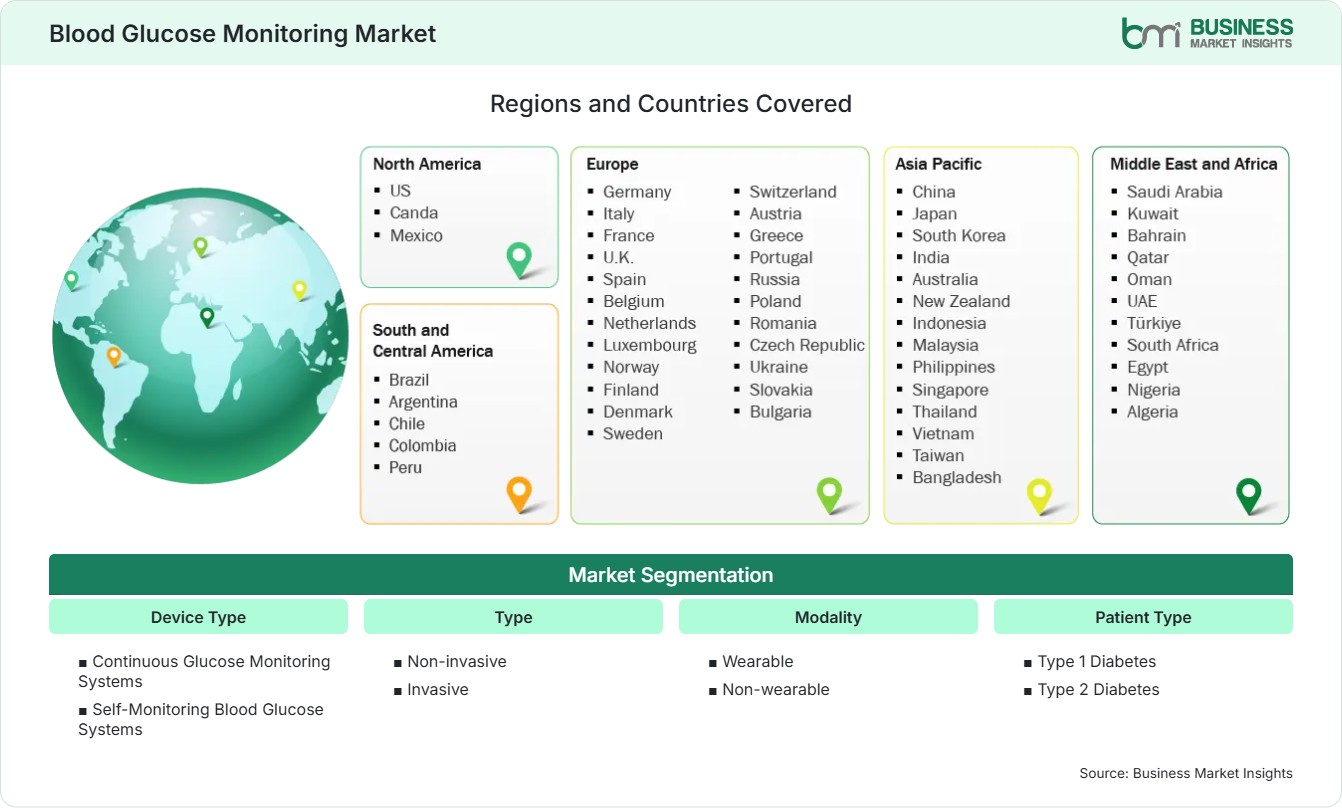
Global Market Geography
FREE PDF
Request your free sample
Request free sample
Segment Analysis

Blood Glucose Monitoring Market Segmentation

Device Type

The Device Type segment is led by Self-Monitoring Blood Glucose Systems, holding a 30%–34% share in 2025 and growing at a 6.8%–7.5% CAGR. CGM systems are the faster-growing category, supported by wearable sensors, continuous readings, connected applications, and broader patient acceptance.

  • Continuous Glucose Monitoring (CGM) Systems: Wearable sensors provide continuous readings and trend information, supporting insulin management, alerts, remote monitoring, and greater patient engagement with daily glucose control.
  • Self-Monitoring Blood Glucose (SMBG) Systems: Meter-based testing remains important because of affordability, simple operation, broad availability, and established use among patients requiring periodic glucose measurements.

Type

The Type segment is led by Invasive monitoring, accounting for a 72%–78% share in 2025 and expanding at a 7.0%–7.7% CAGR. Non-invasive technologies offer higher growth potential as companies work to improve accuracy and user convenience.

  • Non-invasive: Non-invasive monitoring aims to reduce skin penetration and testing discomfort, creating opportunities for easier routine monitoring if accuracy, reliability, and regulatory requirements are satisfied.
  • Invasive: Invasive systems remain widely used because established sensing technologies provide dependable measurements and are supported by mature clinical workflows, manufacturing capabilities, and user familiarity.

Modality

The Modality segment is dominated by Wearable systems, representing a 55%–60% share in 2025 and growing at a 9.0%–10.0% CAGR. Wearables benefit from continuous monitoring, compact designs, wireless connectivity, and stronger demand for convenient home-based diabetes management.

  • Wearable: Wearable devices support continuous data collection with limited user intervention, making them suitable for patients seeking convenient monitoring, trend visibility, alerts, and integration with mobile health platforms.
  • Non-wearable: Non-wearable devices remain relevant where periodic testing, lower acquisition costs, simple operation, and established retail availability are more important than continuous data collection.

Patient Type

The Patient Type segment is led by Type 2 Diabetes, holding a 60%–66% share in 2025 and growing at a 7.4%–8.1% CAGR. Type 1 diabetes supports strong technology adoption because intensive monitoring often requires continuous and frequent measurements.

  • Type 1 Diabetes: Continuous monitoring supports frequent glucose assessment, trend tracking, alerts, and treatment management, making advanced sensors particularly relevant for patients requiring intensive glucose control.
  • Type 2 Diabetes: A broad patient population creates sustained demand for meters and wearable systems, with adoption expanding as monitoring becomes more common in home and primary-care settings.

Distribution Channel

The Distribution Channel segment is led by Retail Sales, representing a 48%–54% share in 2025 and growing at a 6.8%–7.6% CAGR. Institutional Sales remain important for hospitals, clinics, and organized diabetes-care programs requiring procurement at scale.

  • Retail Sales: Pharmacies, medical retailers, and online-enabled consumer channels improve access to meters, strips, sensors, and accessories while supporting recurring purchases associated with routine monitoring.
  • Institutional Sales: Hospitals and healthcare institutions purchase monitoring systems for clinical care, diagnostics, inpatient management, and structured chronic disease programs requiring dependable device supply.
Market Forces

Blood Glucose Monitoring Market Dynamics

Key Market Drivers

Rising Diabetes Prevalence Drives Blood Glucose Monitoring Demand

Diabetes remains the primary driver of demand for glucose monitoring products. According to the International Diabetes Federation, there are 589 million adults in the age range of 20 to 79 years who suffer from diabetes worldwide. This creates a huge demand for glucose testing because of the number of people who require it. As more cases are diagnosed and treated, the demand becomes even higher because the diagnosis and treatment process requires ongoing glucose monitoring. Growth of the Blood Glucose Monitoring Market is thus dependent on the size of the patient pool and the frequency of glucose testing required.

Advancing Monitoring Technologies Improve Diabetes Management

Monitoring technology is shifting to miniaturized sensors, wireless capabilities, automation, and continuous tracking. CGM systems can offer trends information that cannot be provided by traditional glucose testing systems between tests. Applications for mobile phones also play an important role in the device ecosystem, as they deliver results, store historical data, and facilitate remote interaction. The Blood Glucose Monitoring Market trends therefore favor integrated platforms rather than standalone measurement hardware.

Growing Awareness Supports Early Detection and Glucose Control

Increased awareness about managing diabetes leads to an increased role of constant monitoring that takes place outside the hospital setting. Patients gain greater experience with at-home testing, and healthcare practitioners stress the importance of constant monitoring of glucose levels. The shift toward home-based treatment diminishes the need for constant visits to facilities and allows for constant monitoring in between clinical visits. Retail distribution increases the accessibility of meters, strips, and sensors as well. Increased awareness in areas where healthcare access improves translates into greater sales as people are diagnosed and treated.

Key Market Opportunities

Expansion of Early Cancer Detection Programs Worldwide

The most significant opportunity is broadening glucose testing beyond diabetes specialist clinics to include GP practices, pharmacies, homes, and digital chronic disease management programs. Increasing screening and diagnosing will result in more patients needing monitoring following treatment. Affordable meters can cater to stage one testing, while CGM devices can cater to those needing continuous data. Companies can also grow via product ranges tailored to suit different device capabilities and patient requirements and budgets. The platform model is another revenue pathway that allows companies to integrate hardware and data together.

Growing Adoption of Molecular and Genomic Cancer Diagnostics

The wider adoption of advanced monitoring in emerging healthcare markets creates a substantial opportunity for manufacturers with scalable product platforms. Asia Pacific is particularly attractive because healthcare infrastructure is expanding alongside a large diabetes burden. Partnerships with hospitals, pharmacies, insurers, and digital-health providers can accelerate adoption without requiring manufacturers to build every distribution capability internally. The Blood Glucose Monitoring Market Forecasts therefore favor suppliers that combine affordability with dependable performance. Local regulatory knowledge and after-sales support will also become more important as device penetration increases.

Increasing Use of Companion Diagnostics in Precision Oncology

The integration of digital technology offers an additional opportunity by integrating glucose testing with the overall chronic care management system. The devices may be used to send readings to smartphones, clinical dashboard and telehealth care systems in such a way that the trends can be reviewed by health professionals without having to depend on personal visits. This approach is more applicable for individuals who require monitoring and adjustment of treatment plans frequently. Manufacturers can strengthen recurring revenue by combining sensors or strips with software and support services.

Market Restraints and Challenges

High Costs of Advanced Glucose Monitoring Limit Wider Adoption

Factor: Advanced CGM devices have to be coupled with sensors, transmitters, software, and other replaceable materials, leading to increased total ownership costs, compared to conventional meter-based monitoring. Impact: Increased cost may limit usage among price sensitive consumers and healthcare providers. This will lead to disparity between the availability of technology and accessibility of CGM. The restraint is strongest where healthcare budgets are constrained and patients pay directly for monitoring equipment and consumable.

Limited Reimbursement Restricts Access to Continuous Monitoring Systems

Factor: Reimbursement policies differ across countries, patient categories, treatment requirements, and device types, creating uneven financial access to advanced monitoring technologies. Impact: Limited coverage can delay CGM adoption and encourage patients to remain with lower-cost SMBG systems. Reimbursement decisions increasingly depend on evidence of clinical value, accuracy, reliability, and long-term healthcare benefits. Manufacturers therefore need strong clinical evidence and clear economic justification when seeking wider coverage.

Company Analysis

Competitive Landscape

Competitive positioning is increasingly shaped by sensor technology, accuracy, device connectivity, software integration, manufacturing scale, and distribution reach. The Blood Glucose Monitoring Market analysis also shows a clear shift toward integrated ecosystems in which hardware, consumables, mobile applications, and clinical data services support recurring engagement.

Company Name

Overview

Products and Services relevant to this market

Abbott Laboratories

Global healthcare company with a strong diabetes-care portfolio and extensive international distribution.

FreeStyle glucose monitoring systems, CGM sensors, readers, digital applications, and diabetes monitoring technologies.

F. Hoffmann-La Roche Ltd.

Healthcare company with established diagnostics capabilities and diabetes monitoring expertise across multiple markets.

Blood glucose meters, test strips, diabetes management solutions, and connected monitoring technologies.

Medtronic plc

Medical technology company combining glucose monitoring with broader diabetes management and insulin-delivery systems.

CGM sensors, transmitters, monitoring platforms, and integrated diabetes management technologies.

Dexcom, Inc.

Specialist glucose-monitoring company focused heavily on continuous sensing and connected diabetes management.

CGM systems, wearable sensors, mobile applications, data platforms, and monitoring accessories.

Ascensia Diabetes Care Holdings AG

Diabetes-care company focused on blood glucose monitoring and connected solutions for routine testing.

CONTOUR glucose meters, test strips, digital diabetes management, and related monitoring solutions.

LifeScan IP Holdings, LLC

Established diabetes monitoring company serving consumers and healthcare channels with glucose-testing technologies.

OneTouch blood glucose meters, test strips, digital tools, and diabetes monitoring accessories.

B. Braun Melsungen AG

Diversified medical technology company with diabetes-care products and extensive healthcare distribution capabilities.

Blood glucose monitoring systems, diabetes-care products, testing equipment, and healthcare solutions.

Terumo Corporation

Medical technology company with broad healthcare capabilities and established cardiovascular and diabetes-related technologies.

Glucose monitoring products, medical devices, healthcare systems, and supporting technologies.

Senseonics Holdings, Inc.

Medical technology company specializing in implantable continuous glucose monitoring systems.

Eversense CGM technology, implantable sensors, transmitters, monitoring applications, and related services.

ARKRAY, Inc.

Diagnostics company with longstanding expertise in glucose testing and diabetes-care equipment.

Blood glucose meters, test strips, monitoring systems, clinical analyzers, and diabetes management technologies.

Trust & Transparency

Research Methodology

The market analysis combines proprietary research with secondary data from government agencies, company disclosures, regulatory filings, industry databases and expert interviews. Market estimates are validated through data triangulation, cross-market benchmarking and analyst review.

View Full Research Methodology

Questions Answered

Frequently Asked Questions

How is distribution changing in glucose monitoring?

Retail and online channels are expanding consumer access, while institutional procurement remains important for hospitals and organized healthcare programs requiring regular monitoring supplies.

What limits adoption of advanced glucose monitoring systems?

Device and consumable costs, reimbursement limitations, regulatory requirements, and differences in healthcare access can restrict adoption, particularly for continuous monitoring technologies.

Why does Asia Pacific offer strong expansion potential?

Large diabetic populations, improving healthcare infrastructure, growing awareness, expanding private healthcare access, and increasing availability of affordable monitoring devices support regional adoption.

How are manufacturers improving blood glucose monitoring devices?

Manufacturers are focusing on sensor accuracy, smaller form factors, longer wear periods, simplified interfaces, wireless connectivity, and interoperability with digital health systems.

What is driving demand for Blood Glucose Monitoring Market report?

Demand is being supported by the need for continuous readings, trend information, alerts, wearable formats, and easier integration with smartphones and digital diabetes-care platforms.

Access the Full Blood Glucose Monitoring Market Report

Get segment-level forecasts, regional estimates, competitive benchmarking, company profiles and downloadable Excel datasets.

Access the full Blood Glucose Monitoring Market Report
350 pages PDF & Excel | 2026-08-19
Similar Research

Related Market Reports