
Blood Glucose Meters Market Outlook: Size, Share, Trends, Growth Analysis, Competitive Landscape & Forecast, 2026-2033

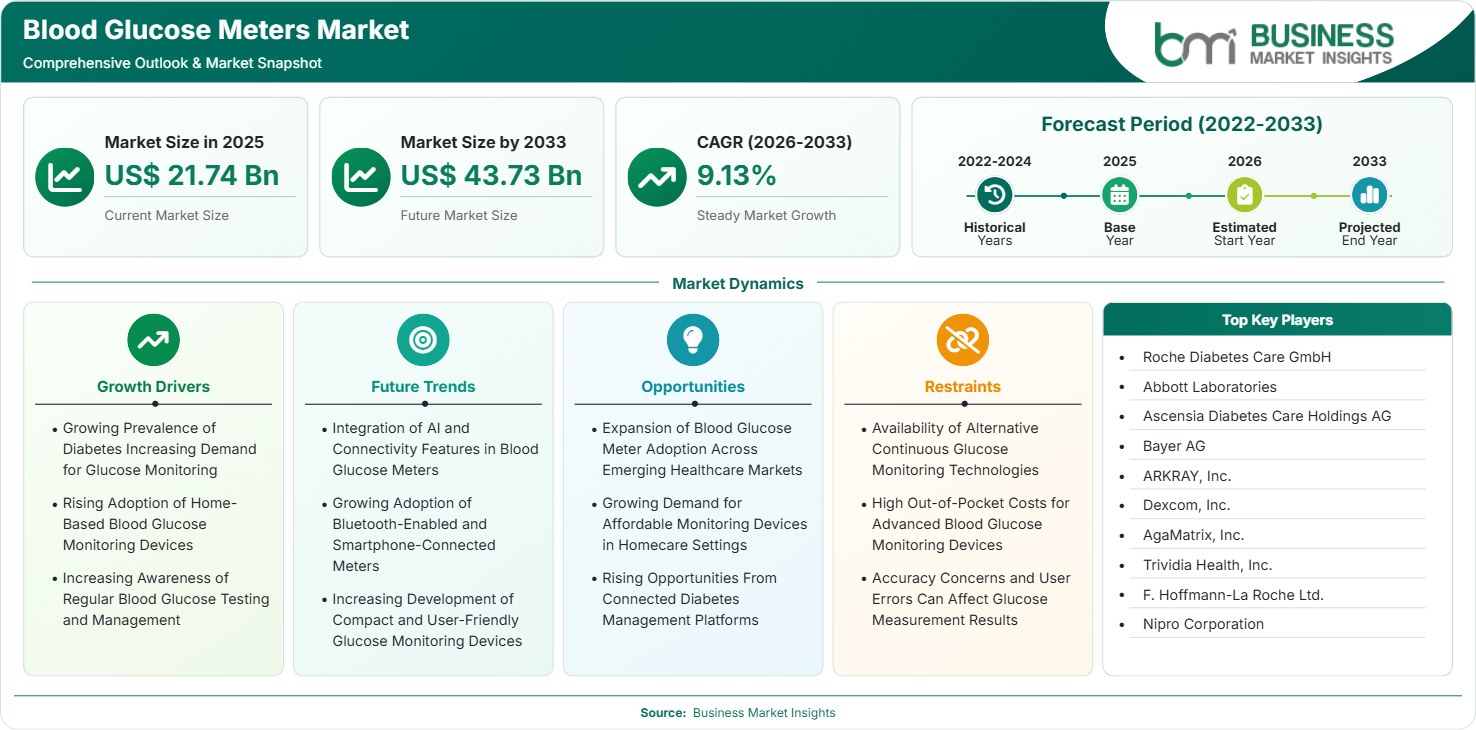
The Blood Glucose Meters Market size was valued at US$ 21.74 Billion in 2025 and is projected to reach US$ 43.73 Billion by 2033, growing at a CAGR of 9.13% during 2026–2033, driven by rising diabetes prevalence, increasing home monitoring, greater testing awareness, and connected diabetes management solutions.

Report Coverage
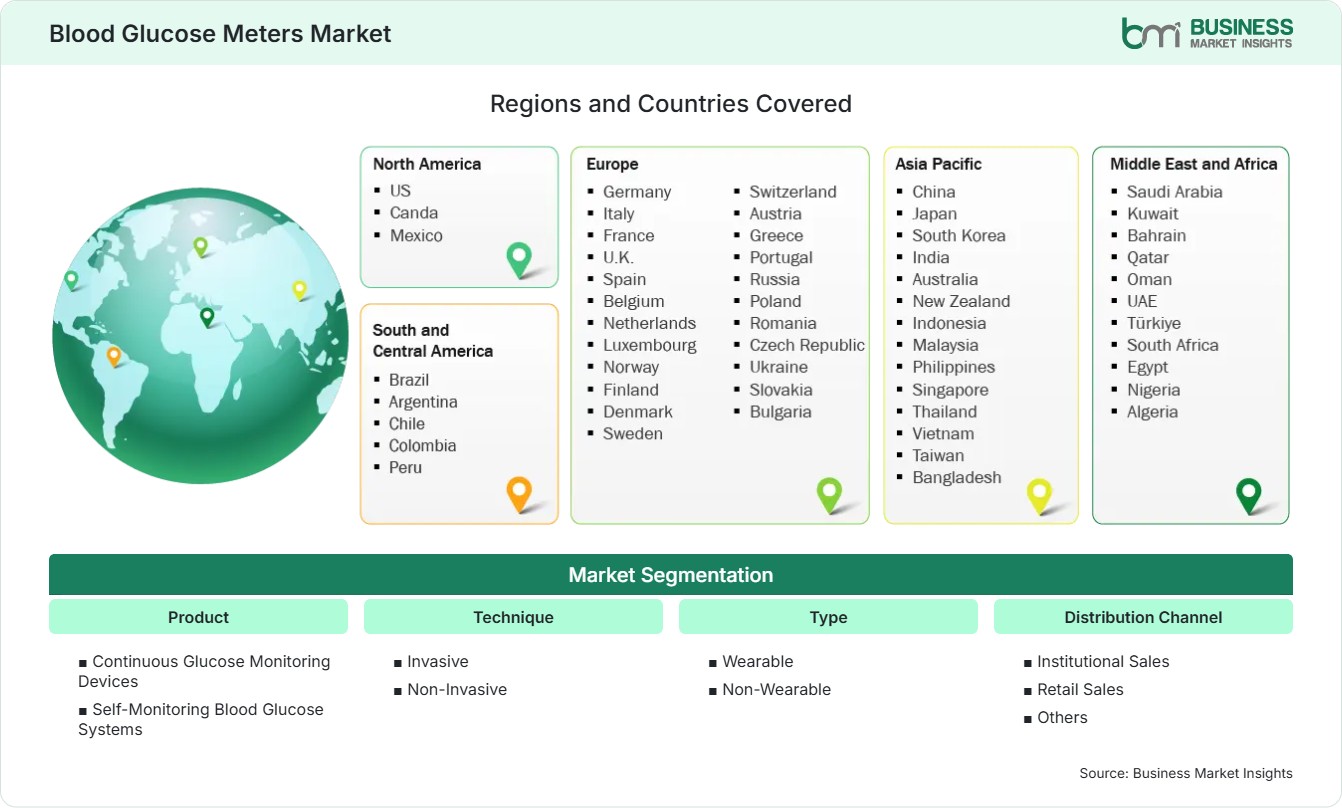
  • Product: Continuous Glucose Monitoring Devices, Self-Monitoring Blood Glucose Systems
  • Technique: Invasive, Non-Invasive
  • Type: Wearable, Non-Wearable
  • Distribution Channel: Institutional Sales, Retail Sales, Others
US$ 21.74 Bn Market size in 2025
US$ 43.73 Bn Market Size by 2033
9.13% CAGR, 2026 - 2033
2026-2033 Forecast Period

AI Overview

Blood Glucose Meters Market Summary

  • North America Region: North America accounted for a 35%–39% share in 2025 and is projected to grow at an 8.0%–10.0% CAGR during 2026–2033, supported by high diabetes prevalence, established reimbursement systems, strong homecare adoption, connected monitoring, and advanced healthcare infrastructure. The US market is projected to grow at an 8.5%–10.5% CAGR through 2033, supported by diabetes management awareness, home testing, digital health integration, and established device distribution networks.
  • Fastest Growing Region: Asia Pacific represented a 27%–31% of blood glucose meters market share in 2025 and is projected to expand at an 11.0%–14.0% CAGR through 2033, driven by increasing diabetes prevalence, expanding healthcare access, rising disposable incomes, growing awareness of glucose monitoring, and increasing adoption of affordable home-based testing devices.
  • Leading Segment: Product, Self-Monitoring Blood Glucose (SMBG) Systems represented a 54%–59% share in 2025 and is projected to grow at an 8.0%–10.0% CAGR through 2033, supported by affordability, widespread availability, established clinical use, home testing, and continued demand among insulin-treated and non-insulin-treated diabetes patients.
  • High Growth Segment: Product, Continuous Glucose Monitoring Devices represented a 28%–33% share in 2025 and is projected to grow at a 12.0%–15.0% CAGR through 2033, driven by sensor innovation, increasing demand for real-time glucose insights, digital connectivity, improved convenience, and growing diabetes management awareness.
  • Key Market Opportunity: Emerging healthcare markets, affordable home monitoring, connected diabetes platforms, and integration with smartphones and digital health ecosystems create opportunities for manufacturers to expand access and improve long-term disease management.
  • Major Market Players: Roche Diabetes Care GmbH, Abbott Laboratories, Ascensia Diabetes Care Holdings AG, Bayer AG, ARKRAY, Inc., Dexcom, Inc., AgaMatrix, Inc., Trividia Health, Inc., F. Hoffmann-La Roche Ltd., and Nipro Corporation.
Strategic Insights

Blood Glucose Meters Market: Strategic Insights

Blood Glucose Meters Market Strategic Framework
FREE PDF
Request your free sample
Request free sample
Stakeholder View

Key Takeaways

  • The ecosystem increasingly connects device manufacturers, sensor developers, test-strip suppliers, digital health companies, healthcare providers, pharmacies, distributors, and reimbursement stakeholders. Competitive advantage increasingly depends on integration across devices, data platforms, and patient management services.
  • Home-based monitoring remains a significant growth opportunity because patients require frequent glucose testing outside clinical settings. Affordable SMBG devices and connected monitoring solutions can expand access among broader diabetes populations.
  • Wearable monitoring is reshaping product development as manufacturers focus on smaller sensors, longer wear times, improved accuracy, reduced calibration requirements, and seamless smartphone connectivity.
  • Asia Pacific provides a compelling expansion opportunity due to its growing diabetes burden, expanding healthcare infrastructure, rising awareness, and increasing demand for accessible chronic disease management technologies.
  • Strategic partnerships between device manufacturers, digital health providers, healthcare organizations, and technology companies can strengthen connected diabetes ecosystems and support remote patient monitoring, data analytics, and personalized treatment management.
  • Manufacturers can strengthen long-term competitiveness by combining affordable monitoring devices with connected data platforms, recurring consumable models, and partnerships across pharmacies.
Geographic Outlook

Blood Glucose Meters Market Regional Highlights

North America Blood Glucose Meters Market

North America held a 35%–39% share in 2025 and North America blood glucose meters market forecast to grow at an 8.0%–10.0% CAGR through 2033. The region benefits from established diabetes care infrastructure, high awareness of glucose monitoring, strong healthcare spending, and broad availability of monitoring technologies. The US dominates regional demand due to its large diagnosed diabetes population and established homecare ecosystem. Canada contributes through public healthcare access and chronic disease management initiatives.

  • The US remains the largest regional market as patients increasingly use home monitoring devices alongside professional healthcare support to manage glucose levels and treatment decisions.
  • Continuous monitoring technologies are expanding as sensor improvements, smartphone connectivity, and real-time glucose data increase convenience and support more personalized diabetes management.
  • Established pharmacy and retail networks provide broad access to meters, test strips, lancets, and monitoring accessories, supporting recurring demand from patients requiring regular testing.

US Blood Glucose Meters Market

The US blood glucose meters market represented approximately 88%–92% of North American demand in 2025 and is projected to grow at an 8.5%–10.5% CAGR through 2033. The country benefits from established diabetes care infrastructure, extensive retail distribution, strong digital health adoption, and high awareness of glucose management. SMBG remains important for affordability and accessibility, while continuous monitoring is expanding among patients seeking real-time insights.

  • Home-based testing remains important for diabetes management, with patients using portable meters and test strips to monitor glucose levels and support treatment decisions.
  • Connected glucose monitoring is gaining traction as patients and clinicians increasingly use digital platforms to track readings, identify trends, and support remote disease management.
  • Retail pharmacies and online channels provide convenient access to monitoring devices and consumables, supporting recurring purchases and broadening product availability.

Europe Blood Glucose Meters Market

Europe blood glucose meters market accounted for a 26%–30% share in 2025 and is projected to grow at a 7.0%–9.5% CAGR through 2033. Germany, the United Kingdom, France, Italy, and Spain represent leading markets supported by established healthcare systems and diabetes management programs. Germany is projected to grow at a 7.5%–9.5% CAGR, while the United Kingdom represents a high-value market supported by organized diabetes care.

  • Germany remains a major market due to established diabetes care infrastructure, strong healthcare access, and demand for reliable glucose monitoring technologies across patient groups.
  • The United Kingdom benefits from structured diabetes management pathways and growing interest in connected monitoring tools that can support patient self-management and clinical oversight.
  • France and Italy provide opportunities through established healthcare systems and increasing adoption of home-based monitoring technologies for chronic disease management.
  • European manufacturers and healthcare providers are increasingly focused on interoperability, data security, and integration of glucose monitoring with broader digital health ecosystems.

Asia Pacific Blood Glucose Meters Market

Asia Pacific blood glucose meters market held a 27%–31% share in 2025 and is projected to achieve an 11.0%–14.0% CAGR through 2033, making it the fastest-growing region. China, Japan, India, South Korea, and Australia represent major markets, while India is projected to grow at a 13.0%–16.0% CAGR. Rising diabetes prevalence, expanding healthcare access, urbanization, and increasing awareness of regular glucose testing are supporting demand.

  • China offers substantial opportunities due to its large diabetes population, expanding healthcare infrastructure, increasing disease awareness, and growing demand for accessible glucose monitoring technologies.
  • India represents a high-growth opportunity as diabetes awareness improves and patients increasingly seek affordable home monitoring devices for routine glucose management.
  • Japan benefits from advanced healthcare infrastructure and an aging population, supporting demand for reliable monitoring technologies and digitally connected diabetes management solutions.
  • South Korea and Australia provide opportunities through strong healthcare systems, increasing digital health adoption, and growing interest in integrated glucose monitoring technologies.

Rest of World Blood Glucose Meters Market

South and Central America blood glucose meters market accounted for a 5%–7% share in 2025 and is projected to grow at a 9.0%–12.0% CAGR through 2033, supported by increasing diabetes prevalence and expanding healthcare access. The Middle East and Africa represented a 4%–6% share in 2025 and is projected to grow at a 10.0%–13.0% CAGR through 2033.

  • Brazil remains a leading South American market, supported by a large diabetes patient population, expanding healthcare infrastructure, and increasing awareness of regular glucose testing and disease management.
  • Mexico offers strong growth potential as diabetes diagnosis increases and healthcare providers encourage greater use of affordable home monitoring devices for routine glucose management.
  • Saudi Arabia and the United Arab Emirates are investing in healthcare infrastructure and digital health capabilities, creating opportunities for connected glucose monitoring and remote diabetes management solutions.
  • South Africa represents an important African market as healthcare providers and public health initiatives increasingly focus on chronic disease screening, diagnosis, and long-term diabetes management.
Global Market Geography
FREE PDF
Request your free sample
Request free sample
Segment Analysis

Blood Glucose Meters Market Segmentation

Product

Self-Monitoring Blood Glucose (SMBG) Systems represented a 54%–59% of global blood glucose meters market share in 2025 and are projected to grow at an 8.0%–10.0% CAGR during 2026–2033. SMBG systems remain widely adopted because of affordability, availability, ease of use, and established clinical acceptance. Continuous monitoring is gaining momentum through wearable sensors and real-time glucose data, supporting broader product innovation.

  • Continuous Glucose Monitoring Devices: CGM devices provide real-time or near-real-time glucose information through wearable sensors, supporting trend analysis, treatment decisions, and increasingly personalized diabetes management.
  • Self-Monitoring Blood Glucose (SMBG) Systems: SMBG systems remain widely used because they offer affordable, accessible, and convenient glucose testing. Demand is supported by established clinical practices and home-based monitoring.

Technique

Invasive techniques represented a 78%–83% share in 2025 and are projected to grow at an 8.0%–10.0% CAGR during 2026–2033. Invasive monitoring remains dominant because established finger-stick and sensor-based technologies offer proven accuracy. Non-invasive approaches are attracting research interest due to their potential to reduce discomfort, although technical validation and accuracy remain important development considerations.

  • Invasive: Invasive methods use blood samples or subcutaneous sensors to measure glucose levels. Established accuracy and widespread clinical adoption continue supporting their use across diabetes management.
  • Non-Invasive: Non-invasive technologies seek to measure glucose without penetrating the skin, offering potential improvements in comfort and convenience. Commercial adoption depends on achieving reliable accuracy and regulatory validation.

Type

Wearable devices represented a 30%–35% share in 2025 and are projected to grow at a 12.0%–15.0% CAGR during 2026–2033. Wearable technologies are gaining adoption through continuous monitoring, smaller form factors, wireless connectivity, and improved user convenience.

  • Wearable: Wearable devices provide convenient and continuous or frequent monitoring while supporting smartphone connectivity and real-time data analysis. Sensor miniaturization and improved comfort are strengthening adoption.
  • Non-Wearable: Non-wearable meters remain widely used for intermittent testing because of their affordability, accessibility, and established clinical role. Demand remains strong among patients seeking straightforward monitoring.

Distribution Channel

Retail Sales represented a 55%–60% share in 2025 and are projected to grow at an 8.5%–10.5% CAGR during 2026–2033. Retail pharmacies, supermarkets, specialized medical stores, and online platforms provide convenient access to meters and recurring consumables.

  • Institutional Sales: Hospitals and healthcare institutions purchase glucose monitoring products for inpatient care, outpatient services, diagnostics, and chronic disease management, supporting demand for reliable professional-use devices.
  • Retail Sales: Retail channels provide patients with convenient access to meters, strips, lancets, and accessories. Pharmacy and online availability supports recurring purchases and home-based glucose monitoring.
Market Forces

Blood Glucose Meters Market Dynamics

Key Market Drivers

Growing Prevalence of Diabetes Increasing Demand for Glucose Monitoring

The increase in cases of diabetes increases the number of people who will need to have their blood sugar levels measured regularly to control the condition. People with insulin and non-insulin-dependent diabetes depend on blood glucose measurement to determine the effectiveness of the treatments used, as well as how food affects the body. Increased cases also increase the number of people enrolling in monitoring programs, thereby increasing the demand for monitors, test strips, sensors, and accessories. This factor becomes even more significant considering the increase in the prevalence of diabetes in emerging countries due to the large numbers of people who will need inexpensive monitors.

Rising Adoption of Home-Based Blood Glucose Monitoring Devices

Home monitoring has become quite significant as people are trying to gain more independence in terms of managing diabetes chronically. The portability of glucose monitors allows individuals to measure blood glucose at home instead of going to the hospital or the clinic regularly and makes treatment decisions in time. With the increasing role of telemedicine and digital monitoring, there has been an increased importance of connected monitoring equipment that can transmit readings to either smartphones or medical personnel. This blood glucose meters market trend is particularly relevant for patients requiring frequent measurements and for healthcare systems seeking more efficient chronic disease management.

Increasing Awareness of Regular Blood Glucose Testing and Management

Diabetes complications awareness and the need for proper glucose level management are making diagnosed individuals monitor themselves in a better way. Educational programs, health care drives, health information through digital media, and the growing understanding of the connection between glucose levels and overall health are contributing to this trend in the market for glucose meters. Growing health literacy levels in emerging economies are particularly significant, as access to healthcare increases alongside rising diabetes cases. This growth in the glucose meter market can be capitalized on by manufacturers.

Key Market Opportunities

Expansion of Blood Glucose Meter Adoption Across Emerging Healthcare Markets

Emerging markets provide significant opportunities as more people are diagnosed with diabetes. In many underdeveloped nations, the number of patients who are properly managed through continuous blood sugar monitoring is quite low owing to a lack of knowledge, unaffordability, and inadequate healthcare provision. Companies can overcome such hurdles by providing affordable blood sugar meters, reliable distribution channels, and user-friendly products for home use. Collaborations with local pharmacies, healthcare organizations, governments, and diabetes associations will also help expand market reach and enhance consumer education.

Growing Demand for Affordable Monitoring Devices in Homecare Settings

Affordability continues to be a significant factor in glucose monitoring use, especially among those needing regular monitoring and hence purchasing consumables on a regular basis. Affordable devices and test strips can make glucose monitoring more accessible while facilitating regular monitoring. There is opportunity for manufacturers to design affordable gadgets with all necessary features, affordable strip technology, and pricing structures that suit the budget conscious. Web-based sales of these products will also make them available and affordable. Besides, subscription services for consumables could aid regular availability of testing materials.

Rising Opportunities from Connected Diabetes Management Platforms

Integration of connected diabetes management platforms is creating opportunities to link the glucose meter to smartphones, cloud computing, EHRs, and even remote monitoring. The platforms can be used to convert individuals' glucose measurements into historical data, enabling both patients and clinicians to track their progress and make necessary changes to the management approach. Manufacturers have the opportunity to distinguish themselves through easy data synchronization, intuitive apps, personalized information, and integration capabilities.

Market Restraints and Challenges

Availability of Alternative Continuous Glucose Monitoring Technologies

Factor: The emergence of glucose monitoring devices is leading to the provision of real-time glucose information, with the potential to offer functionalities that go beyond the capabilities of traditional intermittent blood glucose monitors. With advancements in sensor technology and increased use, some patients are expected to move to the CGM devices for full glucose monitoring. Impact: Availability of alternative glucose monitoring technologies is likely to result in decreased sales of traditional SMBG devices by some patients seeking real-time glucose information and alerts. Traditional meter makers will, therefore, be forced to compete on basis of cost and user-friendliness.

High Out-of-Pocket Costs for Advanced Blood Glucose Monitoring Devices

Factor: Advanced glucose monitoring devices may require higher upfront spending and recurring costs for sensors, test strips, accessories, subscriptions, or replacement components. Patients without comprehensive insurance or reimbursement coverage may find these expenses difficult to sustain. Impact: High out-of-pocket costs can limit adoption, particularly in emerging markets and among lower-income patient groups who may already face significant long-term diabetes treatment expenses. Cost barriers can also encourage patients to reduce testing frequency, potentially weakening adherence to recommended monitoring routines. Manufacturers can address this challenge through lower-cost product variants, efficient consumables, local manufacturing, and flexible pricing strategies.

Company Analysis

Competitive Landscape

The Blood Glucose Meters Market analysis is increasingly shaped by competition between established diabetes care companies, specialized glucose monitoring developers, sensor manufacturers, and digital health providers. Competitive differentiation depends on device accuracy, ease of use, consumable economics, connectivity, sensor performance, reimbursement access, and integration with broader diabetes management platforms.

Company Name

Overview

Products and Services relevant to this market

Roche Diabetes Care GmbH

Diabetes care specialist providing glucose monitoring solutions and digital tools supporting self-management and clinical diabetes care.

Blood glucose meters, test strips, lancing devices, diabetes management software, connected monitoring solutions, and digital health tools.

Abbott Laboratories

Global healthcare company with a major diabetes care portfolio spanning traditional and continuous glucose monitoring technologies.

FreeStyle glucose meters, continuous glucose monitoring systems, sensors, test strips, digital applications, and diabetes data management.

Ascensia Diabetes Care Holdings AG

Diabetes care company focused on blood glucose monitoring and connected solutions supporting people with diabetes.

CONTOUR blood glucose monitoring systems, test strips, meters, digital diabetes management tools, and connected applications.

Bayer AG

Diversified healthcare company with historical expertise in diabetes monitoring and established glucose testing technologies.

Blood glucose meters, glucose test strips, diabetes monitoring technologies, and related healthcare products.

ARKRAY, Inc.

Japanese healthcare technology company specializing in diagnostic and diabetes monitoring equipment for professional and home settings.

Glucose meters, blood glucose testing systems, test strips, diabetes analyzers, and clinical diagnostic equipment.

Dexcom, Inc.

Medical device company specializing in continuous glucose monitoring systems that provide real-time glucose insights.

Continuous glucose monitoring systems, wearable sensors, mobile applications, data platforms, and connected diabetes management solutions.

AgaMatrix, Inc.

Diabetes technology company developing blood glucose monitoring systems and digital solutions focused on accessible self-management.

Blood glucose meters, test strips, digital diabetes management applications, and connected monitoring technologies.

Trividia Health, Inc.

Diabetes care company providing affordable blood glucose monitoring products for home-based diabetes management.

TRUE Metrix glucose meters, test strips, lancing devices, blood glucose monitoring systems, and diabetes testing supplies.

F. Hoffmann-La Roche Ltd.

Global healthcare company with extensive diagnostics capabilities and diabetes care expertise supporting glucose monitoring technologies.

Blood glucose monitoring systems, diagnostics technologies, diabetes management solutions, test strips, and related healthcare products.

Nipro Corporation

Healthcare company providing medical devices and diabetes care technologies across global markets.

Blood glucose meters, test strips, lancing devices, diabetes monitoring products, and medical device solutions.

Trust & Transparency

Research Methodology

The market analysis combines proprietary research with secondary data from government agencies, company disclosures, regulatory filings, industry databases and expert interviews. Market estimates are validated through data triangulation, cross-market benchmarking and analyst review.

View Full Research Methodology

Questions Answered

Frequently Asked Questions

How can manufacturers address affordability challenges in emerging markets?

Companies can develop lower-cost meters, optimize consumable pricing, expand local manufacturing, strengthen pharmacy distribution, and collaborate with healthcare programs.

What product features are becoming more important to users?

Users increasingly value smaller devices, simple testing procedures, accurate results, smartphone connectivity, automatic data synchronization, and easy-to-understand digital insights that support daily diabetes management.

Which region offers the strongest growth opportunity in blood glucose meters market report ?

Asia Pacific offers significant potential because of rising diabetes prevalence, expanding healthcare access, increasing disease awareness, and growing demand for affordable home-based glucose monitoring solutions.

Why does SMBG remain important despite CGM adoption?

SMBG systems remain widely accessible and comparatively affordable, making them important for patients who require intermittent testing.

How are connected blood glucose meters changing diabetes management?

Connected meters automatically transfer readings to smartphones or digital platforms, helping patients track trends and share data with healthcare professionals.

Access the Full Blood Glucose Meters Market Report

Get segment-level forecasts, regional estimates, competitive benchmarking, company profiles and downloadable Excel datasets.

Access the full Blood Glucose Meters Market Report
350 pages PDF & Excel | 2026-08-06
Similar Research

Related Market Reports