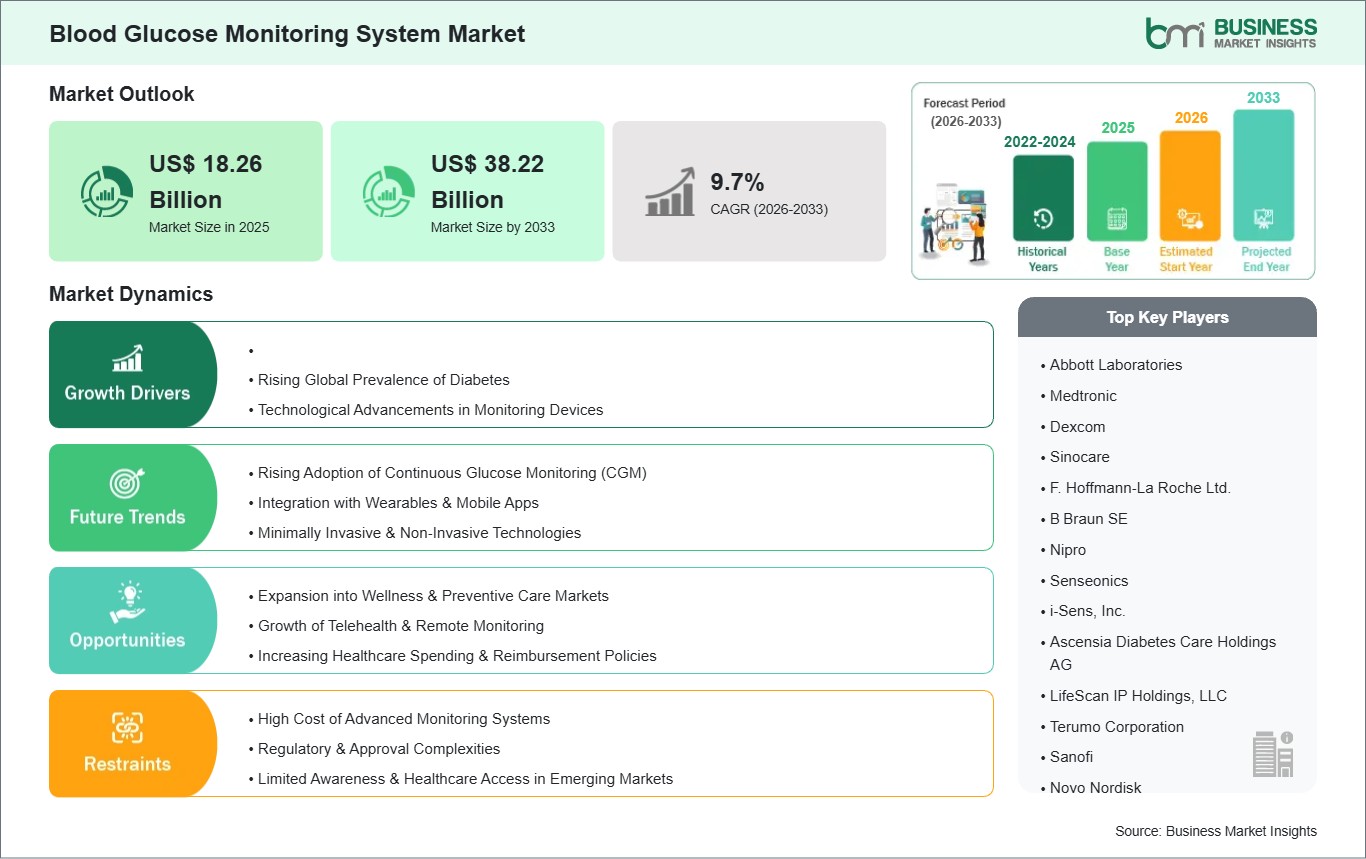
The Blood Glucose Monitoring System Market size is expected to reach US$ 38.22 Billion in 2033 from US$ 18.26 Billion in 2025. The market is estimated to record a CAGR of 9.7% from 2026 to 2033.
Glucose Monitoring Systems have a very important place in the world of healthcare, as they provide the patients suffering from diabetes and other metabolic disorders with precise and quick monitoring of their blood glucose levels. These very systems are the backbone of the hospitals, clinics, home healthcare, research, and telemedicine industries. Glucose monitoring presents many benefits like the very early recognition of hyperglycemia or hypoglycemia, better disease management, and the capability to get connected with the digital health platforms for real-time patient monitoring. The ever-growing diabetes prevalence, the demand for remote healthcare solutions, and the need for personalized treatment plans are the main reasons for the market growth. Besides, there are continuous glucose monitoring, non-invasive sensors, and smart data analytics that are creating the future market of glucose-monitoring systems by the accuracy, adherence, and patient-friendliness they bring about.
However, there are multiple obstacles that can limit the increase in market size, for instance, the high prices of devices, the restrictions on reimbursements, and the long process of obtaining approvals in different regions. Moreover, the industry is greatly influenced by the differences in healthcare infrastructure and the apprehensions regarding data privacy. Still, the market is quite large with opportunities mainly due to the increased need for monitoring at home, the growth of digital health solutions in the less developed countries, and the connection with the AI-enabled caregiver platforms

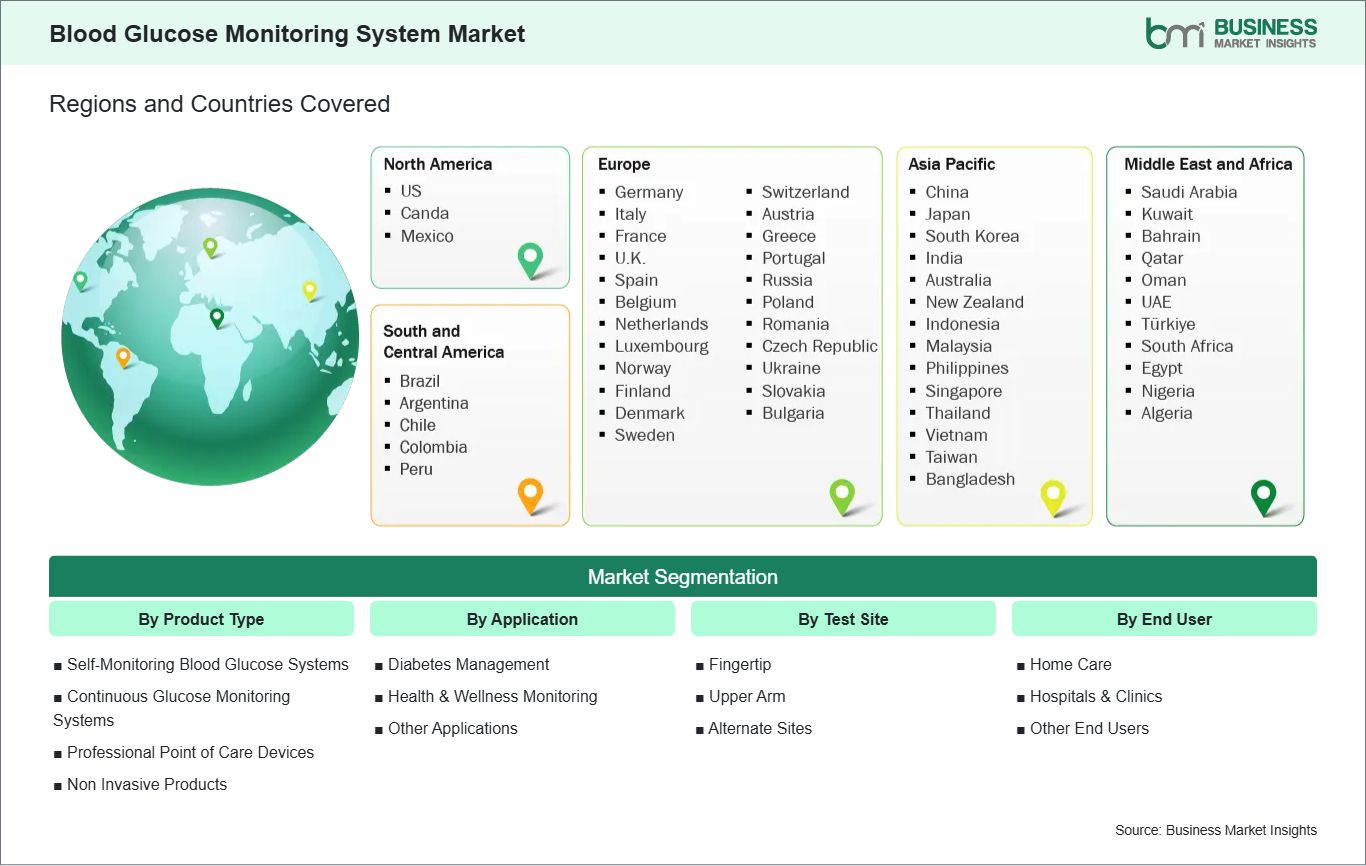
Key segments that contributed to the derivation of the Glucose Monitoring System market analysis are Product Type, Application, Test Site, End User.
The soaring diabetes rate worldwide is a key factor driving the glucose monitoring system market positively. The number of people diagnosed with diabetes is constantly increasing due to lifestyle changes, sedentary living, unhealthy eating habits, and obesity gaining ground, thus the need for trustworthy glucose monitoring tools is growing continuously. Regular measuring of blood glucose is not only a doctor's but also a patient's full trust in a means to manage the disease, prevent complications, and bring about long-term health benefits.
To illustrate, as per the International Diabetes Federation (IDF) Diabetes Atlas 2023, around 537 million adults globally were living with diabetes, and this number is projected to reach 643 million and 783 million in the years 2030 and 2045, respectively. The increase is closely linked with a greater urbanization rate, a gradually aging population, and limited access to preventive healthcare services in numerous places. The escalating cases of type 1 and type 2 diabetes have led to bulk buying of glucose monitoring devices in hospitals, clinics, and home-care settings. The steady increase in the patient population is in direct relation to the expansion of the market, where frequent glucose testing is still considered among the best ways of diabetes management globally.
The need for early detection and ongoing monitoring to minimize diabetes-related complications such as heart disease, kidney problems, and nerve damage has been highlighted by the major health care providers, insurance companies, and drug manufacturers. Glucose monitoring systems, which are recognized for their capacity to deliver real-time and accurate readings, are at the front line of proactive control of the disease. Patients can manage their medication, diet, and lifestyle by laboratory testing done at regular intervals which helps in their glycemic control and lessens the need for hospitalization. If diabetes is a health problem that the world cannot get rid of, then the requirement for better glucose monitoring devices will be very high and it is not going to go down soon.
Digital health solutions and home-based care are having a tremendous impact on the glucose monitoring system market and their acceptance is increasing. Glucose monitoring devices, which are supporting mobile applications, cloud platforms, and telehealth services, are, hence, the major reason for the shift in the healthcare delivery model and making the patients the "kings" in the new world of technology. These solutions allow real-time sharing of data among the patients and the doctors, thus helping in better adherence to the treatment and even better decision-making by the physicians.
Over the past few years, heavy investments have been pumped into telemedicine infrastructure, remote patient monitoring programs, and connected medical devices, thus, access to diabetes care has been made easier especially in places with less medical facilities and rural areas. Continuous glucose monitoring systems along with smart glucometers make it possible for the patients to take care of their health issues from the comfort of their homes while staying in touch with the doctors. This method leads to a decrease in hospital visits and thus lessening the total cost of healthcare.
Technology businesses and medical device producers are, on the whole, moving their focus toward the creation of user-friendly, wearable, and non-invasive glucose monitoring solutions. These innovations are in line with the increasing demand for preventive healthcare and self-management tools. Glucose monitoring systems, therefore, are coming out to be in a perfect spot to receive continuous growth and worldwide accessibility as governments and healthcare institutions keep on encouraging the adoption of digital health and home monitoring models

By Product Type, the Glucose Monitoring System market is segmented into Self-Monitoring Blood Glucose (SMBG) Systems, Continuous Glucose Monitoring (CGM) Systems, Professional Point of Care Devices, Non Invasive Products. The Self-Monitoring Blood Glucose (SMBG) Systems segment dominated the market in 2025. SMBG systems dominate due to affordability, ease of use, widespread availability, strong reimbursement, frequent daily testing needs, and high adoption among type 2 diabetic patients in home and outpatient settings.
By Application, the market is divided into Diabetes Management, Health & Wellness Monitoring, Other Applications. The Diabetes Management segment held the largest share of the market in 2025. Diabetes management leads because glucose monitoring is essential for diagnosis, treatment adjustment, insulin dosing, complication prevention, and long-term disease control, making it a routine requirement across all diabetes care pathways. Fingertip testing dominates owing to higher accuracy, faster reading, clinical validation, compatibility with most glucometers, established user habits, and continued recommendation by healthcare professionals for reliable glucose measurement globally today.
By Test Site, the market is bifurcated into Fingertip, Upper Arm, Alternate Sites. The Fingertip segment held the largest share of the market in 2025. Fingertip testing dominates owing to higher accuracy, faster reading, clinical validation, compatibility with most glucometers, established user habits, and continued recommendation by healthcare professionals for reliable glucose measurement globally today.
By end user, the market is segmented into home care, hospitals and clinics, and other end users. The home care segment held the largest share of the market in 2025. Home care is driven by rising diabetes prevalence, preference for self-monitoring, convenience, cost savings, improved device usability, remote monitoring adoption, and reduced need for frequent hospital or clinic visits worldwide.
| Report Attribute | Details |
|---|---|
| Market size in 2025 | US$ 18.26 Billion |
| Market Size by 2033 | US$ 38.22 Billion |
| Global CAGR (2026 - 2033) | 9.7% |
| Historical Data | 2022-2024 |
| Forecast period | 2026-2033 |
| Segments Covered | By Product Type
|
|
Regions and Countries Covered
| |
| North America | US, Canada, Mexico |
| Europe | Belgium, Austria, Finland, Denmark, Greece, Poland, Romania, Russia, Ukraine, Czech Republic, Slovakia, Bulgaria, Italy, Luxembourg, Germany, Switzerland, France, Netherlands, Norway, Portugal, Spain, Sweden, United Kingdom |
| Asia-Pacific | Australia, China, India, Japan, South Korea, Indonesia, Malaysia, Philippines, Singapore, Thailand, Vietnam, Bangladesh, New Zealand, Taiwan |
| South and Central America | Brazil, Argentina, Peru, Chile, Colombia |
| Middle East and Africa | Bahrain, Kuwait, Oman, Qatar, Saudi Arabia, United Arab Emirates, Turkiye, South Africa, Egypt, Algeria, Nigeria |
| Market leaders and key company profiles |
|
The "Glucose Monitoring System Market Size and Forecast (2022 - 2033)" report provides a detailed analysis of the market covering below areas:
The geographical scope of the Glucose Monitoring System market report is divided into five regions: North America, Asia Pacific, Europe, Middle East & Africa, and South & Central America. The Glucose Monitoring System market in Asia Pacific is expected to grow significantly during the forecast period.
The Asia-Pacific Glucose Monitoring System market is segmented into China, Japan, South Korea, India, Australia, New Zealand, Indonesia, Malaysia, the Philippines, Singapore, Thailand, Vietnam, Taiwan, Bangladesh, and the Rest of Asia. The Asia-Pacific glucose monitoring market is experiencing strong growth, driven by the rising prevalence of diabetes, increasing healthcare awareness, and expanding access to diagnostic and monitoring technologies. Major economies such as China and India are leading the region, supported by large patient populations, improving healthcare infrastructure, and growing investments in medical device manufacturing.
The region is also witnessing increased adoption of advanced glucose monitoring technologies, including continuous glucose monitoring systems, smartphone-connected devices, and cloud-based data platforms—particularly relevant for chronic disease management and home healthcare. Expanding healthcare coverage, favorable government initiatives, and rising penetration of digital health solutions are improving accessibility and affordability of glucose monitoring products. Additionally, growing urbanization, lifestyle changes, and early diagnosis programs are accelerating demand across both urban and rural populations. The presence of local manufacturers, increasing exports of medical devices, and strategic collaborations further position Asia-Pacific as a key growth hub in the global glucose monitoring ecosystem. The expansion of regional healthcare policies and continuous infrastructure development across emerging economies further strengthens the region’s leading market position

The Glucose Monitoring System market is evaluated by gathering qualitative and quantitative data post primary and secondary research, which includes important corporate publications, association data, and databases. A few of the key developments in the Glucose Monitoring System market are:
The Blood Glucose Monitoring System Market is valued at US$ 18.26 Billion in 2025, it is projected to reach US$ 38.22 Billion by 2033.
As per our report Blood Glucose Monitoring System Market, the market size is valued at US$ 18.26 Billion in 2025, projecting it to reach US$ 38.22 Billion by 2033. This translates to a CAGR of approximately 9.7% during the forecast period.
The Blood Glucose Monitoring System Market report typically cover these key segments-
The historic period, base year, and forecast period can vary slightly depending on the specific market research report. However, for the Blood Glucose Monitoring System Market report:
The Blood Glucose Monitoring System Market is populated by several key players, each contributing to its growth and innovation. Some of the major players include:
The Blood Glucose Monitoring System Market report is valuable for diverse stakeholders, including:
Essentially, anyone involved in or considering involvement in the Blood Glucose Monitoring System Market value chain can benefit from the information contained in a comprehensive market report.
Please tell us your area of interest
(Market Segments/ Regions and Countries/ Companies)