
Blood Group Typing Market Outlook: Size, Share, Trends, Growth Analysis, Competitive Landscape & Forecast, 2026-2033

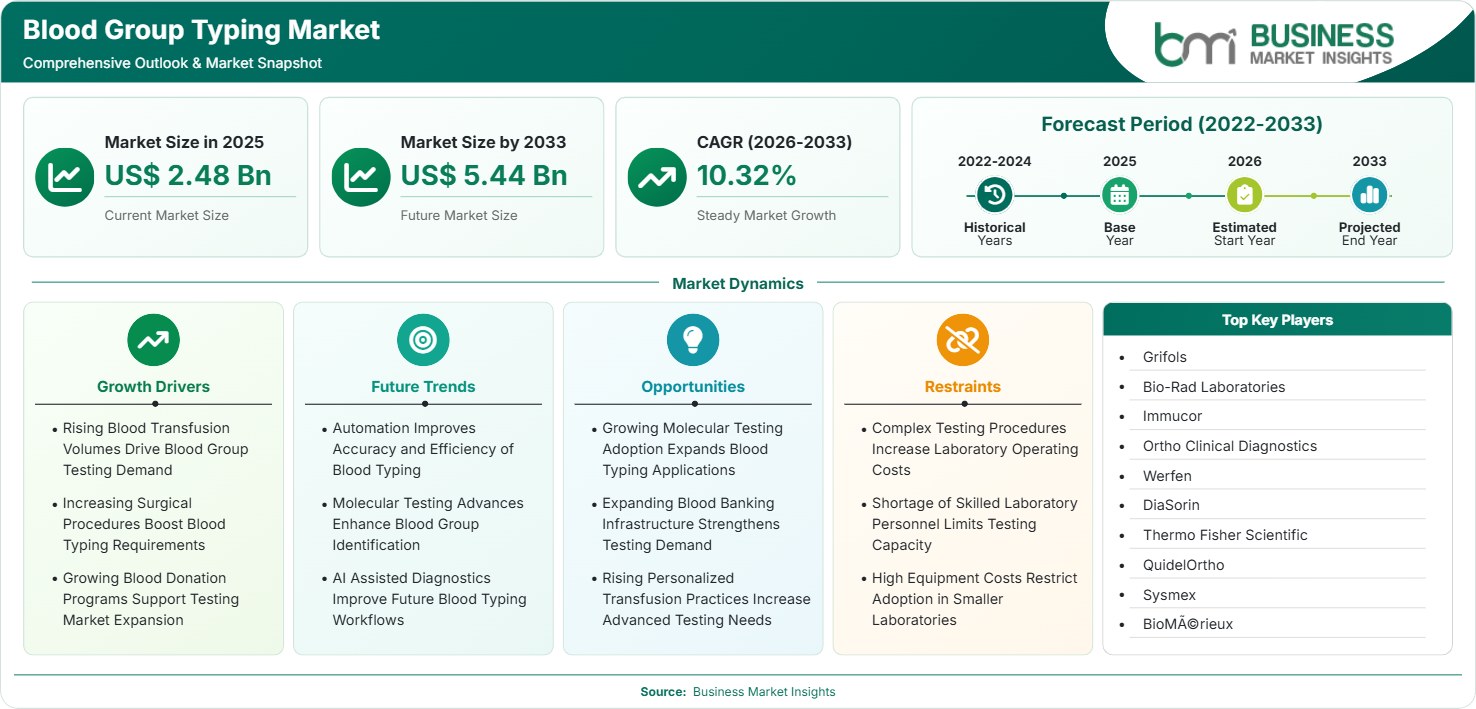
The Blood Group Typing Market size was valued at US$ 2.48 billion in 2025 and is projected to reach US$ 5.44 billion by 2033, growing at a CAGR of 10.32% during 2026–2033, driven by rising transfusion volumes, surgical procedures, blood donation programs, molecular testing, and expanding blood banking infrastructure.

Report Coverage
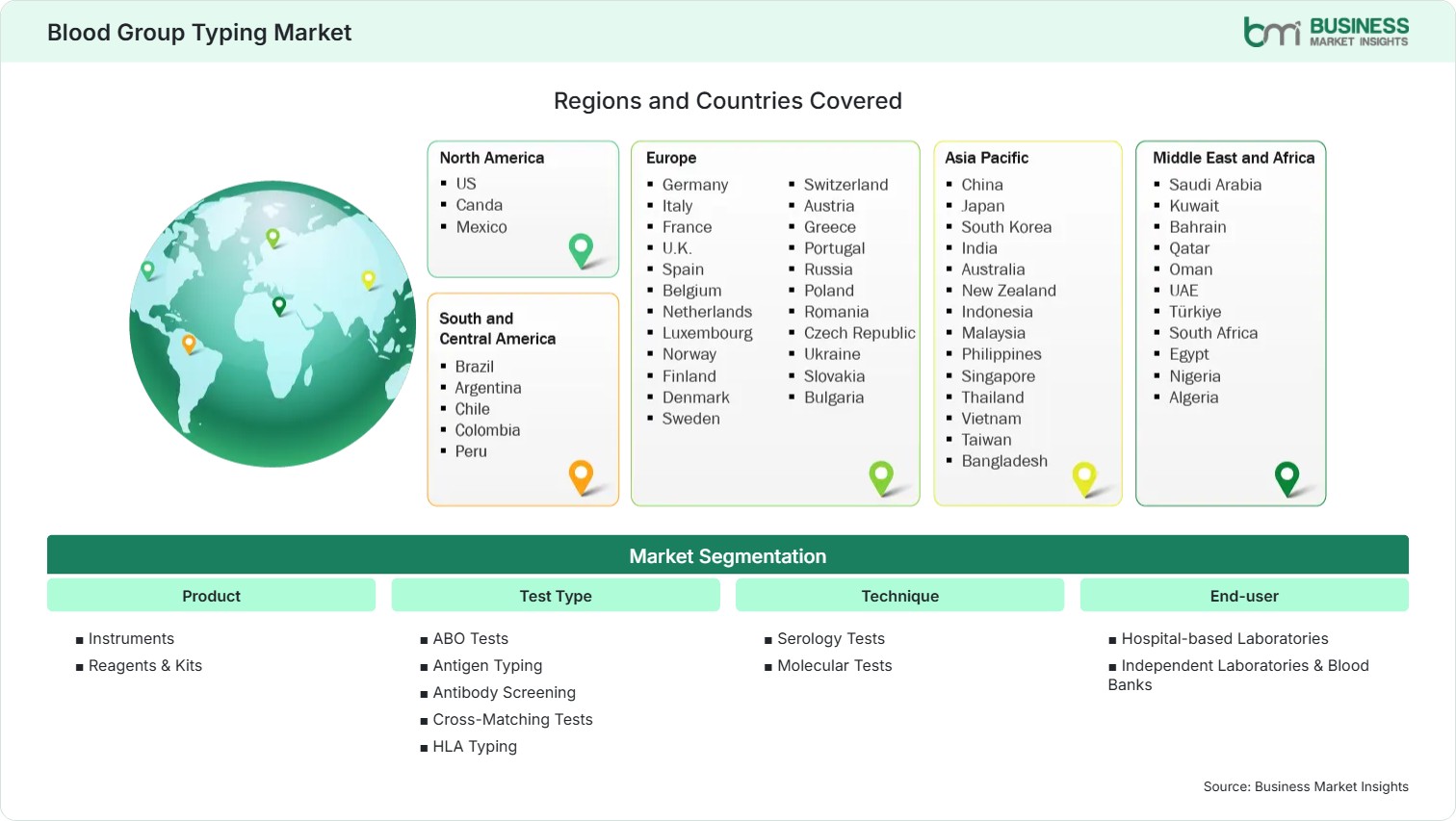
  • Product: Instruments, Reagents & Kits
  • Test Type: ABO Tests, Antigen Typing, Antibody Screening, Cross-Matching Tests, HLA Typing
  • Technique: Serology Tests, Molecular Tests
  • End-user: Hospital-based Laboratories, Independent Laboratories & Blood Banks
US$ 2.48 Bn Market size in 2025
US$ 5.44 Bn Market Size by 2033
10.32% CAGR, 2026 - 2033
2026-2033 Forecast Period

01 AI Overview

Blood Group Typing Market Summary

  • North America Region: North America holds a 32%–37% share in 2025, growing at a 9.5%–10.5% CAGR during 2026–2033, supported by transfusion services, advanced diagnostics, surgical activity, blood donation infrastructure, and molecular testing adoption. The US Blood Group Typing Market is expanding at a 9.8%–10.8% CAGR, supported by established blood banks, hospital laboratories, regulatory standards, and demand for accurate transfusion compatibility testing.
  • Fastest Growing Region: Asia Pacific accounts for a 25%–30% share in 2025 and is projected to expand at a 12.5%–13.5% CAGR, supported by expanding healthcare infrastructure, rising surgical volumes, improved blood donation networks, increasing diagnostic capacity, and greater adoption of automated and molecular testing.
  • Leading Segment: Reagents & Kits represent a 60%–65% share in 2025 and are projected to grow at a 10.5%–11.5% CAGR, supported by recurring laboratory consumption, rising testing volumes, transfusion activity, automation, and demand for standardized blood typing workflows.
  • High Growth Segment: Molecular Tests represent a 15%–20% share in 2025 and are expected to grow at a 12.5%–13.5% CAGR, supported by advanced genotyping, complex antigen identification, improved compatibility assessment, and personalized transfusion practices.
  • Key Market Opportunity: Molecular blood typing, expanding blood banking infrastructure, automated laboratory workflows, and personalized transfusion practices create opportunities for advanced diagnostic platforms and high-value testing solutions.
  • Major Market Players: Grifols, Bio-Rad Laboratories, Inc., Immucor, Inc., Ortho Clinical Diagnostics, Werfen, S.A., DiaSorin S.p.A., Thermo Fisher Scientific Inc., QuidelOrtho Corporation, Sysmex Corporation, bioMérieux S.A.
02 Strategic Insights

Blood Group Typing Market: Strategic Insights

Blood Group Typing Market Strategic Framework
FREE PDF
Request your free sample
Request free sample
03 Stakeholder View

Key Takeaways

  • The value chain spans blood collection organizations, diagnostic manufacturers, reagent suppliers, hospital laboratories, independent laboratories, and blood banks, creating opportunities for integrated testing ecosystems.
  • Reagents and kits provide recurring revenue potential because routine blood typing and compatibility testing require continuous laboratory consumption, while molecular platforms offer higher-value opportunities.
  • Molecular genotyping is expanding beyond specialized applications as laboratories seek improved resolution of complex antigen profiles and more personalized approaches to transfusion management.
  • Asia Pacific presents a compelling expansion opportunity as blood banking infrastructure, diagnostic capacity, surgical volumes, and healthcare investment increase across major emerging economies.
  • Competitive differentiation increasingly depends on automation, workflow integration, reagent reliability, molecular capabilities, and the ability to support laboratories with varying levels of technical sophistication.
04 Geographic Outlook

Blood Group Typing Market Regional Highlights

North America Blood Group Typing Market

North America holds a 32%–37% share in 2025 and is projected to expand at a 9.5%–10.5% CAGR during 2026–2033. The US represents the leading regional market, supported by established transfusion services, sophisticated hospital laboratories, and extensive blood donation infrastructure. Canada contributes through organized blood collection and diagnostic networks. Blood Group Typing Market share is supported by high testing standards and technology adoption. Blood Group Typing Market growth benefits from automation, molecular testing, and complex transfusion requirements.

  • Hospital laboratories increasingly use automated blood typing platforms to improve throughput, standardize procedures, and reduce manual intervention across high-volume testing environments.
  • Molecular testing is gaining relevance for patients requiring complex antigen characterization, particularly when conventional serological methods cannot fully resolve clinically important blood group profiles.
  • Established blood banking networks support consistent demand for reagents, instruments, compatibility testing, and specialized diagnostic services across healthcare systems.

US Blood Group Typing Market

The US represents a 28%–32% share of the global market in 2025 and is projected to grow at a 9.8%–10.8% CAGR through 2033. Demand is supported by extensive hospital networks, organized blood collection systems, surgical procedures, trauma care, and chronic disease management. Laboratories increasingly emphasize automation and molecular characterization. Advanced testing capabilities are particularly relevant for patients with complex transfusion histories, supporting demand for specialized reagents, genotyping technologies, and integrated laboratory workflows.

  • Hospital-based laboratories remain major users of blood typing systems because transfusion compatibility must be established efficiently across routine and emergency clinical settings.
  • Blood banks require reliable testing workflows to characterize donations, confirm compatibility, and maintain consistent inventory management across different blood group profiles.
  • Molecular approaches are gaining attention for complex cases where serological testing provides limited resolution or where extended antigen matching is clinically beneficial.

Europe Blood Group Typing Market

Europe accounts for a 27%–32% share in 2025 and is forecast to expand at a 9.0%–10.0% CAGR during 2026–2033. Germany, the UK, France, Italy, and Spain represent leading Blood Group Typing Markets, while Poland and other Central European countries provide growth opportunities. Germany is projected to grow at a 9.2%–10.2% CAGR, while Poland could reach a 11.5%–12.5% CAGR. Organized transfusion systems, laboratory automation, and advanced diagnostic infrastructure support regional demand.

  • Germany remains an important market because hospitals and blood services operate within sophisticated laboratory networks requiring reliable blood typing and compatibility testing.
  • The UK and France provide opportunities through established blood donation systems, centralized transfusion services, and continued investment in laboratory standardization.
  • Central and Eastern European Blood Group Typing Markets offer growth potential as healthcare infrastructure improves and laboratories adopt more automated testing technologies.

Asia Pacific Blood Group Typing Market

Asia Pacific represents a 25%–30% share in 2025 and is projected to register a 12.5%–13.5% CAGR during 2026–2033, making it the fastest-growing region. China, Japan, India, South Korea, and Australia lead regional demand, while Southeast Asia offers additional opportunities. India is estimated to grow at a 14.0%–15.0% CAGR, while China could reach a 12.5%–13.5% CAGR. Expanding healthcare infrastructure, surgery, blood donation, and diagnostic capacity support adoption.

  • China provides significant demand because healthcare expansion and increasing laboratory capacity are supporting broader adoption of automated blood typing and transfusion diagnostics.
  • India offers substantial growth potential as blood banking infrastructure expands and healthcare providers strengthen transfusion services across public and private facilities.
  • Japan and South Korea maintain advanced diagnostic environments where automation, molecular testing, and laboratory efficiency support continued demand for sophisticated blood typing solutions.

Rest of World Blood Group Typing Market

South and Central America account for a 6%–10% share in 2025 and are projected to grow at a 10.5%–11.5% CAGR, supported by blood donation initiatives, hospital expansion, and laboratory modernization. Brazil and Mexico represent leading opportunities. The Middle East and Africa account for a 5%–9% share and are expected to expand at an 8.5%–9.5% CAGR, supported by healthcare infrastructure development.

Brazil and Mexico provide opportunities as transfusion services and diagnostic networks expand. Middle Eastern countries are investing in healthcare infrastructure and advanced laboratory capabilities, while selected African markets are strengthening blood collection and transfusion systems. Adoption depends on equipment affordability, technical expertise, reagent availability, laboratory quality standards, and the ability to maintain reliable testing workflows.

  • Brazil offers opportunities through its large healthcare system, organized blood services, and continuing demand for transfusion testing across hospitals and laboratories.
  • Mexico is developing diagnostic capacity and blood banking capabilities, creating opportunities for automated instruments, reagents, and advanced compatibility testing.
  • Middle Eastern healthcare investment is supporting laboratory modernization, while African markets present longer-term opportunities through improved blood collection and transfusion infrastructure.
Global Market Geography
FREE PDF
Request your free sample
Request free sample
05 Segment Analysis

Blood Group Typing Market Segmentation

Product

Reagents & Kits represent the leading product category, accounting for a 60%–65% share in 2025 and a 10.5%–11.5% CAGR during 2026–2034. Recurring consumption across blood banks, hospitals, and independent laboratories supports sustained demand. The Blood Group Typing Market scope includes instruments and consumables used for routine typing, compatibility assessment, antibody detection, and advanced diagnostic workflows.

  • Instruments: Automated and semi-automated analyzers support high-throughput testing, improve workflow consistency, and reduce manual handling across hospital laboratories and blood banks.
  • Reagents & Kits: Reagents and kits enable recurring blood typing, antibody screening, antigen identification, and compatibility testing across routine and specialized transfusion workflows.

Test Type

ABO Tests represent a 35%–40% share in 2025 and are projected to grow at a 9.5%–10.5% CAGR during 2026–2034. Their essential role in routine blood typing creates consistent demand. Antibody Screening and Cross-Matching Tests provide additional opportunities as laboratories strengthen compatibility assessment and transfusion safety.

  • ABO Tests: ABO testing establishes fundamental blood group classification and remains essential before transfusion, supporting continuous demand across hospitals and blood banks.
  • Antigen Typing: Antigen typing identifies specific blood group characteristics and supports more precise donor-recipient matching for patients with complex transfusion requirements.
  • Antibody Screening: Screening identifies clinically significant antibodies that could affect transfusion compatibility, helping laboratories select appropriate blood components.
  • Cross-Matching Tests: Cross-matching confirms donor-recipient compatibility before transfusion and remains a central laboratory procedure for reducing adverse transfusion risks.
  • HLA Typing: HLA typing supports specialized immunological applications and transplantation-related testing, requiring advanced laboratory methods and precise genetic characterization.

Technique

Serology Tests represent a 75%–80% share in 2025 and are projected to grow at a 9.5%–10.5% CAGR during 2026–2034. Molecular Tests offer faster expansion at a 12.5%–13.5% CAGR as laboratories seek greater resolution in complex blood group characterization. Both techniques remain complementary within modern transfusion medicine workflows.

  • Serology Tests: Serological methods remain widely used for routine blood grouping, antibody screening, antigen testing, and compatibility assessment across established laboratories.
  • Molecular Tests: Molecular approaches enable genetic characterization of blood group antigens, supporting complex cases, extended matching, and personalized transfusion strategies.

End-user

Hospital-based Laboratories represent a 60%–65% share in 2025 and are projected to grow at a 9.5%–10.5% CAGR during 2026–2034. High transfusion activity, surgical procedures, emergency care, and inpatient services sustain testing volumes. Independent Laboratories & Blood Banks provide additional demand through centralized testing and donor screening operations.

  • Hospital-based Laboratories: Hospitals perform blood typing and compatibility testing for surgery, trauma, maternity care, oncology, and other clinical situations requiring transfusion support.
  • Independent Laboratories & Blood Banks: Independent laboratories and blood banks provide donor testing, blood group characterization, antibody screening, compatibility assessment, and specialized diagnostic services.
06 Market Forces

Blood Group Typing Market Dynamics

Key Market Drivers

Rising Blood Transfusion Volumes Drive Blood Group Testing Demand

To administer blood transfusions to the right individuals, it is essential to accurately determine patients' blood groups before selecting compatible blood products. Increased need arising due to the increase in various activities, including surgery, emergency treatment of trauma, oncology, obstetrics, and long-term disease treatments, makes testing an inevitable necessity. An emphasis on transfusion safety also makes laboratories adopt pre-transfusion tests. High-throughput devices can be introduced in such high-volume laboratories, helping to increase productivity and reduce manual effort. Increased complexity in transfusion medicine also requires antigen and antibody detection.

Increasing Surgical Procedures Boost Blood Typing Requirements

Surgical procedures generally require the availability and compatibility of blood, especially when considerable bleeding is expected. The expansion of orthopedic, cardiac, oncological, and emergency surgeries increases the demand for more effective pre-transfusion testing. Hospitals should have an efficient workflow that enables the planning of surgical procedures while still allowing for emergencies. Blood typing is thus included in wider perioperative and transfusion procedures. The increased capacity of health care facilities and access to advanced surgeries result in higher demands for blood group typing.

Growing Blood Donation Programs Support Testing Market Expansion

Donation activities generate perpetual need for blood typing, screening, and characterization of the donated blood. With growing donor networks, laboratories must conduct testing efficiently without compromising quality or traceability. Blood banks rely on accurate reagents and instruments in order to classify and process compatible blood from donors. With the modernization of test facilities in emerging markets with developing infrastructure for donations, opportunities may arise to automate testing processes using standardized reagents. Existing blood banking service providers also need to upgrade their equipment and work procedures. Increased donations with improved voluntary donation programs may lead to higher testing needs.

Key Market Opportunities

Growing Molecular Testing Adoption Expands Blood Typing Applications

The use of molecular testing offers the opportunity to enhance blood group typing in cases where serology does not provide sufficient resolution of complex antigen phenotypes. Genotyping may prove useful for patients whose blood group has unique features, who have had transfusions before, or who have conditions that make it difficult to interpret serological results. The availability of more sophisticated molecular platforms is likely to make this test available in specialized laboratories and blood centers. The challenge is especially evident in personalized transfusion programs, where extensive antigen typing may be necessary to meet specific requirements.

Expanding Blood Banking Infrastructure Strengthens Testing Demand

The development of infrastructure for blood banks is a promising avenue for diagnostic suppliers. Both existing and newly created blood banks will need equipment, reagents, software, quality control systems, and technical services. The potential of emerging healthcare markets is particularly significant as government agencies and healthcare facilities work to improve blood collection, storage, and transfusion. Process automation can help increase consistency when few highly qualified specialists are available. Collaboration with blood services, healthcare facilities, and regional distributors can also facilitate market entry.

Rising Personalized Transfusion Practices Increase Advanced Testing Needs

The personalization of transfusion therapy will create many opportunities for the development of sophisticated blood typing and antigen matching. People undergoing multiple transfusions are prone to producing antibodies that can make compatibility even more challenging, and hence, there will be a need to conduct more sophisticated antigen typing. There will also be an opportunity for molecular diagnostics to provide additional information to support accurate donor selection. These factors will create an opportunity for diagnostic firms to provide comprehensive solutions rather than isolated tests.

Market Restraints and Challenges

Complex Testing Procedures Increase Laboratory Operating Costs

Factors: Specialized reagents, molecular platforms, quality controls, highly qualified staff, and other considerations may be necessary for complex blood group typing. Impact: Increased operational costs may act as a barrier to implementing advanced technology solutions, especially in small laboratories or healthcare facilities operating on limited budgets. Laboratories should consider the benefits of the advanced test and compare them to the costs of equipment, testing, maintenance, and personnel. The implementation of molecular testing may be especially difficult in cases of low-volume samples or inadequate reimbursement for specialized services. Suppliers can overcome this restriction with flexible platforms and a streamlined testing process.

Shortage of Skilled Laboratory Personnel Limits Testing Capacity

Factor: Blood typing requires lab personnel capable of conducting tests, interpreting results, performing quality control, and addressing complex serological issues. Impact: A lack of adequate lab personnel may limit testing capabilities and prevent the implementation of new technologies. Although the use of automated testing systems may reduce hands-on work, there is always a need for qualified personnel to oversee the process, interpret results, and conduct quality control. This factor is especially critical in areas where specialized knowledge in transfusion medicine is mainly available in large health facilities. Despite all these measures, the availability of qualified personnel remains a significant concern.

07 Company Analysis

Competitive Landscape

The Blood Group Typing Market analysis reflects competition among global diagnostic companies and specialized transfusion medicine providers. Competitive differentiation increasingly depends on reagent reliability, automation, molecular capabilities, testing throughput, workflow integration, and regulatory compliance. Companies with broad diagnostic portfolios can leverage established laboratory relationships, while specialized providers can compete through advanced blood group characterization and focused transfusion solutions.

Company Name

Overview

Products and Services relevant to this market

Grifols

Global healthcare company with extensive expertise in plasma-derived medicines and transfusion diagnostics.

Blood typing and immunohematology systems, reagents, analyzers, and transfusion medicine solutions.

Bio-Rad Laboratories, Inc.

Global life sciences and diagnostics company serving clinical laboratories and transfusion medicine markets.

IH-1000 and IH-500 systems, immunohematology reagents, blood grouping, antibody screening, and compatibility testing.

Immucor, Inc.

Specialized transfusion and transplantation diagnostics provider focused on blood bank technologies.

Automated analyzers, reagents, blood grouping, antibody screening, antigen typing, and molecular immunohematology solutions.

Ortho Clinical Diagnostics

Diagnostics company with established expertise in transfusion medicine and laboratory testing.

VITROS systems, ORTHO BioVue technology, blood grouping reagents, and immunohematology testing solutions.

Werfen, S.A.

Global diagnostics company serving specialized laboratory and healthcare applications.

Immunohematology analyzers, reagents, blood bank testing, and laboratory workflow solutions.

DiaSorin S.p.A.

Diagnostics company providing immunodiagnostic and molecular testing technologies globally.

Molecular diagnostics, immunodiagnostic platforms, reagents, and laboratory testing technologies relevant to blood characterization.

Thermo Fisher Scientific Inc.

Global scientific and diagnostics company supplying technologies for molecular and laboratory testing.

Molecular diagnostic systems, reagents, genetic analysis technologies, and laboratory solutions supporting advanced blood typing.

QuidelOrtho Corporation

Diagnostics provider offering clinical and transfusion-related testing technologies.

Immunohematology systems, reagents, blood typing, antibody screening, and transfusion diagnostics.

Sysmex Corporation

Japanese diagnostics company specializing in hematology, laboratory automation, and related testing technologies.

Automated laboratory systems, molecular diagnostics, analyzers, and workflow technologies supporting transfusion laboratories.

bioMérieux S.A.

Global in vitro diagnostics company serving clinical laboratories and healthcare providers.

Molecular diagnostics, laboratory systems, reagents, and testing technologies supporting specialized clinical applications.

10 Trust & Transparency

Research Methodology

The market analysis combines proprietary research with secondary data from government agencies, company disclosures, regulatory filings, industry databases and expert interviews. Market estimates are validated through data triangulation, cross-market benchmarking and analyst review.

View Full Research Methodology

11 Questions Answered

Frequently Asked Questions

What information is included in a Blood Group Typing Market Report?

The report includes market size, growth projections, segmentation analysis, regional insights, competitive landscape, diagnostic technologies, key drivers, opportunities, restraints, industry trends, company profiles, and strategic market factors.

What challenges affect blood group typing laboratories?

Complex testing workflows, specialized equipment requirements, high operating costs, reagent expenses, and shortages of skilled laboratory professionals can limit testing capacity and restrict adoption of advanced diagnostic technologies.

How is molecular testing influencing blood group typing?

Molecular testing enables more detailed characterization of blood group genes and antigens, supporting complex cases where conventional serology may provide limited resolution. It also facilitates extended antigen matching and personalized transfusion strategies.

Which product segment leads the market?

Reagents & Kits represent the leading product category because blood banks, hospitals, and laboratories require recurring consumables for blood grouping, antibody screening, antigen testing, and compatibility assessment.

What factors are supporting Blood Group Typing Market growth?

Rising blood transfusion volumes, increasing surgical procedures, expanding blood donation programs, growing blood banking infrastructure, molecular testing adoption, and demand for personalized transfusion practices are supporting market expansion.

Access the Full Blood Group Typing Market Report

Get segment-level forecasts, regional estimates, competitive benchmarking, company profiles and downloadable Excel datasets.

Access the full Blood Group Typing Market Report
350 pages PDF & Excel | 2026-08-06