Market Summary
Executive Summary and Global Market Analysis
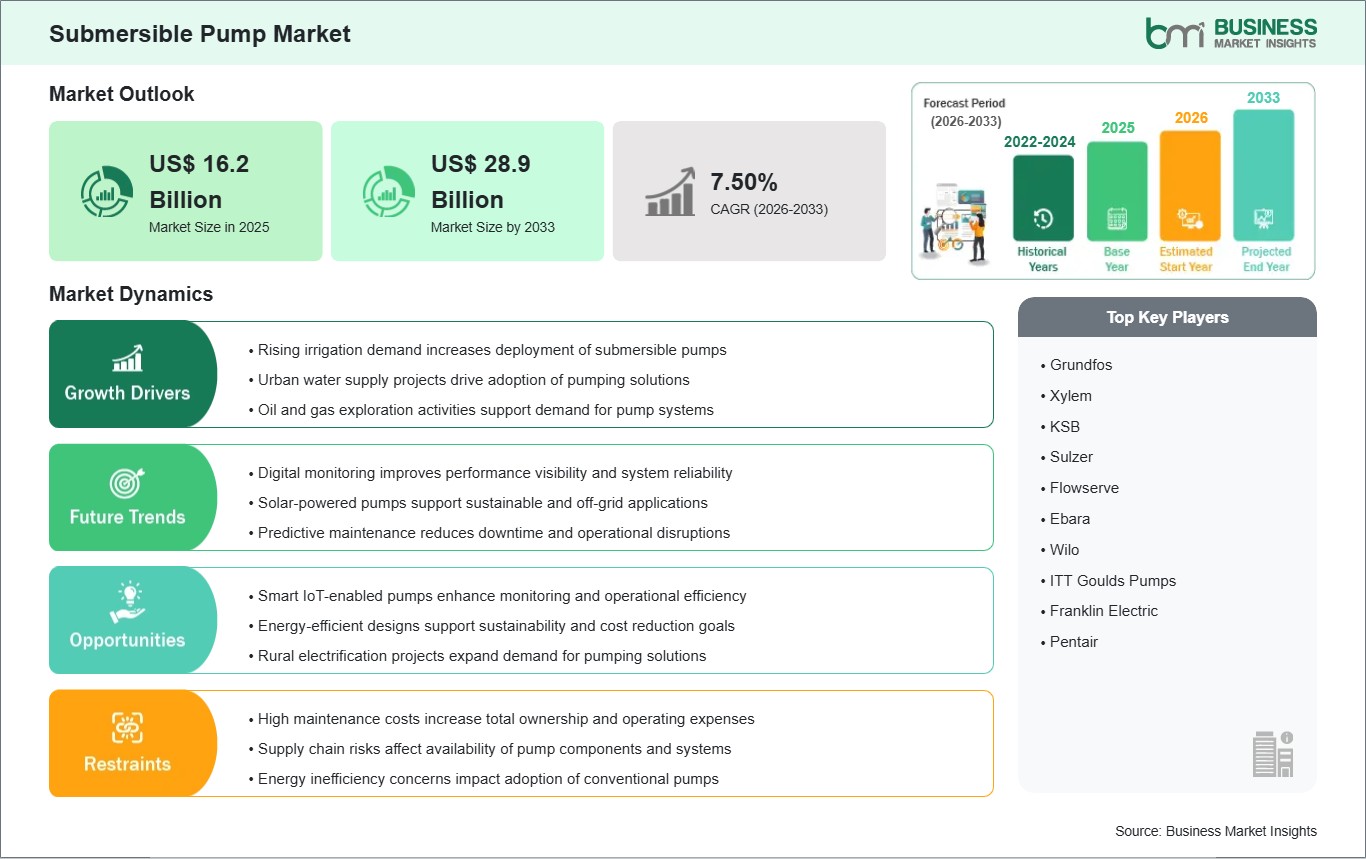
Submersible pumps are electric pumps designed to operate while fully submerged in water or other liquids. These pumps are widely used for groundwater extraction, irrigation, municipal water supply, wastewater management, mining operations, and oil and gas applications. Their ability to operate efficiently underwater reduces energy losses and improves pumping performance. The Submersible Pump market is growing as governments invest in water infrastructure, agricultural activities become more mechanized, and industries require reliable fluid handling systems. Increasing urbanization and the need for sustainable water management are also supporting market expansion.
There are several factors that may limit market growth. High installation and maintenance costs can discourage adoption among small users and budget-sensitive sectors. Submersible pumps operating in harsh environments are exposed to wear, corrosion, and mechanical failures, increasing maintenance requirements. In remote areas, unreliable electricity supply can affect pump performance and operational efficiency. Fluctuations in raw material prices and supply chain disruptions may also influence manufacturing costs and project timelines. Additionally, improper installation and lack of technical expertise can reduce equipment lifespan and increase operational expenses.
Despite these challenges, the market continues to present strong growth opportunities driven by technological improvements and increasing demand for efficient water management solutions. Manufacturers are developing smart submersible pumps equipped with sensors, remote monitoring systems, and energy-efficient motors that improve performance and reduce downtime. The increasing investment in wastewater treatment plants, irrigation modernization, and industrial infrastructure will create more opportunities in various industries. The greater focus on water conservation, sustainability, and the use of technology in monitoring processes is likely to help the market sustain itself in the future. The increasing application in developing countries and the need for dependable water are driving the market for Submersible Pumps.
Segment Analysis
Submersible Pump Market Segmentation
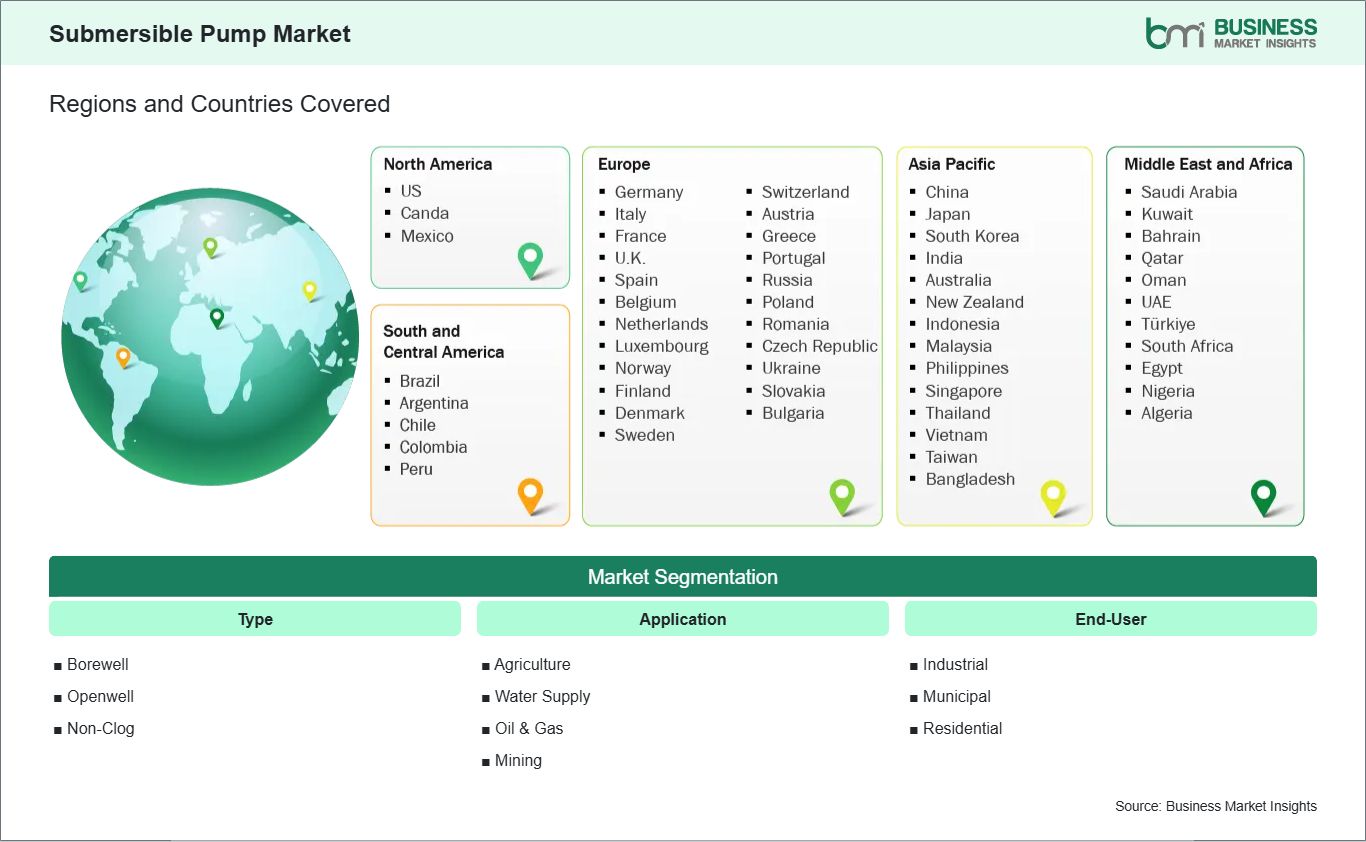
The Submersible Pump market is segmented based on type, application, and end-user. These segments help address varying operational requirements across industrial, municipal, agricultural, and residential sectors.
By Type
- Borewell: Widely used for deep groundwater extraction in agricultural and residential applications.
- Openwell: Commonly installed in shallow water sources and municipal water systems.
- Non-Clog: Designed for wastewater and slurry handling where solid particles are present.
By Application
- Agriculture: Supports irrigation activities and efficient water distribution for farming operations.
- Water Supply: Used in municipal and community water distribution networks.
- Oil & Gas: Facilitates fluid transfer and dewatering operations in energy projects.
- Mining: Assists in mine dewatering and water management activities.
By End-User
- Industrial: Utilized in manufacturing plants, processing facilities, and utility operations.
- Municipal: Supports public water supply, sewage treatment, and wastewater infrastructure.
- Residential: Used for domestic water supply, drainage, and groundwater extraction.
Market Forces
Submersible Pump Market Drivers and Opportunities
Growing Demand for Efficient Water Management Infrastructure
The increasing demand for reliable water supply systems is a major factor supporting the Submersible Pump market. Rapid urbanization, population growth, and industrial expansion have increased pressure on existing water infrastructure. The government, as well as local bodies, are building water distribution pipelines, groundwater extraction systems, and sewage treatment plants to guarantee water sustainability. The benefits of submersible pumps include energy efficiency, less energy loss, and reliable operation while submerged. This makes them ideal choices for construction in large scale and industrial use. Agricultural development is also contributing by promoting advanced systems that increase efficiency in water usage during irrigation processes.
Water preservation and proper sewage management systems are driving industries to adopt better pumps. As there is continued construction work being undertaken not only in developed countries but in developing countries as well, the demand for submersible pumps shall be high.
Expansion of Smart Pumping Technologies and Sustainable Applications
The growing integration of digital technologies into pumping systems is creating new opportunities for the Submersible Pump market. Smart pumps equipped with sensors, automation capabilities, and remote monitoring systems help operators improve efficiency, reduce maintenance costs, and minimize downtime. These innovations are becoming increasingly attractive in industrial and municipal applications where continuous operation is essential.
The global focus on sustainability is another trend that is fostering the uptake of energy-efficient pumps. The use of innovative motor designs and sophisticated control systems will help conserve energy while maintaining effectiveness. The growth in investment in water reclamation systems, desalination plants, and environmentally sustainable water infrastructure projects presents more chances for industry players. Developing countries are scaling up efforts to increase water access through water delivery programs and irrigation systems upgrades, resulting in rising requirements for high-tech pumps. As information technology trends and sustainability become increasingly important when developing infrastructures, more efficient submersible pumps will likely be used across many sectors.
Size and Share Analysis
Submersible Pump Market Size and Share Analysis
The Submersible Pump Market size is expected to reach US$ 28.9 billion by 2033 from US$ 16.2 billion in 2025. The market is estimated to record a CAGR of 7.50% from 2026 to 2033.
By type, borewell pumps account for a significant share due to their extensive use in groundwater extraction for agricultural, residential, and municipal applications. Openwell pumps continue to maintain steady demand in shallow water pumping operations, while non-clog pumps are witnessing increasing adoption in wastewater management and industrial fluid handling applications where solid particles are present.
By application, agriculture dominates the market owing to the growing need for efficient irrigation systems and reliable water supply for farming activities. Water supply applications continue to expand with increasing investments in municipal infrastructure, while oil & gas and mining sectors are generating steady demand for submersible pumps due to their requirement for dewatering, fluid transfer, and resource extraction operations.
Report Coverage
Submersible Pump Market Report Coverage and Deliverables
The "Submersible Pump Market Size and Forecast (2022-2033)" report provides a detailed analysis of the market covering below areas:
- Market size and forecast at global, regional, and country levels for all the key market segments covered under the scope
- Market trends, as well as market dynamics such as drivers, restraints, and key opportunities
- Market analysis covering key market trends, global and regional framework, major players, regulations, and recent market developments
- Industry landscape and competition analysis covering market concentration, heat map analysis, prominent players, and recent developments for the market
- Detailed company profiles, including SWOT analysis
Geographic Insights
Submersible Pump Market Geographic Insights
The Submersible Pump Market shows diverse regional adoption patterns influenced by water infrastructure development, agricultural activities, industrial expansion, and increasing demand for efficient water management solutions.
North America, being a developed region, has a well-established water infrastructure network and a high adoption rate of advanced pumping technologies. The region comprises the United States and Canada, where investments are being made in municipal water systems, wastewater treatment facilities, and industrial infrastructure upgrades. The region focuses on improving operational efficiency, reducing energy consumption, and ensuring reliable water distribution. Strong regulatory frameworks and advanced technological capabilities support the consistent adoption of submersible pumps across industrial, municipal, and residential applications.
Asia Pacific is growing significantly, driven by rapid urbanization, expanding agricultural activities, and increasing industrial development. The region comprises countries such as China, India, and Japan, where rising demand for irrigation systems, groundwater extraction, and municipal water supply projects is creating strong opportunities for market growth. The region focuses on improving water accessibility, modernizing infrastructure, and supporting sustainable resource management. Government investments in water conservation projects and wastewater treatment facilities are further contributing to the expansion of the Submersible Pump Market.
Both regions are contributing significantly to the growth of the Submersible Pump Market, focusing on infrastructure development, increasing water management requirements, and rising demand for efficient pumping solutions across agricultural, industrial, and municipal sectors.
Industry Activity
Recent Developments
The Submersible Pump Market is analyzed using a mix of primary and secondary research sources, including corporate publications, industry associations, and verified databases. This approach ensures accurate tracking of innovation trends and strategic developments influencing the market.
- In March 2026, Grundfos officially launched its new Intelligent Experience Centre in Chennai, India, to showcase advanced, technology-enabled water solutions. The state-of-the-art facility features live demonstrations of real-world water loops integrated with intelligent controllers, smart pumps, and digital monitoring systems. The initiative optimizes resource management across commercial and industrial infrastructures and highlights growing investment in decentralized, cloud-managed water stewardship platforms.
- In September 2025, Xylem Inc. entered a strategic partnership with tech giant Amazon to scale up real-time water tracking deployments funded by Amazon's global community water replenishment program. The sustainability initiative integrates Xylem's advanced digital water monitoring software platform, Xylem Vue, across critical urban infrastructure networks in Monterrey and Mexico City. The development significantly reduces non-revenue water losses by detecting municipal pipe leaks, optimizing resource allocation, and highlighting the growing deployment of cloud-based algorithmic intelligence to build resilient public utility frameworks.
Trust & Transparency
Research Methodology
The market analysis combines proprietary research with secondary data from government agencies, company disclosures, regulatory filings, industry databases and expert interviews. Market estimates are validated through data triangulation, cross-market benchmarking and analyst
review.
View Full Research Methodology
Key Sources Referred:
World Bank - Global Trade IndicatorsWorld Trade Organization (WTO)International Monetary Fund (IMF)International Trade Administration (ITA)Company WebsitesCompany Annual ReportsCompany Investor Presentations