Spirulina Market Regional Highlights
North America Spirulina Market
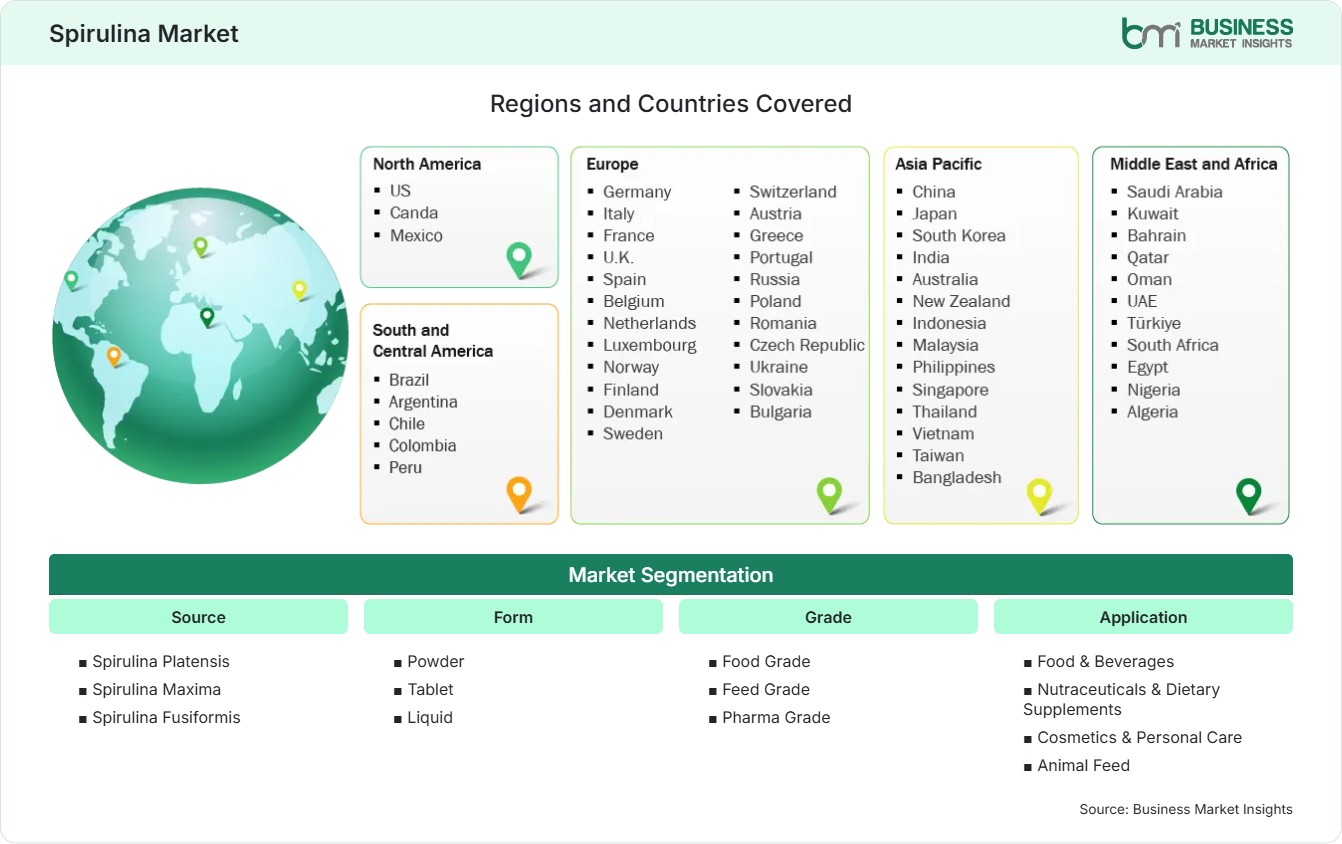
North America accounted for an estimated 18%–22% share in 2025 and is projected to register a 10.1%–10.7% CAGR during 2026–2033. Spirulina Market share reflects strong supplement penetration, premium nutrition demand, natural-color adoption, and established ingredient distribution. The United States remains the regional anchor because of sophisticated nutraceutical manufacturing and food-color reformulation. Canada and Mexico provide additional demand through wellness products and processed foods. FDA recognition of spirulina ingredients and color applications supports commercialization, although safety documentation remains essential.
- Nutraceutical demand: Supplement brands increasingly use spirulina in powders, tablets, capsules, functional drinks, and sports-nutrition products, creating recurring demand for standardized biomass with documented purity and consistent nutritional specifications.
- Natural colors: Food manufacturers are evaluating spirulina-derived blue pigments as alternatives to synthetic colors, particularly where clean-label positioning influences product formulation and consumer purchasing decisions.
- Premiumization: Certified organic, traceable, high-phycocyanin, and application-specific ingredients can command greater value than conventional bulk biomass, encouraging investment in quality systems.
- Regulatory influence: FDA action on spirulina extract demonstrates the importance of regulatory developments for future food applications, while the March 2026 delay highlights the need for manufacturers to manage compliance timing carefully.
US Spirulina Market
The U.S. is expected to account for about 68%–73% of North American demand in 2025 and to see a CAGR of 10.4%–11.0% during 2026–2033. The Spirulina Market growth is driven by existing distribution channels for dietary supplements, natural food dyes, sports nutrition, and functional beverages. The presence of domestic production is also a key quality advantage. The example of Earthrise in California demonstrates the significance of cultivation, automation, and traceability.
- Supplement ecosystem: Mature contract manufacturing and direct-to-consumer nutrition channels support powder and tablet consumption while creating demand for certified, contaminant-tested raw materials.
- Food formulation: Natural blue pigment applications provide an important diversification path as developers seek visually attractive products aligned with clean-label positioning.
- Quality controls: FDA guidance emphasizes contaminant testing, current good manufacturing practices, and certificates of analysis for blue-green algae products, strengthening the competitive position of suppliers with robust quality infrastructure.
Europe Spirulina Market
The Europe region held around 24%–28% share in 2025 and is projected to exhibit a CAGR of 9.7%–10.4% between 2026 and 2033. The main consumer markets are Germany, France, the UK, Italy, and Spain. France and Germany represent the best market potential for organic and functional nutrition. The UK is one of the fastest-growing regions, with a CAGR of 10.5%–11.2%, driven by sports nutrition and plant-based offerings. Traceability and certification are important considerations for European consumers.
- Clean-label demand: Food and beverage formulators increasingly evaluate natural pigments and algae-derived ingredients where synthetic-color reduction and ingredient transparency influence product positioning.
- Organic positioning: Certified organic spirulina can benefit from consumers seeking recognizable, plant-derived nutrition, although certification costs and supply consistency raise requirements for producers.
- Functional nutrition: Sports nutrition, vegan products, meal replacements, and wellness powders create multiple application routes for protein-rich algae ingredients.
- High-growth markets: The United Kingdom and Spain offer attractive expansion opportunities as functional beverages, premium supplements, and plant-based food categories broaden their ingredient requirements.
Asia Pacific Spirulina Market
The Asia Pacific region was estimated to have around 35%–39% market share in 2025 and is expected to witness the highest growth rate among all regions at 12.1%–12.8% CAGR over 2026–2033. The region includes countries such as India, China, Japan, South Korea, Australia, and Southeast Asian nations that can cultivate the crop, as well as a growing demand for functional foods. India and China remain major producers, while Japan and South Korea are premium markets. India is estimated to grow at 12.8%–13.5% CAGR, reflecting domestic wellness consumption, export potential, and established cultivation expertise.
- Production advantage: Large cultivation ecosystems, technical expertise, favorable climatic conditions, and established processing networks allow producers to compete in both bulk biomass and value-added ingredient markets.
- India opportunity: Indian suppliers benefit from deep microalgae cultivation experience, organic certification capabilities, export relationships, and established nutraceutical manufacturing infrastructure. Parry Nutraceuticals reports exports to more than 40 countries.
- China expansion: Chinese producers are positioned to serve cost-sensitive bulk applications while increasingly developing standardized powders, tablets, extracts, and feed ingredients.
- Premium demand: Japan, South Korea, and Australia provide opportunities for certified, traceable, high-purity ingredients used in functional foods, supplements, and beauty products.
Rest of World Spirulina Market
South and Central America, the Middle East, and Africa contributed approximately 14%-18% of demand in 2025, with the Spirulina Market expected to grow at a 10.2%-10.9 % CAGR over 2026-2033. Brazil and Mexico are the best Latin American markets in terms of commercial potential, whereas the United Arab Emirates, Saudi Arabia, and South Africa have been contributing to growth in wellness and functional food distribution channels. The Brazilian market is estimated at 11.2%-12.0% CAGR, and the UAE market at 12.0%-12.8% CAGR, driven by increased premium nutrition and imports of functional ingredients.
Opportunities in Latin America are linked to food processing, dietary supplements, aquaculture, and cultivation activities. Opportunities in the Middle East are related to premium health products, sports nutrition, and food ingredient imports. The long-term potential of the African market is driven by nutritional programs, aquaculture feed, and localized production; however, the lack of infrastructure, finance, and quality certification remains a constraint for the region.
- Latin America: Brazil and Mexico can support applications across supplements, beverages, food enrichment, and aquaculture, with local production reducing exposure to imported ingredient costs.
- Middle East: Premium wellness products and functional beverages provide attractive routes for suppliers offering stable, traceable, and certified ingredients.
- Africa: Nutrition security and aquaculture create long-term application potential, especially where cultivation can be integrated with suitable water and agricultural infrastructure.
- Investment priorities: Local processing, quality laboratories, drying systems, and certification infrastructure are likely to provide greater commercial value than expanding undifferentiated cultivation alone.