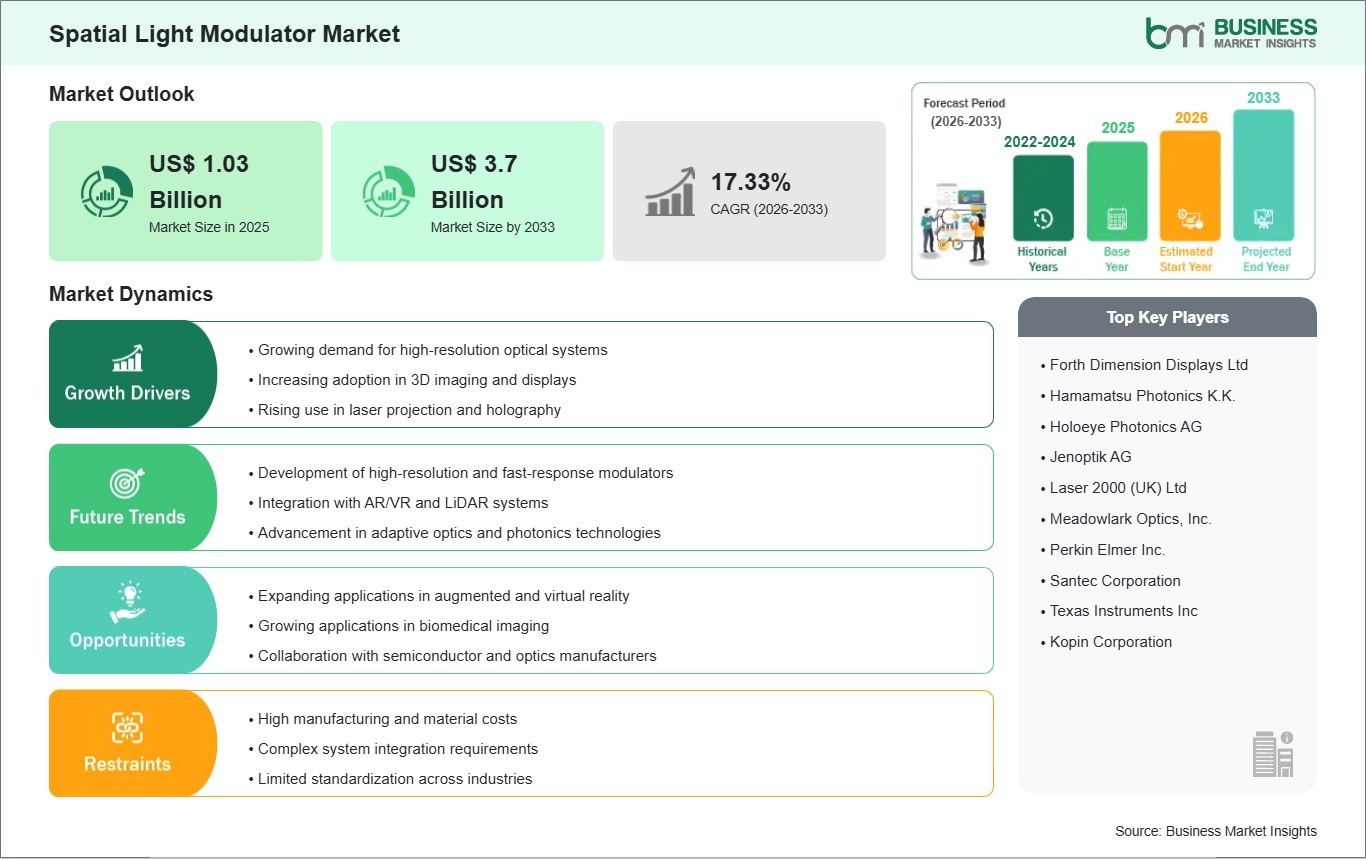
The Spatial Light Modulator Market size is expected to reach US$ 3.7 billion by 2033 from US$ 1.03 billion in 2025. The market is estimated to record a CAGR of 17.33% from 2026 to 2033.
The global spatial light modulator (SLM) market is expanding significantly as the demand for better optical control solutions increases across industries like telecommunications, biomedical imaging, 3D printing, defense, and laser processing. Spatial light modulators are devices that change light properties such as phase, amplitude, or polarization. This allows for precise control in applications like holography, optical switching, adaptive optics, and beam shaping. Their ability to modulate light in real time makes them essential components in high-performance imaging and laser systems.
Technological advancements are driving changes in the market. Innovations in liquid crystal on silicon (LCoS), digital micromirror devices (DMD), and micro-electro-mechanical systems (MEMS) improve resolution, speed, and efficiency. Integration with high-speed computing and optical processing technologies enables SLMs to handle complex light patterning, adaptive beam steering, and real-time holographic displays. The market is also influenced by the rising use of next-generation display systems, augmented reality, virtual reality devices, and precision laser manufacturing. Increased investment in optical research and the need for smaller, energy-efficient modulators further support growth. Additionally, SLM applications in quantum computing and LiDAR technology for autonomous vehicles are emerging as key drivers. This creates opportunities for manufacturers to innovate and expand their products in high-value areas of the photonics and optical systems market.

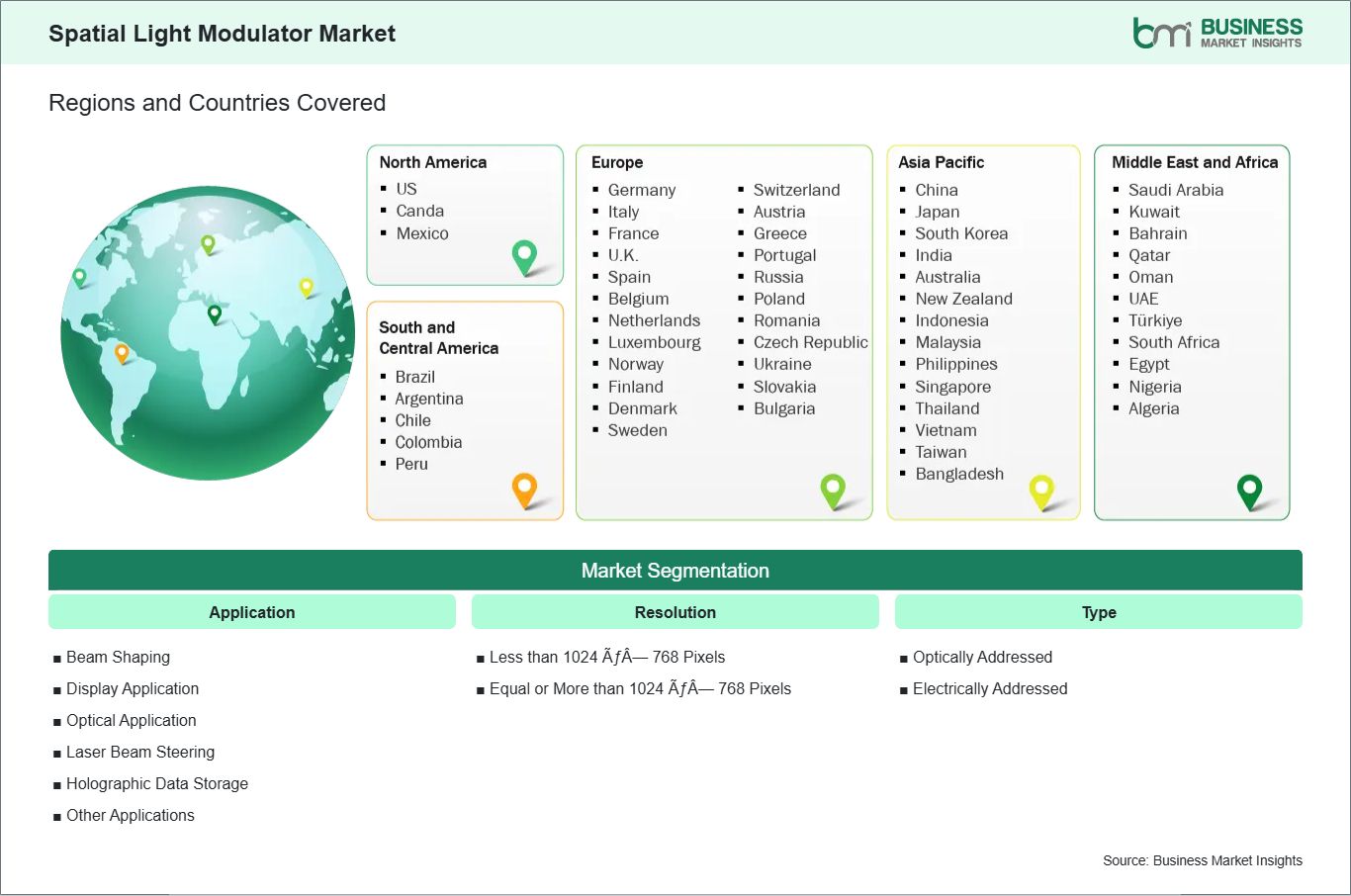
Key segments that contributed to the derivation of the spatial light modulator market analysis are application, resolution, type.
The global Spatial Light Modulator market is being propelled by rising demand for high‑resolution optical systems used in advanced imaging, projection, and display technologies. As SLMs enable precise control of light amplitude, phase, and polarization, they are increasingly integrated into scientific research instruments, laser beam shaping setups, and optical communication systems that require high fidelity and image accuracy. This trend is reflected in strong growth across applications where precise light modulation leads to enhanced imaging performance and richer visual output. Optical systems that benefit from SLM integration include adaptive optics platforms, holographic projectors, and high‑end microscopes where resolution and dynamic control are critical. Market data indicates a significant portion of new SLM units are deployed for high‑resolution display and beam shaping applications, driving overall market expansion as industries prioritize detailed light manipulation.
Accelerating investment in photonics and precision optics also supports this demand. Reports highlight that improved pixel pitch, faster refresh rates, and high‑resolution modulation capabilities are key performance factors prompting optical equipment manufacturers to adopt the latest SLM technologies, fueling further growth as end‑users seek enhanced optical system performance.
The Spatial Light Modulator market is experiencing substantial opportunity from expanding applications in augmented reality (AR) and virtual reality (VR) systems. These immersive technologies depend on high‑performance light modulation to create realistic visual experiences, depth perception, and accurate holographic imagery, making SLMs essential components in next‑generation AR/VR display engines. As AR/VR devices evolve toward higher resolution and wider field‑of‑view, demand for advanced SLMs continues to rise. Market research shows that AR/VR adoption is driving significant SLM usage in display modules designed for immersive content, including head‑mounted displays and holographic interfaces. Development labs and consumer electronics manufacturers are increasingly integrating SLMs into prototypes and production models to achieve sharper visuals and responsive optical performance, contributing to broader market expansion. In addition, the growth of AR/VR in enterprise, entertainment, and educational sectors reinforces this trend.
As institutions and technology developers invest in immersive visualization tools for training, simulation, and interactive experiences, the role of spatial light modulators as enabling technologies becomes more prominent, unlocking new avenues for market growth and technological innovation within AR/VR ecosystems.
The Spatial Light Modulator Market demonstrates steady growth, with size and share analysis highlighting evolving trends and competitive dynamics among key players. The report examines subsegments categorized within application, resolution and type offering insights into their contribution to overall market performance.
Application, the beam shaping (pulse shaping) subsegment dominated the market in 2025, driven by increasing demand in laser processing, optical communication, and ultrafast pulse applications.
Based on Resolution, the equal or more than 1024 × 768 pixels subsegment dominated the market in 2025, driven by the need for high-precision spatial modulation in advanced optical systems.
Type, the electrically addressed subsegment dominated the market in 2025, driven by widespread use in displays, holography, and adaptive optics.
| Report Attribute | Details |
|---|---|
| Market size in 2025 | US$ 1.03 Billion |
| Market Size by 2033 | US$ 3.7 Billion |
| Global CAGR (2026 - 2033) | 17.33% |
| Historical Data | 2022-2024 |
| Forecast period | 2026-2033 |
| Segments Covered | By Application
|
|
Regions and Countries Covered
| |
| North America | US, Canada, Mexico |
| Europe | Belgium, Austria, Finland, Denmark, Greece, Poland, Romania, Russia, Ukraine, Czech Republic, Slovakia, Bulgaria, Italy, Luxembourg, Germany, Switzerland, France, Netherlands, Norway, Portugal, Spain, Sweden, United Kingdom |
| Asia-Pacific | Australia, China, India, Japan, South Korea, Indonesia, Malaysia, Philippines, Singapore, Thailand, Vietnam, Bangladesh, New Zealand, Taiwan |
| South and Central America | Brazil, Argentina, Peru, Chile, Colombia |
| Middle East and Africa | Bahrain, Kuwait, Oman, Qatar, Saudi Arabia, United Arab Emirates, Turkiye, South Africa, Egypt, Algeria, Nigeria |
| Market leaders and key company profiles |
|
The "Spatial Light Modulator Market Size and Forecast (2022 - 2033)" report provides a detailed analysis of the market covering below areas:
The geographical scope of the Spatial Light Modulator Market report is divided into North America, Asia Pacific, Europe, Middle East & Africa, and South & Central America. North America held the largest share in 2025.
Regional adoption of spatial light modulators is influenced by the presence of advanced research infrastructure, industrial R&D, and optical technology initiatives. North America dominates the market, driven by significant investments in defense, aerospace, telecommunications, and biomedical research. The United States, in particular, leads in the deployment of LCoS and DMD-based SLMs for holographic displays, adaptive optics, and high-resolution imaging applications, supported by extensive university and corporate R&D programs.
Asia Pacific is emerging as a fast-growing region, fueled by strong electronics and photonics manufacturing hubs in China, Japan, and South Korea. Industrial adoption of SLMs for 3D printing, laser processing, and LiDAR-based autonomous systems is rapidly increasing, while India is gradually expanding applications in biomedical imaging and optical research.
Europe emphasizes high-precision SLM applications for defense, scientific instrumentation, and advanced manufacturing. Germany, France, and the United Kingdom are investing in MEMS and LCoS-based modulators for adaptive optics, holographic displays, and research applications, supported by strong photonics ecosystems.
Middle East & Africa is gradually adopting SLM technology for defense, scientific research, and industrial laser systems, with UAE, Saudi Arabia, and South Africa focusing on modernizing optical infrastructure.
South & Central America is slowly integrating SLMs in research labs, industrial laser systems, and display technologies, with Brazil, Mexico, and Chile showing growing interest in optical and photonics innovation.

The Spatial Light Modulator Market is evaluated by gathering qualitative and quantitative data post primary and secondary research, which includes important corporate publications, association data, and databases. A few of the key developments in the spatial light Modulator market are:
The Spatial Light Modulator Market is valued at US$ 1.03 Billion in 2025, it is projected to reach US$ 3.7 Billion by 2033.
As per our report Spatial Light Modulator Market, the market size is valued at US$ 1.03 Billion in 2025, projecting it to reach US$ 3.7 Billion by 2033. This translates to a CAGR of approximately 17.33% during the forecast period.
The Spatial Light Modulator Market report typically cover these key segments-
The historic period, base year, and forecast period can vary slightly depending on the specific market research report. However, for the Spatial Light Modulator Market report:
The Spatial Light Modulator Market is populated by several key players, each contributing to its growth and innovation. Some of the major players include:
The Spatial Light Modulator Market report is valuable for diverse stakeholders, including:
Essentially, anyone involved in or considering involvement in the Spatial Light Modulator Market value chain can benefit from the information contained in a comprehensive market report.
Please tell us your area of interest
(Market Segments/ Regions and Countries/ Companies)