
Soup Market Outlook: Size, Share, Trends, Growth Analysis, Competitive Landscape & Forecast, 2026-2033

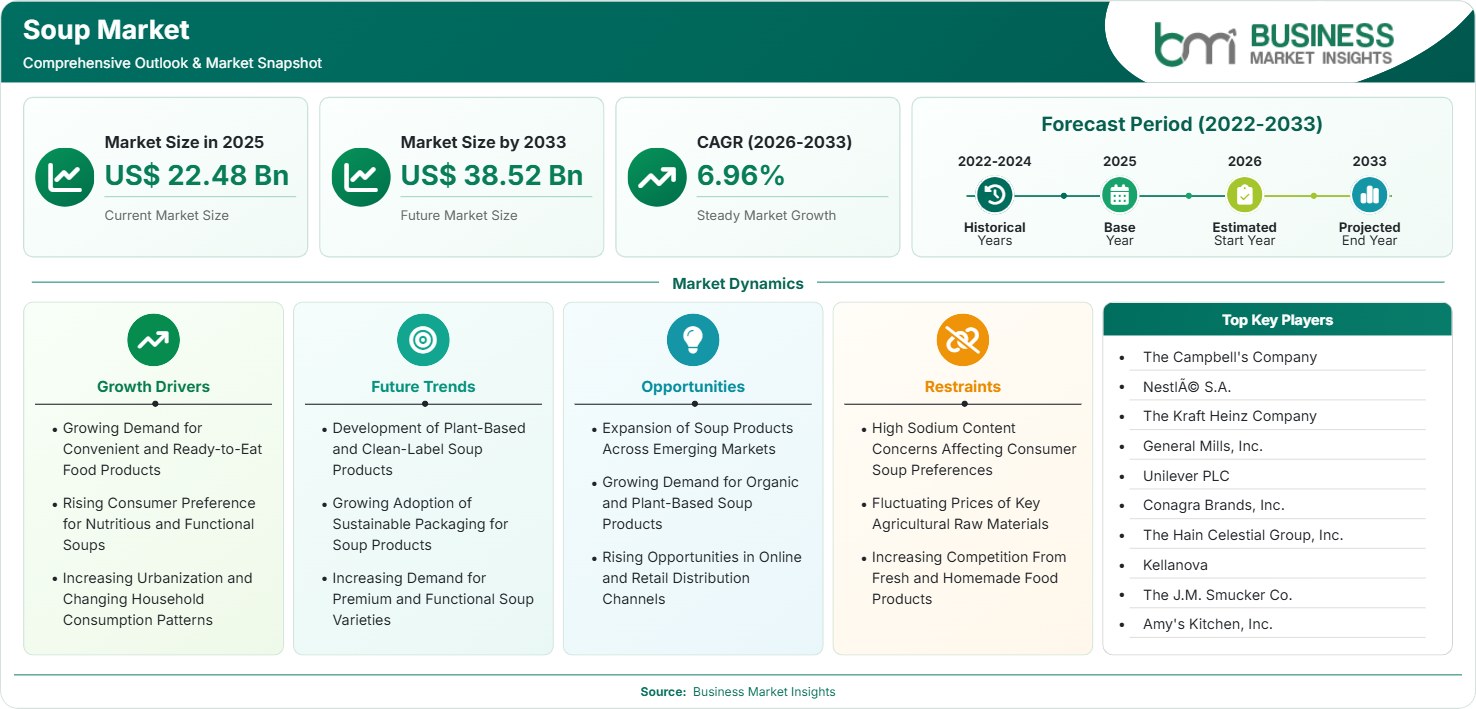
The Soup Market size was valued at US$ 22.48 billion in 2025 and is projected to reach US$ 38.52 billion by 2033, growing at a CAGR of 6.96% during 2026–2033, supported by convenience food demand, healthier formulations, plant-based innovation, urban lifestyles, expanding retail access, and e-commerce penetration.

Report Coverage
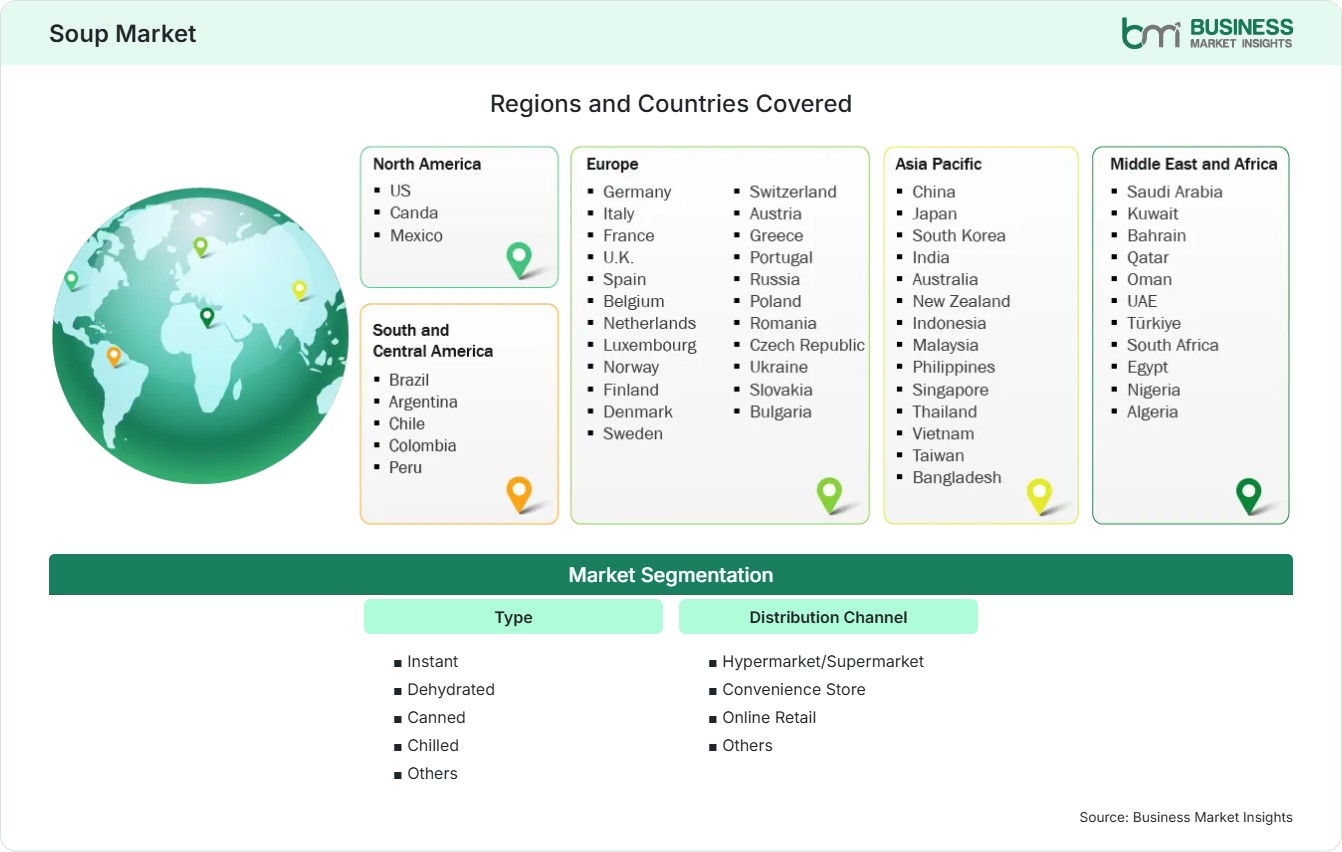
  • Type: Instant, Dehydrated, Canned, Chilled, Others
  • Distribution Channel: Hypermarket/Supermarket, Convenience Store, Online Retail, Others
US$ 22.48 Bn Market size in 2025
US$ 38.52 Bn Market Size by 2033
6.96% CAGR, 2026 - 2033
2026-2033 Forecast Period

01 AI Overview

Soup Market Summary

  • North America Region: North America held a 28%–32% share in 2025, growing at a CAGR of 5.5%–6.5%, supported by established packaged food consumption, convenience-driven lifestyles, premium product innovation, and demand for healthier formulations. The US market is expanding at a CAGR of 5.3%–6.3%, supported by household convenience, premium soups, functional ingredients, and wider online grocery availability.
  • Fastest Growing Region: Asia Pacific held a 25%–29% share in 2025, growing at a CAGR of 8.0%–9.0%, supported by urbanization, expanding middle-class populations, convenience food adoption, modern retail development, and increasing availability of international and localized soup formats.
  • Leading Segment: Instant held a 34%–38% share in 2025, growing at a CAGR of 7.0%–8.0%, supported by convenience, long shelf life, easy preparation, affordable pricing, product innovation, and growing demand among time-constrained consumers.
  • High Growth Segment: Online Retail held a 9%–13% share in 2025, growing at a CAGR of 11.0%–12.0%, driven by digital grocery adoption, broader product selection, subscription opportunities, direct-to-consumer models, and improved delivery infrastructure.
  • Key Market Opportunity: Plant-based, organic, functional, and low-sodium formulations offer manufacturers opportunities to capture health-conscious consumers while digital retail expands product accessibility across developed and emerging markets.
  • Major Market Players: The Campbell's Company, Nestlé S.A., The Kraft Heinz Company, General Mills, Inc., Unilever PLC, Conagra Brands, Inc., The Hain Celestial Group, Inc., Kellanova, The J.M. Smucker Co., and Amy's Kitchen, Inc.
02 Strategic Insights

Soup Market: Strategic Insights

soup-market-market-strategic-framework
FREE PDF
Request your free sample
Request free sample
03 Stakeholder View

Key Takeaways

  • The value chain is shifting toward integrated food ecosystems where ingredient suppliers, co-manufacturers, packaging companies, retailers, and digital platforms jointly influence product innovation, availability, and consumer reach.
  • Instant products remain commercially attractive, but premium growth is increasingly emerging from plant-based, organic, functional, and chilled formulations targeting consumers seeking improved nutritional profiles and differentiated eating experiences.
  • Product development is moving toward cleaner labels, lower sodium, higher protein, added fiber, vegetable-rich formulations, and convenient packaging formats designed for single-person and smaller households.
  • Asia Pacific offers a compelling expansion opportunity as urbanization and modern retail development combine with established regional soup consumption habits and increasing demand for convenient packaged meals.
  • Strategic activity across the industry is increasingly focused on portfolio diversification, healthier product reformulation, premiumization, plant-based innovation, and stronger digital distribution rather than relying exclusively on traditional canned products.
  • Manufacturers that successfully balance nutrition, convenience, affordability, local taste preferences, and shelf stability can strengthen consumer loyalty while expanding into emerging retail and e-commerce channels.
04 Geographic Outlook

Soup Market Regional Highlights

North America Soup Market

North America accounted for a 28%–32% share in 2025 and is projected to grow at a CAGR of 5.5%–6.5% through 2033. Mature packaged food consumption supports a large installed demand base, while healthier recipes and premium formats are creating incremental opportunities. Soup Market share remains substantial as consumers continue to value convenient meal solutions. Lower-sodium, organic, plant-based, and functional products are gaining visibility across grocery and digital retail.

  • Established packaged food consumption provides a stable base for manufacturers, while product reformulation and premium positioning create opportunities to attract health-conscious consumers.
  • Demand for convenient meals remains strong among working households, supporting instant, canned, and ready-to-heat formats that reduce preparation time without requiring extensive cooking.
  • Plant-based and organic innovation is expanding shelf presence as consumers increasingly examine ingredient lists, sourcing practices, nutritional value, and dietary compatibility.
  • Online grocery platforms are improving product discovery and convenience, allowing niche soup brands to reach consumers beyond traditional supermarket distribution networks.

US Soup Market

The US represented a 25%–29% share in 2025 and is expected to expand at a CAGR of 5.3%–6.3% through 2033. Mature demand is being complemented by product innovation around nutrition, convenience, and premium ingredients. Soup Market growth is supported by busy lifestyles, household demand for easy meal solutions, and expanding digital grocery adoption. Manufacturers are increasingly balancing familiar flavors with differentiated formulations and improved nutritional positioning.

  • Consumer interest in lower-sodium and nutrient-dense products is encouraging manufacturers to reformulate established recipes and introduce alternatives with vegetables, legumes, grains, and functional ingredients.
  • Single-serve and portable packaging formats are gaining relevance among consumers seeking convenient lunches, quick dinners, and flexible meal solutions for smaller households.
  • Premium chilled and refrigerated soups provide opportunities for differentiation through fresher positioning, specialty ingredients, and flavor profiles targeting consumers seeking alternatives to traditional shelf-stable products.
  • Digital grocery platforms are expanding product access and supporting direct consumer engagement, particularly for specialized organic, vegan, and allergen-conscious soup offerings.

Europe Soup Market

Europe held a 21%–25% share in 2025 and is projected to grow at a CAGR of 5.5%–6.5% through 2033. Germany leads regional demand, while the UK and France remain important markets. Germany is projected to grow at a CAGR of 5.0%–6.0%, while Poland is expected to expand at 7.0%–8.0%. Premiumization, plant-based diets, convenience, and sustainability are shaping product development and distribution strategies.

  • Germany's established packaged food sector supports demand for convenient soup products, while healthier formulations and premium recipes provide opportunities for portfolio differentiation.
  • The UK market benefits from strong convenience food consumption, with manufacturers increasingly emphasizing lower sodium, plant-based ingredients, and recyclable packaging formats.
  • Poland represents a faster-growing opportunity as modern retail expands and consumers increasingly seek affordable convenience products alongside improved nutritional and ingredient transparency.
  • European manufacturers are increasingly exploring plant-based recipes and cleaner formulations as dietary shifts and sustainability priorities influence purchasing decisions across major consumer markets.

Asia Pacific Soup Market

Asia Pacific represented a 25%–29% share in 2025 and Asia Pacific soup market forecast to grow at a CAGR of 8.0%–9.0% through 2033. China leads regional demand, while India represents a faster-growing opportunity. China is projected to grow at a CAGR of 7.5%–8.5%, whereas India is expected to expand at 9.0%–10.0%. Urbanization, modern retail, convenience, and localized product innovation are accelerating category development.

  • China's large consumer base and established soup consumption traditions provide opportunities for packaged products combining familiar flavors with convenience and modern nutritional positioning.
  • India's expanding urban population and evolving retail infrastructure are supporting demand for convenient meal formats, particularly among younger consumers and time-constrained households.
  • Southeast Asian markets offer opportunities for localized products that adapt regional flavors, ingredients, spice profiles, and consumption habits to packaged soup formats.
  • E-commerce expansion is improving access to imported, premium, organic, and specialized soup products while enabling emerging brands to reach consumers beyond traditional retail.

Rest of World Soup Market

South and Central America soup market accounted for a 9%–11% share in 2025 and are projected to grow at a CAGR of 6.5%–7.5% through 2033, led by Brazil and Mexico. Middle East and Africa represented a 7%–9% share and are expected to grow at a CAGR of 6.0%–7.0%, with the UAE and Saudi Arabia offering attractive opportunities as modern retail expands.

  • Brazil's large food market provides opportunities for convenient soup products, particularly formats combining familiar regional ingredients with affordable pricing and easy preparation.
  • Mexico's urbanization and modern retail development are supporting packaged food consumption, while localized flavors can help manufacturers improve consumer acceptance of convenient soup products.
  • Gulf markets offer opportunities for premium, imported, organic, and functional soups as modern grocery formats, e-commerce, and expatriate populations diversify consumer preferences.
  • African markets present longer-term opportunities as urban households and modern retail networks expand, although affordability, distribution infrastructure, and local taste adaptation remain important adoption considerations.
global-market-geography
FREE PDF
Request your free sample
Request free sample
05 Segment Analysis

Soup Market Segmentation

Type

Instant held a 34%–38% share in 2025 and is projected to grow at a CAGR of 7.0%–8.0% during 2026–2034. Convenience, affordability, and quick preparation support widespread consumption, while dehydrated products benefit from shelf stability. Canned remains established in mature markets, whereas chilled soups offer premiumization potential. Soup Market trends increasingly favor healthier recipes, plant-based ingredients, functional nutrition, and cleaner labels.

  • Instant: Instant soups offer rapid preparation and long shelf life, attracting students, professionals, and smaller households seeking affordable meals with minimal cooking requirements.
  • Dehydrated: Dehydrated soups provide lightweight storage and extended shelf stability, supporting household consumption, travel, foodservice applications, and distribution across markets with logistical constraints.
  • Canned: Canned soups remain established because of convenience, long shelf life, and broad retail availability, while manufacturers increasingly improve nutritional profiles and introduce differentiated recipes.
  • Chilled: Chilled soups appeal to premium consumers seeking fresher sensory experiences, with growth supported by refrigerated distribution, vegetable-based recipes, and convenient ready-to-eat positioning.

Distribution Channel

Hypermarket/Supermarket held a 52%–56% global soup market share in 2025 and is projected to grow at a CAGR of 5.5%–6.5% through 2034. Large retailers remain central because of broad assortment, promotional visibility, and established grocery purchasing habits. Online Retail is expanding faster as digital grocery adoption improves convenience and product discovery. Convenience Stores serve immediate consumption needs, while specialized channels provide additional reach.

  • Hypermarket/Supermarket: Hypermarkets and supermarkets remain dominant due to broad product assortments, established grocery traffic, promotional activity, and strong visibility for leading soup brands.
  • Convenience Store: Convenience stores support impulse and immediate-consumption purchases, particularly among urban consumers seeking portable meal solutions and quick food options.
  • Online Retail: Online retail enables broader product discovery and convenient purchasing while supporting niche categories including organic, plant-based, premium, and specialized nutritional soups.
06 Market Forces

Soup Market Dynamics

Key Market Drivers

Growing Demand for Convenient and Ready-to-Eat Food Products

Modern lifestyles, smaller families, longer working hours, and the need for more time-efficient meals are leading to increasing consumer favor for convenient food items. The makers of soups have gained much from consumer demand for instant, canned, chilled, and heat-and-eat products that require minimum preparation but give flexible meal choices. Such products are especially suitable for urban consumers, who favour convenience but still look for comforting meals. The manufacturers are meeting the challenge by resorting to convenient packaging, microwaveable forms, better recipes, and portion-controlled products. These developments are supporting Soup Market growth, where soups have been made suitable not just for family meals, but for other occasions such as lunches, quick dinners, snacks, and supplementary meal.

Rising Consumer Preference for Nutritious and Functional Soups

The modern consumer evaluates food products on the basis of nutritional value, the quality of ingredients and health benefits. There are multiple soups that incorporate vegetables, legumes, cereals, proteins from plants, fibers, vitamins and functional ingredients into their formulation. As a result of this change, there are multiple options of soups targeted at such aspects as immunity boosting, digestive system support, increased protein consumption, and healthy nutrition. The soup producers are reacting to the issues related to high salt content of soup by creating lower salt recipes and making the ingredient list more transparent. The trend is encouraging portfolio diversification and increasing competition around nutritional differentiation across both mainstream and premium categories.

Increasing Urbanization and Changing Household Consumption Patterns

Urbanization and changing family demographics are impacting the consumer process of planning, buying, and preparing meals. The trend toward smaller families, higher proportions of solo consumers, and limited time spent on cooking is contributing to the need for convenient serving sizes and easy storage of foods. Soups are particularly attractive since they can be eaten as a single meal, a companion to the main meal, or even as a snack, being available in shelf-stable, refrigerated, and instant varieties. Urban settings provide greater exposure to packaged food options. Manufacturers are responding with small packs, individual servings, premium formulations, and convenient packaging, supporting category expansion across developed and emerging urban markets.

Key Market Opportunities

Expansion of Soup Products Across Emerging Markets

Emerging markets offer substantial opportunities due to rising urbanization, income levels, modern retailing, and packaging foods consumption. The company have the ability to bring out products that are customized to the local taste preferences, with added benefit of convenience and increased shelf life. Flavors, vegetables, legumes, spices, and preferred ingredients in the locality can enhance consumer acceptance and minimize the perception that packaging soups is a foreign product category. Inexpensive instant and dehydration packages can penetrate fast in markets where household incomes are still modest. Packaging can be done in small quantities to enable broader reach through reduced prices. Building partnerships with local retailers and distributors can improve market coverage and support more efficient regional expansion.

Growing Demand for Organic and Plant-Based Soup Products

Organic and plant-based soups offer an attractive premiumization opportunity as consumers become more inclined towards sustainability, preference of particular food type, and ingredient clarity. The formulation involves the use of legumes, vegetables, grains, mushrooms, and plant protein sources with less reliance on animal-based ingredients. The clean label strategy would be an added benefit in terms of product differentiation as the products are low on artificial ingredient content. There is potential in the chilled, canned, dehydrated, and instant soup segments for the companies to cater to different consumption scenarios. Retailers are also expanding shelf space for plant-based products, creating greater visibility and improving consumer access to specialized soup formulations.

Rising Opportunities in Online and Retail Distribution Channels

Digital commerce is creating opportunities for soup brands to expand geographic reach and improve consumer access to specialized products. Online channels are particularly useful for organic, premium, functional, and dietary-specific soups that may receive limited shelf space in conventional stores. Subscription models can encourage repeat purchases, while digital advertising enables brands to target consumers based on dietary preferences and shopping behavior. Traditional retailers remain important, but omnichannel strategies can improve product availability across supermarkets, convenience stores, and e-commerce platforms. Manufacturers can strengthen performance by optimizing packaging for shipping, maintaining product stability, and using online channels to test new formulations before broader retail launches.

Market Restraints and Challenges

High Sodium Content Concerns Affecting Consumer Soup Preferences

Factor: Most traditional soups were traditionally made using salt for added taste and formulation stability, which caused worries among consumers who pay close attention to their health and nutrition.

Impact: Worries about high sodium levels could lead to reduced consumption of such soups and encourage people to eat home-cooked meals or other food categories. Manufacturers are therefore investing in reformulation and ingredient mixes that are healthier but also tasty and stable. Lower sodium formulas, however, might create difficulties from the consumer side, especially when it comes to flavor or texture perception.

Fluctuating Prices of Key Agricultural Raw Materials

Factor: The prices of vegetables, grains, legumes, herbs, spices and other raw materials may change as weather changes, supply issues, increased energy prices, logistical problems and international commodity markets.

Impact: Raw material prices will be an extra burden on the profits of the company and will cause difficulties in setting prices especially for those who offer products at affordable prices. The company may consider diversification of suppliers, entering into long-term supply contracts, stock management, recipe formulation and price adjustments. Small firms will be majorly affected by this factor due to lack of bargaining power and cost absorption capacity.

07 Company Analysis

Competitive Landscape

The competitive environment includes global food conglomerates, diversified packaged food companies, specialized natural food brands, and established soup manufacturers. Soup Market analysis shows that competition increasingly centers on healthier formulations, convenience, brand trust, flavor innovation, packaging, and omnichannel availability. Leading companies are diversifying portfolios through plant-based, organic, functional, premium, and reduced-sodium products while strengthening their presence across supermarkets and digital retail.

Company Name

Overview

Products and Services relevant to this market

The Campbell's Company

Major packaged food company with a long-established presence in soup and convenient meal categories.

Canned soups, condensed soups, ready-to-serve soups, broths, meal solutions, and convenience food products.

Nestlé S.A.

Global food and beverage company with broad packaged nutrition and prepared food capabilities.

Soup products, bouillons, culinary solutions, prepared foods, nutritional products, and convenience meal offerings.

The Kraft Heinz Company

Global food manufacturer with extensive packaged food brands and broad retail distribution.

Shelf-stable soups, sauces, meal products, packaged foods, and convenient consumer food solutions.

General Mills, Inc.

Diversified food company serving consumers through established packaged food and convenience brands.

Soup and meal solutions, packaged foods, natural products, and convenient consumer food offerings.

Unilever PLC

Global consumer goods company with food brands serving diverse international consumer markets.

Packaged soup products, culinary products, meal solutions, seasonings, and foodservice offerings.

Conagra Brands, Inc.

Major North American packaged food company with strong frozen and shelf-stable food portfolios.

Canned soups, frozen meals, ready-to-eat products, meal solutions, and convenient packaged foods.

The Hain Celestial Group, Inc.

Natural and organic food company focused on health-oriented consumer product categories.

Organic soups, natural foods, plant-based products, clean-label offerings, and specialty packaged foods.

Kellanova

Global snacking and packaged food company with broad consumer and retail market exposure.

Packaged meals, convenience foods, snacks, and food products serving multiple consumer consumption occasions.

The J.M. Smucker Co.

Consumer food company with established brands across household food and meal categories.

Packaged food products, convenient meal solutions, pantry products, and consumer food offerings.

Amy's Kitchen, Inc.

Privately held food company specializing in organic and vegetarian convenience foods.

Organic soups, vegetarian soups, plant-based meals, frozen foods, and natural packaged food products.

10 Trust & Transparency

Research Methodology

The market analysis combines proprietary research with secondary data from government agencies, company disclosures, regulatory filings, industry databases and expert interviews. Market estimates are validated through data triangulation, cross-market benchmarking and analyst review.

View Full Research Methodology

11 Questions Answered

Frequently Asked Questions

Which emerging markets offer attractive opportunities?

India, Southeast Asia, Latin America, and selected Middle Eastern markets offer opportunities due to urbanization, and modern retail development.

What is the impact of sodium concerns on manufacturers?

Sodium concerns are encouraging manufacturers to reformulate products, improve ingredient transparency, and introduce reduced-sodium alternatives.

Why are plant-based soups gaining consumer attention?

Plant-based soups align with growing interest in vegetables, legumes, sustainability, and alternative protein sources.

How is e-commerce changing soup distribution?

E-commerce is improving access to niche and premium soup products that may have limited physical shelf space.

Which soup format offers the strongest growth potential in soup market report?

Instant soup is expected to remain a leading format because of its affordability, convenience, and long shelf life.

Access the Full Soup Market Report

Get segment-level forecasts, regional estimates, competitive benchmarking, company profiles and downloadable Excel datasets.

Access the full Soup Market Report
350 pages PDF & Excel | 2026-08-04