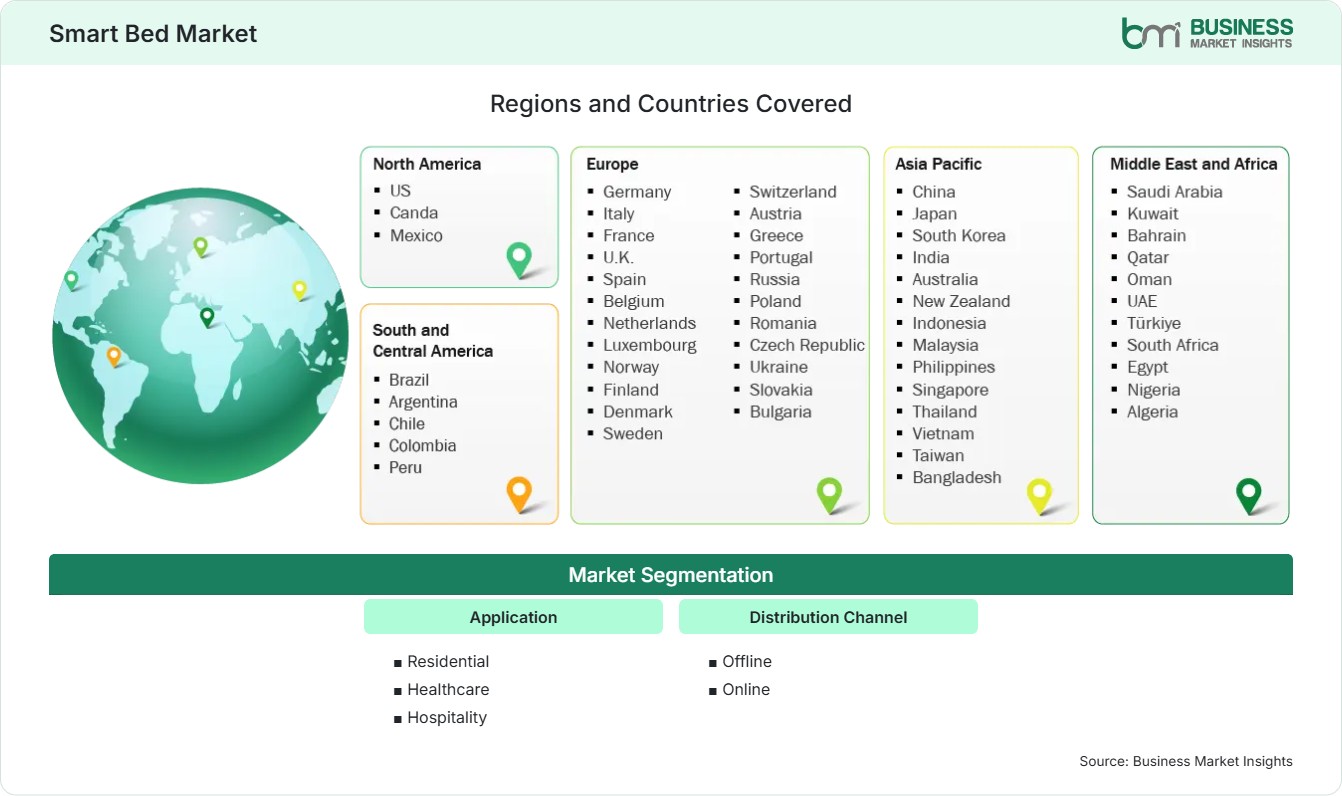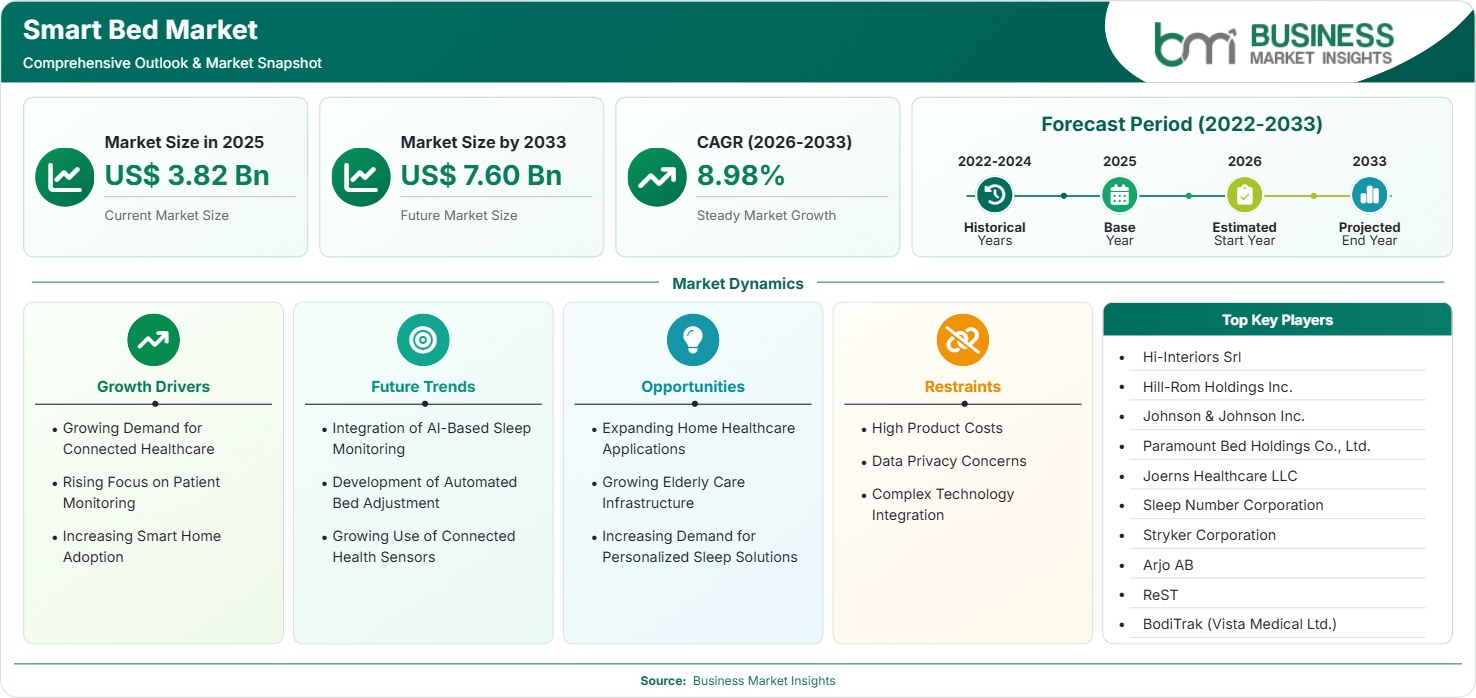
Smart Bed Market Regional Highlights
North America Smart Bed Market
North America represents a modeled 34%–38% share in 2025, with a projected CAGR of 8.5%–9.5% through 2033. The region remains strategically important because manufacturers can address healthcare, residential, and hospitality requirements through differentiated product configurations. Smart Bed Market share is supported by broad channel availability and established technology ecosystems.
- Premium residential demand supports adoption of adjustable systems offering personalized positioning, sleep tracking, automated comfort adjustments, and connected controls, creating opportunities for differentiated products and higher-value configurations.
- Healthcare institutions represent a major application base where adjustable positioning, pressure management, patient support, and operational functionality influence procurement decisions and encourage manufacturers to develop application-specific solutions.
- Hospitality operators can use connected sleeping systems to differentiate guest experiences through automated settings, personalized comfort, and technology-enabled room functionality while supporting premium service positioning.
- Established offline and online channels allow manufacturers to combine demonstrations and professional recommendations with convenient digital purchasing, strengthening access across both institutional buyers and individual consumers.
US Smart Bed Market
The U.S. represents the principal national market within North America, supported by established healthcare purchasing structures, strong consumer interest in premium sleep products, and broad availability of connected home technologies. A modeled 26%–30% regional share in 2025 and 8.4%–9.4% CAGR indicate sustained commercial potential. Manufacturers can strengthen market positioning through differentiated technologies, professional partnerships, direct-to-consumer channels, and application-specific configurations.
- Healthcare demand is supported by products designed for positioning, pressure management, patient comfort, and care environments, creating opportunities for suppliers with strong institutional support and specialized product capabilities.
- Residential adoption benefits from premium positioning, connected controls, personalized sleep features, and increasing consumer interest in technology-enabled wellness products that provide differentiated functionality.
- Hospitality applications provide opportunities for operators to incorporate smart sleeping systems into premium rooms, creating technology-based differentiation while improving the personalization of guest experiences.
Europe Smart Bed Market
Europe holds a modeled 27%–31% share in 2025 and is projected to expand at 8.0%–9.0% CAGR. Germany, the United Kingdom, France, and Italy represent leading commercial markets, while selected European countries provide opportunities for technology-oriented adoption. The region's Smart Bed Market share benefits from diversified application demand and established healthcare procurement channels.
- Germany provides a strong institutional opportunity through healthcare applications, where durable adjustable systems and patient-support functionality can support recurring procurement across professional care environments.
- The United Kingdom offers opportunities across residential and healthcare settings, with digital purchasing and connected product positioning supporting wider access to technology-enabled sleep solutions.
- France and Italy provide hospitality opportunities where premium room experiences, differentiated comfort features, and connected controls can support higher-value product positioning.
- European manufacturers can emphasize modularity, durability, serviceability, and application-specific configuration to address varied procurement requirements across healthcare providers and hospitality operators.
Asia Pacific Smart Bed Market
Asia Pacific accounts for a modeled 22%–26% share in 2025 and is projected to record 10.0%–11.0% CAGR, making it the fastest-growing regional market. China, Japan, South Korea, and Australia represent important markets, while emerging economies offer additional expansion potential. Market growth increasingly reflects rising awareness of connected wellness, healthcare-oriented functionality, and digitally enabled residential products.
- Japan offers strong opportunities for healthcare and residential applications because product design can combine compact configurations, comfort personalization, automation, and technology-enabled functionality within space-conscious environments.
- China provides broad commercial potential across residential, healthcare, and hospitality applications, supported by technology-oriented consumers and expanding demand for connected household products.
- South Korea represents a technology-focused market where connected controls, premium sleep functionality, and digital user interfaces can support differentiated smart sleeping solutions.
- Australia provides opportunities across residential and healthcare channels, with premium positioning and online distribution offering manufacturers additional routes toward geographically dispersed customers.
Rest of World Smart Bed Market
South and Central America represent developing opportunities supported by private healthcare investment, premium residential demand, and hospitality modernization. The region holds a modeled 7%–10% share in 2025 and is projected to expand at 7.5%–8.5% CAGR. In parallel, Middle East and Africa demand is supported by premium hospitality, healthcare infrastructure development, and technology-oriented facilities.
- Brazil and Mexico provide comparatively broader opportunities because healthcare, residential, and hospitality applications can support multiple routes to market and reduce dependence on individual customer categories.
- Middle Eastern hospitality projects can support premium smart sleeping systems where personalized comfort, connected controls, and differentiated guest experiences justify technology-enabled room investments.
- Gulf markets offer opportunities for specialized suppliers capable of providing installation, maintenance, customization, and technology integration alongside physical products.
- African healthcare applications can develop gradually through institutional projects, specialist distributors, and products emphasizing durability, practical functionality, and manageable operating requirements.