
Smart Hospitals Market Outlook: Size, Share, Trends, Growth Analysis, Competitive Landscape & Forecast, 2022-2033

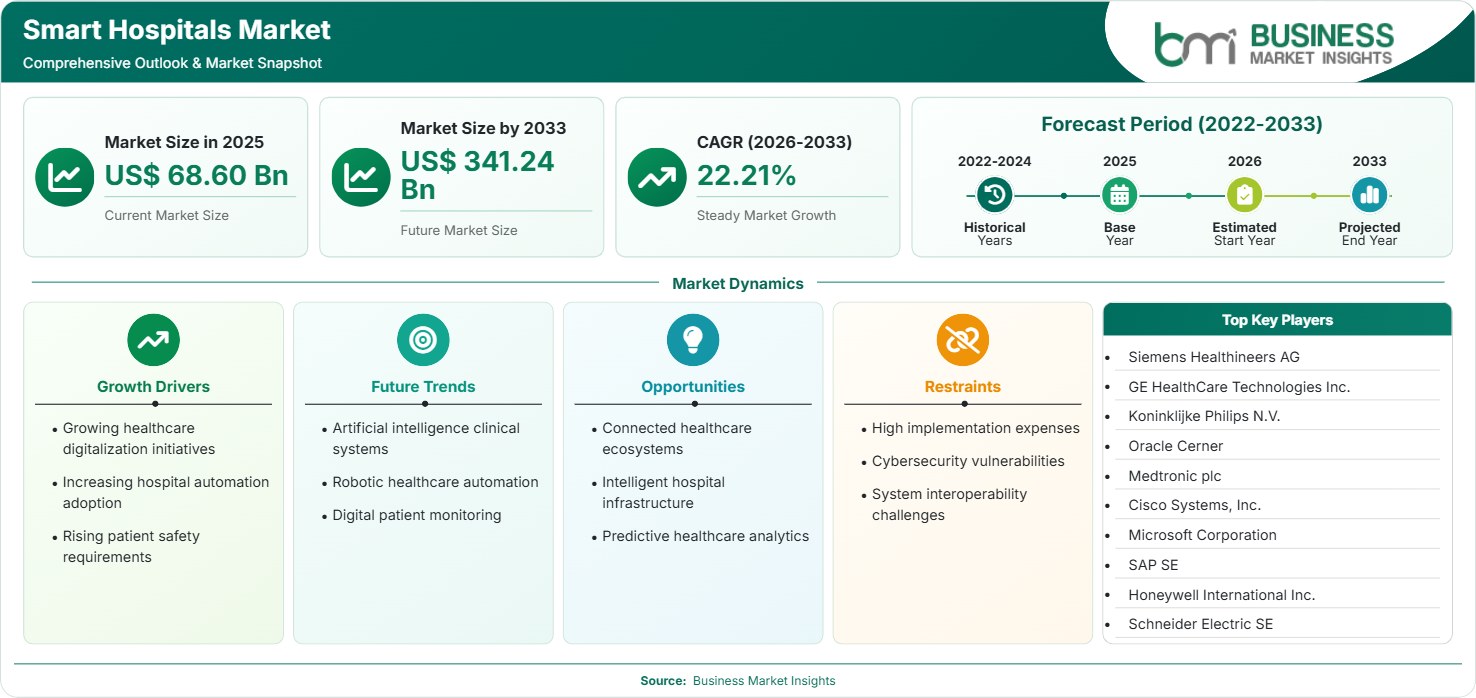
The Smart Hospitals Market size was valued at US$ 68.60 billion in 2025 and is projected to reach US$ 341.24 billion by 2033, growing at a CAGR of 22.21% during 2026–2033. Growing healthcare digitalization initiatives, increasing hospital automation adoption, and rising patient safety requirements are accelerating market expansion. Furthermore, connected healthcare ecosystems, intelligent hospital infrastructure, and predictive healthcare analytics are expected to create significant long-term growth opportunities for healthcare technology providers.

Report Coverage
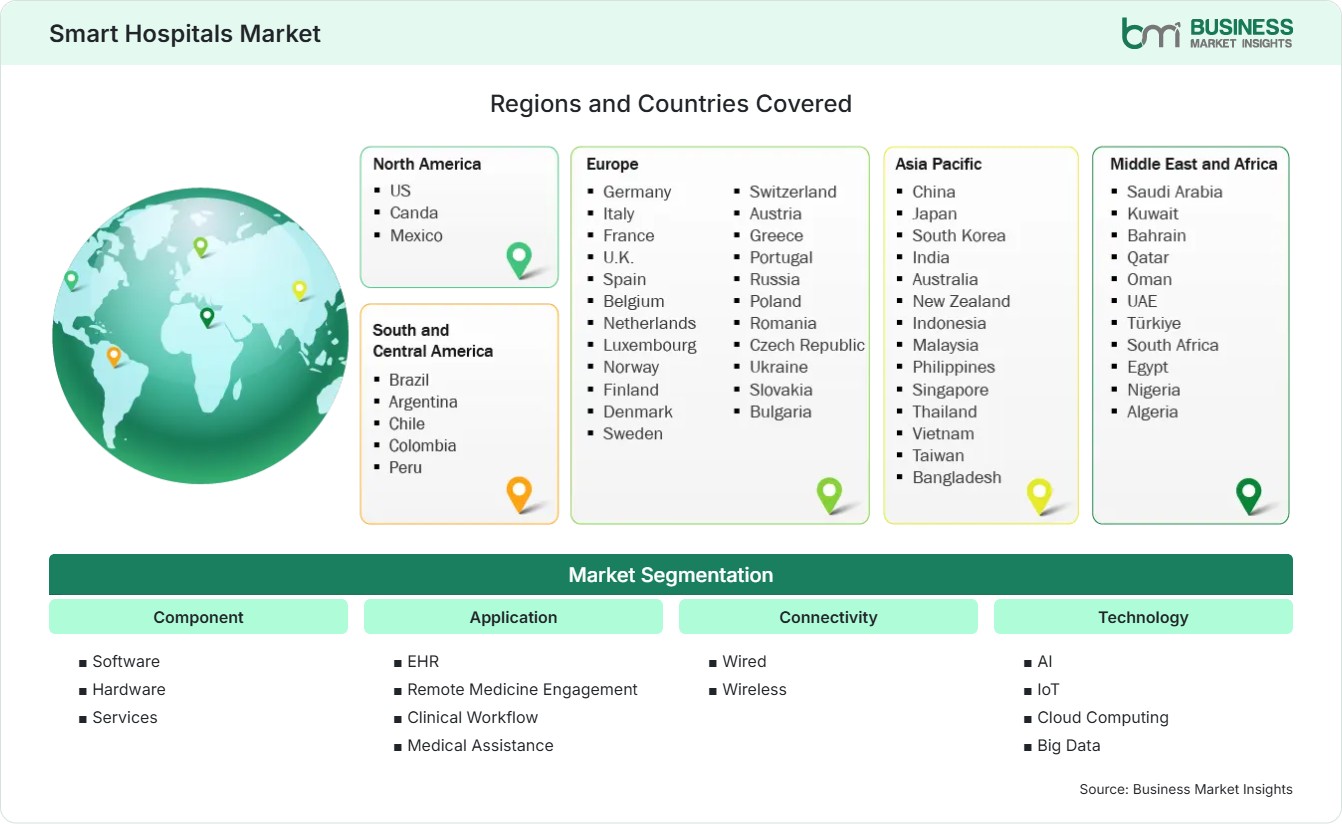
  • Component: Software, Hardware, Services
  • Application: EHR, Remote Medicine Engagement, Clinical Workflow, Medical Assistance
  • Connectivity: Wired, Wireless
  • Technology: AI, IoT, Cloud Computing, Big Data
US$ 68.60 Bn Market size in 2025
US$ 341.24 Bn Market Size by 2033
22.21% CAGR, 2026 - 2033
2026-2033 Forecast Period

AI Overview

Smart Hospitals Market Summary

  • North America: North America accounts for 36%–39% of the global market in 2025 and is projected to grow at a CAGR of 21.4%–22.2% through 2033. High healthcare IT adoption, advanced digital infrastructure, increasing investments in connected care, and widespread implementation of AI-enabled healthcare systems continue supporting regional leadership. The U.S. market is anticipated to register a CAGR of 21.7%–22.5% during the forecast period.
  • Fastest Growing Region: Asia Pacific holds 27%–30% market share in 2025 and is forecast to register the highest CAGR of 23.5%–24.3% through 2033. Expanding healthcare infrastructure, government digital health initiatives, increasing hospital modernization, and rapid adoption of cloud-based healthcare technologies continue driving regional growth.
  • Leading Segment: Software represents 42%–45% of the market in 2025 and is projected to expand at a CAGR of 22.6%–23.4% during 2026–2033. Growing deployment of hospital information systems, electronic health records, AI-powered analytics, and clinical workflow management solutions continues supporting segment dominance.
  • High Growth Segment: Artificial Intelligence accounts for 30%–33% market share in 2025 and is expected to register the fastest CAGR of 24.1%–24.9% through 2033. Increasing adoption of AI-powered diagnostics, predictive analytics, medical imaging, and intelligent decision support systems continues accelerating market expansion.
  • Key Market Opportunity: Growing investments in connected healthcare ecosystems, intelligent hospital infrastructure, predictive healthcare analytics, and cloud-enabled clinical platforms are creating substantial opportunities for technology providers and healthcare institutions.
  • Major Market Players: Siemens Healthineers AG, GE HealthCare Technologies Inc., Koninklijke Philips N.V., Oracle Cerner, Medtronic plc, Cisco Systems Inc., Microsoft Corporation, SAP SE, Honeywell International Inc., and Schneider Electric SE.
Strategic Insights

Smart Hospitals Market: Strategic Insights

Smart Hospitals Market Strategic Framework
FREE PDF
Request your free sample
Request free sample
Stakeholder View

Key Takeaways

  • The market ecosystem continues evolving through healthcare software providers, medical device manufacturers, cloud platform vendors, cybersecurity companies, hospital infrastructure developers, and healthcare system integrators.
  • Hospital automation, digital patient management, remote healthcare services, and intelligent clinical decision support systems represent the strongest commercial opportunities across global healthcare markets.
  • Continuous innovation in artificial intelligence, Internet of Things, cloud computing, robotics, predictive analytics, and healthcare interoperability is significantly improving operational efficiency, patient safety, and clinical outcomes.
  • Asia Pacific offers the strongest long-term investment potential due to rapid healthcare infrastructure expansion, government-backed digital health initiatives, increasing hospital modernization, and growing adoption of intelligent healthcare technologies.
  • Strategic collaborations among healthcare providers, technology companies, cloud service providers, medical equipment manufacturers, and software developers continue accelerating innovation and deployment of next-generation smart hospital ecosystems.
Geographic Outlook

Smart Hospitals Market Regional Highlights

North America Smart Hospitals Market

North America accounts for 36%–39% of the global market in 2025 and is projected to expand at a CAGR of 21.4%–22.2% through 2033. Advanced healthcare infrastructure, strong healthcare IT investments, widespread implementation of electronic health records, and increasing deployment of AI-powered clinical solutions continue driving regional market growth. The Smart Hospitals Market share remains the highest globally due to rapid digital transformation across healthcare systems.

  • Healthcare IT investments strengthen digital transformation.
  • AI-enabled clinical systems improve hospital efficiency.
  • Connected care platforms support patient-centered healthcare.
  • Hospital automation enhances operational performance.

US Smart Hospitals Market

The United States dominates regional revenue and is expected to register a CAGR of 21.7%–22.5% during the forecast period. Growing investments in AI-driven diagnostics, cloud-based hospital management platforms, remote patient monitoring technologies, and cybersecurity infrastructure continue supporting strong market expansion.

  • AI-powered diagnostics improve clinical decision-making.
  • Cloud healthcare platforms streamline hospital operations.
  • Digital health investments accelerate smart hospital adoption.

Europe Smart Hospitals Market

Europe represents 28%–31% of the global Smart Hospitals Market in 2025 and is projected to grow at a CAGR of 21.0%–21.8% during 2026–2033. Germany leads regional demand, while Spain records the fastest growth supported by healthcare digitalization programs, smart infrastructure investments, and increasing adoption of connected medical technologies.

  • Healthcare modernization supports digital hospital expansion.
  • Germany leads healthcare technology implementation.
  • Spain accelerates connected healthcare adoption.
  • Smart infrastructure investments improve hospital efficiency.

Asia Pacific Smart Hospitals Market

Asia Pacific accounts for 27%–30% of global revenue in 2025 and is expected to register the fastest CAGR of 23.5%–24.3% through 2033. China dominates regional demand, while India records the highest growth owing to expanding healthcare infrastructure, government digital health initiatives, rising healthcare expenditure, and increasing deployment of cloud-based hospital information systems.

  • Hospital modernization accelerates digital healthcare adoption.
  • Government initiatives strengthen healthcare digitalization.
  • AI integration improves patient care quality.
  • Cloud technologies enhance healthcare connectivity.

Rest of World Smart Hospitals Market

The Rest of World region accounts for 5%–7% of the global market in 2025 and is projected to grow at a CAGR of 20.2%–21.0% during the forecast period. Brazil, the UAE, and South Africa continue investing in smart healthcare infrastructure, digital hospital management systems, connected medical devices, and intelligent patient care technologies, supporting sustained Smart Hospitals Market expansion.

  • Smart healthcare investments improve service delivery.
  • Connected medical devices strengthen patient monitoring.
  • Digital hospital systems enhance operational efficiency.
  • Healthcare modernization drives long-term market growth.
Global Market Geography
FREE PDF
Request your free sample
Request free sample
Segment Analysis

Smart Hospitals Market Segmentation

Component

The Component segment accounted for 42%–45% of the overall Smart Hospitals Market in 2025 and is projected to grow at a CAGR of 22.6%–23.4% during 2026–2033. Rapid healthcare digitalization, increasing investments in hospital automation, and rising adoption of integrated healthcare information systems continue driving strong demand across software, hardware, and professional healthcare services. Hospitals are increasingly deploying intelligent software platforms, connected medical devices, cloud-based infrastructure, cybersecurity solutions, and analytics tools to improve operational efficiency, enhance clinical decision-making, optimize patient care, and streamline administrative workflows. Continuous technological advancements in artificial intelligence, IoT integration, and cloud computing are further strengthening adoption of comprehensive smart hospital ecosystems worldwide.

  • Software: Software represents the largest component segment owing to widespread adoption of hospital information systems, electronic health records, clinical decision support systems, AI-powered analytics, workflow automation platforms, and integrated healthcare management solutions that improve operational efficiency and patient outcomes.
  • Hardware: Hardware continues witnessing significant growth through deployment of connected medical devices, patient monitoring systems, smart sensors, imaging equipment, automated dispensing systems, robotic technologies, and intelligent networking infrastructure supporting digital healthcare delivery.
  • Services: Services continue expanding steadily as healthcare providers increasingly require consulting, implementation, integration, cybersecurity management, system maintenance, cloud migration, staff training, and technical support for successful deployment and operation of smart hospital technologies.

Application

The Application segment accounted for 35%–38% of the market in 2025 and is projected to expand steadily through 2033. Growing demand for digital patient management, intelligent clinical workflows, real-time healthcare monitoring, and personalized patient care continues accelerating adoption of advanced healthcare applications. The Smart Hospitals Market trends indicate increasing integration of artificial intelligence, cloud computing, remote monitoring, predictive analytics, and interoperable healthcare platforms that enable seamless communication among healthcare professionals while improving clinical efficiency and patient safety.

  • Electronic Health Records (EHR): Electronic Health Records remain the largest application owing to increasing digitalization of patient information, improved clinical documentation, enhanced interoperability, regulatory compliance, and faster access to comprehensive patient medical histories.
  • Remote Medicine Engagement: Remote medicine engagement continues experiencing rapid adoption through telemedicine platforms, virtual consultations, remote patient monitoring, digital health applications, and connected wearable devices that improve healthcare accessibility and continuity of care.
  • Clinical Workflow: Clinical workflow management solutions improve hospital productivity by automating administrative processes, optimizing resource allocation, streamlining patient scheduling, reducing clinical documentation burdens, and enhancing collaboration among healthcare professionals.
  • Medical Assistance: Intelligent medical assistance solutions leverage artificial intelligence, robotics, and clinical decision support systems to assist physicians in diagnostics, treatment planning, medication management, surgical procedures, and patient monitoring while improving clinical accuracy and efficiency.

Connectivity

The Connectivity segment accounted for 62%–65% of the Smart Hospitals Market in 2025 and is projected to register strong growth during the forecast period. Reliable communication infrastructure is becoming increasingly important as hospitals deploy connected medical devices, cloud-based healthcare systems, and intelligent monitoring technologies across healthcare facilities. Growing demand for real-time data exchange, uninterrupted connectivity, cybersecurity, and integrated digital health ecosystems continues supporting investments in both wired and wireless networking solutions.

  • Wired: Wired connectivity continues supporting mission-critical hospital operations by providing highly secure, reliable, and high-speed communication infrastructure for imaging systems, hospital servers, intensive care units, and integrated clinical information systems.
  • Wireless: Wireless connectivity is the fastest-growing segment driven by increasing deployment of Wi-Fi-enabled medical devices, mobile healthcare applications, wearable sensors, remote patient monitoring technologies, Internet of Things (IoT) devices, and cloud-connected healthcare platforms.

Technology

The Technology segment accounted for 30%–33% of the market in 2025 and is projected to experience the fastest growth across the Smart Hospitals Market forecasts. Rapid technological innovation continues transforming hospital operations by enabling predictive healthcare, intelligent automation, data-driven decision-making, and personalized patient care. Hospitals are investing significantly in digital technologies that improve operational efficiency, optimize resource utilization, strengthen cybersecurity, and enhance clinical outcomes.

  • Artificial Intelligence: Artificial Intelligence represents the leading technology segment owing to its growing use in diagnostic imaging, predictive analytics, clinical decision support, workflow automation, personalized treatment planning, and hospital resource optimization.
  • Internet of Things: IoT technologies continue expanding through connected medical devices, smart patient monitoring systems, intelligent asset tracking, environmental monitoring, and real-time healthcare data collection that improve operational visibility and patient safety.
  • Cloud Computing: Cloud computing supports secure healthcare data storage, interoperability, scalable hospital information systems, collaborative healthcare platforms, disaster recovery, and efficient management of digital healthcare infrastructure.
  • Big Data: Big data analytics enables hospitals to process large clinical datasets, improve disease prediction, optimize treatment outcomes, support population health management, and strengthen strategic healthcare planning through advanced analytical capabilities.
Market Forces

Smart Hospitals Market Dynamics

Key Market Drivers

Growing healthcare digitalization initiatives

Governments, healthcare providers, and private healthcare organizations are significantly increasing investments in digital healthcare transformation programs to improve service quality, operational efficiency, and patient outcomes. Widespread implementation of electronic health records, AI-enabled diagnostics, cloud computing, telemedicine platforms, and intelligent healthcare management systems continues accelerating the transition toward fully connected smart hospitals capable of delivering efficient, data-driven, and patient-centric healthcare services.

Increasing hospital automation adoption

Hospitals worldwide are increasingly adopting automation technologies to streamline administrative operations, optimize clinical workflows, reduce manual errors, improve resource utilization, and enhance patient safety. Medication dispensers, robotic surgical systems, intelligent monitoring, AI-based scheduling, and workflow automation software have all enabled health organizations to become more productive and save on operational expenses while improving their quality of care at the same time.

Rising patient safety requirements

Healthcare organizations continue prioritizing patient safety through implementation of intelligent monitoring systems, real-time clinical decision support, automated alert mechanisms, infection control technologies, and predictive healthcare analytics. The introduction of modern smart hospital technology enhances treatment accuracy, prevents medical errors, promotes patient monitoring, and facilitates swift clinical intervention, thus leading to better health care delivery standards.

Key Market Opportunities

Connected healthcare ecosystems

The creation of a unified digital healthcare ecosystem through the integration of hospitals, clinics, laboratories, pharmacies, insurance firms, and home healthcare agencies represents major possibilities for the healthcare technology industry. It facilitates coordination among different entities, allows for data exchanges, promotes collaboration, and offers an easy experience to the patients.

Intelligent hospital infrastructure

Increasing interest in smart buildings, intelligent energy management systems, automatic management of facilities, digital tracking of assets, medical devices connectivity, and AI hospital management solutions is creating many opportunities for IT companies involved in the construction of future healthcare infrastructure.

Predictive healthcare analytics

Increasing adoption of predictive analytics powered by artificial intelligence and big data is enabling hospitals to forecast patient risks, optimize staffing, improve disease management, enhance operational planning, and support personalized treatment strategies. These capabilities continue creating strong growth opportunities for advanced healthcare analytics solution providers.

Market Restraints and Challenges

High implementation expenses

Factor: The implementation of fully-fledged smart hospitals entails huge amounts of spending on healthcare software, intelligent medical devices, networking solutions, cybersecurity measures, cloud computing, AI systems, and staff training.

Impact: High investment costs can slow the process of digital transformation in small and medium healthcare facilities, even as it provides numerous operational advantages.

Cybersecurity vulnerabilities

Factor: Increasing connectivity among hospital information systems, cloud platforms, medical devices, and patient databases significantly expands cybersecurity risks, including ransomware attacks, unauthorized data access, medical device breaches, and healthcare data theft.

Impact: Cybersecurity vulnerabilities may compromise patient privacy, disrupt clinical operations, increase regulatory compliance costs, damage institutional reputation, and require continuous investments in advanced security technologies, threat detection systems, and cybersecurity governance frameworks.

Company Analysis

Competitive Landscape

The competitive landscape of the Smart Hospitals Market analysis is characterized by intense competition among healthcare technology providers, medical device manufacturers, software companies, and digital infrastructure providers. Market participants are investing heavily in artificial intelligence, cloud computing, Internet of Things (IoT), cybersecurity, predictive analytics, and interoperable healthcare platforms to improve patient care and hospital efficiency. Strategic partnerships with healthcare providers, acquisitions of digital health companies, expansion of cloud-based healthcare services, and continuous innovation in connected medical technologies continue strengthening market competitiveness while accelerating the global adoption of intelligent hospital ecosystems.

Company Name

Overview

Products and Services Relevant to this Market

Siemens Healthineers AG

Global healthcare technology company specializing in digital healthcare solutions.

AI-powered imaging systems, hospital management software, diagnostic equipment, digital healthcare platforms.

GE HealthCare Technologies Inc.

Leading provider of healthcare technologies and clinical digital solutions.

Medical imaging systems, patient monitoring solutions, AI diagnostics, hospital workflow software.

Koninklijke Philips N.V.

Global leader in connected healthcare technologies.

Patient monitoring systems, telehealth platforms, healthcare informatics, connected care solutions.

Oracle Cerner

Healthcare information technology company specializing in digital clinical systems.

Electronic Health Records (EHR), clinical workflow software, healthcare data management platforms.

Medtronic plc

Global medical technology company focused on connected healthcare innovation.

Remote patient monitoring systems, surgical technologies, connected medical devices, healthcare software.

Cisco Systems Inc.

Technology company providing secure healthcare networking solutions.

Hospital networking infrastructure, cybersecurity, collaboration platforms, IoT connectivity solutions.

Microsoft Corporation

Global cloud computing and AI technology provider.

Azure cloud healthcare services, AI analytics, healthcare data platforms, cybersecurity solutions.

SAP SE

Enterprise software company serving healthcare organizations worldwide.

Hospital resource planning, analytics platforms, healthcare enterprise management software.

Honeywell International Inc.

Industrial technology company supporting smart healthcare infrastructure.

Building automation systems, hospital safety solutions, energy management, connected facility technologies.

Schneider Electric SE

Global specialist in smart infrastructure and energy management.

Smart building systems, energy management solutions, hospital automation technologies, digital infrastructure.

Industry Activity

Recent Developments

June 2025

Observe Medical ASA announced that its UnoMeter Safeti Plus won major hospital tenders in Stockholm (Sweden) and Helsinki and Tampere (Finland), while expanding supply contracts across Denmark, strengthening the deployment of smart hospital technologies in the Nordic healthcare sector.

February 2025

Boldyn Networks, Nokia, and Oulu University Hospital announced the launch of Europe's first private standalone 5G network in a functioning hospital, enabling advanced connected healthcare applications including smart glasses, AI-assisted workflows, and real-time clinical communications.

February 2025

Nokia announced that its Modular Private Wireless solution had been deployed at Oulu University Hospital in Finland as part of the Hola 5G Oulu project, supporting next-generation smart hospital connectivity, wearable devices, and digital healthcare services.

January 2025

Philips announced an expanded collaboration with Region Västra Götaland (Sweden) to enhance enterprise imaging and digital healthcare workflows across hospitals, supporting AI-enabled diagnostics and smart hospital transformation.

Trust & Transparency

Research Methodology

The market analysis combines proprietary research with secondary data from government agencies, company disclosures, regulatory filings, industry databases and expert interviews. Market estimates are validated through data triangulation, cross-market benchmarking and analyst review.

View Full Research Methodology

Questions Answered

Frequently Asked Questions

What future opportunities are covered in the Smart Hospitals Market Report?

Major opportunities include connected healthcare ecosystems, intelligent hospital infrastructure, predictive healthcare analytics, AI-powered diagnostics, cloud-enabled healthcare platforms, remote patient monitoring, and digital hospital automation.

Who are the major companies operating in the market?

Leading companies include Siemens Healthineers AG, GE HealthCare Technologies Inc., Koninklijke Philips N.V., Oracle Cerner, Medtronic plc, Cisco Systems Inc., Microsoft Corporation, SAP SE, Honeywell International Inc., and Schneider Electric SE.

Which component holds the largest market share?

Software dominates the market with a 42%–45% share in 2025 owing to widespread adoption of hospital information systems, electronic health records, AI-powered analytics, and clinical workflow management platforms.

Which region dominates the market?

North America leads the market with a 36%–39% share in 2025, while Asia Pacific is expected to register the fastest growth due to expanding healthcare infrastructure, digital health investments, and rapid hospital modernization.

What is driving the growth of the Smart Hospitals Market?

The market is driven by growing healthcare digitalization initiatives, increasing hospital automation adoption, rising patient safety requirements, expanding AI integration, cloud computing adoption, and demand for connected healthcare ecosystems.

Access the Full Smart Hospitals Market Report

Get segment-level forecasts, regional estimates, competitive benchmarking, company profiles and downloadable Excel datasets.

Access the full Smart Hospitals Market Report
350 pages PDF & Excel | 2026-07-29