
Silicon Carbide Fibers Market Outlook: Size, Share, Trends, Growth Analysis, Competitive Landscape & Forecast, 2026-2033

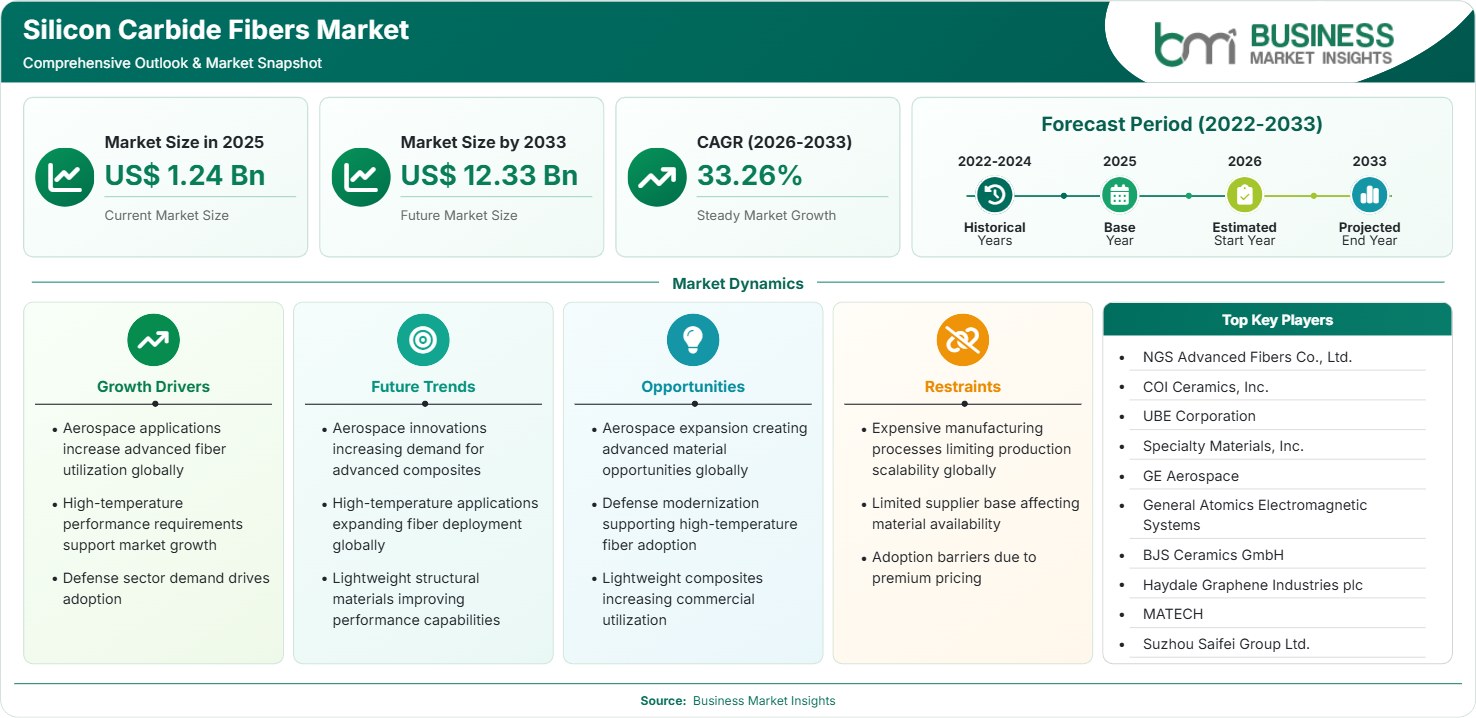
The Silicon Carbide Fibers Market size was valued at US$ 1.24 Billion in 2025 and is projected to reach US$ 12.33 Billion by 2033, growing at a CAGR of 33.26% during 2026–2033, driven by aerospace composites, advanced propulsion, nuclear energy, high-temperature industrial systems, and demand for lightweight, durable reinforcement materials.

Report Coverage
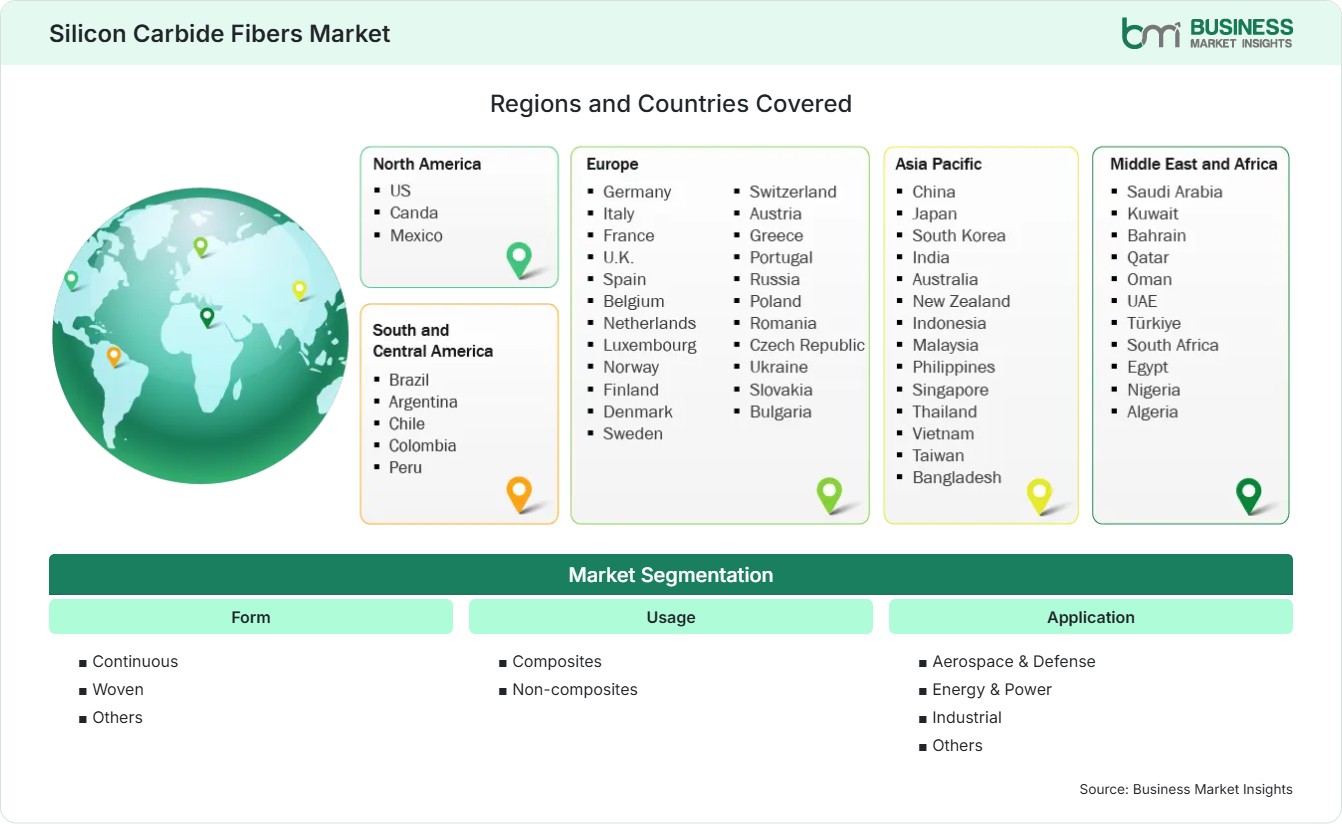
  • Form: Continuous, Woven, Others
  • Usage: Composites, Non-composites
  • Application: Aerospace & Defense, Energy & Power, Industrial, Others
US$ 1.24 Bn Market size in 2025
US$ 12.33 Bn Market Size by 2033
33.26% CAGR, 2026 - 2033
2026-2033 Forecast Period

AI Overview

Silicon Carbide Fibers Market Summary

  • North America Region: North America holds a modeled 34%–38% Silicon Carbide Fibers Market share in 2025, growing at a CAGR of 30%–33%, supported by aerospace engine programs, defense investment, nuclear materials research, and domestic advanced-materials manufacturing.
  • Fastest Growing Region: Asia Pacific accounts for a modeled 25%–29% share in 2025 and advances at a CAGR of 35%–39%, supported by Japanese fiber technology, Chinese industrial investment, and expanding aerospace and energy applications.
  • Leading Segment: Composites represent a modeled 72%–78% share in 2025 and grow at a CAGR of 34%–37%, supported by ceramic matrix composites that improve heat tolerance, structural durability, and component efficiency.
  • High Growth Segment: Energy & Power represents a modeled 18%–22% share in 2025 and grows at a CAGR of 36%–40%, supported by advanced nuclear systems, gas turbines, and high-temperature energy conversion equipment.
  • Key Market Opportunity: Investment in scalable fiber production, improved precursor chemistry, and qualified composite manufacturing can expand applications across aerospace propulsion, nuclear systems, and demanding industrial environments while reducing supply-chain constraints.
  • Major Market Players: NGS Advanced Fibers Co., Ltd., COI Ceramics, Inc., UBE Corporation, Specialty Materials, Inc., GE Aerospace, General Atomics Electromagnetic Systems, BJS Ceramics GmbH, Haydale Graphene Industries plc, MATECH, and Suzhou Saifei Group Ltd.
Strategic Insights

Silicon Carbide Fibers Market: Strategic Insights

Silicon Carbide Fibers Market Strategic Framework
FREE PDF
Request your free sample
Request free sample
Stakeholder View

Key Takeaways

  • Supply-chain control is a competitive differentiator. Fiber production depends on precursor chemistry, controlled conversion, heat treatment, surface finishing, and consistent quality assurance. Companies that coordinate fiber manufacturing with composite processing can reduce material variability and improve qualification efficiency.
  • Composite applications offer the clearest commercialization pathway. Aerospace and defense components already have demanding thermal and mechanical requirements that suit silicon carbide reinforcement. Suppliers should prioritize programs in which component lifetime, weight reduction, and high-temperature performance justify the premium material costs.
  • Manufacturing innovation will influence long-term margins. Better precursor utilization, process repeatability, and lower-cost conversion routes can improve production economics. Research should focus on reliable fiber strength, oxidation resistance, interface compatibility, and manufacturability rather than on maximizing a single laboratory performance measure.
  • Asia Pacific offers a technology-led investment case. Japanese expertise in continuous silicon carbide fibers creates opportunities for supplier partnerships, while Chinese industrial development may expand the regional manufacturing ecosystem. Investors should distinguish established aerospace-qualified products from newer grades still undergoing validation.
  • Strategic partnerships are more important than simple capacity announcements. Fiber producers, ceramic matrix composite manufacturers, engine developers, and energy-system integrators need coordinated qualification programs. Investments tied to identifiable applications and customer validation are more defensible than speculative capacity expansion.
  • Diversification can reduce exposure to aerospace cycles. Nuclear energy, power generation, industrial heat management, and specialized structural systems offer alternative demand channels. Their adoption timelines and technical requirements differ, so suppliers should build application-specific portfolios rather than assume uniform demand across end markets.
Geographic Outlook

Silicon Carbide Fibers Market Regional Highlights

North America Silicon Carbide Fibers Market

The North American region is anticipated to hold 34%-38% of the Global Silicon Carbide Fibers Market by revenue in 2025, with a CAGR of 30%-33% from 2026 to 2034. Some of the key factors driving growth in the region include aerospace engine design, defense spending, advanced ceramics experience, and nuclear material development. The United States is the primary source of demand, and Canada and Mexico offer secondary growth opportunities due to their industrial and aerospace manufacturing capabilities.

  • Aerospace propulsion programs support demand for reinforced components that withstand high thermal loads while reducing dependence on heavier metallic structures. Suppliers benefit when fiber specifications are integrated early into engine design and manufacturing qualification.
  • Defense applications create opportunities for thermal protection, exhaust components, and demanding structural systems. Procurement cycles remain lengthy, making approved material specifications, production traceability, and dependable delivery more important than short-term price competition.
  • Domestic production initiatives can strengthen supply security for strategically important ceramic materials. Investment in specialized manufacturing equipment, precursor chemistry, and testing infrastructure may help reduce dependence on limited international sources.
  • Nuclear research creates a longer-term opportunity for silicon carbide reinforcement in advanced structural systems. Commercialization will require application-specific evidence covering irradiation behavior, material interfaces, environmental resistance, and component reliability under demanding operating conditions.

US Silicon Carbide Fibers Market

The United States is forecast to account for a major share of North American demand, with a projected share of 27%-31% of the world's revenue by 2025 and a CAGR of 31%-34% by 2033. Aerospace propulsion systems, military applications, advanced ceramics, and developments in nuclear technology are some of the key drivers of demand. Companies such as General Atomics Electromagnetic Systems and specialty materials companies are involved in domestic production capabilities. The Silicon Carbide Fibers Market forecast is contingent on qualification, manufacturing capacity, and sustained customer demand.

  • Engine and aircraft programs favor suppliers able to demonstrate consistent fiber properties and integration with ceramic matrix composite manufacturing. Qualification requirements can create durable commercial relationships but limit rapid substitution between competing materials.
  • Defense demand supports development of specialty fibers for thermal protection and high-performance structures. Government-backed research and procurement can help establish initial applications before wider industrial commercialization becomes commercially viable.
  • Domestic fiber production can address supply-security concerns in aerospace and nuclear applications. Producers must nevertheless balance strategic manufacturing investment against the cost of specialized equipment, process controls, skilled personnel, and relatively demanding quality requirements.

Europe Silicon Carbide Fibers Market

Europe is expected to account for 22%–26% of global revenue in the Silicon Carbide Fibers Market in 2025 and to exhibit a CAGR of 31%–34% from 2026–2033. Aerospace engineering, industrial gas turbine manufacturing, advanced ceramics production, and development of efficient propulsion systems drive demand in the region. The three major European nations involved are France, Germany, and the United Kingdom, providing valuable engineering and manufacturing environments. France is forecast to achieve a CAGR of 32%–35%, while Germany is forecast to achieve a CAGR of 30%–33%, reflecting differences in aerospace specialization, industrial applications, and commercialization opportunities.

  • France offers opportunities through aerospace propulsion expertise and supplier relationships serving advanced engine programs. Fiber manufacturers can benefit from early collaboration with composite developers, although certification requirements make adoption a multi-year process.
  • Germany's industrial engineering base supports applications in high-temperature equipment and specialized manufacturing. Adoption depends on demonstrating lifecycle benefits against conventional alloys and alternative ceramics under realistic operating conditions.
  • The United Kingdom offers research opportunities in aerospace, defense, and advanced materials. Collaborative development between research institutions and component suppliers can support testing, but commercial success requires a clear route from prototypes to repeatable production.
  • European clean-aviation initiatives create incentives to evaluate lightweight, heat-resistant materials. Silicon carbide fibers may enable efficiency improvements in suitable components, although overall engine performance depends on design, cooling requirements, manufacturing quality, and system-level validation.

Asia Pacific Silicon Carbide Fibers Market

Asia Pacific is modeled to account for 25%–29% of global Silicon Carbide Fibers Market revenue in 2025 and record a CAGR of 35%–39% through 2033. Japan contributes established expertise in continuous production of silicon carbide fiber, while China offers opportunities in industrial manufacturing and advanced materials. Japan is modeled to grow at a CAGR of 32%–35%, and China at 37%–41%, reflecting differing assumptions about technology commercialization, industrial investment, and the pace of adoption across aerospace, energy, and specialized manufacturing.

  • Japan remains important for established continuous-fiber technology and specialized material grades. Its competitive position rests on manufacturing experience, technical consistency, and relationships with composite developers serving demanding aerospace applications.
  • China offers opportunities to expand domestic material production and develop industrial applications. Commercial progress depends on achieving repeatable quality, demonstrating component performance, and meeting customer requirements for reliability and traceability.
  • South Korea's advanced manufacturing capabilities create potential demand for specialized reinforcement materials. Opportunities depend on application-specific research and the development of supply relationships that connect materials producers with aerospace, energy, and industrial component manufacturers.
  • Regional investment in advanced energy systems can broaden demand beyond aerospace. Suppliers should evaluate qualification requirements separately for each application, as nuclear, turbine, and industrial environments impose different performance and durability demands.

Rest of World Silicon Carbide Fibers Market

South and Central America are projected to contribute a smaller share of global Silicon Carbide Fibers Market revenue, due to limited industrial processing, energy infrastructure, and specialized manufacturing requirements. Brazil provides the most relevant industrial base for evaluating selected applications, although limited local specialization may increase reliance on imported materials. The subregion is modeled to expand at a CAGR of 28%–32%, with future demand depending on capital investment, access to qualified components, and the economics of replacing conventional materials.

The Middle East and Africa present strong potential markets for power generation, industrial heating, and energy infrastructure applications. Suitable countries for investment include Saudi Arabia and the United Arab Emirates because of their need for industrial diversification and energy infrastructure development. The overall growth of the regional market can be estimated at a 30%-34% CAGR; however, this depends on funding and cooperation with composite component suppliers.

  • Brazil may provide opportunities in specialized industrial and energy applications where high-temperature durability supports lifecycle savings. Adoption requires reliable imported supply, local engineering expertise, and evidence that premium materials deliver measurable operating benefits.
  • Saudi Arabia's industrial investment programs create potential demand for advanced materials in selected energy and processing applications. Suppliers need to establish technical partnerships and identify projects with sufficiently demanding operating conditions to justify the use of specialized fibers.
  • The United Arab Emirates can serve as a platform for aerospace and advanced manufacturing partnerships. Market development depends on component qualification, engineering capability, and access to established international materials suppliers.
  • South Africa's industrial and energy sectors provide potential niches for heat-resistant materials. Near-term opportunities are more likely to arise from targeted engineering projects than from broad substitution of conventional industrial components.
Global Market Geography
FREE PDF
Request your free sample
Request free sample
Segment Analysis

Silicon Carbide Fibers Market Segmentation

Form

Continuous fibers are considered to lead the form segment due to their applicability in manufacturing composites and reinforcing structures. The woven forms are used when the orientation of the fibers is important, while the others cater to specific manufacturing requirements. Continuous forms are expected to account for 48%–54% of the Silicon Carbide Fibers Market by 2025, exhibiting a CAGR of 34%–37% through 2034. Demand depends on fiber consistency, component design, processing compatibility, and the availability of qualified manufacturing routes.

  • Continuous: Continuous fibers provide uninterrupted reinforcement for structural composites and demanding thermal environments. Their consistent geometry supports component design, load transfer, and manufacturing control, particularly in aerospace propulsion and advanced energy applications.
  • Woven: Woven fibers provide controlled reinforcement orientations for components exposed to complex stresses. Textile architectures support shaping and handling requirements, although weaving compatibility, filament damage, and manufacturing yield influence the final material cost.

Usage

Composites are assumed to be the main application segment due to the significant value of silicon carbide fibers when incorporated into matrices that provide reinforcement, durability, and heat resistance. The market segment’s estimated size for 2025 is 72%–78% of the Silicon Carbide Fibers Market, with a CAGR of 34%–37% until 2033. Non-composite applications refer to more specific needs, such as special thermal, electrical, and research applications. Adoption depends on performance validation, manufacturing economics, and the operating conditions of the finished component.

  • Composites: Fiber-reinforced ceramic, polymer, or metal systems can improve performance in demanding environments. Ceramic matrix composites are particularly relevant to high-temperature propulsion and energy equipment, where durability and lower component weight can justify higher material costs.
  • Non-composites: Specialized non-composite applications may use silicon carbide fibers where their thermal, electrical, or chemical properties provide a functional advantage. Commercial demand depends on application-specific specifications and whether fiber-based solutions outperform available alternative materials.

Application

Aerospace & Defense continues to be a crucial application segment due to demand for components such as engines, thermal protection systems, and other structural assemblies, in which these materials must exhibit desirable characteristics even under harsh conditions. Turbine systems and research into advanced nuclear energy can enable applications within the Energy & Power industry. Aerospace & Defense will represent the largest share by percentage in 2025 – 46%–52%, with a CAGR of 32%–35%. The broader Silicon Carbide Fibers Market scope depends on progress in qualification and expanding end-use adoption.

  • Aerospace & Defense: High-temperature structural components, propulsion systems, and thermal protection applications favor fibers with reliable mechanical performance. Qualification, traceability, and integration with ceramic matrix composites determine commercial suitability.
  • Energy & Power: Turbine systems and advanced nuclear applications create demand for reinforcement that tolerates severe operating environments. Adoption depends on long-term reliability evidence, environmental testing, and the economics of component fabrication.
  • Industrial: Specialized furnaces, chemical processing equipment, and high-temperature industrial systems provide selective opportunities. Buyers assess corrosion resistance, service life, maintenance requirements, and the cost of replacing conventional alloys or other advanced materials.
Market Forces

Silicon Carbide Fibers Market Dynamics

Key Market Drivers

Demand for Lightweight, High-Temperature Aerospace Components

Propulsion systems in aerospace require materials capable of withstanding high temperatures, oxidation, and thermal cycling without adding excessive weight. Reinforcement of ceramics with silicon carbide fibers is seen in hot-section and exhaust components, encouraging engineers to rethink what traditional superalloys can do. The economic value will be determined by performance in terms of durability, cooling needs, and maintenance intervals, not just by the characteristics of the fibers themselves. With engine makers developing more efficient engines and new propulsion designs, it becomes clear that existing fiber producers stand to gain from qualifying programs and steady demand for their products. Silicon Carbide Fibers Market growth therefore depends on sustained engine production, reliable component manufacturing, and the successful transition of qualified materials into commercial programs.

Expansion of Advanced Ceramic Matrix Composites

Ceramic matrix composites combine ceramic reinforcement with matrices engineered for demanding thermal and mechanical environments. Silicon carbide fibers improve the reinforcement capability of these systems, supporting applications where conventional monolithic ceramics may be too brittle. Infiltration, matrix generation, interface coatings, and heat treatments influence reliability. Companies that can provide reliable fiber properties and adequate surface treatments have an advantage, as unreliable reinforcements can affect part performance. Silicon Carbide Fibers Market trends also indicate a shift toward integrating materials development, with manufacturers of fibers, parts, and systems working together to develop and qualify specifications. Greater use of the technology depends on yields and performance over the life cycle.

Strategic Demand for High-Performance Energy Materials

The energy sector offers several areas for the application of innovative materials, including gas turbines, high-temperature conversion machinery, and certain nuclear systems. The use of silicon carbide reinforcement becomes appropriate when thermal stability, chemical resistance, and durability are considered together. A comprehensive analysis of the effects of radiation, joining methods, and performance is necessary in the nuclear industry. Turbine blades need to have oxidation and thermal-cycle resistance properties. With different requirements, it becomes necessary to develop different types of fiber rather than having just one. It becomes possible with public funds and engineering investments to discover new applications, but implementation will depend on component qualification and integration into production processes.

Key Market Opportunities

Scaling Domestic Manufacturing and Improving Production Economics

Increased capacity may enable suppliers to overcome supply limitations and meet the demands of customers who require a more reliable supply. Additional capacity may be challenging to achieve due to the nature of the silicon carbide fiber manufacturing process, which requires specialized precursors, proper conversion, and stringent quality control. More capacity may result in lower per-unit costs, and material performance may also be ensured through automation, higher yield, better precursors, and improved inspection. Domestic production can help reduce the time taken in the development phase due to customer engineering requirements. Potential investors should consider qualification paths and customer needs. Investors should prioritize projects supported by qualification pathways and identifiable demand rather than capacity announcements alone. Long-term commercial value will depend on throughput, usable yield, product consistency, and customer retention.

Developing Advanced Nuclear and Next-Generation Energy Applications

Advanced nuclear systems offer a potential market for silicon carbide-based materials, as demanding operating environments require strong, stable reinforcement. Fiber suppliers can collaborate with reactor engineers, R&D facilities, and component suppliers to assess irradiation resistance, structural stability, and compatibility with the chosen matrix materials. The commercial potential of SiC fibers will depend on proof of performance under operational conditions; thus, the Silicon Carbide Fibers Market Forecasts should highlight the differences between near-term industrial uses and long-term nuclear application potential. Such partnerships will enable the creation of a defensible position before broad commercialization. Success depends on evidence of safety, durability, manufacturing repeatability, and a credible procurement route.

Expanding Woven Architectures and Specialized Fiber Grades

Weaving structures could enhance reinforcement placement and help component makers address issues with complex geometric shapes or the need for directional properties. Development of grades suited to the task, handling, and interface solutions would give suppliers a way to distinguish their products from mere strength characteristics. Cooperation with composite makers could uncover applications where weaving can minimize material loss or simplify component assembly. Specific grades could be developed for applications requiring certain properties such as thermal, electrical, or environmental stability. Development work should concentrate on proven cases and scalability rather than making sweeping generalizations.

Market Restraints and Challenges

High Manufacturing Costs and Limited Production Scale

Factor: The fabrication of silicon carbide fibers relies on specialized feedstocks, sophisticated thermal processes, rigorous inspection, and machinery designed for harsh industrial environments. All this raises significant entry barriers and can also reduce production volume in the event of uneven yields. Impact: Expensive materials limit this technology to cases where improved heat resistance, reduced weight, or longer lifetime justifies the cost difference. The problem is that producers will have difficulty achieving reasonable economics for their products until demand is clearly understood. Lowering the price should not compromise strength, filament quality, and surface finish.

Qualification Complexity and Application-Specific Reliability Requirements

Factor: Silicon carbide fibers are used in parts where the chemical composition of the matrix, interface coatings, process parameters, geometries, and environmental conditions influence their behavior. Aerospace and nuclear sectors require extensive qualification, whereas industrial clients require proof of lifetime and maintenance advantages. Impact: Qualification can result in delays in revenue generation, increased development costs, and reduced flexibility to switch between suppliers. Even though a fiber can demonstrate good behavior in standalone tests, it will not exhibit the same performance in a composite under exposure to thermal cycling, oxidation, mechanical loading, or irradiation.

Company Analysis

Competitive Landscape

The Silicon Carbide Fibers Market analysis highlights a specialized competitive environment in which fiber manufacturers, advanced ceramics companies, aerospace suppliers, and energy technology developers compete through material performance, process control, qualification expertise, and application-specific engineering. The following companies represent established suppliers and relevant specialists; their roles differ, and not every company manufactures continuous silicon carbide fibers directly.

Company Name

Overview

Products and Services relevant to this market

NGS Advanced Fibers Co., Ltd.

Japanese specialist in continuous silicon carbide fibers, serving advanced composite applications that require high strength and temperature resistance.

Nicalon, Hi-Nicalon, and Hi-Nicalon Type S fiber grades for ceramic matrix, polymer matrix, and metal matrix composite reinforcement.

COI Ceramics, Inc.

US advanced ceramics manufacturer with capabilities in silicon carbide fibers and high-temperature composite component development.

Sylramic silicon carbide fibers, Nicalon distribution, and ceramic matrix composite solutions for aerospace, power generation, and thermal protection.

UBE Corporation

Japanese advanced materials company with experience in specialty fibers and high-performance industrial materials.

Tyranno silicon carbide-based ceramic fibers and related advanced material technologies for high-temperature reinforcement and industrial applications.

Specialty Materials, Inc.

US supplier of advanced fibers and specialty materials for demanding technical and industrial applications.

Specialty fiber products and material solutions relevant to high-temperature reinforcement, advanced composites, and research-oriented applications.

GE Aerospace

Aerospace propulsion company with extensive engineering experience in ceramic matrix composites for commercial and military engines.

Engine systems incorporating silicon carbide fiber-reinforced ceramic matrix composites, alongside composite manufacturing and component engineering capabilities.

General Atomics Electromagnetic Systems

US advanced technology developer focused on engineered materials for nuclear, aerospace, defense, and other demanding environments.

SiGA silicon carbide fibers, prepreg materials, fiber-reinforced composites, and nuclear-grade composite components.

BJS Ceramics GmbH

German advanced ceramics specialist associated with engineered ceramic materials and high-temperature applications.

Ceramic materials and composite-related capabilities serving industrial and technical applications that require thermal and mechanical durability.

Haydale Graphene Industries plc

Advanced materials company focused on functionalized materials and industrial technology development.

Functionalized materials and composite-related technologies; direct silicon carbide fiber manufacturing is not established by the company information reviewed.

MATECH

Advanced materials specialist associated with engineered ceramics and high-performance materials.

Advanced material solutions for demanding technical applications; specific availability of current silicon carbide fiber products requires confirmation.

Suzhou Saifei Group Ltd.

Chinese advanced materials supplier included in the competitive ecosystem for specialist silicon carbide fiber.

Silicon carbide fiber-related materials and composite solutions; product grades, current capacity, and commercial availability require supplier verification.

Trust & Transparency

Research Methodology

The market analysis combines proprietary research with secondary data from government agencies, company disclosures, regulatory filings, industry databases and expert interviews. Market estimates are validated through data triangulation, cross-market benchmarking and analyst review.

View Full Research Methodology

Questions Answered

Frequently Asked Questions

What information should buyers seek in a Silicon Carbide Fibers Market Report?

Buyers should seek transparent market-sizing assumptions, segment definitions, regional demand analysis, supplier capabilities, application-specific qualification requirements, and documented commercialization milestones. Forecast scenarios should distinguish established aerospace applications from emerging industrial and nuclear uses, while identifying manufacturing costs and supply constraints that could affect adoption.

What should procurement teams evaluate before selecting a supplier?

Procurement teams should review material specifications, batch consistency, traceability, production capacity, technical support, and compatibility with the intended matrix and manufacturing process. Aerospace and nuclear projects also require application-specific qualification evidence and dependable long-term supply arrangements.

Why are silicon carbide fibers relevant to advanced nuclear systems?

Silicon carbide fiber-reinforced composites are being investigated for nuclear applications requiring thermal stability and resistance to demanding environments. Their suitability depends on irradiation behavior, joining integrity, chemical compatibility, and long-term reliability. Commercial adoption requires rigorous testing and appropriate regulatory assessment.

How does fiber architecture affect component design?

Continuous tows support structural reinforcement, while woven architectures provide greater control over fiber orientation and handling. The choice influences component geometry, load distribution, processing complexity, manufacturing yield, and final cost. Engineers must also consider how weaving or forming affects filament integrity.

What differentiates continuous silicon carbide fibers from conventional reinforcement materials?

Continuous silicon carbide fibers offer reinforcement for demanding thermal and mechanical environments. Their usefulness depends on tensile properties, oxidation resistance, interface compatibility, and the ability to manufacture consistent composite components. Selection should be based on application-specific operating conditions rather than fiber strength alone.

Access the Full Silicon Carbide Fibers Market Report

Get segment-level forecasts, regional estimates, competitive benchmarking, company profiles and downloadable Excel datasets.

Access the full Silicon Carbide Fibers Market Report
350 pages PDF & Excel | 2026-11-10
Similar Research

Related Market Reports