
Calcium Carbide Market Outlook: Size, Share, Trends, Growth Analysis, Competitive Landscape & Forecast, 2026–2033

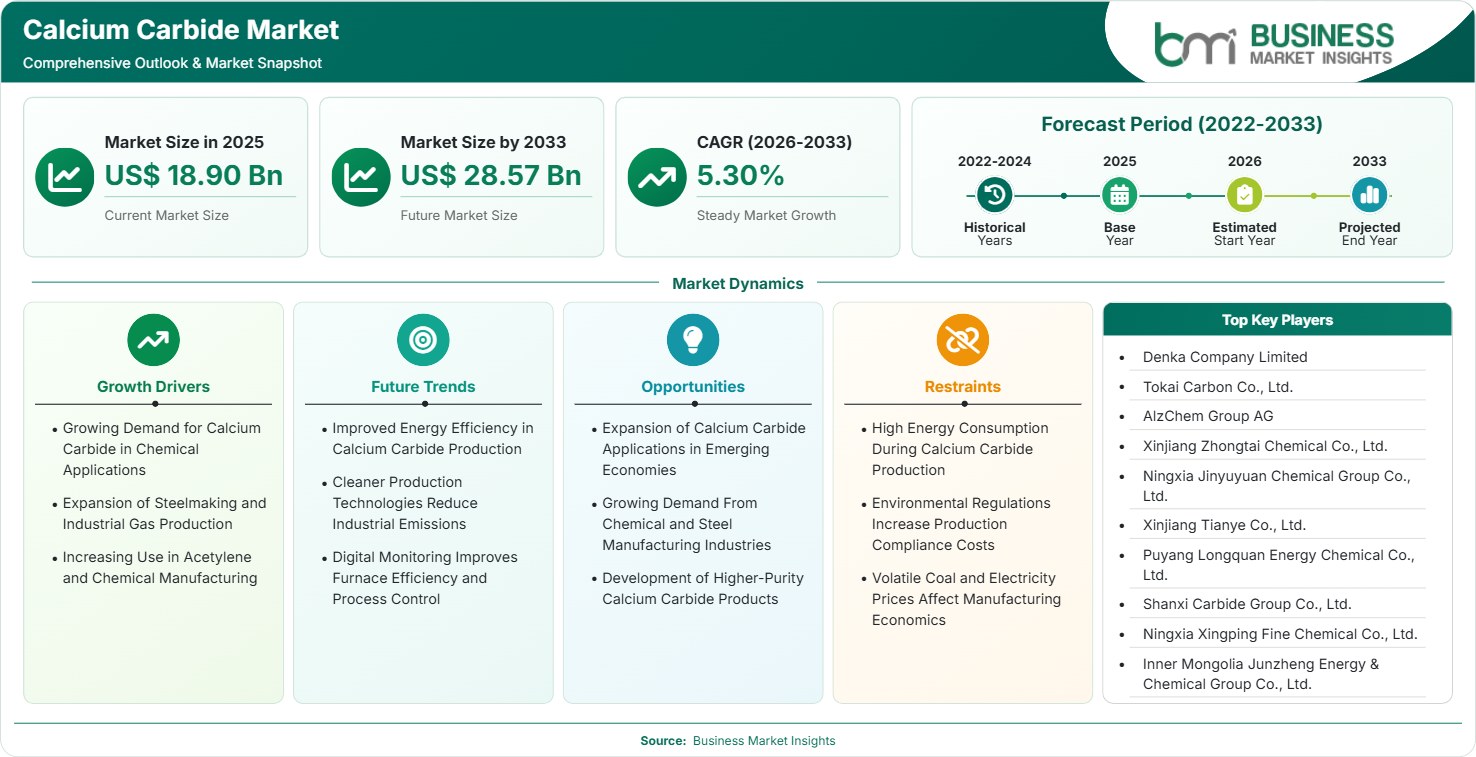
The Calcium Carbide Market size was valued at US$ 18.90 Billion in 2025 and is projected to reach US$ 28.57 Billion by 2033, growing at a CAGR of 5.30% during 2026–2033, driven by chemical processing, industrial gases, emerging-market manufacturing, and higher-purity product demand.

Report Coverage
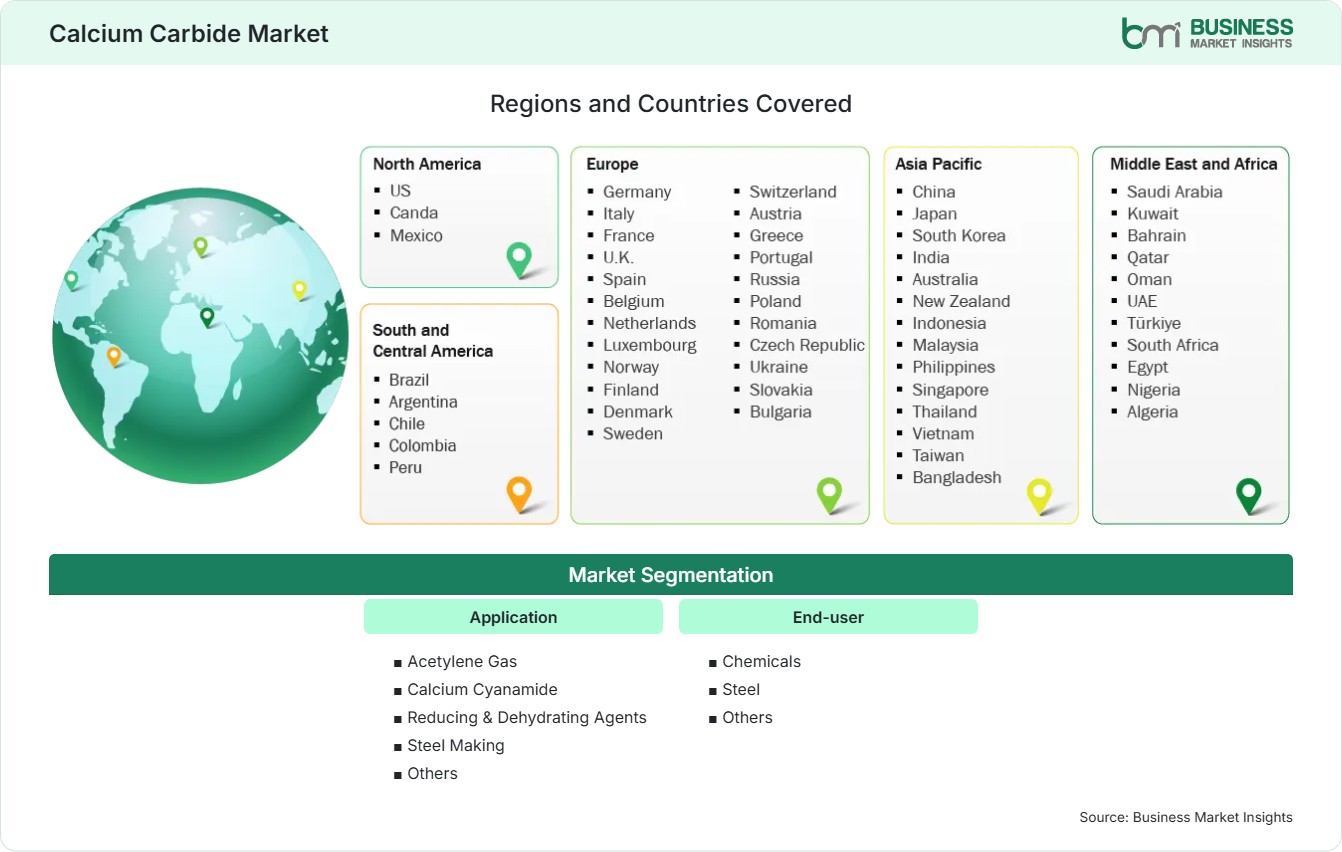
  • Application: Acetylene Gas, Calcium Cyanamide, Reducing & Dehydrating Agents, Steel Making, Others
  • End-user: Chemicals, Steel, Others
US$ 18.90 Bn Market size in 2025
US$ 28.57 Bn Market Size by 2033
5.30% CAGR, 2026 - 2033
2026-2033 Forecast Period

AI Overview

Calcium Carbide Market Summary

  • North America Region: North America accounts for a modeled 8%–11% Calcium Carbide Market share in 2025 and expands at a 4.4%–5.2% CAGR, supported by chemical processing, steel production, and demand for dependable carbide supply chains. The US remains the principal regional market, with demand expanding at a 4.5%–5.3% CAGR as chemical manufacturers and steel producers prioritize reliable raw-material availability.
  • Fastest Growing Region: Asia Pacific accounts for a modeled 70%–74% share in 2025 and expands at a 5.6%–6.3% CAGR, supported by chemical manufacturing, steelmaking, acetylene production, industrialization, integrated carbide production, and expanding downstream processing capacity.
  • Leading Segment: Acetylene Gas accounts for a modeled 35%–39% share in 2025 and expands at a 5.2%–5.9% CAGR, supported by chemical synthesis, welding applications, industrial gases, and continued demand for acetylene-derived products across manufacturing industries.
  • High Growth Segment: Chemicals end-user accounts for a modeled 47%–51% share in 2025 and expands at a 5.5%–6.1% CAGR, supported by acetylene derivatives, chemical intermediates, calcium cyanamide, synthesis processes, and increasing industrial chemical production.
  • Key Market Opportunity: Producers can strengthen margins through higher-purity grades, energy-efficient manufacturing, integrated downstream processing, improved handling systems, and differentiated supply arrangements serving chemical and steel customers.
  • Major Market Players: Denka Company Limited, Tokai Carbon Co., Ltd., AlzChem Group AG, Xinjiang Zhongtai Chemical Co., Ltd., Ningxia Jinyuyuan Chemical Group Co., Ltd., Xinjiang Tianye Co., Ltd., Puyang Longquan Energy Chemical Co., Ltd., Shanxi Carbide Group Co., Ltd., Ningxia Xingping Fine Chemical Co., Ltd., Inner Mongolia Junzheng Energy & Chemical Group Co., Ltd.
Strategic Insights

Calcium Carbide Market: Strategic Insights

Calcium Carbide Market Strategic Framework
FREE PDF
Request your free sample
Request free sample
Stakeholder View

Key Takeaways

  • Production economics remain strongly influenced by electricity, coke, lime, furnace utilization, and logistics, making feedstock integration and energy efficiency central to competitive positioning.
  • Chemical applications provide the strongest value-creation opportunity because acetylene and calcium-based intermediates create recurring downstream demand across multiple industrial processes.
  • Higher-purity grades can improve product differentiation as chemical manufacturers increasingly require tighter impurity control, consistent reactivity, and dependable material performance.
  • Asia Pacific remains the primary investment region because integrated chemical and steel ecosystems support large-scale production, downstream consumption, and cost-efficient supply arrangements.
  • Vertical integration is strategically important because producers that control raw materials, carbide production, downstream processing, and logistics can better manage cost volatility and supply continuity.
  • Environmental performance is becoming a stronger investment consideration, encouraging producers to prioritize furnace efficiency, energy optimization, emissions management, waste utilization, and lower-impact production systems.
Geographic Outlook

Calcium Carbide Market Regional Highlights

North America Calcium Carbide Market

North America accounts for a modeled 8%–11% share in 2025 and North America Calcium Carbide Market forecast to grow at a 4.4%–5.2% CAGR through 2033. Demand is supported by chemical manufacturing, steelmaking, acetylene applications, industrial gases, and specialized industrial processing. The regional market is more dependent on disciplined supply management than high-volume expansion. Producers and distributors benefit from proximity to chemical and metal-processing customers. The US represents the leading regional market, while Canada contributes through industrial and chemical applications.

  • Chemical manufacturers support demand through acetylene-derived synthesis and industrial processes requiring consistent carbide quality and controlled reactivity.
  • Steel producers use carbide-based materials in selected metallurgical processes, supporting recurring industrial demand where operational specifications require dependable product characteristics.
  • Domestic supply-chain reliability is increasingly important as industrial customers seek predictable deliveries, consistent specifications, and reduced exposure to international logistics disruptions.
  • Higher-purity products provide opportunities for suppliers targeting chemical processors requiring tighter impurity controls and more consistent downstream reaction performance.

US Calcium Carbide Market

The US Calcium Carbide Market accounts for a modeled 78%–82% of North American demand in 2025 and expands at a 4.5%–5.3% CAGR through 2033. Chemical processing and industrial applications remain important demand centers, while steelmaking and acetylene-related requirements provide additional consumption. The market favors reliable suppliers with consistent specifications, responsive logistics, and technical support. Domestic customers increasingly value supply continuity as carbide production remains energy intensive and transportation requirements can materially influence delivered costs.

  • Chemical processing remains an important demand center because acetylene and carbide-derived materials support multiple industrial synthesis and processing requirements.
  • Industrial gas applications create recurring consumption where acetylene generation requires consistent calcium carbide quality and predictable material reactivity.
  • Suppliers can strengthen competitiveness through regional distribution, inventory availability, technical support, and specifications aligned with individual customer process requirements.

Europe Calcium Carbide Market

Europe Calcium Carbide Market accounts for a modeled 7%–10% share in 2025 and expands at a 3.8%–4.8% CAGR through 2033. Germany, Italy, France, and Central European manufacturing markets represent important demand centers, while selected Eastern European economies provide higher-growth opportunities. Chemical processing, metallurgy, industrial gases, and specialized manufacturing sustain demand. Environmental requirements are influencing production economics, encouraging suppliers to improve energy efficiency and emissions management. Germany remains a leading market, while Central Europe offers comparatively stronger expansion potential.

  • Germany maintains strong industrial demand through chemical processing, metallurgy, industrial gases, and specialized manufacturing requiring dependable carbide supply.
  • France and Italy provide demand across chemical and industrial applications, with suppliers emphasizing product consistency, logistics reliability, and compliance-oriented manufacturing.
  • Central European markets provide higher-growth opportunities as industrial production and chemical processing capacity develop alongside regional manufacturing ecosystems.
  • Environmental compliance is increasing the importance of efficient furnace operation, emissions control, energy management, and responsible production practices.

Asia Pacific Calcium Carbide Market

Asia Pacific Calcium Carbide Market accounts for a modeled 70%–74% share in 2025 and expands at a 5.6%–6.3% CAGR through 2033. China remains the leading regional market, while India and Southeast Asia provide additional growth opportunities. Extensive chemical manufacturing, steel production, acetylene consumption, and integrated industrial infrastructure support demand. Production economics benefit from established feedstock networks and large industrial clusters. India represents a high-growth market as chemical manufacturing, steel capacity, industrial gases, and downstream processing continue to develop.

  • China remains the dominant regional production and consumption center, supported by integrated chemical, industrial, steel, and downstream manufacturing ecosystems.
  • India offers strong expansion potential through chemical manufacturing, steelmaking, acetylene applications, industrial gases, and growing domestic industrial processing capabilities.
  • Southeast Asian markets provide emerging opportunities as industrialization increases demand for chemical intermediates, metal processing, and industrial gas applications.
  • Integrated production clusters provide cost advantages by connecting feedstocks, electricity, carbide manufacturing, downstream processing, and logistics within concentrated industrial ecosystems.
  • Producers increasingly emphasize energy efficiency and process optimization to protect margins because electricity consumption remains a major component of carbide production economics.

Rest of World Calcium Carbide Market

Rest of World accounts for a modeled 7%–11% share in 2025 and expands at a 4.8%–5.8% CAGR through 2033. South and Central America are supported by chemical processing, metallurgy, industrial gases, and regional manufacturing requirements. Brazil and Mexico represent important demand centers, while other industrializing economies provide additional opportunities. Local supply availability, transportation economics, and industrial development influence purchasing decisions. Import-dependent markets can create opportunities for suppliers with dependable logistics and regional distribution capabilities. The Middle East and Africa provide additional demand through chemical processing, metal production, industrial gases, and developing manufacturing ecosystems. Saudi Arabia, the United Arab Emirates, South Africa, and selected North African markets provide opportunities as industrial diversification expands.

  • Brazil provides demand through industrial processing and chemical applications, while regional distribution capabilities remain important for managing delivered product economics.
  • Mexico benefits from manufacturing and industrial activity, creating opportunities for carbide suppliers serving chemical, metal-processing, and industrial gas applications.
  • Saudi Arabia and the United Arab Emirates provide opportunities through industrial diversification, chemical manufacturing, metallurgy, and expanding downstream processing capabilities.
  • South Africa provides demand from industrial and metallurgical applications, with supply reliability and technical product specifications influencing procurement decisions.
Global Market Geography
FREE PDF
Request your free sample
Request free sample
Segment Analysis

Calcium Carbide Market Segmentation

Application

Acetylene Gas accounts for a modeled 35%–39% share in 2025 and expands at a 5.2%–5.9% CAGR through 2033. Chemical synthesis, industrial gases, welding, and downstream acetylene derivatives support demand. Calcium cyanamide and metallurgical uses provide additional consumption, while reducing and dehydrating applications diversify the demand base. Application-specific quality requirements increasingly influence supplier selection, particularly where reactivity and impurity levels affect downstream processes.

  • Acetylene Gas: Remains a major application because carbide reacts with water to generate acetylene used across chemical synthesis, industrial gases, fabrication, and related industrial processes.
  • Calcium Cyanamide: Supports nitrogen-based chemical production and agricultural-related applications, with demand influenced by downstream manufacturing requirements and availability of alternative production routes.
  • Reducing & Dehydrating Agents: Serves specialized industrial processes where calcium carbide contributes reducing or moisture-removal functions, supporting niche but technically differentiated consumption.
  • Steel Making: Supports metallurgical operations requiring carbide-based inputs for selected processing functions, with demand influenced by steel output, process requirements, and operating economics.

End-user

Chemicals account for a modeled 47%–51% share in 2025 and expand at a 5.5%–6.1% CAGR through 2033. Chemical manufacturers remain important customers because carbide supports acetylene production and multiple downstream synthesis pathways. Steel consumption remains closely linked to metallurgical production and process requirements. The segment structure favors producers capable of meeting application-specific specifications, maintaining consistent reactivity, and providing reliable industrial-scale supply. Higher-purity offerings can further strengthen chemical-sector value capture.

  • Chemicals: Represents the leading end-user because calcium carbide supports acetylene generation, chemical intermediates, synthesis processes, and other downstream manufacturing requirements.
  • Steel: Uses calcium carbide in selected metallurgical applications, with demand influenced by steel production, process efficiency, material specifications, and operating requirements.
Market Forces

Calcium Carbide Market Dynamics

Key Market Drivers

Growing Demand for Calcium Carbide in Chemical Applications

Chemical processing continues to be a major driving force for demand as the calcium carbide serves as a crucial feedstock for the production of acetylene. Acetylene has various pathways for synthesis; hence, carbide usage is strongly related to industrial chemical processing. Demand gets stronger when manufacturers need to have a reliable source of feedstock with stable reaction properties. Manufacturers having integrated facilities and logistics to solve such problems could fulfill these demands while making supply more reliable. Consequently, the Calcium Carbide Market growth is driven by demand in the chemical industry.

Expansion of Steelmaking and Industrial Gas Production

Steel manufacturing and production of industrial gases form further bases of demand because they tie the use of calcium carbide into established manufacturing processes. The steel applications will create a repeatable demand for carbide in selected steelmaking processes, whereas the acetylene process forms part of the manufacturing process that produces industrial gases. Demand in such cases is shaped by volumes of production, utilization of plants, process economics, and customer demands. With the development of industrial manufacturing capacity in emerging economies, such applications can offer incremental demand opportunities.

Increasing Use in Acetylene and Chemical Manufacturing

Acetylene remains a critical source of calcium carbide consumption due to its flexibility as a chemical feedstock for subsequent processing. The stability of calcium carbide properties is essential in maintaining a consistent production of acetylene and other downstream processes. These conditions provide a growth factor for manufacturers to improve consistency, moisture content, impurities, and packaging of the material based on customer specifications. Some chemical manufacturers might prefer suppliers who can deliver stable supplies of the material at a commercial level, especially when their production processes depend on carbide supply. These factors support Calcium Carbide Market trends involving downstream integration and closer producer-customer coordination.

Key Market Opportunities

Expansion of Calcium Carbide Applications in Emerging Economies

Emerging markets present opportunities, since there is increased manufacture of chemicals, steel, industrial gases, and downstream processes. An increase in the number of industries presents new demands for calcium carbide and increases the need for reliable supplies of raw materials. Such opportunities can be exploited using regional logistics and reliable long-term supply contracts. The clustering of factories offers the advantage of proximity to the consumers, which simplifies logistics.

Growing Demand from Chemical and Steel Manufacturing Industries

Increased manufacturing of chemicals and steel is an extensive market opportunity due to the fact that both these industries are associated with a recurring industrial need for calcium carbide. While the chemical industry can fulfill the need through acetylene and subsequent synthesis, the steel industry can fulfill the need through metallurgical consumption. There are a number of opportunities for the suppliers in terms of product development, technical services, and supply agreements based on industrial needs.

Development of Higher-Purity Calcium Carbide Products

Higher-purity calcium carbide offers an opportunity to move competition toward product quality rather than volume and price alone. Chemical manufacturers can require tighter impurity control, predictable reactivity, controlled particle characteristics, and consistent moisture levels for sensitive downstream processes. Producers can respond by improving feedstock quality, furnace control, screening, storage, packaging, and quality-assurance systems. Higher-purity products can also support closer technical collaboration because customers may require specifications tailored to particular chemical processes. This creates potential for stronger customer retention and differentiated commercial relationships.

Market Restraints and Challenges

High Energy Consumption During Calcium Carbide Production

Factor: The production of calcium carbide utilizes energy-intensive electric furnaces, making electricity availability, costs, and furnace efficiency an integral part of production costs. Impact: Energy intensive nature makes it expensive, reducing the profit margin and competitiveness in case of increased cost of electricity or uncertain electricity supply. Producers must therefore reduce process losses, optimize furnace operation, and improve energy utilization.

Environmental Regulations Increase Production Compliance Costs

Factor: Calcium carbide production involves energy-intensive processing and environmental management requirements that can increase obligations related to emissions, waste handling, resource use, and plant operations. Impact: Tighter environmental requirements can raise capital expenditure, operating costs, monitoring requirements, and compliance complexity for producers. Manufacturers may need to upgrade process controls, improve emissions management, strengthen waste-handling systems, and invest in more efficient equipment.

Company Analysis

Competitive Landscape

Calcium Carbide Market analysis shows a competitive environment that depends on production scale, availability of feedstocks, cost of power supply, product uniformity, integration with downstream industries, and geographical location relative to customers in the chemicals and steel industry. Big companies have an advantage due to their raw materials supply management and downstream integration.

Company Name

Overview

Products and Services relevant to this market

Denka Company Limited

Japanese chemicals and materials producer with capabilities across specialty and industrial chemical applications.

Calcium carbide-related materials, industrial chemicals, specialty chemical products, and downstream processing capabilities.

Tokai Carbon Co., Ltd.

Carbon materials company with broad industrial manufacturing expertise and strong process-material capabilities.

Carbon materials, industrial products, specialty materials, and chemical-related manufacturing technologies relevant to industrial supply chains.

AlzChem Group AG

German specialty chemicals producer with expertise in nitrogen-carbon chemistry and industrial chemical manufacturing.

Calcium carbide, calcium cyanamide, downstream chemical products, and specialized nitrogen-based industrial materials.

Xinjiang Zhongtai Chemical Co., Ltd.

Integrated Chinese chemical producer with extensive chlor-alkali and industrial chemical manufacturing operations.

Calcium carbide, industrial chemicals, chemical intermediates, and integrated upstream and downstream manufacturing products.

Ningxia Jinyuyuan Chemical Group Co., Ltd.

Chinese industrial chemical producer operating within an integrated energy and chemical manufacturing environment.

Calcium carbide and related industrial chemical products serving downstream chemical and manufacturing applications.

Xinjiang Tianye Co., Ltd.

Integrated chemical producer with established operations across industrial chemicals and related manufacturing chains.

Calcium carbide, chlor-alkali products, chemical intermediates, and associated industrial chemical materials.

Puyang Longquan Energy Chemical Co., Ltd.

Chinese energy and chemical producer with integrated industrial production capabilities.

Calcium carbide and associated chemical products supporting downstream industrial manufacturing applications.

Shanxi Carbide Group Co., Ltd.

Chinese carbide producer focused on industrial-scale calcium carbide manufacturing and supply.

Calcium carbide products serving acetylene generation, chemical processing, and industrial applications.

Ningxia Xingping Fine Chemical Co., Ltd.

Chinese chemical manufacturer supplying carbide-related materials to industrial downstream customers.

Calcium carbide and chemical products supporting acetylene, chemical processing, and industrial applications.

Inner Mongolia Junzheng Energy & Chemical Group Co., Ltd.

Integrated energy and chemical producer with substantial industrial manufacturing infrastructure.

Calcium carbide, chlor-alkali chemicals, PVC-related products, and integrated chemical-chain materials.

Trust & Transparency

Research Methodology

The market analysis combines proprietary research with secondary data from government agencies, company disclosures, regulatory filings, industry databases and expert interviews. Market estimates are validated through data triangulation, cross-market benchmarking and analyst review.

View Full Research Methodology

Questions Answered

Frequently Asked Questions

Why is energy efficiency important for calcium carbide producers?

Electricity is a major production input because calcium carbide is manufactured through high-temperature furnace processing. Improving furnace efficiency can reduce production costs, strengthen margins, and support environmental performance.

Which industries create the strongest demand in Calcium Carbide Market report?

Chemical manufacturing represents the principal demand base, while steelmaking and industrial gas applications provide additional consumption. Demand depends on downstream process requirements and industrial production activity.

How can producers differentiate calcium carbide products?

Producers can differentiate through purity, particle consistency, reactivity, moisture control, packaging, technical support, supply reliability, and specifications tailored to individual downstream applications.

Why is calcium carbide important for acetylene production?

Calcium carbide reacts with water to generate acetylene gas, making it an established feedstock for industrial gas production and downstream chemical synthesis where acetylene is required.

What raw materials are essential for calcium carbide production?

The principal inputs are lime and carbonaceous materials, while electricity is essential for the high-temperature furnace process. Their availability, quality, and delivered cost directly influence production economics and product consistency.

Access the Full Calcium Carbide Market Report

Get segment-level forecasts, regional estimates, competitive benchmarking, company profiles and downloadable Excel datasets.

Access the full Calcium Carbide Market Report
350 pages PDF & Excel | 2026-08-20
Similar Research

Related Market Reports