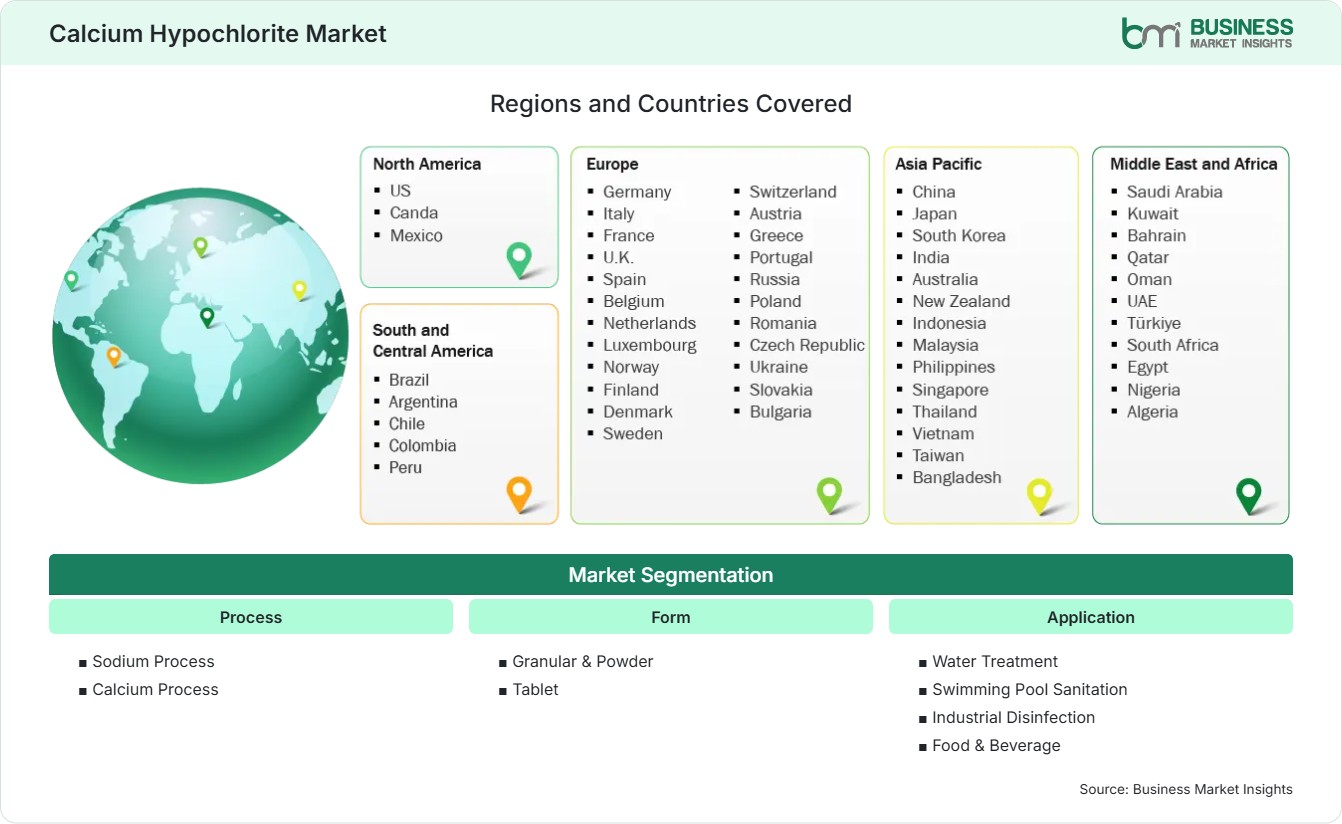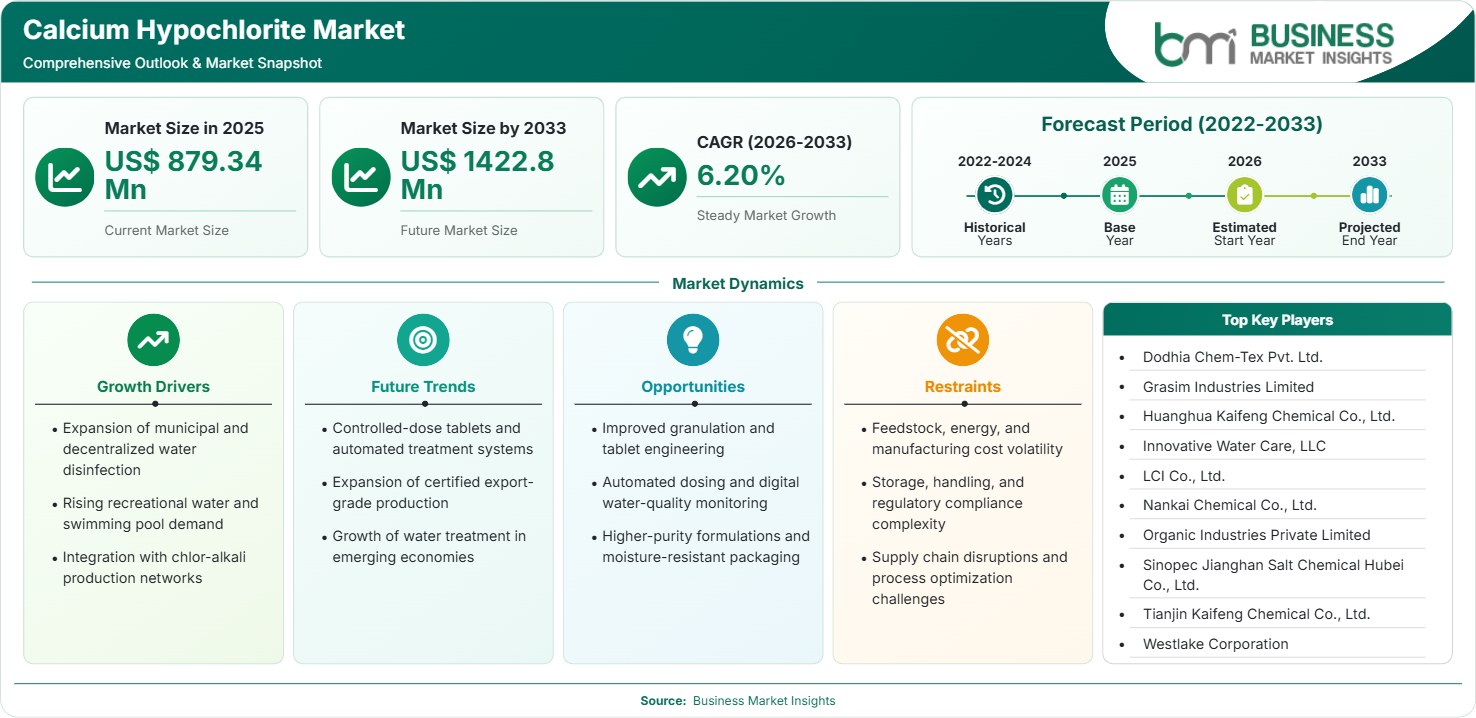
Calcium Hypochlorite Market Regional Highlights
North America Calcium Hypochlorite Market
North America accounts for 22%–25% Calcium Hypochlorite Market share in 2025 and is projected to grow at a 5.6%–6.1% CAGR during 2026–2033. Demand is supported by municipal water treatment, swimming pools, industrial sanitation, and replacement purchases. The region benefits from established distribution networks and stringent quality expectations. U.S. demand dominates regional consumption, while Canada and Mexico provide supplementary opportunities through municipal treatment and recreational water applications. Regulatory requirements favor certified formulations, traceable supply, and consistent active-chlorine performance across diverse end-use environments.
- Municipal utilities provide resilient baseline demand because chlorine-based disinfection remains integral to microbiological control, while replacement cycles create recurring purchases independent of new infrastructure construction.
- Commercial and residential swimming pools sustain granular and tablet consumption, with automated feeders and easier dosing formats supporting higher-value products where operators prioritize consistency and labor efficiency.
- Industrial users increasingly evaluate disinfectant performance alongside water reuse, corrosion management, and operational safety, creating opportunities for suppliers offering application-specific formulations and technical service.
- Import logistics and domestic manufacturing capacity influence regional pricing, making dependable inventories strategically important during seasonal pool demand peaks, maintenance shutdowns, and supply-chain disruptions.
US Calcium Hypochlorite Market
The U.S. represents 72%–76% of North American Calcium Hypochlorite Market demand in 2025 and is projected to grow at a 5.5%–6.0% CAGR during 2026–2033. Its scale reflects extensive municipal treatment infrastructure, commercial pools, recreational facilities, food processing, and industrial water applications. Product registration and drinking-water standards encourage suppliers to maintain documented quality. EPA records also show active calcium hypochlorite registrations associated with Westlake Corporation, demonstrating the continuing regulatory relevance of chlorinated treatment products.
- Pool sanitation creates substantial seasonal demand, particularly for tablets and granules, while professional operators increasingly favor formulations that simplify storage, feeding, and routine chlorine management.
- Municipal systems prioritize reliable active-chlorine delivery and regulatory documentation, supporting suppliers with certified products, stable logistics, technical assistance, and consistent batch quality.
- Food and beverage applications create specialized demand because calcium hypochlorite can support antimicrobial water treatment under controlled processing conditions, subject to applicable food-safety requirements.
Europe Calcium Hypochlorite Market
Europe represents 18%–21% Calcium Hypochlorite Market share in 2025 and is projected to expand at a 5.4%–5.9% CAGR during 2026–2033. Germany, France, Italy, Spain, and the United Kingdom provide established demand, while Spain and Poland offer comparatively stronger growth potential. Water-quality compliance, pool sanitation, wastewater treatment, and industrial hygiene support consumption. Buyers increasingly emphasize certified chemistry, safe packaging, supply reliability, and traceability as environmental and occupational requirements become more integrated into chemical procurement decisions.
- Germany remains an important industrial and municipal market, with demand linked to treatment reliability, manufacturing water systems, and professional sanitation requirements across large installed infrastructure.
- Spain and Italy benefit from extensive recreational pool infrastructure and warm-season demand, creating attractive opportunities for tablets, granules, distributors, and specialized dosing equipment.
- European procurement increasingly rewards documented product quality, regulatory conformity, and responsible chemical handling, encouraging suppliers to strengthen certifications, packaging controls, and technical documentation.
- Eastern European infrastructure upgrades provide incremental growth opportunities as municipalities and industrial operators modernize water treatment and disinfection systems.
Asia Pacific Calcium Hypochlorite Market
Asia Pacific holds 40%–44% Calcium Hypochlorite Market share in 2025 and is projected to grow at a 6.8%–7.4% CAGR during 2026–2033, making it the fastest-growing regional market. China leads regional production and supply, while India, Japan, South Korea, Indonesia, and Vietnam contribute substantial consumption. India and Southeast Asia offer particularly attractive growth prospects as urbanization, industrialization, sanitation programs, and recreational facilities expand. Local manufacturing and export-oriented production strengthen regional availability and cost competitiveness.
- China combines extensive manufacturing capacity with export-oriented supply chains, giving regional buyers access to sodium-process and calcium-process products across multiple grades and formats.
- India offers strong downstream potential through municipal infrastructure, industrial water treatment, food processing, agriculture-related sanitation, and rapidly expanding commercial swimming-pool installations.
- Southeast Asian economies are increasing investment in urban sanitation, tourism facilities, industrial parks, and water reuse, supporting demand for compact, stable solid disinfectant products.
- Japan and South Korea emphasize quality, certification, and application performance, supporting premium formulations and technically differentiated products for municipal, industrial, and recreational water treatment.
Rest of World Calcium Hypochlorite Market
Rest of World represents 12%–15% Calcium Hypochlorite Market share in 2025 and is projected to grow at a 6.1%–6.7% CAGR during 2026–2033. South and Central America benefit from municipal sanitation, mining, food processing, and pool applications, while Brazil, Mexico, and Chile provide leading opportunities. Middle Eastern and African demand is supported by water scarcity, desalination-related treatment, municipal infrastructure, and industrial reuse. Saudi Arabia, the United Arab Emirates, Egypt, and South Africa provide attractive growth markets.
- Brazil and Mexico provide strong demand bases through municipal treatment, food processing, commercial pools, and industrial water management, while distributor networks remain important for regional penetration.
- Chile and Peru present specialized opportunities where mining operations require dependable water disinfection, process-water management, and sanitation solutions under demanding operating conditions.
- Saudi Arabia and the United Arab Emirates benefit from water scarcity, large-scale infrastructure, hospitality facilities, and industrial water reuse, creating demand for stable high-available-chlorine products.
- Egypt and South Africa offer opportunities linked to municipal sanitation and industrial treatment, although procurement can be sensitive to foreign-exchange movements, freight costs, and local distribution capabilities.