
Sodium Hypochlorite Market Outlook: Size, Share, Trends, Growth Analysis, Competitive Landscape & Forecast, 2026–2033

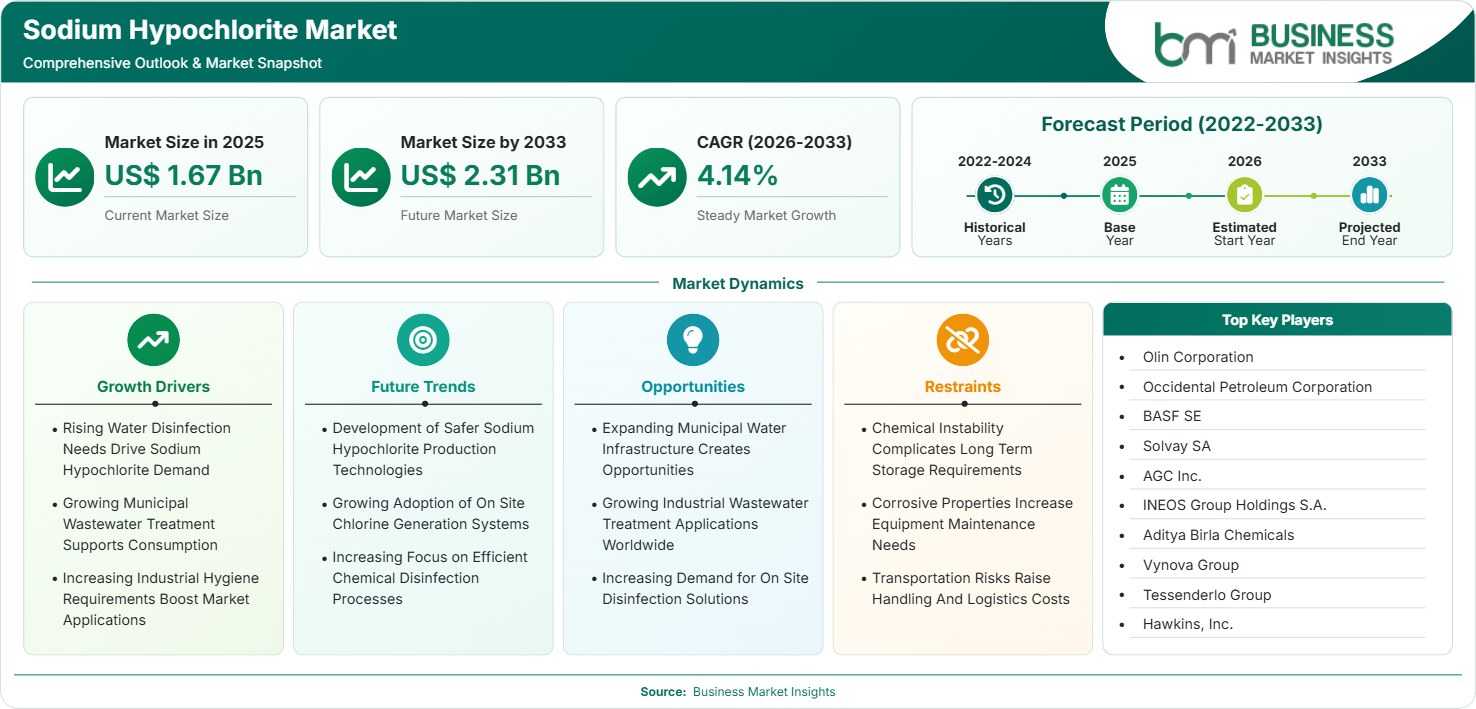
The Sodium Hypochlorite Market size was valued at US$ 1.67 Billion in 2025 and is projected to reach US$ 2.31 Billion by 2033, growing at a CAGR of 4.14% during 2026–2033, driven by water disinfection requirements, wastewater treatment expansion, industrial hygiene needs, municipal infrastructure investment, and demand for on-site disinfection.

Report Coverage
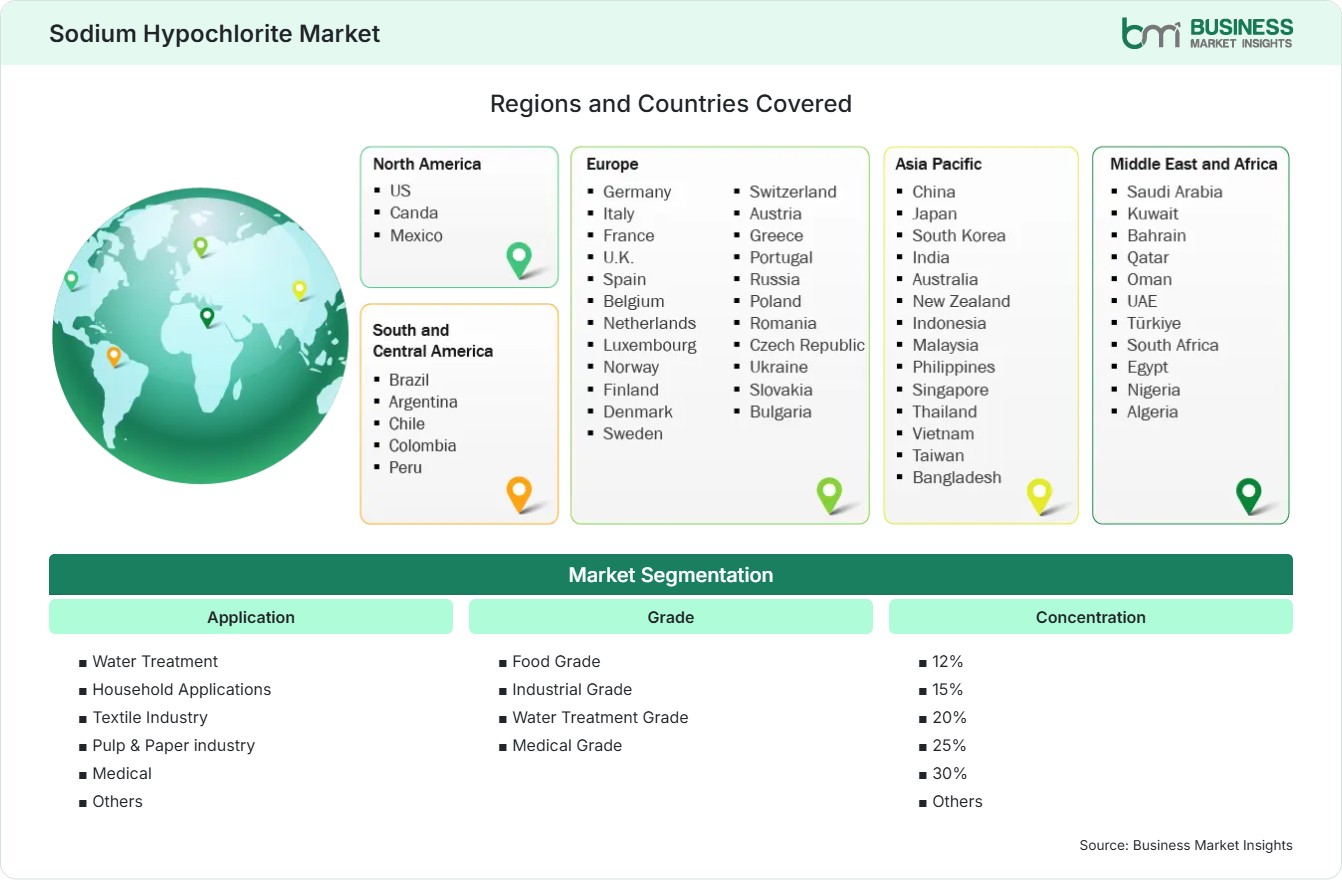
  • Application: Water Treatment, Household Applications, Textile Industry, Pulp & Paper industry, Medical, Others
  • Grade: Food Grade, Industrial Grade, Water Treatment Grade, Medical Grade
  • Concentration: 12%, 15%, 20%, 25%, 30%, Others
US$ 1.67 Bn Market size in 2025
US$ 2.31 Bn Market Size by 2033
4.14% CAGR, 2026 - 2033
2026-2033 Forecast Period

AI Overview

Sodium Hypochlorite Market Summary

  • North America: North America holds a 28%–31% share in 2025 and is growing at a 3.8%–4.5% CAGR through 2033, supported by established municipal water treatment infrastructure, industrial sanitation requirements, and demand for reliable chlorination solutions. The US Sodium Hypochlorite Market accounts for a 24%–27% global share and is advancing at a 3.9%–4.6% CAGR, supported by municipal disinfection, food processing, healthcare sanitation, and industrial water management.
  • Fastest Growing Region: Asia Pacific holds a 31%–34% share in 2025 and is advancing at a 4.8%–5.5% CAGR, supported by urbanization, wastewater treatment investments, industrial expansion, drinking-water infrastructure development, and growing adoption of localized chemical dosing systems.
  • Leading Segment: Water Treatment accounts for a 43%–47% share in 2025 and is advancing at a 4.1%–4.7% CAGR, supported by municipal disinfection, wastewater management, drinking-water treatment, and demand for established chlorine-based treatment processes.
  • High Growth Segment: Medical applications represent a 7%–10% share in 2025 and are advancing at a 5.0%–5.8% CAGR, supported by hygiene requirements, surface disinfection, institutional sanitation, and growing attention to infection-control practices.
  • Key Market Opportunity: Expanding municipal and industrial water infrastructure creates opportunities for localized sodium hypochlorite generation, automated dosing systems, safer chemical handling, and integrated disinfection solutions.
  • Major Market Players: Olin Corporation, Occidental Petroleum Corporation, BASF SE, Solvay SA, AGC Inc., INEOS Group Holdings S.A., Aditya Birla Chemicals, Vynova Group, Tessenderlo Group, Hawkins, Inc.
Strategic Insights

Sodium Hypochlorite Market: Strategic Insights

Sodium Hypochlorite Market Strategic Framework
FREE PDF
Request your free sample
Request free sample
Stakeholder View

Key Takeaways

  • Municipal drinking-water and wastewater treatment remains the principal demand foundation because sodium hypochlorite integrates effectively with established chlorination and chemical-dosing infrastructure.
  • Industrial users are increasingly evaluating disinfection solutions according to handling safety, dosing consistency, storage requirements, equipment compatibility, and operational continuity.
  • On-site generation systems can create attractive opportunities by reducing dependence on long-distance transportation and enabling treatment facilities to produce disinfectant closer to the point of consumption.
  • Asia Pacific presents strong expansion potential as urban development, industrialization, wastewater infrastructure, and investments in public water systems increase chemical treatment requirements.
  • Product differentiation is shifting toward concentration management, packaging, automated dosing compatibility, supply reliability, technical support, and solutions designed for specific treatment environments.
  • Long-term competitive positioning will depend on balancing effective disinfection performance with storage stability, corrosion management, regulatory compliance, operational safety, and total treatment economics.
Geographic Outlook

Sodium Hypochlorite Market Regional Highlights

North America Sodium Hypochlorite Market

North America holds a 28%–31% share in 2025 and is projected to grow at a 3.8%–4.5% CAGR through 2033. Mature municipal treatment networks and industrial sanitation requirements provide a stable demand base across the region.

  • Municipal water utilities continue to use chlorine-based disinfection processes across drinking-water and wastewater treatment applications.
  • Food processing, institutional facilities, healthcare environments, and commercial sanitation provide additional demand outside municipal treatment.
  • Operators increasingly prioritize automated dosing and monitoring systems that improve consistency while reducing direct chemical-handling requirements.
  • Replacement and modernization of aging treatment infrastructure support demand for compatible chemical-disinfection solutions.

US Sodium Hypochlorite Market

The US represents a 24%–27% global share in 2025 and is advancing at a 3.9%–4.6% CAGR through 2033. Demand is supported by municipal treatment, industrial water management, food sanitation, and institutional hygiene.

  • Water utilities provide a dependable consumption base through drinking-water and wastewater disinfection programs.
  • Industrial facilities increasingly require controlled chemical dosing for process-water treatment, sanitation, and wastewater management.
  • On-site chemical generation can appeal to facilities seeking greater supply control and reduced dependence on bulk transportation.
  • Distribution networks with local storage capabilities remain important because concentration and stability considerations influence handling and delivery requirements.

Europe Sodium Hypochlorite Market

Europe accounts for a 24%–27% Sodium Hypochlorite Market share in 2025 and is advancing at a 3.6%–4.3% CAGR. Germany, France, Italy, the UK, and Spain represent important demand centers due to established water-treatment infrastructure and industrial applications.

  • Municipal utilities continue to require dependable disinfection chemicals for drinking-water and wastewater operations.
  • Industrial users are placing greater emphasis on chemical handling, storage efficiency, corrosion control, and environmental management.
  • Food and beverage processing creates recurring demand for sanitation and water-treatment applications.
  • Infrastructure modernization can support replacement demand for dosing equipment and compatible chemical-disinfection systems.

Asia Pacific Sodium Hypochlorite Market

Asia Pacific represents a 31%–34% share in 2025 and records the fastest growth at a 4.8%–5.5% CAGR. China, Japan, India, South Korea, and Southeast Asia provide diverse opportunities across municipal and industrial treatment.

  • China benefits from extensive municipal wastewater management and continued investment in industrial water treatment.
  • India offers expanding opportunities as urban water infrastructure and wastewater-treatment capacity develop across municipalities and industrial clusters.
  • Japan and South Korea maintain sophisticated water-treatment systems, supporting demand for reliable chemical dosing and controlled disinfection.
  • Southeast Asia provides emerging opportunities as population growth, manufacturing expansion, tourism, and urban development increase water-treatment requirements.

Rest of World Sodium Hypochlorite Market

Rest of World holds a 15%–18% share in 2025 and is projected to grow at a 3.9%–4.7% CAGR. Latin America, the Middle East, and Africa offer opportunities linked to water availability, sanitation infrastructure, and industrial development.

Latin American demand is supported by municipal water treatment, food processing, mining, and industrial wastewater management. Middle Eastern countries require dependable disinfection solutions for water-intensive operations, while African Sodium Hypochlorite Markets provide longer-term opportunities as access to treated water and wastewater infrastructure expands.

  • Brazil provides demand across municipal water treatment, food processing, industrial sanitation, and wastewater management.
  • Mexico benefits from industrial facilities and municipal treatment programs requiring dependable chlorine-based disinfection.
  • Gulf countries offer opportunities linked to water reuse, desalination-related treatment processes, industrial facilities, and municipal infrastructure.
  • South Africa and other developing African markets provide expansion potential as sanitation and water-treatment capacity increases.
Global Market Geography
FREE PDF
Request your free sample
Request free sample
Segment Analysis

Sodium Hypochlorite Market Segmentation

Application

Water Treatment leads the application structure with a 43%–47% share in 2025 and a 4.1%–4.7% CAGR through 2033. Its position reflects recurring municipal and industrial requirements for drinking-water and wastewater disinfection.

  • Water Treatment: Supports drinking-water disinfection, wastewater treatment, oxidation processes, and microbial control across municipal, industrial, and institutional treatment facilities.
  • Household Applications: Serves household cleaning, surface sanitation, laundry-related applications, and general disinfection where diluted formulations are appropriate for consumer use.
  • Textile Industry: Supports bleaching, sanitation, and selected processing operations where controlled oxidation is required during textile manufacturing and finishing.
  • Pulp & Paper industry: Provides bleaching and process-treatment applications, particularly where controlled chemical oxidation supports pulp processing and operational hygiene.
  • Medical: Supports institutional sanitation and selected disinfection applications where controlled chemical treatment is required within healthcare environments.

Grade

Industrial Grade accounts for a 46%–50% share in 2025 and is advancing at a 4.0%–4.6% CAGR. Its broad applicability across manufacturing, water treatment, sanitation, and industrial processing supports sustained consumption.

  • Food Grade: Serves applications requiring appropriate purity and controlled chemical characteristics for food-related processing and sanitation environments.
  • Industrial Grade: Provides versatile performance for industrial water treatment, manufacturing processes, sanitation, chemical processing, and other large-scale applications.
  • Water Treatment Grade: Is formulated for controlled use in drinking-water and wastewater treatment, where dependable disinfection performance and dosing consistency are essential.
  • Medical Grade: Addresses specialized institutional and healthcare-related applications requiring carefully controlled chemical specifications and appropriate handling procedures.

Concentration

The 12% concentration segment holds a 31%–35% share in 2025 and is advancing at a 4.2%–4.8% CAGR. Its widespread applicability and manageable handling characteristics support adoption across multiple treatment environments.

  • 12%: Provides a widely applicable concentration for water treatment, sanitation, and industrial applications where controlled dosing and practical handling are required.
  • 15%: Supports applications requiring somewhat higher active chlorine content while remaining suitable for established chemical storage and dosing systems.
  • 20%: Serves industrial users seeking higher concentration solutions that can reduce delivered chemical volume for selected treatment requirements.
  • 25%: Addresses applications where higher active chlorine concentration can improve transportation and storage efficiency under appropriate handling conditions.
  • 30%: Provides concentrated chemical supply for specialized industrial and treatment applications requiring higher active chlorine content and controlled dosing.
Market Forces

Sodium Hypochlorite Market Dynamics

Key Market Drivers

Rising Water Disinfection Needs Drive Sodium Hypochlorite Demand

Growing demands for safe drinking water and effective treatment of sewage are driving demand for reliable chemical disinfectants. Sodium hypochlorite will continue to be used due to the ease with which the treatment plants can incorporate sodium hypochlorite with the current dosing and monitoring systems. The municipal utility companies will need to ensure reliable microbial control in varying amounts of water, while the industries are employing disinfection techniques to enhance process water quality. Increased re-use of water could further drive the demand for chemical disinfection treatments as the operators of the water are required to control the microbial risks in more elaborate treatment systems. Such suppliers that offer steady concentrations, reliable deliveries, and technical service will have an advantage in dealing with utilities and industrial clients.

Growing Municipal Wastewater Treatment Supports Consumption

The growing expansion of capacity for municipal wastewater treatment is creating a consistent need for chemicals involved in disinfection and oxidation treatment processes. As population and urban development grow, increasing the volume of wastewater production, municipalities look for increasing treatment capacity and effluent management. The use of sodium hypochlorite may be added to existing systems, and it can be used in facilities that want an assured supply of chemicals without having to modify their treatment processes. Growing interest in water recycling adds to the possibility of consumption because the treated effluent might need further microorganism elimination before being disposed of or recycled. The suppliers may benefit from providing options for concentration levels, delivery options, storage options, and technical support.

Increasing Industrial Hygiene Requirements Boost Market Applications

There is now an increasing need for control in the sanitization of industrial plants, including their production areas, water used in processes, equipment, and even wastewater streams. Disinfection by chemicals can be necessary in operations like food and beverage manufacturing, textile, pulp and paper industries, chemicals, health-care related industries, and others. Sodium hypochlorite is a well-known and easily scalable option for disinfection, which can be easily integrated into the existing dosing systems. There is a need for chemical consumption to be assessed along with issues like worker safety, equipment compatibility, storage, and maintenance in the industrial sector. It means that suppliers have to offer specific solutions rather than commodity chemicals. Increases in industrial production in developing nations will also boost consumption as more factories establish formal sanitation and water management systems.

Key Market Opportunities

Expanding Municipal Water Infrastructure Creates Opportunities

Water networks, wastewater treatment, water recycling facilities, and treatment plants are areas where investments can offer opportunities for sodium hypochlorite suppliers because new facilities need reliable chemical disinfection systems, whereas existing facilities would require replacement of dosing systems and tanks. Integration of products and services such as chemical supply, dosing equipment, and storage facilities will allow suppliers to distinguish themselves. Local production and distribution of products could be beneficial in case there are problems with the transportation of chemicals to certain locations. The Sodium hypochlorite market forecast is likely to create opportunities for those companies whose products fulfill government and utility company criteria for sanitation and water quality. Those companies having product specifications meeting the municipal procurement criteria stand a chance of getting repeat orders.

Growing Industrial Wastewater Treatment Applications Worldwide

The wastewater treatment industry offers an ideal opportunity for expansion since industries now require treatment for discharge control, water reuse, and sanitization issues. High-volume industries could consider disinfection via chemicals as one step of their treatment system, which would ensure steady demand depending on the volume of operations. This Sodium Hypochlorite Market trend is encouraging suppliers to consider industrial clients through concentration and delivery models that are dependent on storage and dose requirements. Manufacturing plants in the APAC and Latin American regions could present new opportunities as management systems get well-established in those regions. The technical service offering is another source of competitive advantage since industrial customers would have different needs regarding concentration, dose, and storage, among others.

Increasing Demand for On Site Disinfection Solutions

The onsite disinfection products have a way of resolving supply chain and logistics issues related to liquid disinfectants, where the onsite generation systems provide a means of production of sodium hypochlorite near where the product is going to be used, thus eliminating the need for bulk shipments and improving supply chain management. This system will appeal to facilities such as those far from urban areas, treatment plants, industries, and those where water treatment requirements are known and predictable. Equipment manufacturers and chemical suppliers may work together to offer an integrated generation, dosing, monitoring, and maintenance system. The model offers a chance of earning from equipment maintenance services. Adoption depends on capital investment, availability of electricity and salt, technical knowledge, and economic feasibility of making disinfectant at home vs buying chemical disinfectant.

Market Restraints and Challenges

Chemical Instability Complicates Long Term Storage Requirements

Factor: Sodium hypochlorite can lose active chlorine strength during storage, with degradation influenced by factors such as temperature, concentration, light exposure, impurities, and storage duration. Impact: Product stability requirements can increase inventory-management complexity and encourage customers to optimize delivery frequency, storage conditions, and concentration selection. Suppliers must maintain appropriate production, packaging, transportation, and storage practices to preserve product quality. Customers may also need controlled storage environments and inventory rotation procedures. These requirements can affect logistics costs and reduce the attractiveness of maintaining large inventories. On-site generation can provide an alternative in applications where stable supply and operational control justify investment in generation equipment.

Corrosive Properties Increase Equipment Maintenance Needs

Factor: Sodium hypochlorite is corrosive and can affect storage tanks, piping, pumps, valves, dosing equipment, and other components when materials are poorly selected or operating conditions are unsuitable. Impact: Facilities may incur higher maintenance requirements and need corrosion-resistant equipment to maintain safe and reliable operations. Proper material selection, system design, inspection, and maintenance are therefore important considerations when implementing chemical-dosing infrastructure. Equipment suppliers can address this challenge by offering compatible components and technical guidance. Higher upfront infrastructure requirements may influence purchasing decisions, particularly among smaller industrial users. However, improved equipment design and preventive maintenance can help reduce operational disruptions and extend system service life.

Company Analysis

Competitive Landscape

The Sodium Hypochlorite Market analysis indicates competition among large chemical producers, integrated chlor-alkali companies, regional manufacturers, and specialty chemical suppliers. Competitive differentiation centers on production scale, supply reliability, concentration options, geographic coverage, distribution capabilities, technical support, and integration with water-treatment applications.

Company Name

Overview

Products and Services relevant to this market

Olin Corporation

Major integrated chemical producer with established chlor-alkali capabilities and broad industrial customer reach.

Sodium hypochlorite, chlorine-based chemicals, chlor-alkali products, industrial water-treatment chemicals, and related chemical solutions.

Occidental Petroleum Corporation

Diversified chemical producer with significant chlor-alkali operations serving industrial and water-treatment customers.

Sodium hypochlorite, chlorine, caustic soda, chlor-alkali chemicals, and industrial chemical solutions.

BASF SE

Global chemical company serving numerous industrial applications through a broad portfolio and international distribution network.

Sodium hypochlorite-related chemical solutions, water-treatment chemicals, industrial chemicals, and process-support products.

Solvay SA

Specialty and essential chemicals company with established capabilities across industrial and water-related applications.

Hypochlorite and chlorine chemistry, water-treatment solutions, industrial chemicals, and specialty chemical products.

AGC Inc.

Diversified materials and chemicals company with established chlor-alkali and chemical manufacturing capabilities.

Sodium hypochlorite, chlor-alkali chemicals, industrial chemicals, water-treatment applications, and chemical intermediates.

INEOS Group Holdings S.A.

Large chemical producer with integrated manufacturing assets and extensive global industrial distribution.

Sodium hypochlorite, chlorine derivatives, chlor-alkali chemicals, industrial treatment products, and chemical solutions.

Aditya Birla Chemicals

Chemical manufacturer serving industrial customers across multiple applications and geographic markets.

Chlor-alkali products, sodium hypochlorite, caustic soda, chlorine derivatives, and water-treatment chemicals.

Vynova Group

European chlor-alkali producer with established manufacturing and supply capabilities.

Sodium hypochlorite, chlorine, caustic soda, chlor-alkali products, and industrial chemical solutions.

Tessenderlo Group

Diversified industrial company with chemical activities supporting water treatment and other industrial applications.

Sodium hypochlorite, chlor-alkali chemicals, water-treatment products, and industrial chemical solutions.

Hawkins, Inc.

Specialty chemical distributor and manufacturer serving water treatment and industrial customers across regional markets.

Sodium hypochlorite, water-treatment chemicals, chemical distribution, technical support, and industrial treatment solutions.

Trust & Transparency

Research Methodology

The market analysis combines proprietary research with secondary data from government agencies, company disclosures, regulatory filings, industry databases and expert interviews. Market estimates are validated through data triangulation, cross-market benchmarking and analyst review.

View Full Research Methodology

Questions Answered

Frequently Asked Questions

What does the Sodium Hypochlorite Market report indicate about future competition?

The report indicates that competition will increasingly emphasize supply reliability, concentration flexibility, local distribution, on-site generation capabilities, technical support, corrosion management, and integrated dosing solutions. Producers capable of addressing both chemical supply and operational requirements should gain stronger customer relationships.

Why does concentration selection matter for sodium hypochlorite users?

Concentration influences transportation efficiency, storage requirements, dosing practices, handling considerations, and chemical stability. Users generally select concentrations according to treatment requirements, available infrastructure, delivery frequency, storage conditions, and operational safety considerations.

How is on-site generation changing sodium hypochlorite procurement?

On-site generation can reduce dependence on delivered chemical supplies by producing disinfectant close to the treatment point. It may improve supply control and reduce storage requirements, although adoption depends on equipment investment, operating conditions, electricity availability, and facility-specific economics.

Which applications present the strongest opportunity in the market?

Water treatment remains the strongest opportunity, while municipal wastewater, industrial wastewater, food processing, institutional sanitation, and industrial hygiene provide additional avenues. On-site disinfection solutions offer a particularly attractive opportunity where transportation and storage constraints influence chemical procurement.

What factors are improving Sodium Hypochlorite Market return on investment?

Reliable disinfection performance, established dosing infrastructure, recurring municipal demand, industrial wastewater treatment, and expanding water infrastructure support commercial returns. Localized production and optimized chemical dosing can further improve operational economics for suitable facilities.

Access the Full Sodium Hypochlorite Market Report

Get segment-level forecasts, regional estimates, competitive benchmarking, company profiles and downloadable Excel datasets.

Access the full Sodium Hypochlorite Market Report
350 pages PDF & Excel | 2026-09-15
Similar Research

Related Market Reports