
Sodium Benzoate Market Outlook: Size, Share, Trends, Growth Analysis, Competitive Landscape & Forecast, 2026–2033

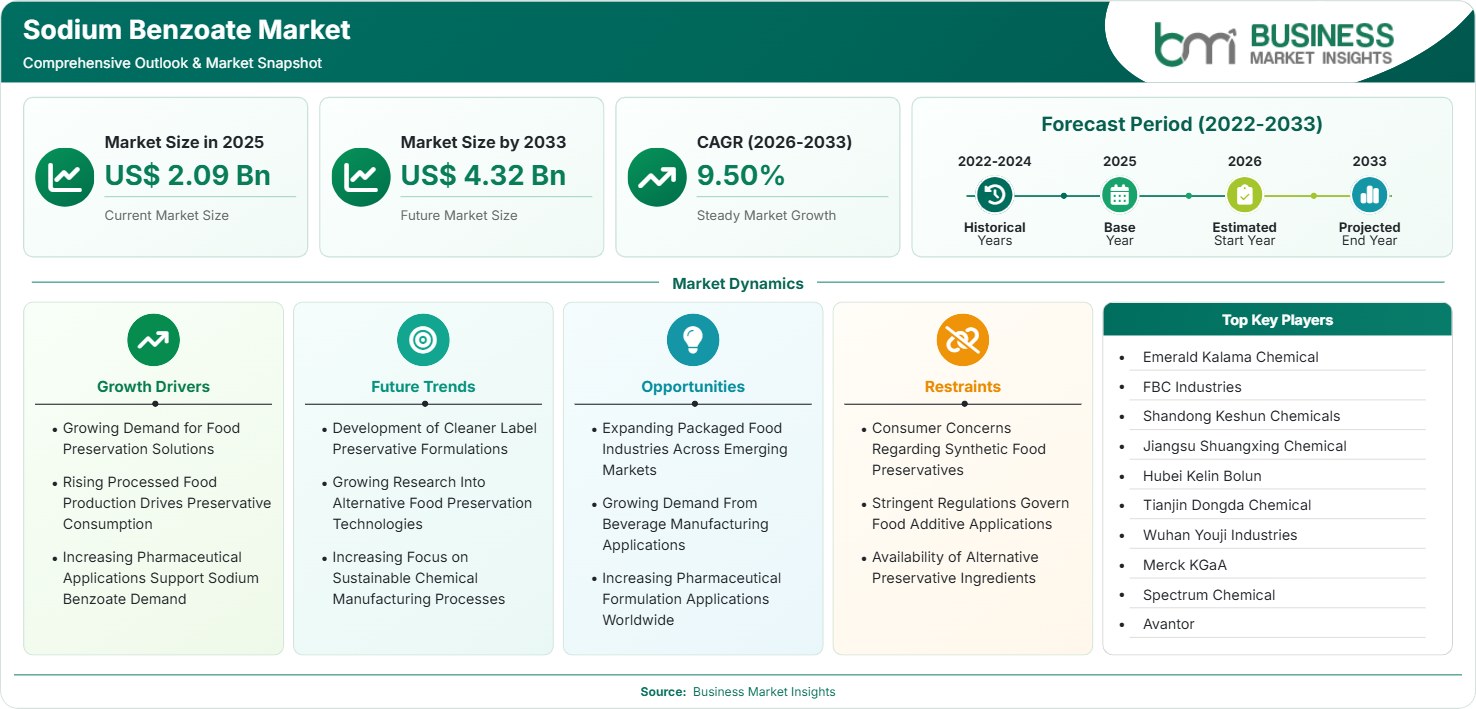
The Sodium Benzoate Market size was valued at US$ 2.09 billion in 2025 and is projected to reach US$ 4.32 billion by 2033, growing at a CAGR of 9.50% during 2026–2033, supported by packaged foods, beverages, pharmaceutical formulations, cosmetics preservation, emerging-market consumption, and expanding formulation requirements.

Report Coverage
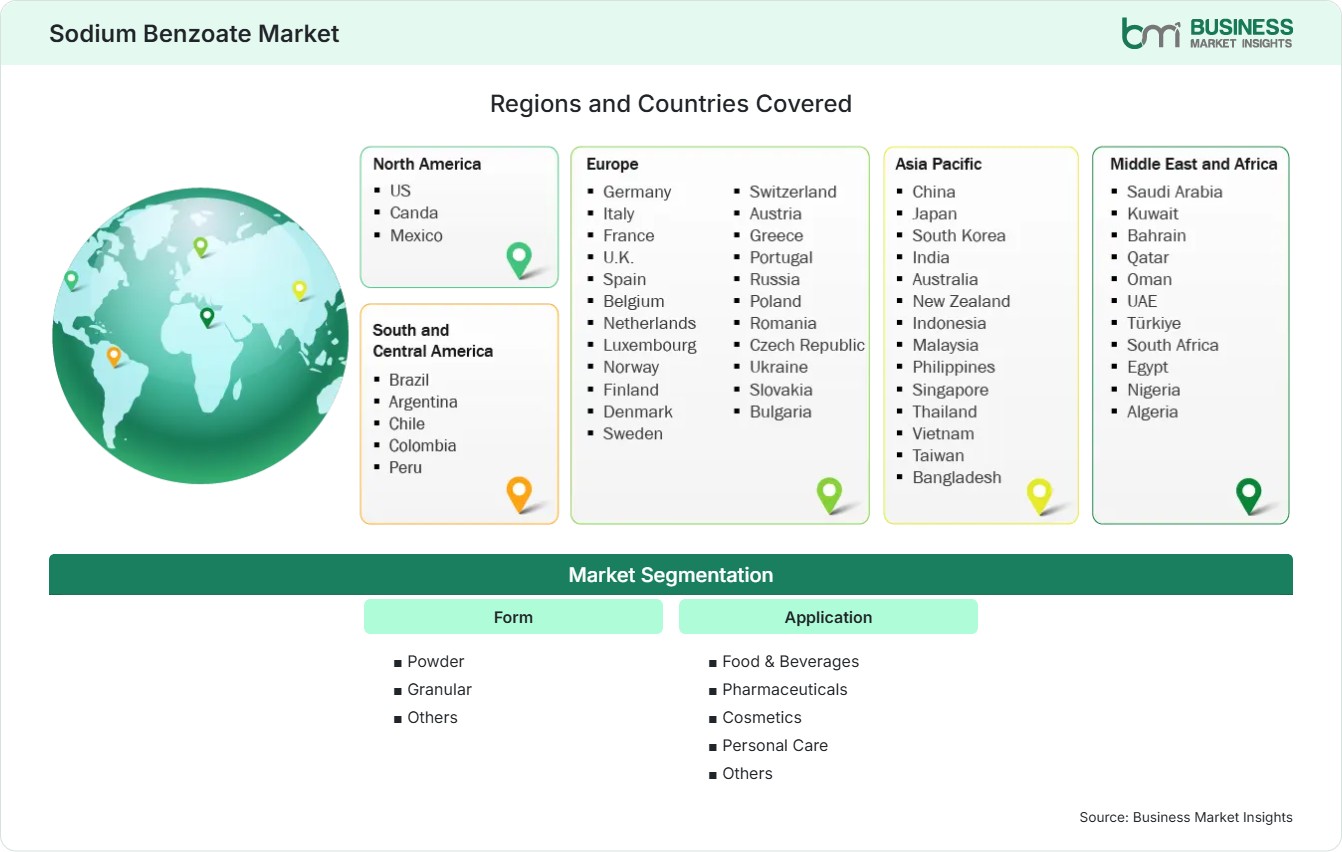
  • Form: Powder, Granular, Others
  • Application: Food & Beverages, Pharmaceuticals, Cosmetics, Personal Care, Others
US$ 2.09 Bn Market size in 2025
US$ 4.32 Bn Market Size by 2033
9.50% CAGR, 2026 - 2033
2026-2033 Forecast Period

AI Overview

Sodium Benzoate Market Summary

  • North America Region: North America holds a 24%–28% share in 2025 and is projected to grow at a 8.4%–9.1% CAGR through 2033, supported by processed food demand, beverage production, pharmaceutical formulations, established additive supply chains, and stringent quality requirements.
  • Fastest Growing Region: Asia Pacific is the fastest-growing region, holding a 32%–36% share in 2025 and expanding at a 10.2%–11.1% CAGR through 2033, driven by packaged food manufacturing, beverage consumption, pharmaceutical production, urbanization, and expanding ingredient distribution.
  • Leading Segment: Food & Beverages represents a 44%–47% share in 2025 and is projected to expand at a 8.8%–9.6% CAGR through 2033, supported by preservation requirements, acidic beverages, packaged foods, sauces, condiments, and extended distribution chains.
  • High Growth Segment: Cosmetics is estimated at a 10%–13% share in 2025 and is projected to grow at a 10.4%–11.5% CAGR through 2033, supported by water-based formulations, preservative demand, personal care diversification, and broader low-pH product development.
  • Key Market Opportunity: Expanding packaged food production, beverage manufacturing, pharmaceutical formulations, and personal care products creates opportunities for suppliers offering consistent purity, reliable availability, formulation support, and application-specific grades.
  • Major Market Players: Emerald Kalama Chemical; FBC Industries; Shandong Keshun Chemicals; Jiangsu Shuangxing Chemical; Hubei Kelin Bolun; Tianjin Dongda Chemical; Wuhan Youji Industries; Merck KGaA; Spectrum Chemical; Avantor.
Strategic Insights

Sodium Benzoate Market: Strategic Insights

Sodium Benzoate Market Strategic Framework
FREE PDF
Request your free sample
Request free sample
Stakeholder View

Key Takeaways

  • The value chain links benzoic acid production, chemical conversion, purification, quality testing, packaging, distribution, and formulation support, making supply reliability a central purchasing consideration.
  • Food and beverage preservation remains the core demand base, while pharmaceuticals, cosmetics, and personal care provide diversification and support higher-value formulation opportunities.
  • Product development is moving toward application-specific grades, tighter impurity control, formulation compatibility, improved packaging, and technical support for manufacturers managing increasingly complex preservation systems.
  • Asia Pacific offers the strongest expansion opportunity because packaged foods, beverages, pharmaceuticals, and personal care manufacturing are broadening across large consumer markets.
  • Procurement strategies are increasingly focused on supplier diversification, regional inventories, quality consistency, regulatory documentation, and long-term contracts to manage chemical supply and pricing uncertainty.
  • Manufacturers can strengthen competitiveness by combining scalable production with application expertise, reliable logistics, regulatory support, and customized grades for different downstream industries.
Geographic Outlook

Sodium Benzoate Market Regional Highlights

North America Sodium Benzoate Market

North America holds a 24%–28% share in 2025 and is projected to grow at a 8.4%–9.1% CAGR through 2033. Within the Sodium Benzoate Market, demand benefits from mature packaged food production, established beverage manufacturing, pharmaceutical formulation capabilities, and sophisticated ingredient distribution. The United States remains the principal regional demand center, while Canada provides additional opportunities.

  • Food manufacturers increasingly prioritize consistent preservative performance, predictable formulation behavior, documentation, and supply continuity when selecting chemical ingredient suppliers.
  • Beverage producers remain important buyers because acidic formulations require reliable antimicrobial preservation and stable ingredient quality across high-volume production environments.
  • Pharmaceutical manufacturers value controlled purity and dependable documentation, particularly for oral liquid and other formulations requiring validated excipient inputs.
  • Supplier competition increasingly centers on technical support, regulatory expertise, logistics reliability, packaging flexibility, and consistent product specifications.

U.S. Sodium Benzoate Market

The United States accounts for approximately 84%–88% of North American demand in 2025 and is projected to expand at a 8.3%–9.0% CAGR through 2033. The Sodium Benzoate Market benefits from extensive food processing, beverage manufacturing, pharmaceutical formulation, and personal care production. Established distribution infrastructure supports both large-volume industrial customers and smaller formulation-focused buyers.

  • Processed foods and beverages remain major consumption areas, particularly applications where microbial stability and extended distribution periods influence formulation decisions.
  • Pharmaceutical demand benefits from continued production of oral liquids and other formulations requiring antimicrobial preservation and controlled excipient characteristics.
  • Cosmetics and personal care manufacturers provide incremental demand as water-based formulations require effective preservation systems compatible with product pH and formulation architecture.

Europe Sodium Benzoate Market

Europe holds a 27%–31% share in 2025 and is projected to expand at a 8.0%–8.8% CAGR through 2033. Germany, France, Italy, the United Kingdom, and Spain represent leading markets, while Central and Eastern Europe provide additional growth opportunities. The regional Sodium Benzoate Market share reflects strong food processing, beverage production, pharmaceutical manufacturing, and cosmetic formulation capabilities.

  • Germany remains a major industrial and formulation center, supporting demand from food processing, pharmaceuticals, specialty chemicals, and personal care applications.
  • France and Italy offer opportunities through established food, beverage, cosmetic, and pharmaceutical manufacturing bases with sophisticated ingredient procurement requirements.
  • The United Kingdom supports demand through processed foods, beverages, pharmaceutical formulations, and personal care products requiring reliable preservative systems.
  • Southern European markets provide additional beverage and packaged-food opportunities as manufacturers expand shelf-stable and convenience-oriented product portfolios.

Asia Pacific Sodium Benzoate Market

Asia Pacific holds a 32%–36% share in 2025 and is projected to grow at a 10.2%–11.1% CAGR through 2033. China, India, Japan, South Korea, and Southeast Asia represent major demand centers, with India and Southeast Asia offering particularly strong expansion potential. The Sodium Benzoate Market growth is supported by expanding packaged food production, beverage manufacturing, pharmaceuticals, cosmetics, urbanization, modern retail, and ingredient distribution networks.

  • China combines large-scale chemical manufacturing with extensive downstream food, beverage, pharmaceutical, and personal care production, supporting both domestic demand and export-oriented supply.
  • India provides strong growth potential through expanding packaged food manufacturing, pharmaceutical production, beverage processing, and personal care formulation.
  • Southeast Asia benefits from rising processed food consumption, beverage diversification, modern retail development, and increasing local manufacturing capacity.
  • Japan and South Korea emphasize high-quality ingredients, formulation precision, regulatory documentation, and advanced food and pharmaceutical manufacturing capabilities.

Rest of World Sodium Benzoate Market

Rest of World holds a 12%–16% share in 2025 and is projected to grow at a 8.1%–8.9% CAGR through 2033. Latin America, the Middle East, and Africa offer differentiated opportunities shaped by packaged food penetration, beverage manufacturing, pharmaceutical production, import dependence, and modernization of ingredient distribution. Brazil, Mexico, Saudi Arabia, the UAE, and South Africa represent key commercial markets.

Latin American demand is supported by processed foods, beverages, sauces, and pharmaceutical products, while Middle Eastern markets benefit from expanding food processing and modern manufacturing. Africa presents longer-term potential as packaged food production and pharmaceutical supply networks develop.

  • Brazil and Mexico provide attractive opportunities through established food processing, beverage production, pharmaceutical manufacturing, and expanding modern retail networks.
  • Gulf markets support demand from beverage, packaged food, pharmaceutical, and personal care manufacturers seeking consistent imported ingredient supplies.
  • South Africa offers opportunities through developed food processing, beverage, pharmaceutical, and chemical distribution infrastructure serving regional customers.
  • Emerging African markets provide longer-term potential as local formulation capacity and packaged food manufacturing expand.
Global Market Geography
FREE PDF
Request your free sample
Request free sample
Segment Analysis

Sodium Benzoate Market Segmentation

Form

Powder represents the dominant form, accounting for a 63%–68% share in 2025 and growing at a 9.1%–9.7% CAGR through 2033. The Sodium Benzoate Market scope across forms reflects powder’s efficient handling, transport, storage, dosing, and broad compatibility with industrial food, beverage, pharmaceutical, cosmetic, and personal care formulations.

  • Powder: Powder remains preferred for large-scale formulation because it supports accurate dosing, efficient storage, straightforward transportation, and broad use across dry and liquid manufacturing processes.
  • Granular: Granular material supports controlled handling, reduced dust generation, and convenient industrial processing, making it useful for manufacturers seeking improved workplace handling and dosing efficiency.

Application

Food & Beverages represent a 44%–47% share in 2025 and are projected to grow at a 8.8%–9.6% CAGR through 2033. Demand is supported by preservation requirements across acidic beverages, sauces, condiments, processed foods, fruit preparations, and shelf-stable products. Pharmaceutical, cosmetic, and personal care applications diversify consumption and provide additional formulation opportunities.

  • Food & Beverages: Food and beverage manufacturers use sodium benzoate primarily for antimicrobial preservation, supporting shelf stability across acidic products, beverages, sauces, condiments, and processed foods.
  • Pharmaceuticals: Pharmaceutical applications include preservative systems for selected liquid and topical formulations, where controlled purity, formulation compatibility, and regulatory documentation influence procurement.
  • Cosmetics: Cosmetic formulators use sodium benzoate in suitable preservation systems for water-containing products, with performance influenced by pH, formulation composition, and regulatory requirements.
  • Personal Care: Personal care applications include shampoos, cleansers, lotions, and other water-based products where microbial control supports product stability, quality, and consumer safety.
Market Forces

Sodium Benzoate Market Dynamics

Key Market Drivers

Growing Demand for Food Preservation Solutions

Preservation processes are needed by food makers to stabilize their products during production, transport, storage, and distribution. Sodium benzoate is an ingredient that helps preserve foods through its antimicrobial properties and is used in drinks, sauces, condiments, fruits, and many other foods. The Sodium Benzoate Market trend shows increasing demand for known preservatives whose performance in formulations can be predicted. The need for this ingredient is further increased by long distribution channels and the need to maintain product quality for longer periods. This can be achieved by suppliers with consistent specifications, application advice, technical information, and delivery to major processors and regional manufacturers.

Rising Processed Food Production Drives Preservative Consumption

The field of processed food production expands in line with consumer preference for convenience, extended shelf life, packaging, and ready-to-eat foods. This leads to a continuous need for preservatives to ensure stability during distribution. The issue of sodium benzoate becomes pertinent for foods with acidic formulation due to its antimicrobial properties. There is an increasing tendency for formulators to consider preservatives alongside other ingredients, such as acidity regulators, packaging systems, and processing methods. This holistic perspective enables continued application across diverse food sectors. Suppliers who can offer consistent specifications, application information, technical data, and consistent supply have a higher chance of capturing volumes from processors and regional food producers.

Increasing Pharmaceutical Applications Support Sodium Benzoate Demand

Sodium benzoate is used in certain drug formulations as needed for antimicrobial preservation and for formulating stable products. The oral liquids category is one such area where sodium benzoate is widely used because aqueous formulations require well-designed preservative systems to inhibit microbial proliferation. Sodium benzoate may be used in other pharmaceutical preparations as per the formulation needs and regulatory requirements. Higher drug production capacity in emerging markets will drive demand, as they manufacture locally to replace imported formulations or expand access to drugs.

Key Market Opportunities

Expanding Packaged Food Industries Across Emerging Markets

There are many opportunities in emerging markets, driven by the development of products such as packaged and convenient foods, sauces, drinks, and stable formulas, among others. Changes in lifestyle and urbanization are leading to increased demand for better preservation and product stability among producers. Sodium benzoate market forecasts indicate more opportunities for companies to build up regional stock and technical assistance in close proximity to regional food-processing centers. Localization of packaging and application-specific grades will further simplify the logistics process. Companies that offer competitive prices along with high-quality products can develop strong relationships with regional food processors looking for a reliable supply of preservatives.

Growing Demand From Beverage Manufacturing Applications

This field holds potential for growth, as preservation plays a vital role in the production of various acidic beverages. There is a growing need for suppliers to provide carbonated drinks, fruit drinks, syrups, concentrates, and other beverages with suitable antimicrobial formulations. The beverage industry is expanding into various fields, and suppliers have the potential to differentiate themselves on the basis of assistance provided in applications, packaging, technical support, and quality assurance.

Increasing Pharmaceutical Formulation Applications Worldwide

Expansion in pharmaceutical formulations allows for the possibility of developing higher-grade and technically justified applications. Demand may grow through oral liquids, some topicals, and other formulations in which preservation is one aspect of the stability strategy. Companies supplying the pharmaceutical industry have to meet higher standards of specifications, traceability, testing, packaging, and documentation compared to many commodity applications. It limits entry into the market but provides for a good retention rate when qualified. The producer may grow through collaboration with formulation firms, contract manufacturing facilities, and regional pharmaceutical suppliers. Supporting the development of applications is yet another way of growing value through assisting customers with developing preservative systems while maintaining compatibility with the active ingredients and other product components.

Market Restraints and Challenges

Consumer Concerns Regarding Synthetic Food Preservatives

Factor: Consumer preference for familiar ingredients and clean-label formulations may lessen the acceptability of artificial preservatives in certain categories of foods and beverages. Impact: Food/beverage manufacturers will re-formulate their products or reduce the level of preservative use, possibly opting for alternative systems of preservation, thus reducing demand in the categories where natural positioning is of high importance for the consumers. However, this factor does not rule out the technical demand since food/beverage manufacturers continue to have a need for microbial protection and stability. The suppliers will be faced with the task of communicating their technical benefits, regulatory situation, and proper use of the products.

Stringent Regulations Govern Food Additive Applications

Factor: Food additive legislation outlines what is allowed, concentrations, labeling laws, quality standards, and documentation required, which differ between jurisdictions. Impact: Variations in regulation raise the complexity, costs, testing needed, and obstacles for the producers and further processors. Sodium benzoate is classified as a food preservative under the main regulating schemes, but international evaluations provide guidance on allowable levels of exposure and uses. It is important for suppliers to have a good understanding of the regulatory environment, since it could affect allowed uses, customer requirements, labeling, and product development. Having an advanced compliance system and proper technical documentation could turn a regulatory challenge into a competitive advantage.

Company Analysis

Competitive Landscape

Sodium Benzoate Market analysis shows competition across integrated chemical producers, specialty ingredient suppliers, pharmaceutical-grade manufacturers, and regional commodity suppliers. Competitive differentiation centers on product purity, production scale, consistency, regulatory documentation, supply reliability, geographic reach, technical support, and pricing.

Company Name

Overview

Products and Services relevant to this market

Emerald Kalama Chemical

Specialty chemical producer with established capabilities in preservative and chemical ingredient manufacturing for multiple downstream industries.

Sodium benzoate, benzoate-based preservatives, specialty chemicals, formulation support, quality documentation, and industrial ingredient supply.

FBC Industries

Chemical manufacturer and distributor serving food, industrial, pharmaceutical, and specialty formulation markets.

Sodium benzoate and related chemical ingredients, specialty additives, formulation materials, packaging, distribution, and technical supply support.

Shandong Keshun Chemicals

Chinese chemical producer serving domestic and international customers with commodity and specialty chemical ingredients.

Sodium benzoate, benzoate chemicals, industrial preservatives, chemical intermediates, bulk packaging, and export-oriented ingredient supply.

Jiangsu Shuangxing Chemical

China-based chemical manufacturer focused on benzoate-related products and industrial chemical production.

Sodium benzoate, preservative ingredients, chemical intermediates, bulk supply, industrial grades, and export distribution capabilities.

Hubei Kelin Bolun

Chinese specialty chemical producer serving food, pharmaceutical, and industrial ingredient markets.

Sodium benzoate, preservative chemicals, formulation ingredients, bulk chemical products, quality testing, and international supply services.

Tianjin Dongda Chemical

Chemical producer with capabilities supporting preservative and related ingredient supply across international markets.

Sodium benzoate, benzoic acid derivatives, chemical preservatives, industrial chemicals, bulk packaging, and export-oriented supply.

Wuhan Youji Industries

Chinese chemical manufacturer with an established presence in specialty and commodity chemical production.

Sodium benzoate, benzoate derivatives, chemical intermediates, industrial ingredients, bulk products, and international distribution.

Merck KGaA

Global science and technology company serving pharmaceutical, laboratory, and chemical customers with high-quality ingredients and materials.

Sodium benzoate grades, pharmaceutical ingredients, laboratory chemicals, formulation materials, analytical products, and quality documentation.

Spectrum Chemical

Specialty chemical supplier focused on high-purity products and regulated laboratory, pharmaceutical, and industrial applications.

Sodium benzoate grades, pharmaceutical and laboratory chemicals, analytical materials, custom packaging, documentation, and quality-controlled supply.

Avantor

Global provider of mission-critical products and services for pharmaceutical, healthcare, laboratory, and advanced manufacturing customers.

Sodium benzoate, laboratory chemicals, pharmaceutical ingredients, specialty materials, quality-controlled products, technical support, and global distribution.

Trust & Transparency

Research Methodology

The market analysis combines proprietary research with secondary data from government agencies, company disclosures, regulatory filings, industry databases and expert interviews. Market estimates are validated through data triangulation, cross-market benchmarking and analyst review.

View Full Research Methodology

Questions Answered

Frequently Asked Questions

What does the Sodium Benzoate Market report indicate about future competition?

Competition is expected to emphasize product consistency, regulatory compliance, manufacturing scale, supply reliability, technical support, application-specific grades, and geographic reach. Suppliers capable of serving food, beverage, pharmaceutical, cosmetic, and personal care customers with dependable quality and flexible logistics should strengthen their competitive position.

Why are emerging economies creating new opportunities for sodium benzoate suppliers?

Expanding packaged food production, beverage manufacturing, pharmaceutical capacity, modern retail, and personal care formulation is increasing demand for reliable preservation ingredients. Local suppliers and international producers can benefit by improving regional inventory, distribution partnerships, technical support, and application-specific product availability.

How are formulation requirements influencing sodium benzoate adoption?

Formulators increasingly assess preservation alongside pH, packaging, processing conditions, water activity, and other ingredients. This encourages suppliers to provide consistent grades and technical support rather than commodity material alone. Application expertise can help manufacturers optimize preservation performance while meeting product quality and regulatory requirements.

Which applications present the strongest opportunity in the market?

Food and beverages provide the broadest demand base, particularly beverages, sauces, condiments, fruit products, and processed foods. Pharmaceuticals, cosmetics, and personal care provide additional opportunities because manufacturers require controlled preservation systems, consistent quality, and application-compatible ingredients.

What factors are improving Sodium Benzoate Market return on investment?

Demand from packaged foods, beverages, pharmaceuticals, cosmetics, and personal care products supports investment potential. Manufacturers can improve returns through scalable production, reliable raw-material sourcing, application-specific grades, regulatory support, regional distribution, and long-term contracts with downstream formulators.

Access the Full Sodium Benzoate Market Report

Get segment-level forecasts, regional estimates, competitive benchmarking, company profiles and downloadable Excel datasets.

Access the full Sodium Benzoate Market Report
350 pages PDF & Excel | 2026-08-20
Similar Research

Related Market Reports