Market Summary
Executive Summary and Global Market Analysis
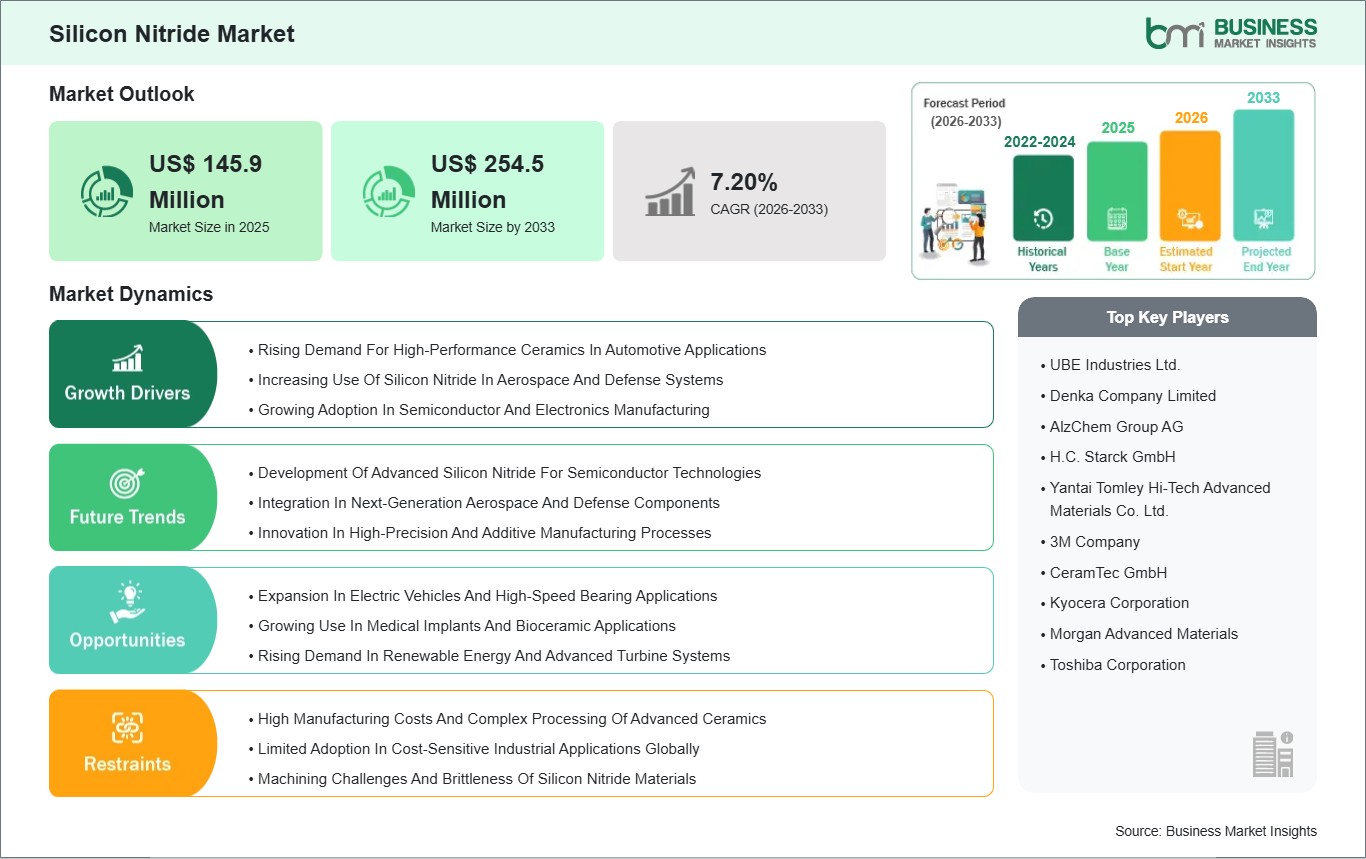
The global silicon nitride market is experiencing continuous growth which results from rising demand for advanced engineering ceramics that high-performance industries utilize. Silicon nitride serves as a preferred material because it possesses exceptional mechanical strength and fracture toughness and thermal shock resistance and chemical stability, which enables its use in situations where standard metals do not meet requirements. Its ability to perform reliably under extreme temperatures and corrosive environments has positioned it as a critical material in sectors such as automotive, aerospace, electronics, healthcare, and energy.
The global market experiences strong growth because industries require lightweight systems that consume less energy, which they need for both transportation and industrial machinery. Silicon nitride components are widely used in bearings, engine parts, and turbine systems, where they reduce friction, improve efficiency, and extend operational lifespan. The electronics industry experiences rapid development which creates demand for silicon nitride because it functions as an insulating material and substrate and semiconductor processing material with superior electrical and thermal characteristics.
The market sees increased adoption because infrastructureand industrial applications now prioritise durable solutions which provide lasting performance. Silicon nitride functions as a suitable material for high-demand uses because it maintains its properties against wear and chemical attacks in both chemical processingand heavy machinery environments.
The development of manufacturing technologies enables production facilities to achieve better shaping through advanced material consistency which leads to broader material usage. The main market barrier exists because high production expenses and difficult manufacturing methods prevent businesses from using their products in markets which require low-cost solutions. The need for specialized equipment and expertise for machining and processing also adds to overall cost considerations. The materials market will remain active because companies keep developing advanced products while silicon nitride maintains its importance throughout various industries.
Segment Analysis
Silicon Nitride Market Segmentation
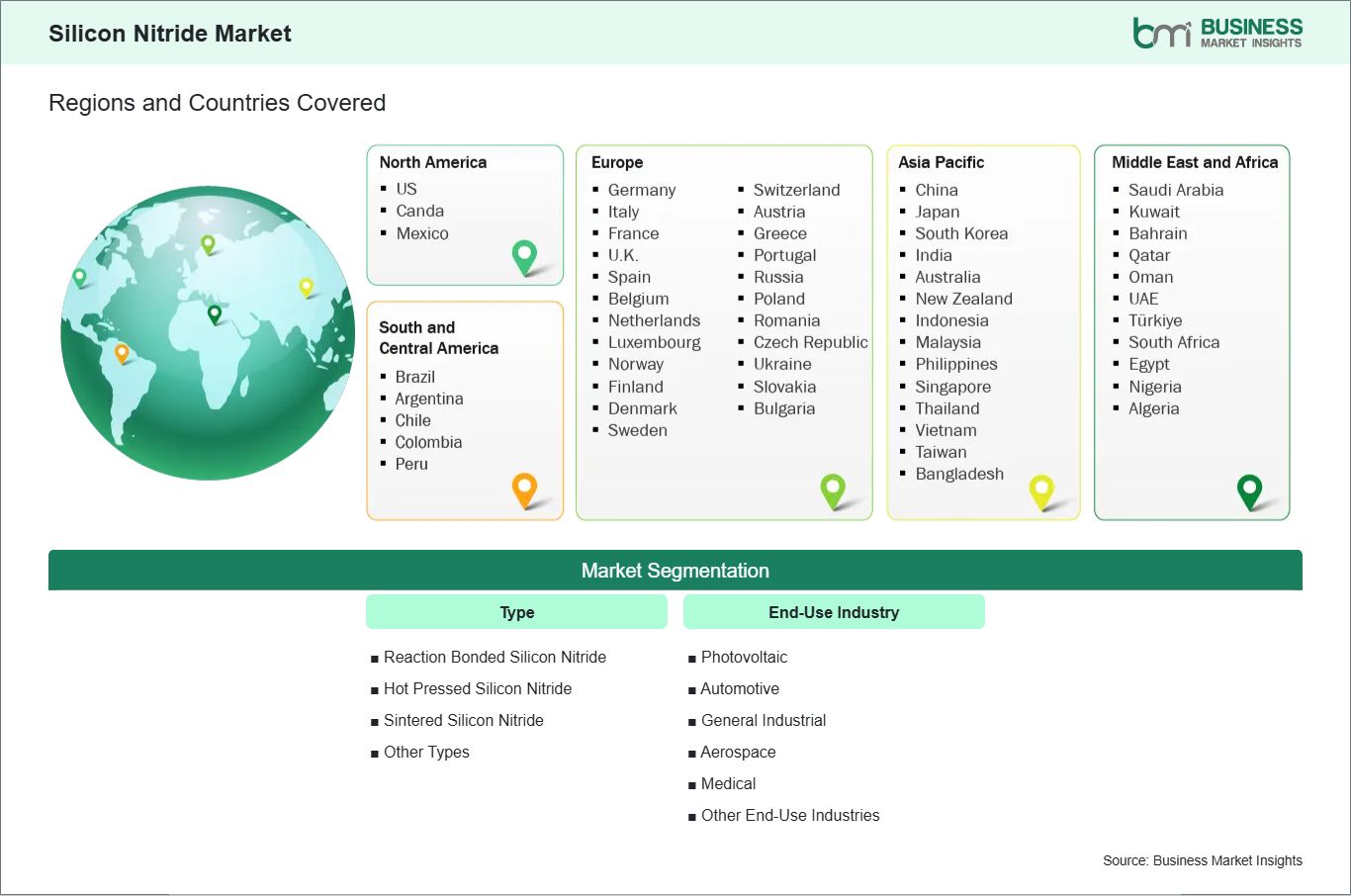
Key segments that contributed to the derivation of the silicon nitride market analysis are type and end use industry.
- By type, the silicon nitride market is segmented into reaction bonded silicon nitride (RBSN), hot pressed silicon nitride (HPSN), sintered silicon nitride (SSN), and others. The sintered silicon nitride (SSN) segment dominated the market in 2025.
- Based on end-use industry, the silicon nitride market is categorized into photovoltaic, automotive, general industrial, aerospace, medical, and other end-use industries. The automotive segment dominated the market in 2025.
Market Forces
Silicon Nitride Market Drivers and Opportunities
Rising Demand for High-Performance Ceramics in Automotive Applications
The automotive industry needs high-performance ceramic materials to achieve better efficiency and durability and better thermal resistance which drives the global market for silicon nitride. The critical components of bearings and turbocharger rotors and engine parts use silicon nitride because it can withstand extreme mechanical stress and high-temperature conditions. The material provides lower weight and better wear resistance when compared to standard metal materials which results in improved fuel efficiency and extended product lifespan. The material has become essential for contemporary vehicle design because engineers need to enhance vehicle efficiency through their work. The market for silicon nitride experiences growth because electric and hybrid vehicle adoption expands. The vehicles need materials which can handle high rotational speeds and thermal changes and provide electrical insulation.
The use of silicon nitride bearings and structural components enables system efficiency improvements because they reduce energy losses, which makes them appropriate for advanced drivetrains and power systems. Automotive manufacturers across North America, Europe, and Asia Pacific are increasingly incorporating such materials to meet evolving performance and sustainability expectations. The global movement to reduce maintenance expenses while enhancing system dependability has resulted in increased use of advanced ceramics. Silicon nitride provides extended operational periods and lower maintenance needs because it withstands corrosion and fatigue and thermal shock. The rising use of silicon nitride in automotive technologies develops as high-performance energy-efficient solutions gain traction in the industry.
Expansion in Electric Vehicles and High-Speed Bearing Applications
The global silicon nitride market is experiencing growth because electric vehicles (EVs) are expanding and industries require high-speed bearing solutions. Silicon nitride serves as the perfect bearing material because it possesses low density and high hardness and proceeds to exhibit outstanding wear resistance which suits high-speed rotational operations that need demanding performance requirements. Silicon nitride bearings enable electric vehicle efficiency improvement through friction loss reduction which leads to better energy efficiency and overall electric drivetrain performance enhancement. The material functions as the primary material choice in next-generation mobility solutions which have been developed to construct future transportation systems. The automotive industry is switching to electrification which results in new material needs that must endure thermal stress and electrical currents while functioning at high speeds. Silicon nitride provides better insulation than traditional steel bearings which decreases electrical pitting risks while extending the lifespan of electric motor components.
The growing global adoption of electric vehicles leads manufacturers to implement ceramic-based bearing solutions which enhance product reliability and decrease maintenance requirements for high-performance vehicles and premium vehicle segments. The industrial sector demands silicon nitride for high-speed machinery use beyond its current automotive applications. Industrial sectors including aerospace and precision manufacturing and energy systems require bearings that can operate efficiently under extreme conditions with minimal lubrication and wear. Silicon nitride maintains its structural integrity when exposed to high temperatures and mechanical stress which makes it suitable for these environments.
Size and Share Analysis
Silicon Nitride Market Size and Share Analysis
The silicon nitride market demonstrates steady growth, with size and share analysis highlighting evolving trends and competitive dynamics among key players. The report examines subsegments categorized within type and end use industry, offering insights into their contribution to overall market performance.
By type, the sintered silicon nitride (SSN) subsegment dominated the market in 2025, driven by its superior strength, thermal shock resistance, and widespread use in high-performance industrial applications.
Based on end-use industry, the automotive subsegment dominated the market in 2025, driven by increasing demand for advanced ceramics in engine components and wear-resistant parts for improved efficiency and durability.
Report Coverage
Silicon Nitride Market Report Coverage and Deliverables
The "Silicon Nitride Market Size and Forecast (2022 - 2033)" report provides a detailed analysis of the market covering below areas:
- Silicon Nitride Market size and forecast at global, regional, and country levels for all the key market segments covered under the scope
- Silicon Nitride Market trends, as well as drivers, restraints, and opportunities
- Silicon Nitride Market analysis covering key trends, global and regional framework, major players, regulations, and recent developments
- Industry landscape and competition analysis covering market concentration, heat map analysis, prominent players, and recent developments for the Silicon Nitride Market
- Detailed company profiles, including SWOT analysis
Geographic Insights
Silicon Nitride Market Geographic Insights
The geographical scope of the Silicon Nitride Market report is divided into North America, Asia Pacific, Europe, Middle East & Africa, and South & Central America. North America held the largest share in 2025.
The global silicon nitride market shows different regional patterns which North America controls because its strong industrial system and developed aerospace and defense industry and its widespread use of advanced materials in automotive and electronics sectors. The United States, in particular, drives demand through the use of silicon nitride in high-speed bearings, turbine components, and precision-engineered automotive parts, where performance under extreme temperatures and mechanical stress is critical. North America maintains its technological edge through a robust research and development system which connects manufacturers with universities and research institutions, enabling ongoing progress in silicon nitride product development and usage.
Asia Pacific has developed into a rapidly expanding area which industrializes quickly while the automotive and electronics industries grow and advanced manufacturing systems receive greater funding. Countries such as China, Japan, and South Korea are major contributors, leveraging expertise in precision ceramics and high-performance materials. The region experiences increased demand for silicon nitride components because of rising electric vehicle adoption and growing semiconductor manufacturing and industrial machinery use.
European economies display continuous expansion because their automotive and industrial equipment industries experience strong growth together with their increased focus on energy efficiency and sustainable practices. The three main markets for silicon nitride in electric vehicle applications and high-speed manufacturing equipment and energy systems are Germany and France and Italy because strict quality and environmental regulations require the use of advanced ceramics materials.
The Middle East and Africa region exhibits basic technology adoption which main industrial machinery and oil and gas equipment and high-temperature applications require because these applications need materials to maintain durability and thermal stability. The region people live in experiences growth because people build new infrastructure and people modernize their industrial facilities.
The automotive production sector and mining activities and industrial processing work together to create demand which drives South and Central America development as an emerging market. Silicon nitride components now become part of manufacturing systems because manufacturers use them to create dependable equipment which needs less upkeep and functions better under tough working conditions.
North America leads the market because its technological skills and ability to create high-value products. Nevertheless, all other regions start using more silicon nitride because industries need advanced materials to achieve their operational performance and efficiency needs.
Industry Activity
Recent Developments
The Silicon Nitride Market is evaluated by gathering qualitative and quantitative data post primary and secondary research, which includes important corporate publications, association data, and databases. A few of the key developments in the silicon nitride market are:
- In December 2025, SINTX Technologies, Inc. announced that the company signed a supply agreement with Evonik Corporation to manufacture its proprietary silicon nitride - PEEK compound (SiN/PEEK) for AI‑assisted, 3D‑printed patient‑specific implants, enabling immediate production of advanced biomedical devices at its U.S. facility.
- In October 2025, TRUNNANO announced that it launched silicon nitride‑silicon carbide ceramic products, achieving large‑scale production of hybrid advanced ceramics with high temperature stability and superior mechanical properties, highlighting progress in industrial refractory materials that include silicon nitride components.
Trust & Transparency
Research Methodology
The market analysis combines proprietary research with secondary data from government agencies, company disclosures, regulatory filings, industry databases and expert interviews. Market estimates are validated through data triangulation, cross-market benchmarking and analyst
review.
View Full Research Methodology
Key Sources Referred:
World Health Organization (WHO) Organisation for Economic Cooperation and Development (OECD) The World Bank Group Worldometer The Lancet International Bar Association International Trade Administration