
Shotcrete Market Outlook: Size, Share, Trends, Growth Analysis, Competitive Landscape & Forecast, 2026-2033

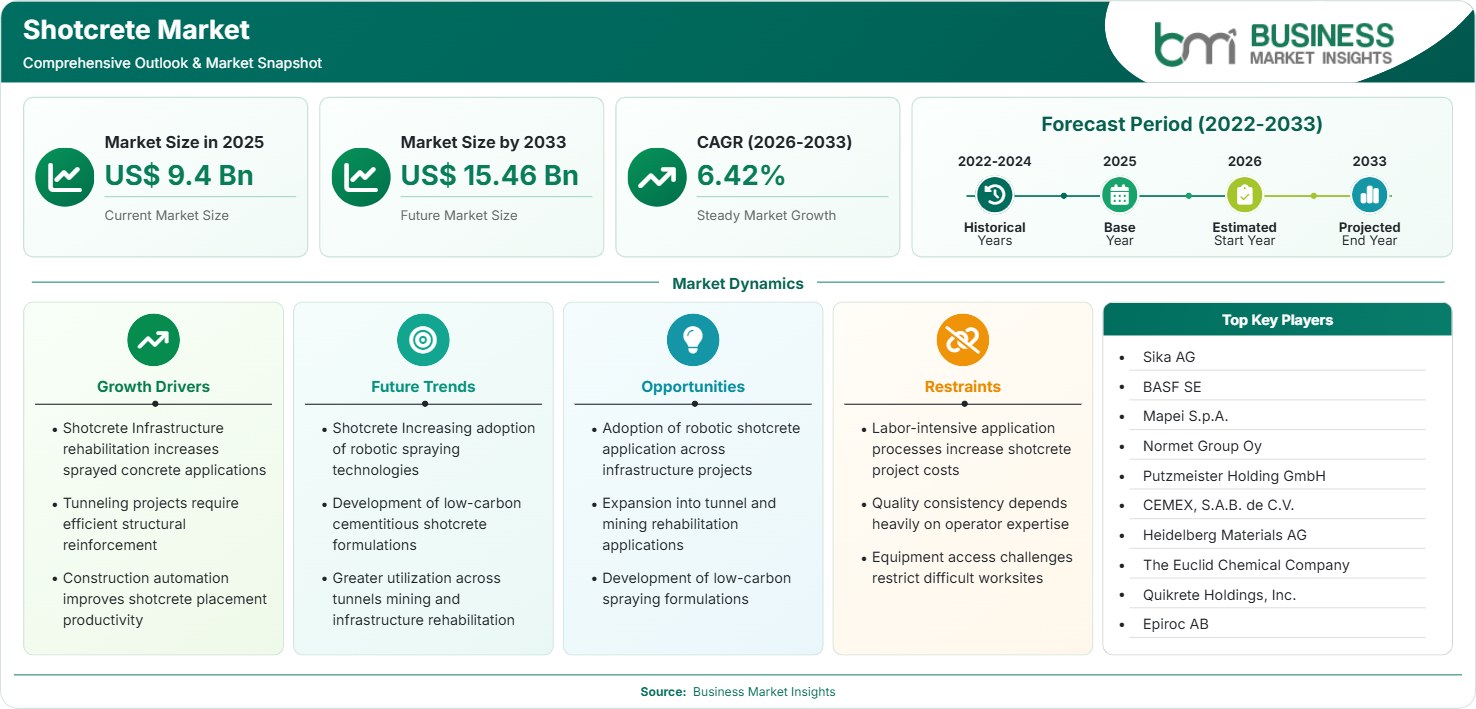
The Shotcrete Market size was valued at US$ 9.4 Billion in 2025 and is projected to reach US$ 15.46 Billion by 2033, growing at a CAGR of 6.41% during 2026–2033, driven by tunneling, mining, rehabilitation, water infrastructure, automation, and faster construction cycles.

Report Coverage
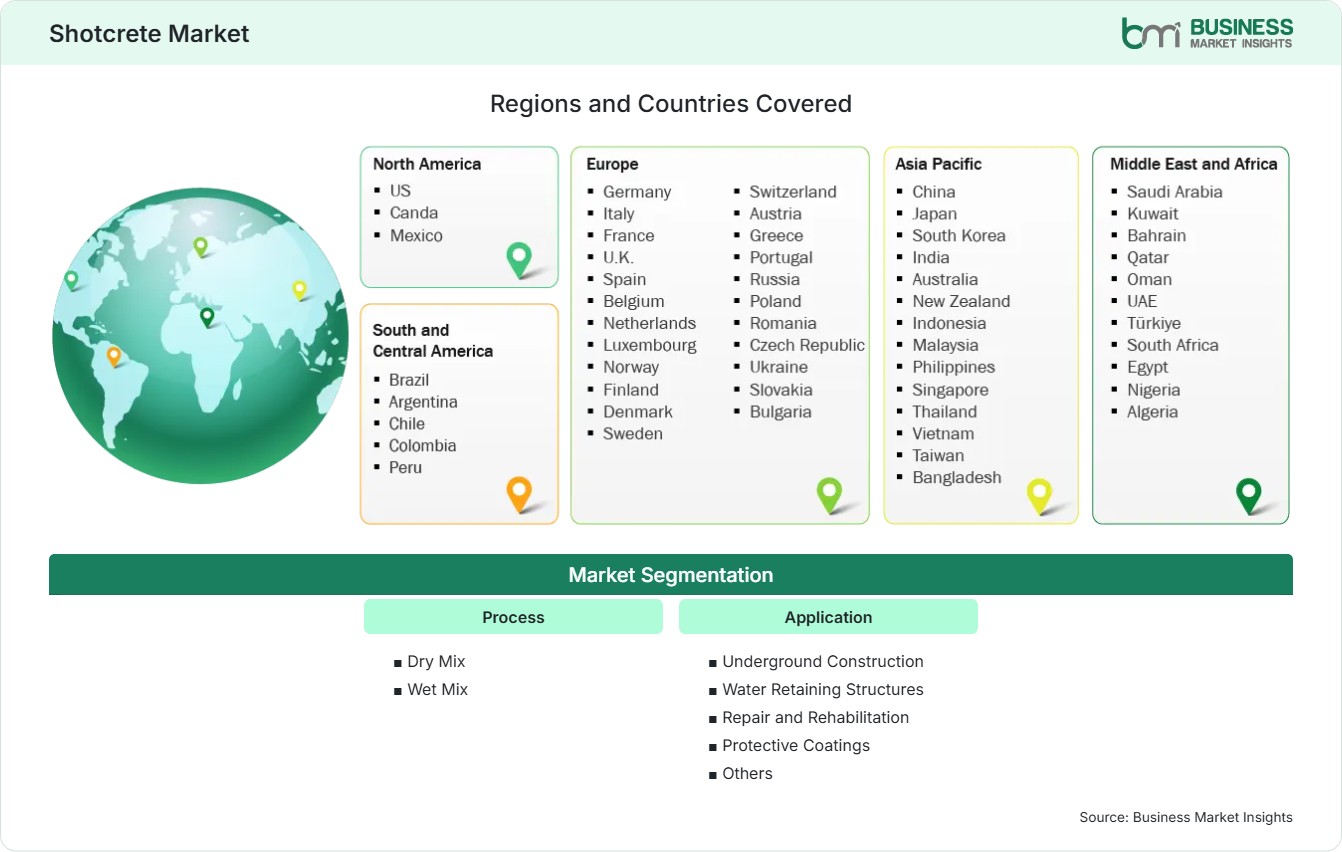
  • Process: Dry Mix, Wet Mix
  • Application: Underground Construction, Water Retaining Structures, Repair and Rehabilitation, Protective Coatings, Others
US$ 9.4 Bn Market size in 2025
US$ 15.46 Bn Market Size by 2033
6.42% CAGR, 2026 - 2033
2026-2033 Forecast Period

AI Overview

Shotcrete Market Summary

  • North America: North America holds a Shotcrete Market share of 24%–27% in 2025, growing at a CAGR of 5.6%–6.1%, supported by tunnel rehabilitation, mining modernization, water infrastructure, automated spraying, and repair applications. The U.S. market benefits from infrastructure renewal, mining investment, tunnel rehabilitation, and mechanized spraying adoption, supporting a 5.5%–6.0% CAGR through 2033.
  • Fastest Growing Region: Asia Pacific holds a share of 38%–42% in 2025 and advances at a CAGR of 7.1%–7.6%, supported by metro tunneling, hydropower, mining, urbanization, infrastructure spending, and expanding construction-chemicals production.
  • Leading Segment: Wet Mix holds a share of 60%–64% in 2025 and expands at a CAGR of 6.7%–7.1%, benefiting from mechanized tunneling, higher output, reduced dust exposure, improved quality control, and automated spraying equipment.
  • High Growth Segment: Underground Construction accounts for 42%–46% in 2025 and records a CAGR of 7.0%–7.4%, supported by metro expansion, road tunnels, mining development, cavern construction, faster ground stabilization, and fiber-reinforced sprayed concrete.
  • Key Market Opportunity: Demand is shifting toward integrated material-equipment-digital packages that improve pumpability, rebound control, application consistency, worker safety, lifecycle durability, and project traceability across complex underground construction environments.
  • Major Market Players: Sika AG, BASF SE, Mapei S.p.A., Normet Group Oy, Putzmeister Holding GmbH, CEMEX, S.A.B. de C.V., Heidelberg Materials AG, The Euclid Chemical Company, Quikrete Holdings, Inc., and Epiroc AB.
Strategic Insights

Shotcrete Market: Strategic Insights

Shotcrete Market Strategic Framework
FREE PDF
Request your free sample
Request free sample
Stakeholder View

Key Takeaways

  • Supply-chain competitiveness is increasingly determined by proximity between admixture production, aggregate and cement sourcing, equipment support, and project-site technical service. Regional manufacturing reduces freight exposure and enables faster formulation adjustments for local aggregates and climatic conditions.
  • Underground Construction provides the strongest upside because sprayed concrete directly addresses rapid ground support, irregular excavation profiles, reduced formwork requirements, and shortened construction cycles across tunnels, mines, caverns, and underground transport systems.
  • Product development is moving toward alkali-free accelerators, synthetic and steel fiber reinforcement, low-rebound formulations, digital thickness monitoring, robotic spraying, and electric equipment, creating higher-value opportunities than conventional material supply.
  • Asia Pacific provides the most compelling regional investment case because metro systems, transportation tunnels, mining, hydropower, and industrial infrastructure create multiple demand pools rather than dependence on one construction end use.
  • Investment and M&A activity increasingly focuses on complementary technologies, particularly construction chemicals, underground equipment, automation, and digital application systems. Strategic expansion is aimed at capturing recurring consumables and service revenue alongside equipment sales.
Geographic Outlook

Shotcrete Market Regional Highlights

North America Shotcrete Market

North America Shotcrete Market represented a 24%–27% share in 2025 and is projected to grow at 5.6%–6.1% through 2033. Demand is anchored by underground transportation, mining, water infrastructure, structural repair, and rehabilitation. The region favors wet-mix systems where mechanized application and stringent worker-safety requirements justify higher equipment intensity. United States demand remains dominant within regional consumption, while Canada benefits from mining and hydroelectric projects. Mexico provides additional upside through industrial and infrastructure construction, although project timing remains sensitive to capital availability and procurement cycles.

  • Tunnel rehabilitation supports replacement of deteriorated linings while limiting disruption to existing transport corridors and enabling staged construction.
  • Mining operators increasingly prioritize mechanized spraying to improve worker separation from excavation faces and achieve consistent support coverage.
  • Water infrastructure creates recurring demand for repair systems where rapid application minimizes shutdown periods and improves asset rehabilitation economics.
  • Equipment suppliers gain differentiation through remote controls, digital monitoring, and lower-emission underground machinery.

US Shotcrete Market

The U.S. Shotcrete Market accounted for approximately 72%–76% of North American demand in 2025 and is forecast to expand at 5.5%–6.0% through 2033. Federal and state infrastructure programs support transportation rehabilitation, water assets, bridges, and tunnels, while mining applications provide a separate demand channel. Domestic contractors increasingly value certified admixture systems, predictable pump performance, and technical support. The application mix also benefits from repair and rehabilitation because sprayed concrete can reduce formwork, accelerate curing, and maintain access around constrained structures.

  • Aging transportation assets support repair demand where rapid placement and reduced site congestion improve project scheduling.
  • Mining investment supports high-output wet-mix equipment, fiber reinforcement, and automated application technologies.
  • Water and wastewater rehabilitation favors low-permeability, durable formulations with controlled shrinkage and adhesion.

Europe Shotcrete Market

Europe Shotcrete Market held 20%–23% of global demand in 2025 and is expected to expand at 5.8%–6.3% through 2033. Germany, Italy, France, Spain, Austria, Switzerland, and Nordic countries remain important markets because of tunneling expertise and established underground engineering supply chains. Germany and Italy provide leading demand, while Poland, Spain, and Nordic mining markets offer higher-growth opportunities. Environmental regulation increasingly favors low-alkali chemistry, material efficiency, lower rebound, and equipment electrification, raising technology requirements across major projects.

  • Switzerland and Austria sustain demand through alpine transportation tunnels requiring advanced ground-support systems and controlled application quality.
  • Germany benefits from rail, road, water, and urban infrastructure rehabilitation, supporting both wet-mix and repair applications.
  • Southern European markets increasingly combine rehabilitation demand with infrastructure modernization and climate-resilience investment.
  • Nordic mining applications support mechanized spraying, fiber reinforcement, and low-emission underground equipment.

Asia Pacific Shotcrete Market

Asia-Pacific region accounted for 38%-42% of total demand in 2025 and is expected to grow by 7.1%-7.6%, making it the fastest-growing market. China continues to be the biggest regional demand market, while India, Japan, Australia, Indonesia, and Southeast Asia are sources of diversified growth. The growth potential of India and Southeast Asia is especially appealing, given the need for rapid ground stabilization for metro, highway, hydroelectric, mining, and industrial construction.

  • China sustains high application volumes through extensive metro, railway, highway, hydropower, and underground utility development.
  • India offers strong upside from urban metro construction, transportation corridors, water projects, and mining modernization.
  • Australia supports demand through underground mining, where productivity, safety, and equipment automation remain major purchasing criteria.
  • Southeast Asia benefits from urbanization, transportation infrastructure, hydropower, and industrial development across Indonesia, Vietnam, and Malaysia.

Rest of World Shotcrete Market

South and Central America represented approximately 10%–13% of global Shotcrete Market demand in 2025, with growth of 6.0%–6.5% through 2033. Brazil, Chile, Peru, Colombia, and Mexico provide mining, hydropower, transportation, and water infrastructure opportunities. Brazil combines mining and construction demand with expanding localized admixture capacity, while Chile and Peru remain attractive for underground mining applications. Regional infrastructure modernization provides additional demand for repair and rehabilitation systems.

Middle East and Africa demand is supported by metro projects, water infrastructure, mining, energy development, and major civil works. Saudi Arabia and the United Arab Emirates lead Gulf demand, while South Africa remains important for mining. Morocco provides an emerging North African opportunity as regional construction-material capacity expands.

  • Brazil combines infrastructure rehabilitation, mining, and localized production, improving supply responsiveness for contractors.
  • Chile and Peru favor high-performance underground systems because mine depth and productivity requirements increase support complexity.
  • Saudi Arabia and the UAE create opportunities through large infrastructure, water, transportation, and urban-development programs.
  • South Africa provides established mining demand, while Morocco offers expanding construction-material distribution and manufacturing capabilities.
Global Market Geography
FREE PDF
Request your free sample
Request free sample
Segment Analysis

Shotcrete Market Segmentation

Process

The Wet Mix had a market share of 60% - 64% in 2025 and is forecast to grow at 6.7% - 7.1% until 2033. The scope of the Shotcrete Market is increasingly inclined toward wet-mix technologies, in which increased production and automated dosing, among other things, improve tunneling and mining efficiency.

  • Dry Mix: Dry-mix systems suit repair, rehabilitation, remote sites, and intermittent spraying because water addition occurs at the nozzle, enabling flexible batch handling and minimizing equipment setup requirements.
  • Wet Mix: Wet-mix systems support high-volume tunneling and mining because premixed concrete enables stable water control, higher output, reduced dust, and easier integration with automated spraying equipment.

Application

The Underground Construction segment is estimated at 42%–46% in 2025 and is projected to grow at 7.0%–7.4% through 2033. Underground construction tends to focus on fast curing, a minimum number of forms, and uniform lining thickness, which makes the use of sprayed concrete essential in today’s underground mining process cycle.

  • Underground Construction: Tunnels, mines, caverns, and underground transit require immediate ground support, making productivity, adhesion, rebound control, and early strength critical purchasing factors.
  • Water Retaining Structures: Reservoirs, channels, dams, and water-treatment assets use sprayed concrete for rehabilitation, waterproofing support, localized strengthening, and rapid restoration with limited service interruption.
  • Repair and Rehabilitation: Structural repair benefits from reduced formwork and rapid placement, particularly for bridges, tunnels, industrial structures, and aging concrete assets requiring localized strengthening.
  • Protective Coatings: Protective applications use sprayed concrete to create durable barriers against abrasion, impact, moisture, and aggressive environments across industrial and infrastructure assets.
Market Forces

Shotcrete Market Dynamics

Key Market Drivers

Expansion of Underground Infrastructure

Fast tunneling, mine development, urban railway projects, and underground utility construction have been increasing the demand for sprayed concrete as the main ground support technique. It allows rapid ground stabilization right after excavation, resulting in reduced time exposure and reduced reliance on formwork. Asia Pacific is especially attractive due to transportation projects that generate a recurrent need for high-volume spraying. Global passenger traffic growth is also increasing pressure for expanded transport capacity around major urban centers and hubs. The Shotcrete Market growth outlook therefore remains closely connected to underground construction intensity, project cycle times, and contractor adoption of mechanized spraying systems.

Automation and Application Productivity

Contractors are emphasizing robotic spraying, remote operation, digital thickness measurement, automatic boom control, and low-pulsation pumping to enhance productivity and eliminate variability. Higher-reach spraying machines are becoming popular for large tunnel profiles, while digital spraying systems enable better control of application parameters. With this approach, the focus of the purchase shifts from the machinery's cost to its productivity, safety, and efficiency. As such, Shotcrete Market trends favor manufacturers who can integrate machinery, chemicals, education, and digital monitoring. Automation will also help address nozzleman shortages and ensure repeatability in complex tunnel profiles.

Durability and Lower-Impact Formulations

Environmental needs have been driving the use of less-alkali-based accelerator compounds, optimized cement ratios, fibers, extended lifespans, and minimized rebound. Infrastructure developers are looking at the performance of materials over their lifecycle rather than at their acquisition cost. Material manufacturers have been adapting chemically and in their formula development, rather than increasing volume alone. Quality control using digital means minimizes waste by catching application deviations before they lead to defects. All these make it possible to command premium prices on formulas that offer the advantages of durability, efficiency, and safety. Demand is strongest where underground environments require reliable early strength without compromising long-term structural performance.

Key Market Opportunities

Integrated Material and Equipment Packages

The most lucrative business opportunity lies in offering comprehensive packages that include shotcrete mixes, accelerators, fibers, pumps, spray equipment, instrumentation, commissioning, and technical assistance. Contractors are increasingly inclined towards single-responsibility for application performance, as material and equipment compatibility plays an important role in determining the levels of rebound, pumpability, adhesion, and early strength. This allows vendors with large product portfolios to monetize their offerings through equipment, consumable materials, and service revenues. This business model is especially interesting in developing tunneling markets with contractors of varying levels of expertise, where specification assistance is also helpful.

Regionalized Manufacturing and Distribution

The regionalization of manufacturing provides an excellent way to access growth opportunities without being burdened by high freight costs, customs clearance issues, currency fluctuations, and supply disruptions. The growth in the presence of manufacturing capabilities across Central Asian, Latin American, African, and Asian regions is clear evidence that construction-chemicals companies are locating their manufacturing capabilities closer to growing regions. Regionalized manufacturing can provide shorter lead times, tailored product formulations based on local raw material quality, and strengthened relationships with contractors. A regionalization approach may prove beneficial in regions where construction is outpacing the development of distribution systems.

Digital Quality Assurance and Electrification

Digital quality assurance represents an underpenetrated opportunity because sprayed-concrete performance depends heavily on application technique, layer thickness, rebound, mix consistency, and curing conditions. A combination of sensing and electronic recording, automated boom control, remote operation, and as-built scanning technologies will allow traceable recording for the benefit of the owner and engineering consultancy companies. The battery-electric machines used underground provide additional benefits by reducing diesel emissions. The commercial viability of battery-powered machines underground shows that people are accepting this technology. Those suppliers who can combine digitization with chemistry and machinery gain a competitive advantage.

Market Restraints and Challenges

Operator Skill and Application Variability

Factor: Expert nozzleman presence and discipline are important because spraying angle, distance, speed, water content, and layer order affect adhesion, rebound rate, and thickness. Impact: Poor discipline may lead to increased material use, the need for repairs and rework, testing, and process delays, which will negate the economic benefits that sprayed concrete offers. Automation helps overcome this factor; however, the investment in equipment and personnel training limits its adoption among smaller construction firms. This problem is particularly pressing when the rate of tunneling growth exceeds the supply of skilled laborers. Contractors still require competent personnel capable of interpreting changing geological conditions.

Input Costs, Standards, and Project Timing

Factor: There is regional price volatility in cement, aggregates, fibers, accelerators, energy, machinery, and logistics, and various standards and specifications are in place. Impact: Increased costs would be incurred, potentially affecting contractors' profit margins and purchasing strategies, as infrastructure budgets are set ahead of commodity and energy price movements. There will also be problems with procurement, permits, geological factors, and financing in large projects, leading to fluctuations in material demand. According to the Shotcrete Market forecast, suppliers that operate regionally and have diversified supply sources and qualifications will mitigate this risk. However, small suppliers might find it difficult to maintain the necessary inventory buffers, lab testing, certifications, and technical staff needed for complex tunnel and mining projects.

Company Analysis

Competitive Landscape

The Shotcrete Market analysis indicates competition is increasingly organized around three capabilities: construction-chemical formulation, underground equipment, and integrated application support. Scale matters, but specialist expertise is becoming equally important as contractors demand productivity, safety, durability, and digital traceability.

Company Name

Overview

Products and Services relevant to this market

Sika AG

Global construction-chemicals supplier with extensive admixture, fiber, repair, and underground-construction capabilities.

Shotcrete accelerators, admixtures, fibers, mortars, concrete technologies, technical support, and underground application solutions.

BASF SE

Diversified chemical company serving construction markets through advanced admixture and underground-construction technologies.

Concrete admixtures, accelerator technologies, performance chemicals, and solutions for tunneling and mining applications.

Mapei S.p.A.

Italian construction-products specialist with broad concrete, underground, repair, and sustainability capabilities.

Admixtures, concrete technologies, repair systems, waterproofing, underground-construction products, and technical services.

Normet Group Oy

Underground technology specialist combining spraying equipment, chemicals, automation, and digital systems.

Spraymec equipment, spraying systems, admixtures, SmartSpray, SmartScan, and underground technical services.

Putzmeister Holding GmbH

Concrete-pumping and spraying equipment specialist serving infrastructure and underground applications worldwide.

Shotcrete machines, concrete pumps, spraying systems, synchronized additive equipment, and digital support.

CEMEX, S.A.B. de C.V.

Global building-materials producer with integrated cement and concrete supply capabilities across major construction markets.

Ready-mix concrete, specialized concrete solutions, cement, aggregates, and project-oriented construction-material supply.

Heidelberg Materials AG

Global cement and building-materials producer with strong infrastructure and lower-carbon-material development capabilities.

Cement, aggregates, ready-mixed concrete, specialty materials, and lower-carbon solutions suitable for sprayed-concrete applications.

The Euclid Chemical Company

North American concrete-products specialist focused on admixtures, repair materials, fibers, and shotcrete technologies.

Dry and wet shotcrete materials, accelerators, admixtures, fibers, repair products, and concrete-performance solutions.

Quikrete Holdings, Inc.

Major North American packaged-concrete supplier with strong distribution and repair-material reach.

Packaged shotcrete mixes, repair materials, concrete products, specialty mortars, and construction-material distribution.

Epiroc AB

Mining and infrastructure equipment specialist positioned around underground productivity and automation.

Underground equipment, automation, digital mine technologies, rock excavation systems, and complementary shotcrete-project equipment support.

Trust & Transparency

Research Methodology

The market analysis combines proprietary research with secondary data from government agencies, company disclosures, regulatory filings, industry databases and expert interviews. Market estimates are validated through data triangulation, cross-market benchmarking and analyst review.

View Full Research Methodology

Questions Answered

Frequently Asked Questions

What should buyers evaluate when selecting a supplier?

Shotcrete Market report states that buyers should assess material compatibility, accelerator performance, equipment reliability, technical service, local inventory, training, certification, digital monitoring, lifecycle support, and demonstrated performance in comparable geological and climatic conditions.

How are sustainability requirements changing shotcrete procurement?

Procurement increasingly evaluates rebound reduction, accelerator chemistry, cement efficiency, recycled inputs, equipment emissions, durability, and lifecycle performance. Owners and contractors are therefore placing greater emphasis on measurable environmental performance alongside compressive strength and application productivity.

Why is underground construction such an important demand center?

Sprayed concrete provides rapid ground support immediately after excavation and adapts to irregular rock profiles without extensive formwork. This makes it particularly valuable where construction cycles, worker exposure, geological variability, and access constraints influence project economics.

What role does fiber reinforcement play in shotcrete applications?

Fibers improve crack control, toughness, and post-cracking performance while potentially reducing dependence on conventional reinforcement. Steel and synthetic fibers are selected according to structural requirements, exposure conditions, pumping characteristics, and project specifications.

What factors determine the choice between dry-mix and wet-mix shotcrete?

Dry-mix is generally suited to intermittent work, repair, remote sites, and smaller volumes, while wet-mix is preferred for high-output tunneling and mining. Project scale, dust control, available equipment, material handling, required output, and contractor expertise determine the economically optimal process.

Access the Full Shotcrete Market Report

Get segment-level forecasts, regional estimates, competitive benchmarking, company profiles and downloadable Excel datasets.

Access the full Shotcrete Market Report
350 pages PDF & Excel | 2026-09-30
Similar Research

Related Market Reports