Market Summary
Executive Summary and Global Market Analysis
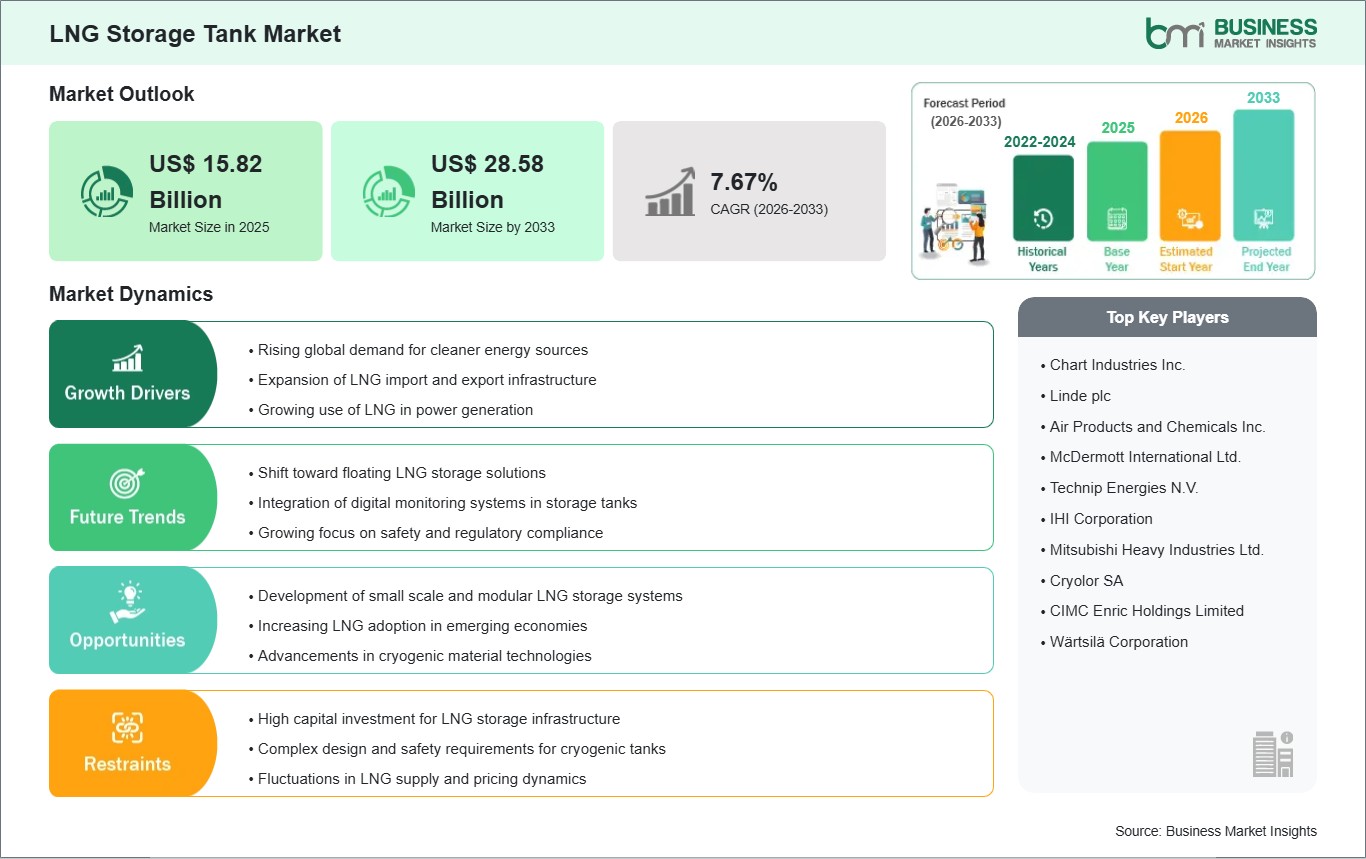
The liquefied natural gas (LNG) storage tank industry is experiencing a trend of steady growth. The driving factor of this growth is the rising use of liquefied natural gas as a cleaner energy alternative. The importance of using LNG is essential to lower carbon emissions, as well as helping to meet the growing demand for energy worldwide, resulting in large investments in LNG storage infrastructure. LNG storage tanks are critical for keeping LNG in a liquid state at cryogenic temperatures, allowing for the safe storage, transportation, and distribution of LNG in different industries.
The LNG storage tank market can be segmented by type, material type, and end-user; however, the energy and power generation industry is the largest consumer of LNG storage tanks. Advanced materials such as 9% nickel alloy steel are used to construct LNG storage tanks due to their ability to withstand very low temperatures while maintaining their structural integrity. The LNG storage tank market is also benefiting from new innovations in the design and construction of LNG storage tanks and the growth in the use of modular LNG storage solutions. While the LNG storage tank market has been challenged by high capital costs and complex engineering requirements, continued improvements in LNG storage tank technology and increased LNG usage are causing the LNG storage tank market to expand. In addition, the continued focus on transitioning to alternative forms of energy and developing new energy distribution infrastructures is expected to continue to increase LNG storage tank demand around the world.
Segment Analysis
LNG Storage Tank Market Segmentation
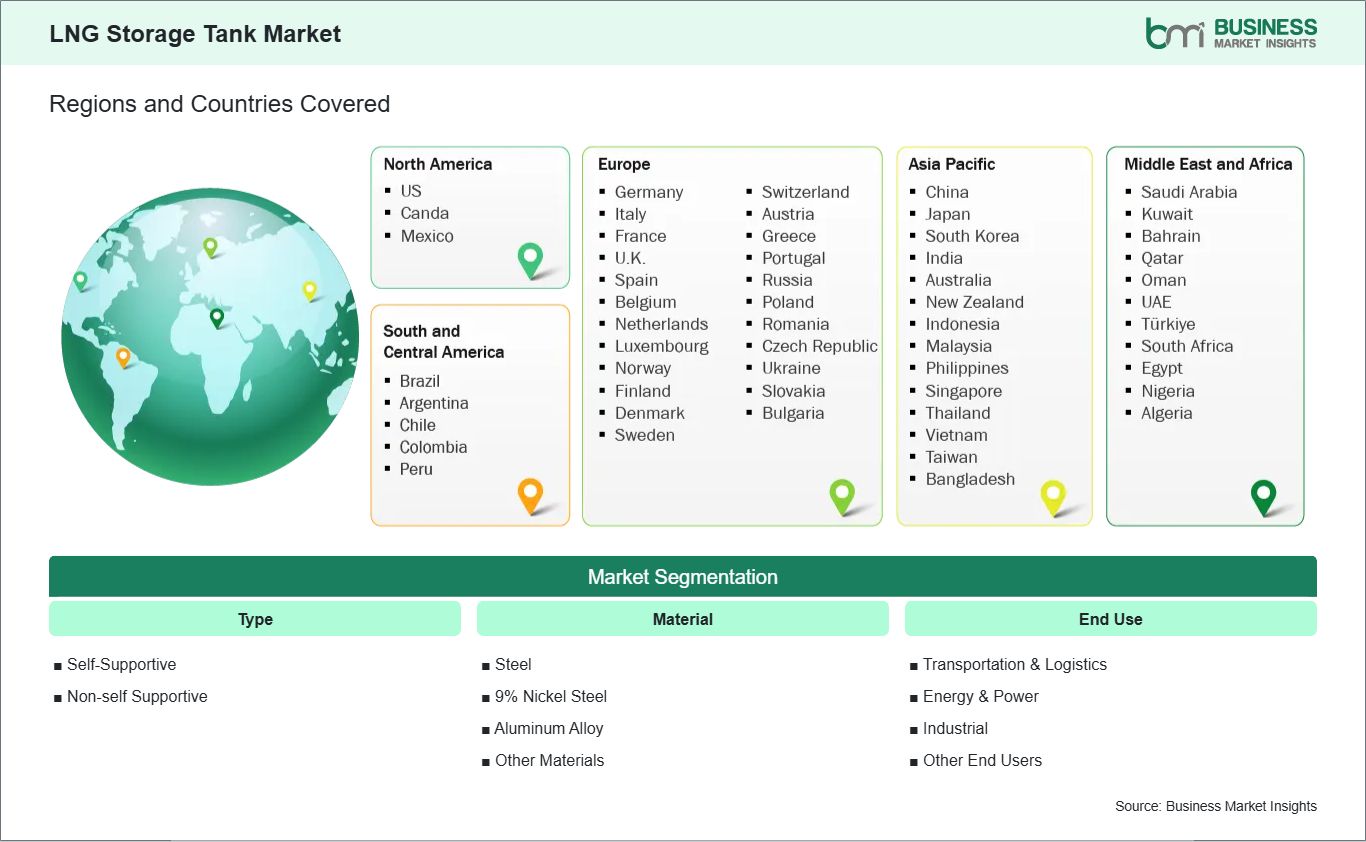
Key segments that contributed to the derivation of the LNG Storage Tank market analysis are type, material, and end user.
- By type, the LNG storage tank market is segmented into Self-Supportive and Non-self Supportive. The Self-Supportive segment dominated the market in 2025.
- By material, the LNG storage tank market is segmented into Steel, 9% Nickel Steel, Aluminum Alloy, and Other Materials. The 9% Nickel Steel segment dominated the market in 2025.
- By end user, the LNG storage tank market is segmented into Transportation & Logistics, Energy & Power, Industrial, and Other End Users. The Energy & Power segment dominated the market in 2025.
Market Forces
LNG Storage Tank Market Drivers and Opportunities
Rising global demand for cleaner energy sources
The increasing demand for clean and green energy sources across the globe is one of the most important factors that is contributing to the growth of the LNG storage tank industry. This is because various countries and sectors are looking for clean and green energy sources that can replace the conventional fossil fuels that emit harmful greenhouse gases. Liquefied natural gas is one of the clean and green energy sources that has been recognized across the globe for its low greenhouse emissions and ability to replace fossil fuels such as coal and oil.
LNG storage tanks have been playing an important role in maintaining fuel at extremely low temperatures that are necessary for LNG. The expansion of LNG import-export facilities is also contributing to the increasing demand for high-capacity LNG storage tanks. Moreover, with the integration of LNG with other energy supplies that include renewable energy, there is an increased need for effective LNG storage tanks that can cater to fuel supply fluctuation. Investments in energy infrastructure have been consistent, and with the global focus on sustainability, there is an increase in demand for LNG storage tanks.
Development of small scale and modular LNG storage systems
The increasing adoption of LNG in transportation, including marine vessels and heavy-duty vehicles, is also driving the need for compact and mobile storage solutions. Small scale LNG systems support fuel distribution in areas where pipeline networks are not available, enhancing accessibility and market penetration. Technological advancements in insulation materials and cryogenic engineering are improving the performance, safety, and durability of modular storage tanks. These innovations are making small scale LNG storage more commercially viable and attractive to a wider range of end users. As LNG continues to expand into new applications and geographies, modular storage solutions are expected to play a crucial role in supporting this growth.
The growing demand for the adoption of LNG in the transportation sector, such as in vessels and heavy-duty trucks, is also creating the need for small scale storage. The small scale storage helps in the fuel supply in areas that do not have access to pipeline infrastructure. Technological advancements in the insulation of materials and cryogenic engineering are improving the efficiency and longevity of modular storage tanks. The advancements in technology are making small scale storage more viable and attractive for the end users. The growing demand for the adoption of LNG in various sectors is likely to create the need for small scale storage in the future.
Size and Share Analysis
LNG Storage Tank Market Size and Share Analysis
The global LNG Storage Tank market is experiencing steady growth, with market size and share analysis reflecting evolving treatment preferences and competitive dynamics among key players. The report evaluates important subsegments categorized within type, material, and end user, highlighting their respective contributions to overall market performance.
By type, the Self-Supportive subsegment dominated the market in 2025 due to its structural integrity, ability to withstand cryogenic temperatures, and suitability for large-scale LNG storage, making it ideal for onshore terminals and long-term storage applications.
By material, the 9% Nickel Steel subsegment dominated the market in 2025 due to its superior toughness at extremely low temperatures, high resistance to thermal stress, and reliability in maintaining structural stability, making it the preferred material for cryogenic LNG containment systems.
By end user, the Energy & Power subsegment dominated the market in 2025 due to increasing reliance on LNG for power generation, growing demand for cleaner fuels, and expansion of LNG-based infrastructure to support stable and efficient electricity supply.
Report Coverage
LNG Storage Tank Market Report Coverage and Deliverables
The "LNG Storage Tank Market Size and Forecast (2022 - 2033)" report provides a detailed analysis of the market covering below areas:
- LNG Storage Tank market size and forecast at the regional and country levels for segments covered under the scope
- LNG Storage Tank market trends, as well as drivers, restraints, and opportunities
- LNG Storage Tank market analysis covering key trends, regional framework, major players, regulations, and recent developments
- Industry landscape and competition analysis covering market concentration, heat map analysis, prominent players, and recent developments for the LNG Storage Tank market
- Detailed company profiles, including SWOT analysis
Geographic Insights
LNG Storage Tank Market Geographic Insights
The geographical scope of the LNG Storage Tank market report is divided into: North America, Asia Pacific, Europe, Middle East & Africa, and South & Central America. North America held the largest share in 2025.
North America dominates the LNG storage tank market due to its well-established energy infrastructure and significant investments in LNG production and export facilities. The region has a strong presence of LNG terminals, supported by advanced engineering capabilities and access to abundant natural gas resources. Increasing demand for LNG in both domestic and international markets has led to continuous expansion of storage capacity, driving the demand for high-performance LNG storage tanks.
In addition, supportive regulatory frameworks and initiatives promoting cleaner energy adoption are encouraging the use of LNG across various sectors. The region is also witnessing growing investments in small scale LNG infrastructure and technological advancements in storage tank design. Strong collaboration between industry players and technology providers is enhancing innovation and operational efficiency. As North America continues to expand its LNG export capabilities and strengthen its energy security, the demand for advanced and reliable LNG storage solutions is expected to remain strong, reinforcing the region’s leading position in the global market.
Industry Activity
Recent Developments
The LNG Storage Tank market is evaluated by gathering qualitative and quantitative data post primary and secondary research, which includes important corporate publications, association data, and databases. A few of the key developments in the LNG Storage Tank market are:
- In February 2023, Venture Global LNG, announced the successful roof-raising of the first LNG storage tank at its Plaquemines LNG facility, marking a key construction milestone for large-scale LNG storage infrastructure.
- In April 2023, Venture Global LNG, announced the successful roof-raising of the second LNG storage tank at the Plaquemines LNG project, accelerating the development of its LNG export terminal capacity.
- In July 2024, Sempra Infrastructure, announced that Bechtel was selected for a fixed-price EPC contract for the Port Arthur LNG Phase 2 project, which includes development of additional LNG storage tanks and related infrastructure.
Trust & Transparency
Research Methodology
The market analysis combines proprietary research with secondary data from government agencies, company disclosures, regulatory filings, industry databases and expert interviews. Market estimates are validated through data triangulation, cross-market benchmarking and analyst
review.
View Full Research Methodology
Key Sources Referred:
American Chemistry Council (ACC)International Council of Chemical Associations (ICCA)European Chemical Industry Council (Cefic)China National Building Materials Group (CNBM)Indian Minerals & Granite Exporters Association (IMGEA)Japan Mining Industry Association (JMIA)Brazilian Mining Association (IBRAM)Gulf Petrochemicals and Chemicals Association (GPCA)Company WebsitesCompany Annual ReportsCompany Investor Presentations