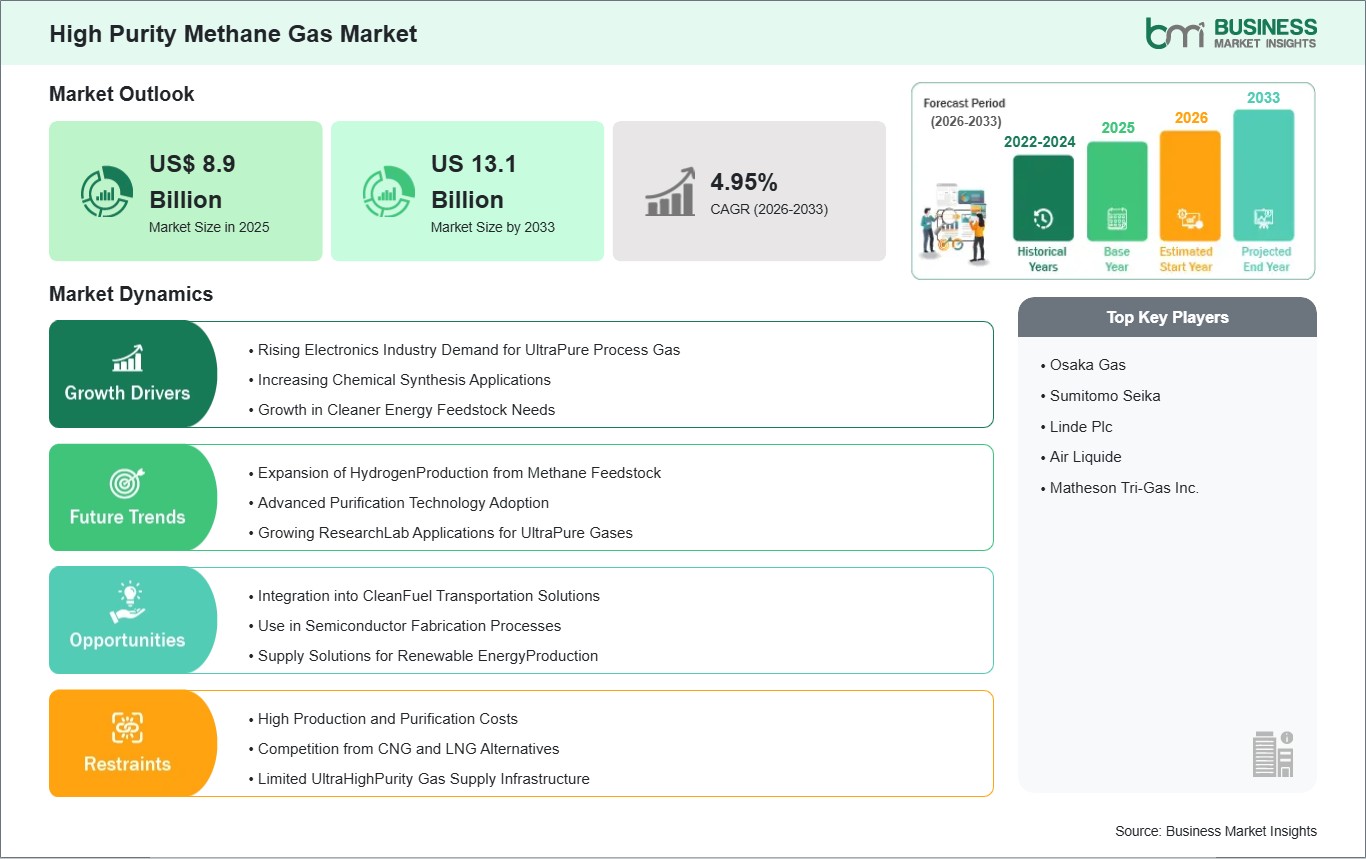
Rising Electronics Industry Demand for UltraPure Process Gas
The global high purity methane gas market is witnessing robust growth driven primarily by the electronics and semiconductor industries. As chip manufacturing and other microelectronic processes become increasingly sophisticated, the demand for ultra-pure process gases, including methane, has intensified. High purity methane is critical in chemical vapor deposition (CVD) and plasma-enhanced processes, where even trace impurities can compromise the performance of semiconductors and thin films. Manufacturers across the world rely on methane that meets stringent purity standards to ensure product consistency, device reliability, and yield optimization, making it a cornerstone of modern electronics production.
In addition to this, the increasing production of display panels, LED components, and sophisticated sensors is also contributing to the growing demand for methane. The chemical environment for these components needs to be highly controlled to achieve precise deposition layers and material properties. Globally, electronics manufacturers are investing more in cleanroom environments and sophisticated gas handling systems. This further emphasizes the importance of ultra-pure methane, which is completely devoid of moisture, oxygen, and other impurities. The increasing practice of using automated gas delivery systems and online monitoring is further emphasizing the importance of ultra-pure methane.
The demand for high purity methane is also influenced by innovation trends within the electronics industry, particularly in the development of next-generation semiconductor nodes, power electronics, and optoelectronic devices. As devices shrink and performance requirements grow, tolerances for contamination decrease, making gas purity more critical than ever. The global industry recognizes that high purity methane is not merely a raw material but a strategic enabler of technological advancement. Its role spans manufacturing lines worldwide, from Asia’s leading semiconductor hubs to advanced European and North American electronics production centers, cementing its importance as a fundamental process gas in high-tech manufacturing.
Integration into CleanFuel Transportation Solutions
High purity methane is also becoming central to the global transition toward cleaner transportation fuels. Compressed natural gas (CNG) and liquefied natural gas (LNG) vehicles, as well as emerging hydrogen-methane blends for fuel cells, require methane of consistent high quality to ensure engine performance, reduce emissions, and maintain infrastructure longevity. Ultra-pure methane minimizes contamination in fuel lines and storage systems, reducing risks associated with catalyst degradation, particulate formation, and corrosion in engines. As governments and industries worldwide pursue stricter emission standards, the adoption of high purity methane as a clean transportation fuel is increasingly emphasized.
The role of methane in alternative fuel plans is especially important for transit and logistics vehicles in urban areas. Buses and trucks driven by top-quality methane fuels will see improved fuel efficiency and longer engine life. Additionally, methane is being considered for hybrid energy systems where it is combined with pure hydrogen for fuel cells to provide low-carbon electricity for transportation and stationary applications. Across the world, energy providers are developing supply chains that emphasize purity, consistency, and reliability, thus again emphasizing the importance of high purity methane for scaling clean fuel plans.
Finally, the expansion of clean transportation infrastructure is creating broader applications for high purity methane beyond traditional vehicles. Maritime transport, rail systems, and industrial fleets are increasingly evaluating methane as a viable alternative to conventional diesel and gasoline. The adoption of ultra-pure methane is critical in these applications to ensure compatibility with advanced engines, reduce maintenance cycles, and comply with evolving environmental regulations. As the transportation sector globally transitions toward lower-emission fuels, high purity methane is emerging as a strategic resource that bridges the gap between conventional fossil fuels and next-generation sustainable energy solutions.