
LNG and Gas Processing Equipment Market Outlook: Size, Share, Trends, Growth Analysis, Competitive Landscape & Forecast, 2026-2033

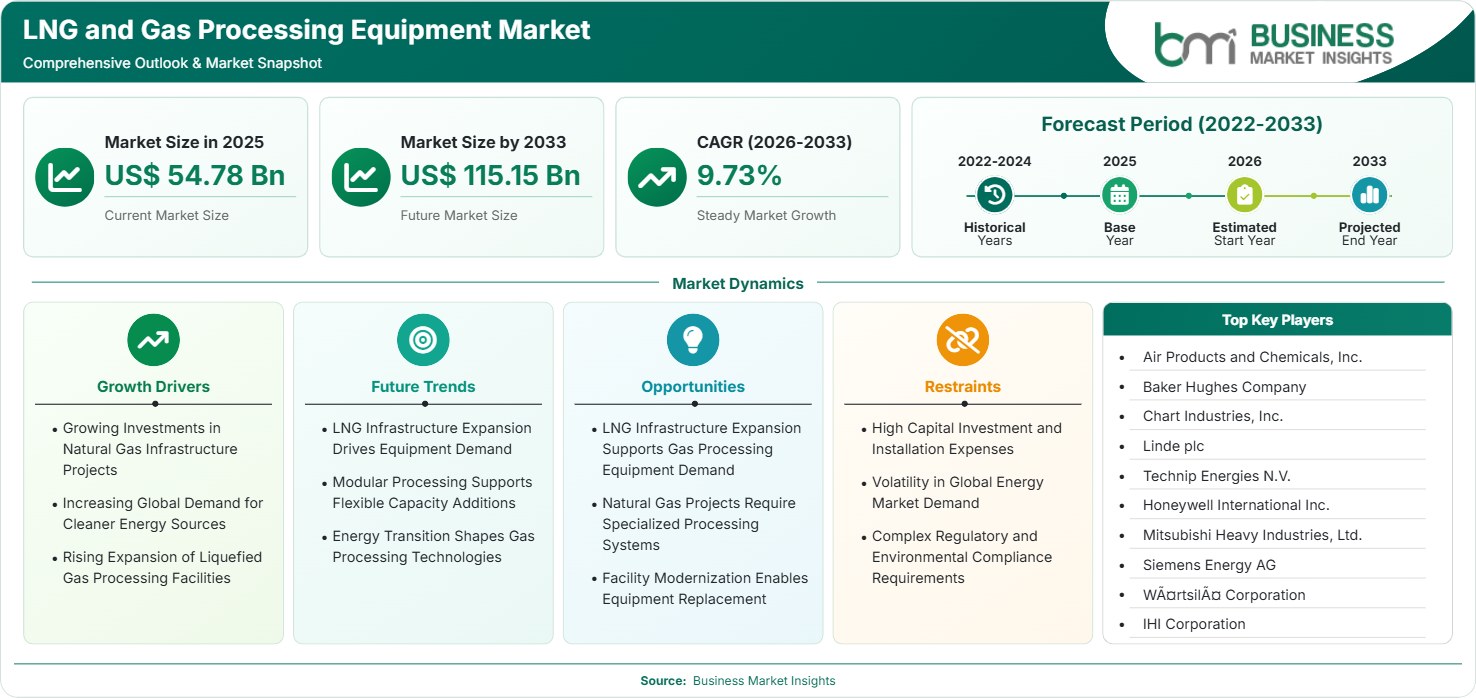
The LNG and Gas Processing Equipment Market size was valued at US$ 54.78 Billion in 2025 and is projected to reach US$ 115.15 Billion by 2033, growing at a CAGR of 9.73% during 2026–2033. Expanding LNG export capacity, rising natural gas demand, energy security initiatives, floating LNG deployment, decarbonization investments, and modernization of gas infrastructure are creating substantial opportunities across global processing and liquefaction value chains.

Report Coverage
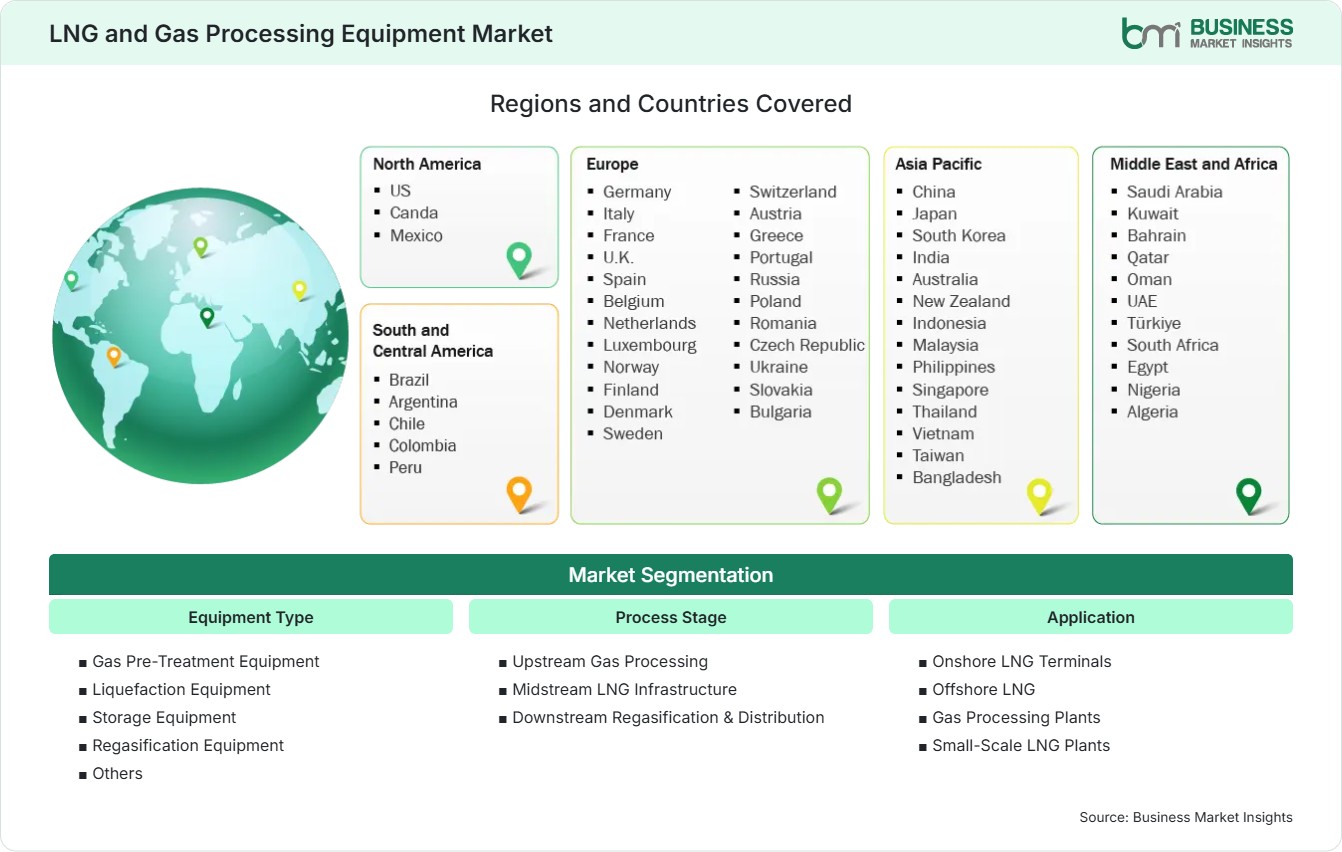
  • Equipment Type: Gas Pre-Treatment Equipment, Liquefaction Equipment, Storage Equipment, Regasification Equipment, Others
  • Process Stage: Upstream Gas Processing, Midstream LNG Infrastructure, Downstream Regasification & Distribution
  • Application: Onshore LNG Terminals, Offshore LNG, Gas Processing Plants, Small-Scale LNG Plants
US$ 54.78 Bn Market size in 2025
US$ 115.15 Bn Market Size by 2033
9.73% CAGR, 2026 - 2033
2026-2033 Forecast Period

AI Overview

LNG and Gas Processing Equipment Market Summary

  • North America Region: North America holds a LNG and Gas Processing Equipment Market share of 34%–37% in 2025, growing at a CAGR of 8.8%–9.4% during 2026–2033, supported by liquefaction capacity additions, export terminal investments, shale gas production growth, modular equipment adoption, supply-chain localization, digital monitoring deployment, emissions reduction projects, and strategic energy security programs globally. Brief U.S. analysis: The U.S. dominates regional demand through LNG export infrastructure expansion and advanced processing technologies, advancing at 9.0%–9.6% CAGR.
  • Fastest Growing Region: Asia Pacific holds a market share of 27%–30% in 2025, growing at a CAGR of 10.8%–11.5% during 2026–2033, driven by gas-fired power expansion, industrial fuel switching, LNG import infrastructure development, urbanization, rising energy consumption, terminal construction activities, government-backed investments, and cross-border energy connectivity projects.
  • Leading Segment: Liquefaction Equipment accounts for 28%–31% share in 2025, expanding at 10.1%–10.8% CAGR during 2026–2033, supported by megaproject investments, cryogenic technology advancement, capacity expansion requirements, efficiency optimization initiatives, export-oriented developments, contractor partnerships, digital process controls, and demand for reliable operations.
  • High Growth Segment: Offshore LNG (FLNG & FSRU) represents 15%–18% share of the LNG and Gas Processing Equipment Market in 2025 and advances at 11.4%–12.2% CAGR during 2026–2033, supported by deployment flexibility, lower development timelines, remote resource monetization, capital efficiency advantages, maritime infrastructure upgrades, floating regasification demand, and energy diversification initiatives.
  • Key Market Opportunity: Accelerated deployment of modular liquefaction systems, floating infrastructure, carbon-managed processing facilities, and digital asset optimization platforms is creating attractive opportunities for equipment suppliers serving emerging gas monetization projects worldwide.
  • Major Market Players: Air Products and Chemicals, Inc.; Baker Hughes Company; Chart Industries, Inc.; Linde plc; Technip Energies N.V.; Honeywell International Inc.; Mitsubishi Heavy Industries, Ltd.; Siemens Energy AG; Wärtsilä Corporation; IHI Corporation.
Strategic Insights

LNG and Gas Processing Equipment Market: Strategic Insights

LNG and Gas Processing Equipment Market Strategic Framework
FREE PDF
Request your free sample
Request free sample
Stakeholder View

Key Takeaways

  • The industry value chain is increasingly integrated, with engineering firms, cryogenic equipment providers, EPC contractors, automation specialists, and terminal operators collaborating through long-term project frameworks.
  • Offshore LNG platforms, FSRUs, and small-scale LNG facilities present the strongest upside due to faster deployment timelines and growing demand for flexible gas infrastructure solutions.
  • Product innovation is concentrating on energy-efficient liquefaction trains, advanced heat exchangers, digital twins, predictive maintenance systems, and carbon-aware gas processing architectures.
  • Asia Pacific provides an attractive investment case as expanding import infrastructure, industrialization, and fuel-transition programs create sustained demand for processing and regasification assets.
  • Strategic acquisitions involving cryogenic equipment manufacturers and energy technology suppliers indicate rising consolidation aimed at expanding LNG lifecycle capabilities.
  • Increasing emphasis on methane-emission reduction and operational transparency is encouraging adoption of monitoring technologies integrated directly into processing and liquefaction equipment platforms.
Geographic Outlook

LNG and Gas Processing Equipment Market Regional Highlights

North America LNG and Gas Processing Equipment Market

North America accounted for approximately 34%–37% of global revenue in 2025 and is expected to expand at a CAGR of 8.8%–9.4% through 2033. The region benefits from abundant shale gas resources, large-scale LNG export terminals, and strong engineering capabilities. The LNG and Gas Processing Equipment Market share remains concentrated around major liquefaction and gas treatment projects across the United States and Canada. Export-oriented infrastructure spending, equipment modernization initiatives, and emissions-focused upgrades continue strengthening regional demand across processing, storage, and regasification applications.

  • Expansion of Gulf Coast liquefaction facilities continues stimulating demand for compressors, heat exchangers, gas treatment modules, and storage tanks integrated within export infrastructure developments.
  • Operators increasingly deploy digital condition-monitoring systems to enhance reliability, reduce unplanned shutdowns, and optimize lifecycle performance across processing and liquefaction assets.
  • Carbon capture integration within gas-processing facilities is encouraging procurement of advanced separation and treatment equipment supporting lower-emission production strategies.
  • Increased long-term LNG supply agreements improve project bankability, encouraging developers to advance equipment-intensive infrastructure investments.

US LNG and Gas Processing Equipment Market

The United States represents around 78%–82% of North American demand and is projected to record a 9.0%–9.6% CAGR through 2033. Continued export terminal expansion, favorable resource economics, and strong private-sector investment support equipment procurement. The country remains a leading center for liquefaction technology deployment and cryogenic infrastructure construction. Ongoing terminal upgrades, feed-gas treatment requirements, and extensive pipeline connectivity reinforce equipment demand throughout the LNG value chain.

  • Gulf Coast developments continue generating substantial procurement activity for liquefaction modules, storage facilities, treatment equipment, and automation systems.
  • Engineering contractors increasingly favor modular solutions that shorten construction schedules and reduce project execution risks.
  • Rising export commitments encourage additional investments in gas conditioning and storage infrastructure supporting long-term capacity utilization.

Europe LNG and Gas Processing Equipment Market

Europe accounted for 23%–26% of global demand during 2025 and is anticipated to grow at a 9.3%–10.0% CAGR of the LNG and Gas Processing Equipment Market through 2033. Energy diversification strategies, regasification investments, and infrastructure resilience initiatives support regional expansion. Germany leads current investments, while Poland and Greece demonstrate higher growth momentum with estimated growth rates exceeding regional averages. Demand centers primarily around regasification systems, storage terminals, and import infrastructure supporting energy security objectives across multiple countries.

  • Floating storage and regasification facilities remain important for improving supply flexibility and reducing infrastructure deployment timelines.
  • Import terminal modernization projects support replacement demand for advanced cryogenic and gas-handling equipment.
  • Digital monitoring and efficiency improvements are increasingly integrated into terminal operations throughout the region.
  • National energy security strategies continue accelerating capital expenditure across LNG receiving and distribution assets.

Asia Pacific LNG and Gas Processing Equipment Market

Asia Pacific represented approximately 27%–30% of global revenue in 2025 and is expected to achieve the fastest expansion at a 10.8%–11.5% CAGR through 2033. China remains the largest market, while India and Southeast Asian economies exhibit particularly strong adoption rates. Rising industrial consumption, gas-fired power capacity additions, and LNG import terminal development drive investment. Growing urbanization and efforts to replace higher-emission fuels continue expanding demand for processing, storage, and regasification equipment.

  • Rapid expansion of LNG import terminals creates robust demand for storage tanks, vaporizers, and unloading infrastructure.
  • Industrial fuel-switching initiatives support investments in gas processing and distribution assets across manufacturing clusters.
  • Government-backed energy transition programs strengthen project pipelines in several emerging economies.
  • Increasing participation from regional EPC contractors accelerates development of localized equipment ecosystems.

Rest of World LNG and Gas Processing Equipment Market

The Rest of World region accounted for 12%–15% of global demand in 2025 and is anticipated to advance at a 9.8%–10.6% CAGR through 2033. Middle Eastern producers continue investing in export-oriented gas infrastructure, while South and Central America pursue import diversification projects. Qatar and the United Arab Emirates remain leading markets, whereas Brazil demonstrates one of the strongest growth trajectories. The LNG and Gas Processing Equipment Market growth outlook benefits from resource monetization initiatives and expanding LNG trade participation.

  • Large-scale export expansion projects across the Middle East support demand for liquefaction and processing technologies.
  • Brazil continues increasing LNG utilization through import infrastructure and industrial energy diversification programs.
  • New offshore resource developments encourage investment in floating infrastructure and associated processing systems.
  • International partnerships support technology transfer and execution of complex gas infrastructure projects.
Global Market Geography
FREE PDF
Request your free sample
Request free sample
Segment Analysis

LNG and Gas Processing Equipment Market Segmentation

Equipment Type

The Equipment Type sub-segment had the largest share of spending, with Liquefaction Equipment having the highest market share. The market share held by this segment ranges between 28% and 31% in 2025 and is expected to grow at a compound annual growth rate of 10.1% to 10.8%. The scope of the LNG and Gas Processing Equipment Market continues to expand in light of the need for process integration, efficient cryogenics performance, and lifecycle optimization across gas treatment, liquefaction, storage, and regasification installations.

  • Gas Pre-Treatment Equipment: Essential for removing contaminants and moisture before liquefaction, supporting efficiency improvements, equipment protection, regulatory compliance, and improved downstream process reliability.
  • Liquefaction Equipment: Core technology enabling natural gas conversion into LNG through advanced cryogenic processes, benefiting from export terminal expansions and capacity enhancement programs.
  • Storage Equipment: Supports secure cryogenic containment and operational continuity, driven by increasing LNG inventories, distribution activities, and terminal infrastructure development.
  • Regasification Equipment: Critical for converting LNG back into gaseous form, supported by import terminal growth and regional energy diversification strategies.

Process Stage

Process Stage Segmentation emphasizes the importance of infrastructure spending along the entire gas value chain. Midstream LNG Infrastructure takes the lion's share, with 36%-39% market share by 2025 and growing at a CAGR of 10.0%–10.7%. Capital spending continues to be dominated by liquefaction plants, transportation-related storage, and terminal construction supporting increased international gas trade and infrastructure modernization.

  • Upstream Gas Processing: Focuses on treatment, separation, and feed-gas conditioning technologies required before transportation or liquefaction activities.
  • Midstream LNG Infrastructure: Encompasses liquefaction, storage, transportation interfaces, and export facilities supporting global LNG trade expansion.
  • Downstream Regasification & Distribution: Driven by import terminal deployment and growing demand for reliable gas delivery networks.

Application

Application demand is shaped by long-term infrastructure spending and changing supply patterns. Onshore LNG Terminals remain the leading category with approximately 41%–44% share in 2025, while Offshore LNG (FLNG & FSRU) is the fastest-growing application at 11.4%–12.2% CAGR. The LNG and Gas Processing Equipment Market trends indicate increasing adoption of flexible infrastructure configurations and modular deployment strategies.

  • Onshore LNG Terminals: Continue attracting substantial investment because of large capacity capabilities, operational reliability, and integration with national energy networks.
  • Offshore LNG (FLNG & FSRU): Gains momentum through deployment flexibility, remote field development opportunities, and reduced construction lead times.
  • Gas Processing Plants: Remain central to feed-gas quality management and efficient resource monetization across producing regions.
  • Small-Scale LNG Plants: Support localized distribution, transportation fuel applications, and energy access solutions in underserved markets.
Market Forces

LNG and Gas Processing Equipment Market Dynamics

Key Market Drivers

Expansion of Global LNG Liquefaction Capacity

The international trade in LNG is expected to grow further, with nations seeking diversified fuel sources and greener options. The new projects taking shape in North America, the Middle East, and Africa will generate greater demand for cryogenic heat exchangers, gas processing facilities, compressors, and storage solutions. According to international energy outlooks, LNG is one of the fastest-growing traded energy sources, prompting billions of dollars in infrastructure investment. Equipment ordering now begins years before commercial operations start, ensuring visibility for equipment suppliers. Repeated additions of liquefaction trains and other facilities increase equipment demand over the long term and create new opportunities for aftermarket solutions and performance management.

Rising Natural Gas Adoption in Industrial and Power Sectors

The use of natural gas by industrial plants and utility providers is expected to rise to enhance efficiency and reduce per-unit emissions compared with heavier fuels. Gas processing plant needs are increasing as more nations expand their capacity to import LNG and distribute it domestically. The gas processing facilities should also be equipped with efficient systems for treatment, monitoring, and storage to ensure maximum efficiency and compliance. Increased power demand, particularly in developing nations, requires gas-fired facilities to be fueled by LNG. Such conditions will result in investment in processing technology, terminal construction, and regasification technologies while encouraging modernization of aging assets across established markets.

Digitalization and Automation Across Gas Infrastructure

Use of predictive analytics, digital twin technology, sensors, and automation is on the rise as operators seek optimal performance. Predictive analytics increases efficiency, reduces maintenance costs, and improves operational reliability. Real-time monitoring integration enables processing plants to detect inefficiencies and emissions issues. Manufacturers are incorporating smart features into equipment, which improves service-driven business models. Increased use of digital technology will enable the offering of high-value equipment while creating recurring income opportunities through software, remote diagnostics, and lifecycle optimization programs across processing and liquefaction infrastructure.

Key Market Opportunities

Growth of Floating LNG and FSRU Deployments

FLENG production facilities and regasification units present highly versatile alternatives to conventional land-based installations. They are gaining greater preference in projects where permit considerations, location issues, or cost concerns become critical. The demand keeps growing in developing importing regions that seek prompt access to LNG resources. Equipment manufacturers benefit from the need for specialized equipment for compact process systems, cryogenic facilities adapted for marine conditions, and automation systems. Long-Term LNG and Gas Processing Equipment Market Forecasts show that investment in floating installations will continue to grow in line with energy security needs and the development of new trade routes.

Small-Scale LNG Ecosystem Development

Small-scale LNG plants are increasingly moving from utility-based use to transportation, industrial energy, and power generation applications. This necessitates the development of modular plants suited to lower-output applications. Growing attention to local energy options makes this market segment more attractive, as demand for liquefaction plants, storage facilities, and regasification technology is rising. Companies that can offer quick and efficient solutions are well placed to benefit from this trend. This market segment is also conducive to development in areas without established pipeline networks, broadening addressable market potential.

Integration of Carbon Management Technologies

Modern gas pipeline companies also incorporate carbon-reduction programs and innovations in processing and liquefaction. Advanced technologies such as carbon capture mechanisms, methane detection devices, and efficiency systems drive demand for sophisticated equipment. Even now, procurement is affected by regulatory and investor considerations. Companies that demonstrate substantial emissions reductions and efficiency gains are at an advantage. Such a development helps foster the use of advanced technologies and encourages innovation-oriented partnerships.

Market Restraints and Challenges

High Capital Intensity and Project Execution Risks

Factor: Massive liquefaction and processing plants entail considerable capital investments, which generally involve complicated processes of engineering, procurement, and construction. Impact: Delays, inflationary pressures, workforce and supply shortages, and supply chain problems can significantly affect the project schedule and financial performance. For the equipment manufacturers, the risks involve delays in capital investment and long-term procurement. Financing difficulties are even more evident during periods of uncertainty in commodity prices. Even though the fundamentals of future demand are strong, the business's capital-intensive nature makes the approval and purchase process difficult.

Regulatory Complexity and Environmental Scrutiny

Factor: Environmental assessment, emissions regulation, and permitting have become more common for LNG and gas infrastructure projects. Impact: Delays in the approval process may postpone project implementation and equipment procurement. Regulatory changes are likely to affect the project's economic viability and the decisions regarding equipment type and project financing. Equipment and facility operators must allocate resources to comply with new regulations. Although sustainability initiatives offer innovative possibilities, compliance adds complexities and drives up infrastructure costs for project developers and equipment providers alike.

Company Analysis

Competitive Landscape

The competitive environment remains shaped by technology leadership, engineering expertise, and global project execution capabilities. This LNG and Gas Processing Equipment Market analysis shows increasing emphasis on integrated solutions, digital services, and cryogenic innovation.

Company Name

Overview

Products and Services relevant to this market

Air Products and Chemicals, Inc.

Global industrial gases company with extensive LNG technology and process expertise supporting major energy infrastructure projects.

LNG process technologies, heat exchangers, gas treatment solutions, engineering support, and industrial gas systems.

Baker Hughes Company

Energy technology provider serving upstream, midstream, and LNG infrastructure customers worldwide.

Turbomachinery, compressors, LNG solutions, digital monitoring systems, and energy technology services.

Chart Industries, Inc.

Leading cryogenic equipment specialist supporting global LNG and industrial gas value chains.

Cryogenic tanks, cold boxes, heat exchangers, liquefaction systems, and monitoring platforms.

Linde plc

Major industrial engineering and gas technology company with broad LNG processing capabilities.

Gas processing technologies, separation systems, cryogenic engineering, and plant solutions.

Technip Energies N.V.

International engineering company active in LNG project delivery and technology deployment.

LNG process technologies, EPC services, modular facilities, and infrastructure engineering.

Honeywell International Inc.

Diversified technology supplier providing automation and gas processing solutions.

Process controls, automation platforms, analytics software, and gas treatment technologies.

Mitsubishi Heavy Industries, Ltd.

Industrial engineering leader involved in large-scale energy infrastructure programs.

Compressors, machinery systems, LNG equipment, and energy plant technologies.

Siemens Energy AG

Global provider of energy technologies across power and gas infrastructure.

Compression systems, turbines, automation solutions, and digital service offerings.

Wärtsilä Corporation

Energy and marine technology company supporting flexible LNG infrastructure.

LNG storage solutions, regasification technologies, marine applications, and engineering services.

IHI Corporation

Japanese industrial manufacturer participating in LNG infrastructure developments.

LNG storage tanks, cryogenic systems, engineering services, and industrial equipment.

Trust & Transparency

Research Methodology

The market analysis combines proprietary research with secondary data from government agencies, company disclosures, regulatory filings, industry databases and expert interviews. Market estimates are validated through data triangulation, cross-market benchmarking and analyst review.

View Full Research Methodology

Questions Answered

Frequently Asked Questions

How can this LNG and Gas Processing Equipment Market Report support business decisions?

The study helps stakeholders evaluate technology trends, competitive positioning, regional opportunities, investment priorities, and infrastructure development patterns influencing long-term market strategy.

Which region is expected to expand most rapidly?

Asia Pacific is forecast to record the fastest growth due to industrialization, LNG import terminal expansion, energy transition initiatives, and rising natural gas consumption across major economies.

How does digitalization influence equipment demand?

Digital monitoring, predictive maintenance, and real-time analytics improve reliability and efficiency, encouraging operators to upgrade existing assets and purchase intelligent equipment platforms.

Which application area offers the highest growth potential?

Offshore LNG, particularly FLNG and FSRU deployments, offers the strongest growth potential because of deployment flexibility, shorter development timelines, and suitability for emerging import and export markets.

What makes LNG equipment investment attractive through 2033?

Growing LNG trade, energy security priorities, and rising natural gas demand are encouraging investment in liquefaction, storage, and regasification infrastructure, creating sustained demand for advanced equipment and technology solutions.

Access the Full LNG and Gas Processing Equipment Market Report

Get segment-level forecasts, regional estimates, competitive benchmarking, company profiles and downloadable Excel datasets.

Access the full LNG and Gas Processing Equipment Market Report
350 pages PDF & Excel | 2026-09-21
Similar Research

Related Market Reports